Does Dipladenia Like Sun or Shade? Sunlight Hours and Placement
Dipladenia likes sun: at least 6 hours of direct sunlight per day to bloom well. In intense heat, afternoon shade prevents scorched leaves. See which balcony exposure to choose, how to read the foliage, and what to expect indoors.
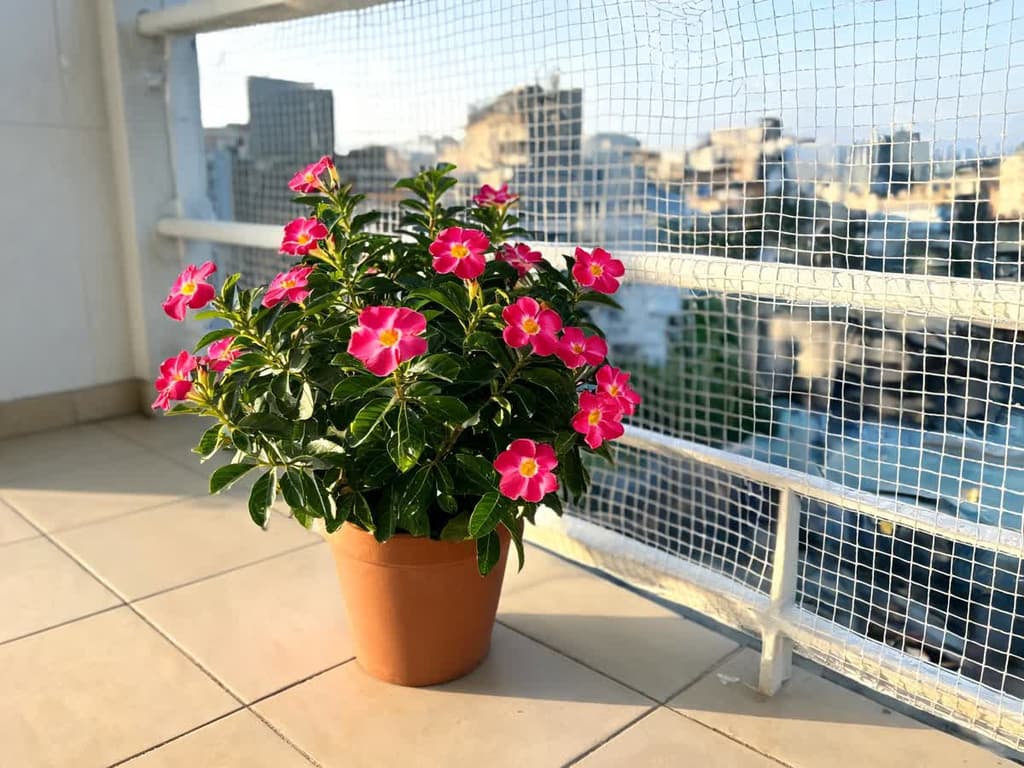
If the question is whether dipladenia prefers sun or shade, the answer is sun. To bloom well, it needs at least 6 hours of direct sun per day, according to the Mississippi State University Extension. In very hot areas, the same source recommends partial shade (sun during only part of the day) so the leaves do not scorch. The safest spot receives morning sun and stays protected during the hot afternoon hours.
In the shade all day, dipladenia stays alive, but produces few flowers. UF/IFAS, from the University of Florida, states that the plant needs full sun to flower well. Full sun means 6 hours or more of direct sun per day. Dipladenia and mandevilla are names for the same group of plants, the genus Mandevilla, and the light rule applies to both.
How many hours of sun does dipladenia need to bloom
The sources for this article are extension services, the branches of American universities that advise plant growers. All of them call for direct sun during part of the day, but the numbers vary from one to another:
Direct sun per day | What happens to the dipladenia | Source |
|---|---|---|
6 hours or more (full sun) | Blooms the most | Mississippi State; UF/IFAS |
2 to 6 hours (partial shade) | Tolerates it, but profuse flowering requires more sun | NC State |
Fewer than 2 hours (shade) | Stays green and sets few flowers | RHS; UF/IFAS |
Mississippi State calls for at least 6 hours of sun for dipladenia and says that sun stimulates flowering. NC State Extension accepts full sun (6 hours or more) or partial shade (from 2 to 6 hours). Clemson University recommends partial shade for the plant outdoors, without specifying hours. The Royal Horticultural Society (RHS), the horticultural society of the United Kingdom, says the plant dislikes shade.
This article follows Mississippi State and UF/IFAS, the two sources that connect sun with flowering: direct sun for part of the day, and the more hours of sun, the more flowers. The concern is with afternoon heat, which can scorch the leaves. The plant manages with 2 hours of direct sun, according to NC State. To fill it with flowers, choose a spot with 6 hours of direct sun.
Do compact dipladenia and climbing mandevilla need the same sun?
Both require direct sun, and the compact type tolerates slightly more shade. According to UF/IFAS, compact varieties, such as 'Rio Pink' and the Sun Parasol series, tolerate a bit more shade than the large climbers. Even so, Mississippi State calls for 6 hours of sun for compact dipladenia to bloom.
In a spot with partial shade, the compact variety is the safer choice of the two. The name on the tag does not guarantee whether the plant is compact or climbing. The dipladenia care guide explains how to distinguish the compact form from the climber before purchasing.
Does afternoon sun burn dipladenia leaves?
In very hot areas, the afternoon sun can scorch dipladenia foliage. Mississippi State recommends partial shade in very hot locations to keep the leaves from burning. NC State recommends afternoon shade in hot, humid climates, which is the climate across much of Brazil.
None of the sources provides a specific temperature threshold at which foliage burns. For this reason, the safest option during the Brazilian summer, from December to March, is morning sun and afternoon shade after midday. If no leaves fade during the first few weeks of afternoon sun, your plant can take all-day sun in your location.
Sunburn appears as faded, nearly white areas on leaves that face the sun directly. According to the University of Georgia (UGA) Extension, strong sun breaks down chlorophyll (the leaf's green pigment) and overheats the leaf. Recovery comes with new leaves and can take months, UGA warns.
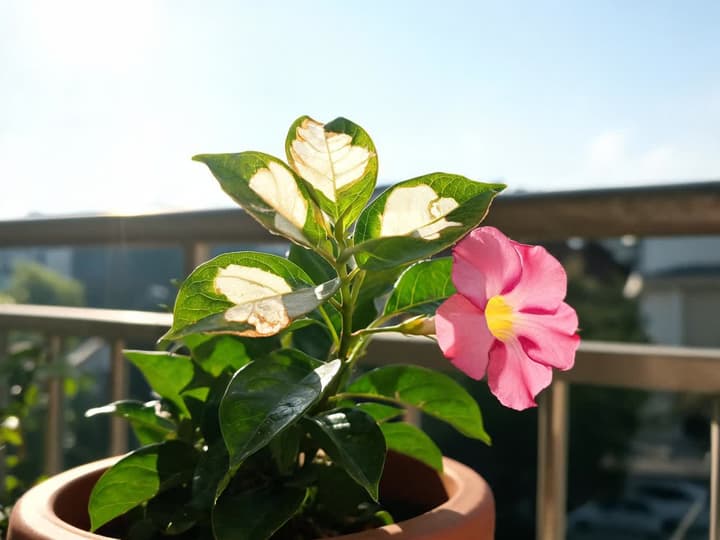
A scorched leaf will not turn green again. Moving the plant out of intense afternoon sun prevents further burns:
Where to place dipladenia: balcony exposure decides
In Brazil, a north-facing window or balcony receives the most sun. The University of Illinois Extension points to south-facing windows as the brightest. Illinois is in the Northern Hemisphere, where the midday sun comes from the south. In Brazil, it comes from the north.
Each balcony exposure catches the sun at a different time of day:
North exposure: direct sun throughout much of the day, more so in winter (from June to August) than in summer. Suitable for flowering where summers are mild. In intense heat, give the plant shade after midday.
East exposure: morning sun and afternoon shade. This is the safest exposure where summers are very hot. It provides the afternoon shade that NC State recommends for hot, humid climates.
West exposure: afternoon sun, the hottest part of the day. This is the exposure where foliage scorches most often in summer.
South exposure: little to no direct sun for most of the year. The dipladenia stays alive, but produces few flowers.
In the backyard, the same applies to walls and garden beds: morning sun and afternoon shade during intense heat. Mississippi State accepts partial shade for mandevilla in hot locations. The example it gives is a south-facing wall, which gets the most sun in the Northern Hemisphere. In Brazil, the equivalent wall is the north-facing one.
Balcony with full afternoon sun
On a west-facing balcony, dipladenia tolerates afternoon sun where summers are mild. Where summers get very hot, the upper leaves may scorch. During the first few weeks, inspect the upper leaves at every watering. If bleached patches appear, set up a shade cloth (garden mesh that filters part of the sunlight) for the hours after midday.
To cover a balcony safety net, choose climbing mandevilla. According to UF/IFAS, the compact form grows upright with stems that rarely twine, so it will not climb the net on its own. The plant's white sap can irritate skin, according to UF/IFAS. What is known about the risk to dogs and cats is covered in the article is dipladenia toxic to pets?
Signs of too little light and too much sun on dipladenia
Low light leaves dipladenia green and flowerless, while excessive sun bleaches the upper leaves:
What you see | Likely cause | What to do |
|---|---|---|
Green leaves and almost no flowers | Too little sun | Move the pot to a spot with more hours of direct sun, preferably in the morning |
Long, thin stems stretching toward the light | Low light | Move the plant closer to the light and rotate the pot at every watering |
Older leaves yellowing and dropping on a shaded plant | Low light | Check the soil first: waterlogged soil causes the same yellowing |
Bleached, nearly white patches on upper leaves | Sunburn | Provide afternoon shade; if the plant came from shade, introduce it to the sun gradually |
The low-light symptoms in the table come from the University of Illinois Extension, which describes them in potted plants. They include long, spindly stems and older leaves that turn yellow and drop. The lack of flowers in shade comes from UF/IFAS, which links blooming to full sun.
If your dipladenia gets only afternoon sun and the leaves are turning yellow, look at where the yellow is. Sunburn bleaches the top leaves, the ones that take the direct sun. If the yellow is on the top leaves, move the plant out of the afternoon sun and leave it with morning sun only. Yellowing that starts on the lower leaves, with wet soil, points to watering. The guide on dipladenia with yellow leaves separates these causes by the location of the yellowing. The page on yellow leaves on dipladenia shows photos of each one.
How to move dipladenia from shade to sun without burning
Leaves that grew in shade burn if the plant is moved into strong sun all at once. UGA warns that taking a plant from a dark spot into strong sun causes severe leaf burn. The New Mexico State University Extension (NMSU) recommends moving the plant gradually, from shadier spots to brighter ones.
None of the sources provides a specific timeline for this transition. The safest route is to begin in a spot with morning sun only. After a week without any bleached leaves, move the plant to its permanent spot. Acclimate seedlings or starts that spent days indoors or inside a shop slowly. Do the same for any plant that has lived in the shade.
Inherited a red-flowering climber sitting in a dark corner and do not know its name? Confirm the species before moving the plant around. Other wall vines bear similar blooms, and the sunlight hours in this article apply specifically to dipladenia. Bloom (available for iOS) identifies plants from a photo, and the free version includes 2 identifications per month.
Dipladenia indoors: it survives, but blooms poorly
Dipladenia can stay indoors next to a bright window, but none of the consulted sources guarantees flowers in that spot. Indoors, Clemson calls for bright light filtered by a curtain, and NC State calls for bright indirect light, with no sun hitting the leaves directly. The RHS says the plant may not bloom below 21 °C in spring and summer (in Brazil, from September to March).
Keep the pot as close as possible to a bright window, never 8 feet (2.4 m) or more away from it. According to the Illinois Extension, the light is already low beyond that distance. In Brazil, choose a north-facing window. The New York Botanical Garden suggests a sunny window in winter, and the extensions call for light without strong sun. This article follows the extensions: use a sheer curtain during hours of strong direct sun. Rotate the pot at each watering so the plant does not grow lopsided, as Illinois recommends.
On nights below 10 °C, bringing the pot indoors protects the plant from cold. Watering and shelter practices for this period are in the winter dipladenia guide.
Light, temperature, and flowering in dipladenia
Dipladenia forms flowers on new growth, according to Mississippi State. UF/IFAS links heavy blooming to full sun. The RHS warns that the plant may not flower below 21 °C in spring and summer (in Brazil, from September to March). Therefore, in shade or cold, dipladenia blooms sparsely even with proper watering and fertilizer. The blooming season, fertilizer, and pruning are in the dipladenia care guide.
Frequently asked questions about dipladenia and sunlight
Can dipladenia stay in the shade?
Dipladenia survives in the shade, but sets few flowers. The RHS states that the plant dislikes shade, and UF/IFAS links flowering to full sun. If the location receives fewer than 2 hours of direct sun, move the container to a spot with morning sun. Another option is choosing a compact cultivar, which tolerates slightly more shade.
Does dipladenia bloom year-round?
Dipladenia blooms most in summer (in Brazil, from December to March), according to UF/IFAS. In zones 10 and 11 of the United States climate map, those with warmer winters, some flowers appear year-round. None of the consulted sources measured blooming month by month in Brazil. In the cold and shade, the plant flowers little: according to Clemson, low temperatures and weaker winter light put the plant into dormancy.
How do you get dipladenia to bloom?
Give dipladenia at least 6 hours of direct sun per day, preferably in the morning, as Mississippi State recommends. Fertilize every 2 weeks in spring and summer, according to Clemson. Do not cut back new shoots that already have buds, because the flowers form on them. According to the RHS, below 21 °C in spring and summer (in Brazil, from September to March) the plant may not flower.
Can I dig dipladenia up from a wall and plant it in a pot in full sun?
None of the consulted sources address transplanting a mature dipladenia from the ground into a pot. The safest option is taking cuttings without digging up the plant. The UF/IFAS production guide uses single-node cuttings (a section of mature stem with one pair of leaves). With bottom heat between 70 and 75 °F (21 and 24 °C), they root in about 4 weeks. The rooted cuttings go into a pot with morning sun only and transition to full sun gradually.
Summary: the right sunlight for dipladenia
Dipladenia likes sun: at least 6 hours of direct sun per day to bloom well, preferably in the morning. In intense heat, provide the plant with afternoon shade so the leaves do not scorch. In Brazil, the east-facing side of the balcony is the safest. The north-facing side works with afternoon shade in intense heat, and the south-facing side yields few flowers.
Move your plant from shade to sun gradually. Indoors, place the container near a bright window, never 2.4 m or more away from it, and expect limited blooming.
Related articles
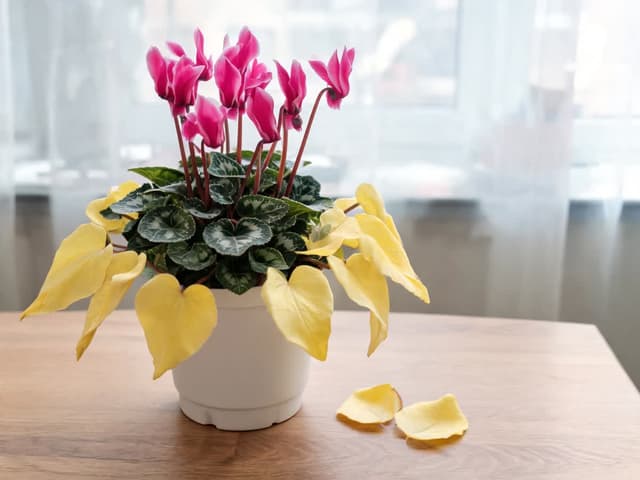
Cyclamen with Yellow Leaves: Causes and What to Do
A cyclamen with yellow leaves might just be going dormant. Learn how the tuber and the time of year tell dormancy apart from rot, heat, thirst, and mites, and what to do in each case.
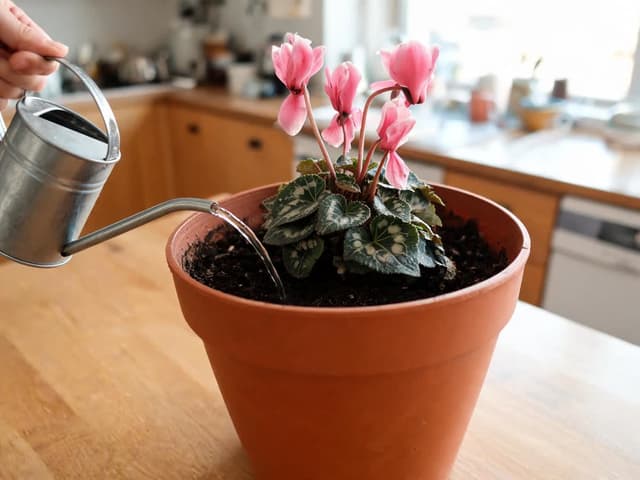
How to Water Cyclamen: Bottom Watering, Edge Watering, and the Wilt Test
How to water cyclamen without rotting the tuber: when the soil surface dries out, from below for 15 minutes or around the edge, never in the center. Plus the test to tell wilting from thirst apart from rot.
Dipladenia with Sticky White Dots: Which Pest Is It?
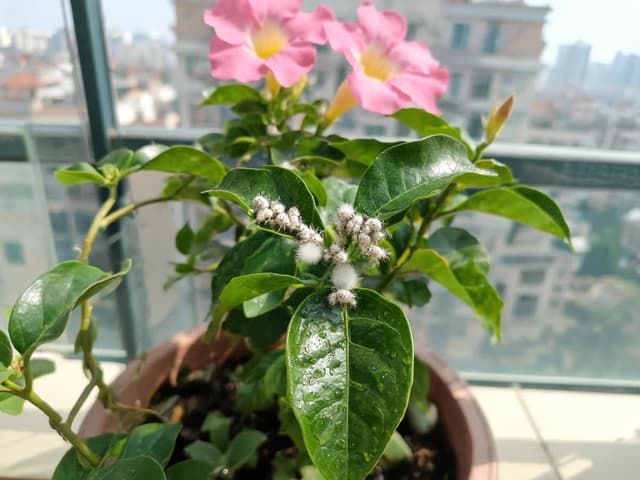
A sticky white dot on a dipladenia is almost always a mealybug, but whiteflies, aphids, spider mites, and the plant's own sap leave similar marks. See the test that separates each one and the source-backed treatment.