How Often to Water Pothos: Dry Soil and Wilting Leaves
Water your pothos when the potting soil feels dry, not on a set day of the week. Learn how to check the soil accurately, what wilting leaves mean, and what changes in winter or hanging baskets.
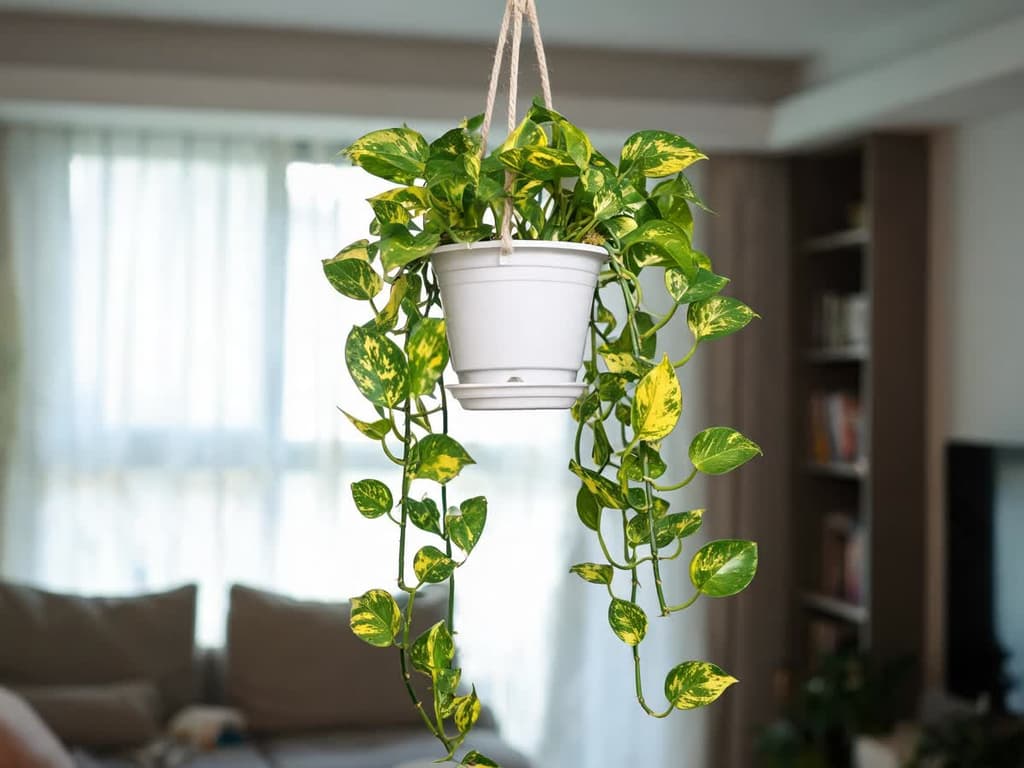
How often to water pothos (Epipremnum aureum): when the soil in the pot is dry, not on a set day of the week. Penn State University Extension summarizes the rule: water when the soil is dry. According to Penn State, pothos handles being too dry better than being too wet. Extension is the service through which a university guides the public on plants.
If your pothos soil is completely dry right now, water it today until water drains out through the hole in the bottom of the pot. As a starting point, the American magazine Southern Living mentions watering once every 1 to 2 weeks. During winter and farther from windows, the soil takes longer to dry and that interval stretches out.
Quick summary:
Water when the soil is also dry beneath the top layer: your finger comes out dry and the pot feels light.
A pothos wilts slightly when it runs out of water. Wilted leaves with dry soil call for watering the same day.
Wilted leaves with still-moist soil signal a different issue: it could be root rot, and watering will only make the problem worse.
In Brazil, winter runs from June to August. With less light, the soil takes longer to dry and waterings become more spaced out.
Water until it drains freely from the hole and discard any water left standing in the saucer.
How often to water pothos
There is no single number of days that works for every pothos. Clemson University Extension explains why. The frequency depends on the species, plant size, location, pot, soil, and climate. Two identical pothos plants, one by a window and the other in a hallway, dry out at different rates.
The numbers you see circulating only serve as a baseline for checking the soil. Each number comes from a different source and applies to a specific set of conditions:
Source | What it says | Under what conditions |
|---|---|---|
Southern Living (US magazine) | Water once every 1 to 2 weeks | Allowing the soil to dry out between waterings |
Spider Farmer (grow light store) | Water 1 to 2 times per week | Spring and summer |
Water once every 2 weeks | Winter | |
Water once every 2 to 3 weeks, sometimes | Winter, houseplants in general |
None of the extension services cited in this guide publishes a set number of days for pothos. The only day range provided by a university, Kentucky, applies to indoor plants during winter, not pothos alone. That is why the interval in this guide comes from checking the soil, never a fixed calendar day.
How dry should pothos soil get before the next watering?
Extension services agree that the soil must dry out between waterings. They disagree, however, on how far down:
Soil dry only on the surface: University of Wisconsin Extension instructs to water when the soil surface is dry.
Dry soil, without specifying how deep: three extensions advise letting the soil dry between waterings. These are Penn State, the South Dakota State University Extension (SDSU), and the NC State Extension.
Soil drying out completely: Clemson's pothos factsheet instructs waiting until the soil dries out completely.
This guide follows the middle group, which includes three of the five extensions. Penn State notes that pothos tolerates errors on the dry side much better. Watering while the soil remains moist leads to root rot, one of the few problems the plant faces, according to the same source.
Clemson's factsheet calls for completely dry soil. The watering page from Clemson and the Iowa State University Extension warn that overly dry soil begins to repel water. When this happens, water runs down the sides of the pot and the center of the root ball stays dry. The root ball is the mass of soil and roots that comes out of the pot in one piece. For this reason, the rule of thumb is to wait until the soil dries thoroughly, without letting it pull away from the pot walls.
On that spectrum, pothos sits closer to a cactus. The guide on how often to water a cactus also advises waiting until the soil dries to the bottom. Monstera is on the other end: the guide on how often to water monstera advises watering when the top quarter to third of the soil dries out.
How to check if your pothos soil is dry
Use at least two of these tests, because your finger can only reach the top layer:
Finger test: insert your finger into the soil down to the first knuckle, about 2.5 cm (1 inch). If your fingertip comes out dry and clean, the top layer has dried out. Clemson's watering page calls this test the most accurate method for container plants.
Weight: lift the pot right after a thorough watering and remember how heavy it feels. Once that same pot feels significantly lighter, the soil in the middle and bottom has dried out as well.
Wooden skewer: push a wooden barbecue skewer down to the bottom of the pot and pull it back out. If it comes out clean and pale, the soil is dry all the way down. If it comes out dark with bits of soil clinging to it, wait 2 or 3 days and test again.
Color and sound: dry soil turns visibly lighter in color. In an unglazed clay pot, tapping the sides with your knuckles produces a hollow sound once the soil dries, according to Clemson.
Stick-in moisture meters also exist, but Clemson notes that their accuracy varies widely. Fertilizer and soil composition distort the readings.
Pothos wilts when it needs water, and also when its roots rot
Pothos warns you through its leaves when it runs out of water. According to SDSU, drooping leaves show that the plant needs water. The Nebraska Extension states that many plants can wilt slightly before watering, and that this slight wilting indicates it is time to water.
SDSU advises not waiting until the leaves begin to wrinkle. This guide uses the soil as the primary signal and wilting as an alert: water when the soil dries, before the leaves wrinkle. Dry, brown leaf margins, according to the same source, indicate that the plant stayed too dry for too long. Penn State notes that underwatering can cause leaves to droop temporarily.
That exact same drooping foliage can stem from the exact opposite cause. Clemson warns that wilting is not always a sign of underwatering. Root rot from overwatering also leaves the plant unable to absorb moisture, causing it to wilt even in wet soil. In that situation, watering makes the problem worse.
The condition of the soil tells the two causes apart:
Wilted leaves and soil dry all the way to the bottom: the plant is thirsty. Water it the same day until it drains through.
Wilted leaves and soil that has stayed moist for days: do not water. Slide the root ball out of the pot and inspect the roots. The Bloom page on pothos with wilted leaves covers the other potential causes.
How to water pothos
Clemson lays out the method: when it is time, water thoroughly until it drains out the bottom of the pot. This thorough soak wets the roots at the base of the container, where most of them reside, and flushes away excess fertilizer salts that build up in the potting mix. Once drainage stops, dump the excess water from the saucer.
Pothos should not sit with the bottom of the pot in saucer water. According to the Nebraska Extension on containers, a pot sitting in water keeps the soil waterlogged, and roots run out of air. Pots without drainage holes do not let water escape and leave roots without air. Repot your pothos into a pot with drainage holes. If your pothos is in a cachepot (a decorative pot without holes), take the inner pot out and water it in the sink. Return it to the cachepot only after it drains completely.
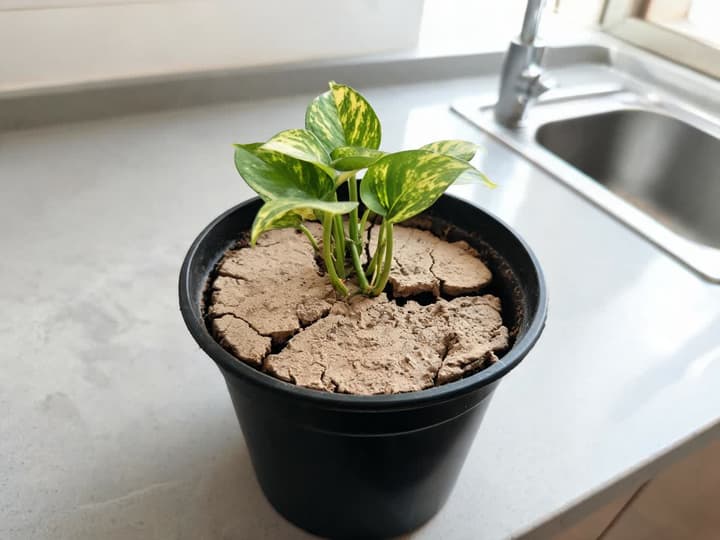
If the soil has dried out excessively and shrunk away from the inner walls of the pot, water poured from the top slips straight down the gap. In that case, Clemson recommends watering twice, 30 minutes apart. Another option is bottom-watering the pot in a basin filled with water until the soil surface turns moist. Iowa State caps this soaking method at 2 hours, since leaving it submerged longer can rot the roots. Afterward, let it drain completely.
Use room-temperature water. Clemson recommends water between 17 and 22 °C (62 and 72 °F), avoiding both ice-cold and hot water.
Pothos can also grow with its roots kept entirely in water, without any potting mix. Growing pothos in water is a distinct growing method with its own specific care requirements.
What speeds up and what slows down the pothos watering interval
Soil dries out faster when the plant receives more light, stays in a warmer environment, and grows in a small or unglazed clay pot. Clemson lists these conditions for container plants in general, and the University of Kentucky adds the factor of the seasons:
Condition | Soil dries faster (shorter intervals between waterings) | Soil dries slower (longer intervals between waterings) |
|---|---|---|
Season | Spring and summer | Fall and winter |
Light | Near a bright window | Far from windows |
Pot type | Unglazed terra cotta | Plastic or glazed ceramic |
Size | Large plant in a small pot | Small plant in a large pot |
Potting mix | Loose mix containing bark and perlite (lightweight white volcanic rock) | Fine mix with high peat moss content (dark fiber that holds water) |
The season in Brazil
In Brazil, winter runs from June to August. The University of Kentucky sums up the effect: with less light, the plant uses less water. In winter, pothos soil takes longer to dry, and the finger test and weight test will yield more spaced-out waterings. Do not change the interval based on the calendar date: check the soil, because a warm winter requires more water than a cold winter.
Light
Pothos grows well in moderate to bright light without direct sun, according to Penn State. Direct sunlight turns the leaves yellow. A pothos near a bright window uses more water than one in the back of the room. In Brazil, a north-facing window receives the most sun, and the soil dries faster near it. If you move the plant to a new spot, you also change the watering interval and need to test the soil again.
Hanging pothos or plants up on high shelves
A pothos hung up high or placed on top of a cabinet makes the finger test difficult, as the soil sits above eye level. In that scenario, weight is your best guide: support the pot from underneath and lift it slightly. If it feels significantly lighter than it did right after its last watering, it is time to water.
If your hanging basket has an attached saucer underneath, water the plant over the sink or in the shower. Wait until it stops dripping before hanging it back up. That prevents the saucer from staying full and keeps water from dripping onto the floor.
Recently repotted pothos
After repotting your pothos, avoid soaking the soil excessively. Penn State cautions that excess water right after repotting adds extra stress to the plant. Water once until it runs out through the drainage holes, then wait until the soil dries before watering again.
How to find the watering interval for your pothos
You can find the right interval for your pothos by keeping track over 2 to 3 weeks:
Water your pothos until water runs out of the drainage holes and write down the date.
Starting on day 4, check the soil every 3 to 4 days using both the finger test and pot weight.
Write down the date the soil feels dry (finger comes out dry and the pot feels light). The number of days between those two dates represents your interval for that season, in that specific spot.
Track the timing again whenever seasons change, whenever you relocate the plant, or after repotting.
The measured interval becomes the day to check the soil, not an automatic day to water. If the soil still feels moist on that day, wait another 2 to 3 days and check again.
Signs your pothos watering interval is off
Leaves alert you when the interval is too long or too short, but the same leaf symptom can stem from both mistakes. Check the soil before adjusting how you water:
What you see | With soil dry all the way down | With soil that has stayed moist for days |
|---|---|---|
Drooping, limp leaves | Underwatering: water until it drains through | Possible root rot: do not water, inspect roots |
Yellow, limp leaves | Unlikely | Overwatering: space waterings further apart |
Black leaf spots | Unlikely | Soil stayed wet for too long, according to SDSU |
Dry, brown margins | Soil stayed dry for too long, according to SDSU | Unlikely |
Black margins | Underwatering or fertilizer salt buildup, according to Wisconsin | Overwatering or fertilizer salt buildup, according to Wisconsin |
Two common situations have nothing to do with watering. According to NC State, pothos leaves naturally turn yellow and drop over time, leaving most of the foliage concentrated at the ends of trailing stems. An occasional yellow leaf while the rest of the plant remains firm and healthy is often just this natural shedding process.
The other situation involves the yellow variegation on the foliage. According to Clemson, most pothos cultivars produce patterned leaves. On golden pothos, the yellow streaks and splashes are natural characteristics of the cultivar. An entirely yellow leaf is different: Clemson notes that overall yellowing typically stems from overwatering or too little fertilizer.
The Bloom guide on pothos with yellow leaves covers the other possible causes of yellowing beyond watering.
Pothos wilted and yellow after coming back from a trip
If you return from a 2-week trip and find your pothos wilted, start by inspecting the soil. Soil dry all the way down, paired with a light pot, indicates dehydration. Water thoroughly until it drains. If the soil pulled away from the pot walls, water twice, spaced 30 minutes apart. Alternatively, bottom-water in a basin for up to 2 hours.
If the leaves remain wilted after the soil is thoroughly moist, thirst is not the problem. Slide the root ball out of the pot and check the roots: according to Wisconsin, rotted roots turn brown or disintegrate entirely. Yellow leaves paired with moist soil point to overwatering.
Pothos turns yellow when watered and wilts when you stop
Watering more because leaves turned yellow and then stopping because they wilted, without checking the soil, blurs two separate issues together. Return to testing the soil and only water when it has dried out.
If the foliage keeps turning yellow even when watering exclusively after the soil dries out, inspect the roots. According to Wisconsin, rotted roots turn brown or disintegrate entirely. Root rot caused by overwatering requires its own diagnosis and treatment:
Is your plant actually a pothos?
This guide applies to Epipremnum aureum, the pothos featuring heart-shaped leaves that are solid green or patterned with yellow or white variegation. The pothos care guide brings together the full care profile for this species.
Pothos is often confused with heartleaf philodendron (Philodendron hederaceum), another climbing plant with heart-shaped leaves. Penn State points to two distinguishing features. The pothos leaf stem has a grooved ridge that hugs the main vine. New philodendron leaves emerge from a protective sheath (cataphyll) that dries up and falls off, whereas new pothos leaves develop without this sheath. If you received your plant without a plant tag, the Bloom app identifies the species from a quick leaf photo.
Frequently asked questions about watering pothos
How many days can a pothos go without water?
None of the university extensions cited in this guide provides a specific timeline. Spider Farmer, an indoor grow light retailer, suggests around 10 days and states that 3 weeks is too long. LivelyRoot, an online plant retailer, mentions 3 weeks or more. Lacking verified field measurements, use 10 days as the safest upper limit for your plant. Before leaving home, water until it drains thoroughly and move the pot away from sunny windows, as lower light levels decrease moisture use.
Does misting the leaves replace watering?
No, misting does not replace watering. Pothos takes in moisture through its root system, and water misted onto foliage never reaches the root zone. Pothos appreciates humid air according to Wisconsin, but Clemson notes that it readily tolerates dry indoor air. Because it withstands low humidity, misting will not alter your watering schedule, which should always depend on testing the soil.
Does pothos need a lot of water?
No. Pothos requires thorough waterings that drain out of the pot, but spaced well apart. According to Penn State, it tolerates staying too dry far better than staying too wet. Watering while the potting soil remains moist is what brings on root rot.
Can I water pothos on the same day every week?
You can pick a fixed day of the week to inspect the soil, but not to water automatically. Spider Farmer suggests watering 1 to 2 times per week during spring and summer. In winter, they suggest watering once every 2 weeks. Watering strictly on a calendar schedule adds moisture to soil that has not had time to dry out.
What to do with your pothos today
Push your finger into the soil down to your first knuckle and pick up the pot. If the soil feels dry and the pot feels light, water until it drains freely and empty the saucer. If the soil still feels moist, record the date and recheck in 3 to 4 days.
The free tier of Bloom includes a plant care schedule. Add a reminder there to check the soil based on the interval you measured.
Bloom is currently available only for iPhone.
Sources
South Dakota State University Extension: Pothos (Devil's Ivy, Golden Pothos): House Plant How-To
University of Wisconsin Extension: Pothos, Epipremnum aureum
Nebraska Extension, Lancaster County: Winter Care of Indoor Plants
Nebraska Extension, Lancaster County: Choosing a Container for Houseplants
University of Kentucky: Keeping your houseplants happy during wintertime (2023)
Iowa State University Extension: How often should I water plants in hanging baskets?
Related articles
How to Care for a Maidenhair Fern: Light, Water, and Revival Tips
Learn how to care for a maidenhair fern indoors: bright indirect light, consistently moist soil, high humidity, and how to revive it if it dries out completely.
How to Propagate Spider Plants: Root the Pup Before Cutting
The safest spider plant cutting comes from a pup still attached to the mother plant: rest the plantlet on soil in a small pot, wait for roots to establish, and only then cut the stolon. Learn when the pup is ready, whether rooting in water is worth it, how to divide the clump, and why plants fail to produce babies.
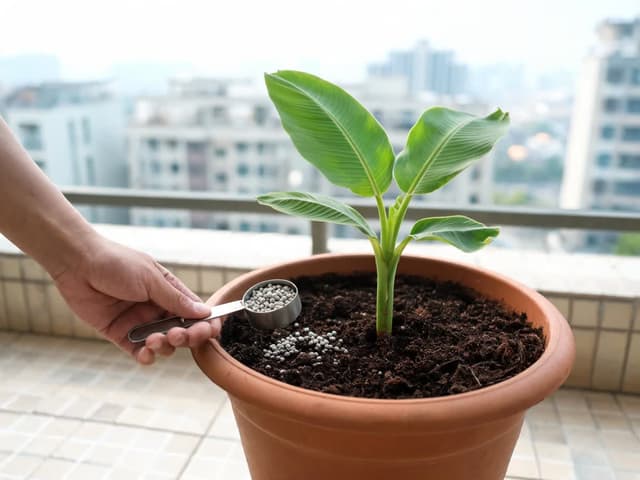
Banana plant fertilizer: fertilizing potted and backyard plants
Banana plant fertilizer needs more potassium than nitrogen, in a 3-1-6 ratio. For a potted plant on a balcony, use the label dose in spring and summer. In the backyard, fertilize every 2 months, adjusting the amount by mat age. Learn the formula, timing in Brazil, and signs of deficiency or excess.