How to Care for Pothos in Soil or Water: Potting Mix and Pots
In soil, pothos needs a light potting mix and a pot with drainage holes. It also grows in water, where weekly water changes and cleaning prevent dengue mosquitoes. Learn the differences and how to move pothos from water to soil without stressing the plant.
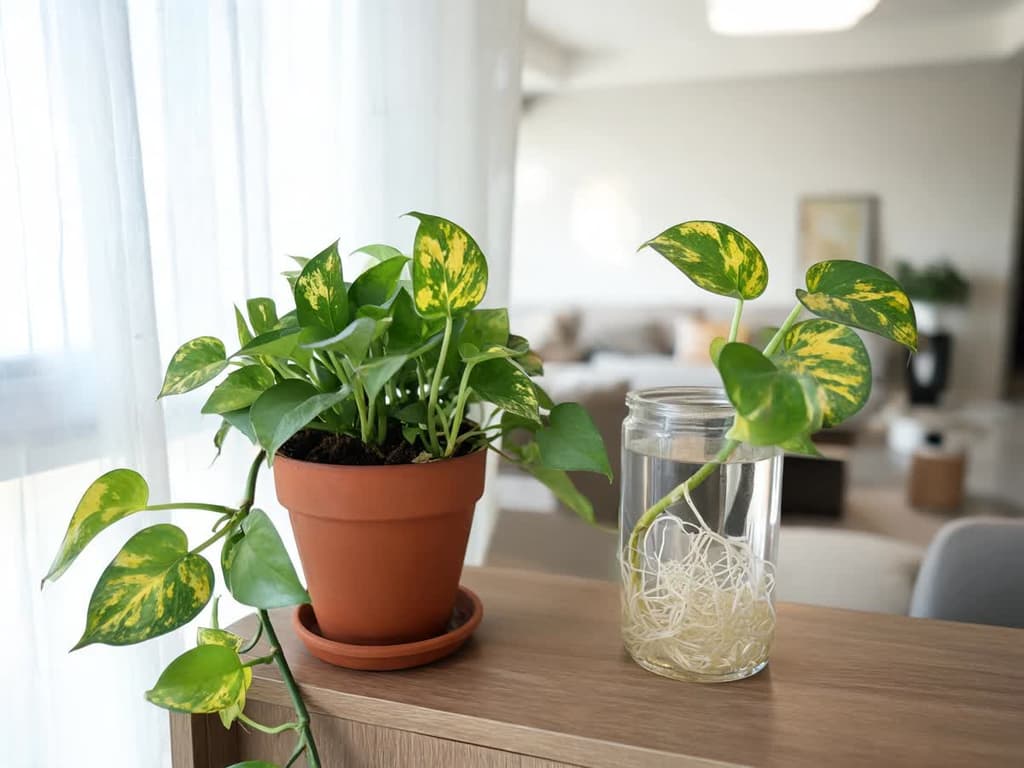
To care for pothos in soil, plant your pothos (Epipremnum aureum) in ready-to-use potting mix formulated for container plants, using a pot with drainage holes at the bottom. Potting mix is bagged soil designed specifically for pots, which is lighter than garden soil. Pothos also lives in a vase with just water. To prevent dengue mosquitoes, change the water and wash the container at least once a week.
To transfer pothos from water to soil, plant the cutting when the new root is about 2.5 cm (1 inch) long. This is recommended by the Iowa State University Extension. Extension is the service through which a university advises the public about plants. The root formed in water is thicker and struggles when it moves to a pot with soil.
Quick summary:
In soil: well-draining potting mix, a pot with drainage holes, and watering only when the mix dries out.
In water: change the water and scrub the inside of the vase with a brush at least once a week against dengue mosquitoes.
Tap water provides only trace nutrients. In water, pothos receives almost no nutrition beyond the fertilizer you add.
No research we found has measured how long pothos can live in water, nor whether it grows slower than in soil.
When moving from water to soil, the plant may wilt and drop leaves during the first few weeks. Do not increase watering because of this.
Pothos in soil vs. water: what changes
In soil, pothos draws water and nutrients from the potting mix, and you water when it dries out. In water, the plant depends on the water you change and the fertilizer you add. The University of New Hampshire Extension explains that the plant needs 13 nutrients. In water culture, they come from dissolved fertilizer.
Aspect | Pothos in soil | Pothos in water |
|---|---|---|
Source of nutrients | From the potting mix and occasional fertilizer applications | Almost exclusively from fertilizer dissolved in the water |
Routine maintenance | Water when the potting mix dries out | Change the water and scrub the container with a brush every week |
Root type | Fine roots adapted to potting mix | Thicker roots that struggle if the plant is moved to soil |
Dengue mosquito | Only if standing water remains in the saucer | The entire vase becomes a breeding site if water sits longer than 1 week |
Biggest risk | Root rot from overwatering | Stagnant water and rotting roots inside the glass |
The extension services consulted describe growing pothos in soil. Water is mentioned only as a medium for rooting cuttings. For that reason, for a plant meant to grow for years, this guide recommends soil.
Can you keep pothos in water forever?
You can keep pothos in water for months, but no one has measured how long it stays healthy. Clemson University Extension states that cuttings root in both soil and water. None of the consulted extensions mentions keeping the plant in water for years.
The longest test we found lasted 86 days. In a study published in 2026 in the scientific journal Scientific Data, researchers removed pothos from soil, washed the roots, and moved the plants to water. One group remained in distilled water, without any nutrients. The authors describe pothos as adaptable to soil and water, and tolerant of low nutrients. The study analyzed root bacteria, not growth.
The claim that "pothos grows slower in water" is common, but no study has compared pothos growth rates in water versus soil. What is known is that distilled water contains no nutrients, and tap water contains only trace amounts. Without fertilizer, pothos in water receives very few nutrients.
How to care for pothos in water
Change all the water and wash the inside of the container with a brush, water, and soap at least once a week. This is the guidance from the Espírito Santo Health Department for water-grown plants. The dengue mosquito (Aedes aegypti) goes from egg to adult in 7 to 10 days (Rio Grande do Sul Health Department).
A brush is necessary because mosquito eggs stick to the container's walls. Fiocruz reports that eggs can survive up to 450 days out of water. Just changing the water leaves these eggs on the glass.
Bleach is not necessary in the pothos water. The recipe calling for "2 drops per 100 ml" does not come from health authorities. The Health Department of Espírito Santo recommends bleach for water tanks, swimming pools, and puddles, but does not mention plant containers. No source has evaluated the effect of bleach on pothos roots. Weekly water changes combined with scrubbing are the recommended measure for these containers, avoiding a chemical with unknown effects on the roots.
No extension service has published a specific fertilizer dosage for pothos grown in water. The most dilute recommendation we found comes from Clemson, intended for potted plants. It uses 1/10 of the label rate for liquid fertilizer with every watering during the active growing season. In water, use that same dilution in the fresh water with each change during spring and summer.
Keep the stem node and roots completely submerged in water at all times, while keeping the leaves out of the water. Iowa State warns never to let the water drop low enough to expose roots to the air. Instructions for taking stem cuttings and locating the node can be found in our guide on how to propagate pothos, if you are just getting started.
How to transfer pothos from water to soil
Plant pothos in soil when the new root is about 2.5 cm (1 inch) long. According to Iowa State, roots formed in water are thicker and not adapted to potting mix. After planting, the cutting may wilt, drop leaves, develop brown leaves, or dry out at the branch tips. University of Illinois Extension describes roots formed in water as weak.
Sources disagree on root length. For philodendrons, Iowa State itself advises waiting until roots are "several inches long," meaning more than 5 cm. This guide follows the 2.5 cm (1 inch) recommendation from Iowa State's stem cutting guide. The "several inches" guideline applies to philodendrons, which are a different plant.
If your pothos has lived in water for months and has developed long roots, no research has evaluated the best method for transitioning it. The safest option is to plant the entire root system without trimming it, choosing a pot large enough to spread the roots out.
Choose a pot with drainage holes at the bottom that is only slightly larger than the cutting's root system.
Moisten the potting mix before planting and squeeze it in your hand: it should be damp, not dripping wet. Penn State recommends moistening the potting mix beforehand so that it absorbs water evenly.
Place the cutting in the pot with the roots spread out. Bury only the roots and the node from which they emerge.
Fill with potting mix and press down lightly around the cutting to keep it secure.
Water thoroughly once until water flows out of the drainage hole, and discard any runoff from the saucer.
Only water again when the potting mix dries out. Penn State Extension warns that too much water right after repotting increases stress on pothos.
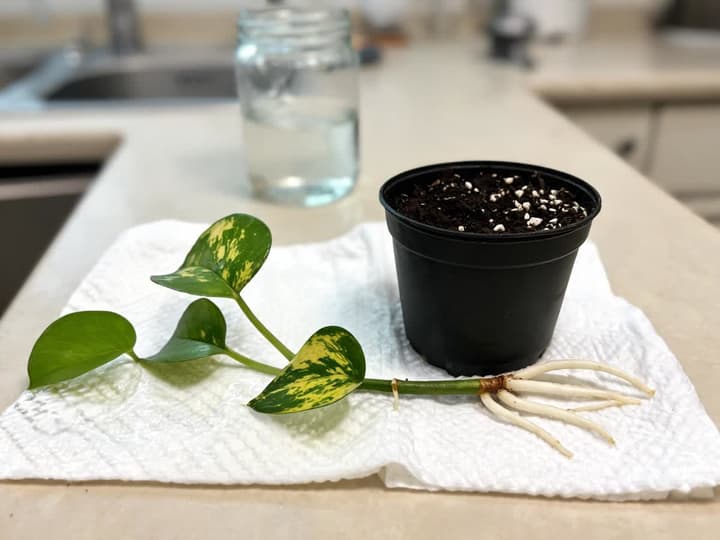
During the first few weeks after potting, wilting, browning, or dropping leaves is normal. Watering more frequently will not help the new roots and will leave the potting mix waterlogged. Yellow, soft leaves in wet potting mix point to a different issue, covered below in the yellow leaves section. Check the mix with your finger before each watering, as explained in our guide on how often to water pothos.
Ideal potting mix for pothos in soil
The ideal potting mix for pothos is lightweight, drains quickly, and retains a small amount of moisture. Clemson calls for an airy, well-draining mixture. Penn State recommends a high-quality soilless potting mix (composed of peat moss, coconut coir, or perlite) with good drainage. Ready-to-use potting mix for indoor plants, sold in bags, meets both descriptions.
Do not use garden soil in your pothos pot. Penn State warns that outdoor garden soil used in indoor containers can introduce pests and diseases.
The University of Florida (UF/IFAS) writes a guide for commercial pothos growers. According to it, growers mix peat moss, pine bark, vermiculite, or perlite. Peat moss is decomposed plant material that serves as the base for many ready-to-use potting mixes.
Material | Role in the pot | When to use |
|---|---|---|
Ready-to-use potting mix | Retains water and nutrients | Base of the potting mixture |
Fine pine bark | Creates air pockets between particles | To loosen up a fine potting mix that holds too much water |
Perlite (small, lightweight white particles) | Creates long-lasting air spaces, according to Iowa State | Same function as fine pine bark |
Vermiculite (golden flakes) | It holds water and a small amount of nutrients, according to Iowa State. | Do not replace perlite with vermiculite: the two serve opposite functions |
Coconut coir | Replaces peat, according to Purdue University | It appears as a base in various ready-to-use potting mixes |
Coarse sand | Adds weight to the pot | Pothos on a tall support: 10% to 20% of the mix, to keep the pot from tipping over |
Coarse sand is the only component with a published proportion for pothos. The UF/IFAS guide calls for 10% to 20% coarse sand when the support exceeds 3 feet (90 cm). A support is the pole or stake that pothos climbs. For the rest of the mixture, no extension service has published exact ratios for pothos.
Because of this, start with pure commercial potting mix. Some commercial mixes are as fine as dust and remain soggy days after watering. In that case, incorporate perlite or fine pine bark, one handful at a time. Stop when a handful of squeezed mix crumbles apart when you open your hand. This same blend works for monstera, which belongs to the same plant family as pothos.
Dry potting mix that repels water
If the potting mix has dried out all the way to the bottom and water runs down the sides of the pot, water it before thinking about changing the soil. Purdue University explains that dry peat moss repels water. To get the mix to absorb water again, place the pot in a basin of water for 1 to 2 hours, never more than 2. That is what Iowa State recommends. Then let it drain and empty the saucer.
Adding fresh potting mix on top will not hydrate the dry root ball below, where the roots live. If roots fill the entire container, the pothos needs a larger pot.
Drainage layers at the bottom of the pot: sources disagree
Adding a layer of gravel, expanded clay pebbles, or stones to the bottom of the pot is optional. What pothos requires is a drainage hole. Sources disagree on the effect of a drainage layer.
Linda Chalker-Scott, a plant specialist at Washington State University (WSU), wrote that the layer impedes drainage. According to her, water moves from the fine substrate to the gravel only when the substrate above is saturated. Clemson also instructs not to place gravel or pot shards at the bottom.
A 2025 study from the scientific journal PLOS ONE measured something else. In soilless potting mix, almost every drainage layer reduced the water retained in the pot. The most effective layer was 60 mm (6 cm) of coarse sand. The test was conducted with a waterlogged pot, with no plant growing.
This guide follows the 2025 study because it represents published measurements, whereas the WSU text is extension advice. Since the study was conducted without a living plant, adding a layer remains optional, while a drainage hole is essential. If you choose to add a drainage layer, a 2.4-inch (6 cm) layer of coarse sand proved most effective. In a shallow pot, that layer will take up a substantial portion of the root zone.
Pots for pothos: size, drainage holes, and hanging baskets
Use a pot with bottom drainage holes, made of any material. Penn State explains that drainage holes allow excess water to escape and prevent waterlogged potting mix. Pots without drainage holes (cachepots) should only serve as decorative outer containers holding a plastic nursery pot with drainage holes inside.
When repotting, the new pot should be 1 to 2 inches (2.5 to 5 cm) larger in diameter than the current one. That is the measurement from Clemson's repotting page.
A shallow, wide pot holds more water at the bottom. Montana State University measured the air space of the same mix: 13% in a 4-inch (10 cm) tall pot and 20% in a 6-inch (15 cm) pot. In a shallow pot, check with your finger to see if the potting mix has also dried below the top layer before watering.
Hanging pothos plants grow in containers that dry out faster. Iowa State notes that potting mixes in hanging baskets are lightweight, drain freely, and dry quickly. Empty the attached saucer beneath the basket after every watering. Standing water in saucers also serves as a breeding site for dengue mosquitoes.
When to repot pothos
Repot your pothos when you notice any of these signs:
Roots growing out through the drainage holes (Clemson).
Roots wrapping tightly around the root ball, so dense that almost no potting mix is visible in the bottom third (Penn State). The root ball is the mass of roots and soil that slides out of the pot in one piece.
The potting mix dries out unusually fast, even during colder months, requiring more frequent watering (Penn State).
Clemson mentions repotting every 1 to 2 years. Penn State mentions every year, in the spring. The difference depends on how much the plant grows: repot a fast-growing pothos every year, and a slow-growing one every 2 years. In Brazil, spring runs from September to November.
A pothos with leaves only at the tips of bare vines needs pruning; a larger pot will not solve this problem. Guidance on pruning and repotting vine tips into the same container can be found in our guide on how to care for pothos.
Pothos with yellow, soft leaves or cottony residue on stems
Soft, yellow leaves on damp potting mix usually point to overwatering and potentially root rot. Slip the plant out of its pot and examine the root system: brown, mushy roots are rotted. Step-by-step instructions to save the plant appear in our guide on pothos with yellow leaves. If root rot is present, replace the entire potting mix.
A white, cotton-like mass or sticky white webbing on the stem, accompanied by dropping leaves, points to a pest rather than the potting mix. A white tuft of cotton is mealybug, one of the most common pests of pothos according to the University of Wisconsin Extension. The guide on mealybugs shows how to remove the tufts.
Frequently asked questions
What kind of container should I use for pothos in water?
Use a wide-mouth glass container. Clear glass lets you monitor root development and see when the water turns cloudy. A wide opening allows access for a scrub brush, which is necessary to remove dengue mosquito eggs from the walls every week. Narrow-neck bottles prevent interior scrubbing, leaving eggs stuck to the glass.
Can I use garden soil to pot my pothos?
No. Penn State cautions that garden soil in indoor pots can introduce pests and plant diseases into your home. The same extension service advises using a high-quality soilless potting mix for pothos. Choose ready-to-use potting mix for indoor plants, and if it stays waterlogged, amend it with perlite or fine pine bark.
Is my plant really a pothos?
Three similar plants are confused with pothos. Satin pothos (Scindapsus pictus) has silvery patches and belongs to a different genus. Heartleaf philodendron (Philodendron hederaceum) has thinner heart-shaped leaves. Epipremnum pinnatum is a close relative, and the name was once used for pothos itself. The Bloom app identifies the plant from a photo.
The yellow streaks on golden pothos foliage are natural variegation, not a sign of disease.
What to do today with your pothos
If your pothos is growing in water, do a complete water change today and scrub the inside of the container with soap and a brush. Want to grow it in soil and your cutting has roots 1 inch (2.5 cm) or longer? Plant it in a pot with drainage holes and moist potting mix. If it is already in soil, check that the pot has drainage holes and make sure the saucer is empty.
Bloom identifies plants from a photo and sets up a custom watering schedule in its free plan.
Bloom is currently available only for iPhone.
Sources
Iowa State University Extension: How to Propagate Houseplants by Stem Tip Cuttings
Iowa State University Extension: Growing Philodendrons at Home
Iowa State University Extension: Potting Media, Components and Handling (2025)
Iowa State University Extension: How often should I water plants in hanging baskets?
University of Illinois Extension: Winter gardening, propagating houseplants (2025)
Clemson HGIC: Indoor Plants, Cleaning, Fertilizing, Containers and Light Requirements
UF/IFAS EP151: Epipremnum, Interiorscape and Production Guide
Purdue Extension HO-255-W: Evaluating Container Substrates and Their Components
Montana State University: Greenhouse Substrates and Fertilization
Chalker-Scott, WSU: The Myth of Drainage Material in Container Plantings
Scientific Data (2026): bacterial community data set of pothos from soil to hydroponic cultivation
Rio Grande do Sul State Health Department: life cycle of Aedes aegypti
Fiocruz: How long does the Aedes aegypti egg survive in the environment?
Related articles
How to Care for a Goldfish Plant: Light, Watering, and Blooms
How to care for a goldfish plant: bright light without strong sun, water when the soil surface dries, and humid air. Learn how to tell a Nematanthus from a Columnea, why it drops leaves, and how to get it to bloom again.
Lavender Leaves Turning Yellow: Where the Yellowing Starts Shows the Cause
Lower leaves turning yellow with moist soil means overwatered roots, the most common cause. Old leaves drying one by one on woody stems is normal. Take the stem and root test, see if your plant can still be saved, and find out what to do today.
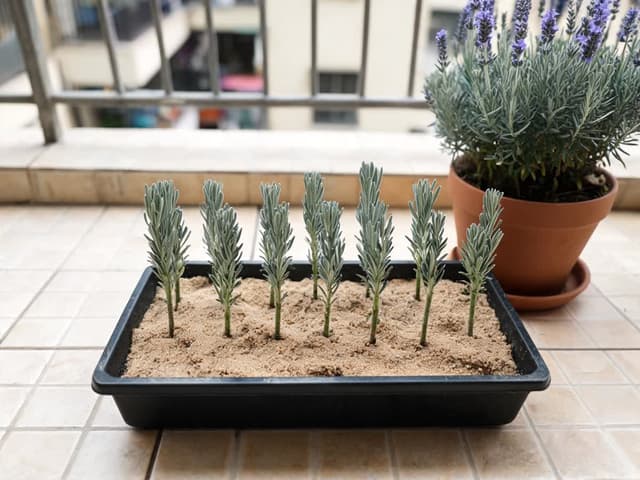
How to Propagate Lavender: Where to Cut and Why Cuttings Rot
A lavender cutting comes from a non-flowering branch tip, about 4 inches long, planted in sandy soil that never stays soggy. Learn where to cut, rooting times, seasonality in Brazil, and what to do if the base turns black.