How Often to Water a Cactus: The Pot Decides More Than the Calendar
The honest answer is a range, not a single number: from once a week to over a month for the exact same cactus. What decides where you land is the pot, light, and temperature in your home.
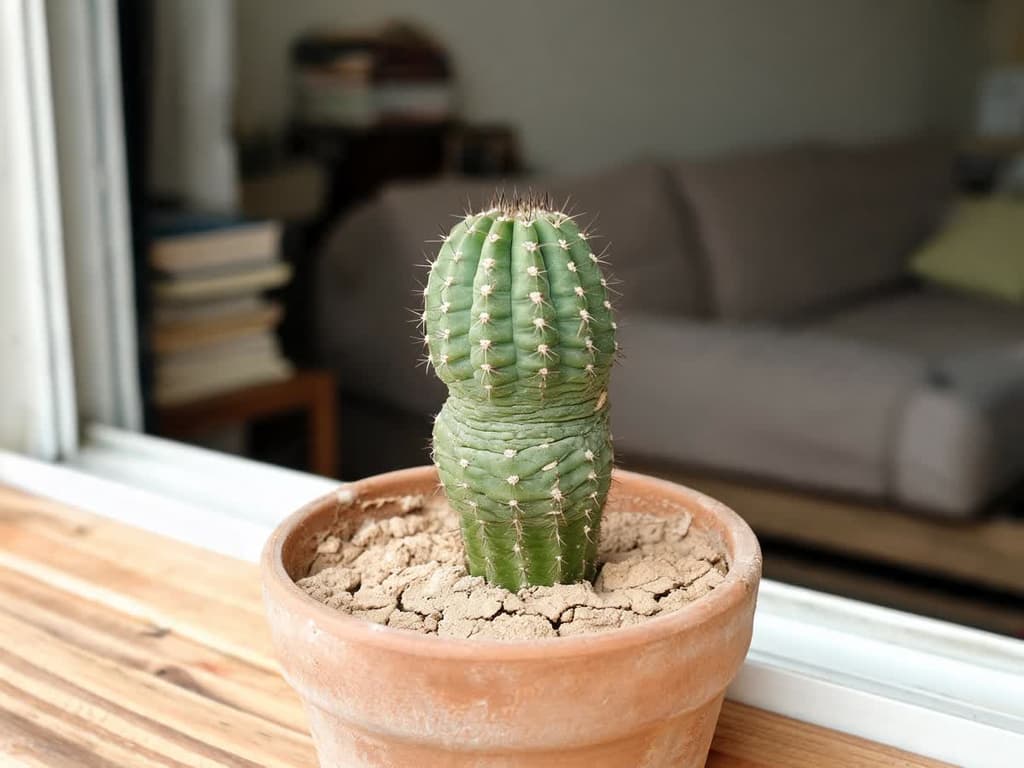
A potted desert cactus asks for water every 7 days in some cases and every 42 in others, and it is the same plant. The New York Botanical Garden puts the difference in a single sentence. It can be once a week in a warm, dry home, or only every few weeks in a cool, humid home. Both numbers are correct for different homes. What does not work is copying one of them without looking at the pot.
The test that replaces the calendar has two parts, and both must be true on the same day. The potting mix is dry all the way to the bottom, and the stem gives slightly when you squeeze it, without wrinkling yet. When both happen together, water. When only one shows up, the schedule is not the problem.
Quick summary:
During the active growing season, the typical interval for a potted desert cactus is between 7 and 21 days. During dormancy, it extends to 14 to 42 days if the plant spends winter in the cold, and stays at 7 to 14 days if kept in a heated room.
A clay pot dries out much faster than plastic, making it the easiest factor you can control.
In winter, watering decreases but does not stop entirely: the New York Botanical Garden describes the amount as "just enough to prevent the plant from shriveling."
A wrinkled stem while the potting mix is still moist is not thirst: it is root rot, and watering makes it worse.
How often to water a cactus
A potted desert cactus is watered when the potting mix has dried out completely. This falls every 7 to 21 days during the growing season and every 14 to 42 days during winter dormancy in a cool spot. The range is wide because the schedule depends on the pot, light, and temperature, not the species.
Six horticultural sources give different intervals for the exact same query, and all of them state the conditions they measured. Those conditions explain the difference.
Source | Interval | Under what conditions |
|---|---|---|
New York Botanical Garden | 7 days to "a few weeks" | warm, dry home versus cool, humid home |
Cambridge University Botanic Garden | 7 to 14 days, from March to the end of October | greenhouse in the UK, minimum night temperature of 6 °C (43 °F) |
Henry Shaw Cactus and Succulent Society | check every 2 to 3 weeks during the growing season | houseplant in the American Midwest, from March to October |
Henry Shaw, during winter | 7 to 14 days in a heated home, 30 days in a cool spot | the temperature of the room where the plant spends the winter |
Planet Desert | 14 to 28 days indoors, 28 to 42 days outdoors | indoors versus outdoors |
14 to 28 days in the growing season, roughly 30 days or no water at all from October to March | United Kingdom, Northern Hemisphere |
Going from weekly watering to monthly watering is a fourfold difference, and none of these sources are wrong. They measured different homes. None of them name a specific species. Cactaceae is a family with over 1,500 species, and "cactus" covers everything from a 2-inch mammillaria in an espresso cup to a 6-foot cereus on a patio.
None of these intervals serve as a fixed schedule in another home. What translates from a source to your pot is the decision criteria, not the exact number of days.
Is your cactus a desert cactus or a holiday cactus?
Both plants belong to the same botanical family, yet they require opposite watering routines.
A desert cactus has a thick, rigid stem, often with vertical ribs, and spines emerging from small cushions of fuzz called areoles. It goes months without rain in its native habitat and easily handles drying out completely in its pot.
The Thanksgiving cactus (Schlumbergera truncata) has flattened segments that cascade over the sides of the pot, without ribs and with almost no spines. It is an epiphyte: in nature it grows supported on tree branches, with its roots exposed to the air and running rainwater. The Henry Shaw Cactus and Succulent Society treats this group separately. According to them, it must be kept evenly moist year-round, especially while flowering. The Thanksgiving cactus blooms precisely in winter, when the desert cactus is dormant. Its seasonal interval is covered in how often to water holiday cacti.
If your plant has flattened segments, the holiday cactus guide covers it. The rest of this page focuses on desert cacti.
The test that replaces the calendar
Watering a cactus by date is a gamble that your home evaporates water at the exact same rate as the guide author's home. Two simple tests, done on the same day, remove the guesswork.
Check whether the potting soil has dried all the way to the bottom. Soil is the common name; substrate is the technical name for the mix that fills the pot. Push a barbecue skewer straight to the bottom, leave it in place for one minute, and pull it out. If it comes out with dark soil clinging to it, there is still water in the root zone. The New York Botanical Garden teaches this test using a thin matchstick kept in place for about a minute.
Squeeze the stem with your thumb and index finger. A well-hydrated stem is hard and does not yield. The Cambridge University Botanic Garden uses the same sign in reverse: if the tissue is plump and firm, the plant does not need water at that moment.
Water only when both tests agree. A dry skewer and a still-firm stem mean the plant still has reserves: wait. A damp skewer and a yielding stem mean the roots have stopped absorbing water, and in that scenario, the right answer is not to water.
Reliable sources disagree on the exact depth of dry soil required. In its desert cactus guide, the New York Botanical Garden advises watering when the top inch (2.5 cm) is dry. In its library FAQ, the same institution recommends half an inch (1.3 cm), as does the Boyce Thompson Arboretum. The difference between these measurements matters little when you use a coarse mix in a snug pot, because the pot dries out almost uniformly. It matters immensely in the opposite situation: fine soil in an oversized pot dries an inch at the surface while remaining soaking wet at root level. Testing with a skewer all the way to the bottom works reliably in both cases.
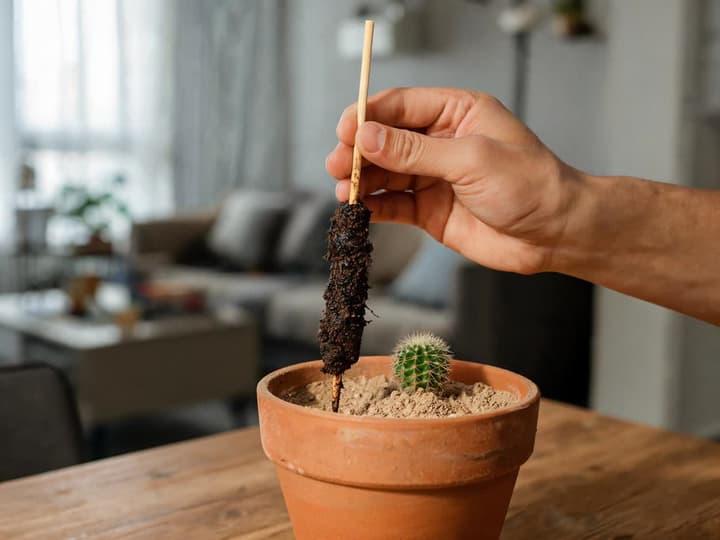
When to water and how to water are two separate decisions: the technique (from above or from below, how much water, what time of day) does not change the interval.
What shifts your cactus watering schedule
Seven factors alter the watering frequency, and none of them are the month of the year.
Factor | Effect on interval | Why |
|---|---|---|
Clay pot instead of plastic | shortens | Clay is porous and loses water through the walls in addition to surface evaporation |
Direct sun instead of filtered light | shortens | The plant transpires more and the potting mix dries out faster |
Pot much larger than the root ball | lengthens, creating a trap | Excess wet soil surrounds few roots, rotting them without wetting the surface |
Warm, dry home instead of cool and humid | shortens | Dry air pulls moisture from the potting soil and from the plant itself |
Dropping minimum temperatures | lengthens | Below 4 °C (40 °F), the plant consumes virtually no water |
Coarse mix instead of standard potting soil | shortens | Drains quickly and retains less water per volume |
Large plant instead of a small one | lengthens | A thicker stem stores more moisture and endures longer between waterings |
The first two factors come from the same sentence from the Henry Shaw Cactus and Succulent Society. According to it, plants in full sun and clay pots dry faster than those in filtered light and plastic pots. The Boyce Thompson Arboretum, in Arizona, adds the mechanical reason: clay pots dry faster than plastic ones and let fresh air reach the roots. Neither source quantifies the difference. The direction, however, is large enough to shift the interval by days.
An oversized pot looks like good care and lengthens the interval for the wrong reason. The Boyce Thompson Arboretum is direct: avoid an oversized pot, because the plant prefers a snug space. The soil in the pot should dry out completely in about seven days. The University of Florida Extension adds the other side: cacti like being slightly pot-bound. A new pot is only needed every two to four years, once roots appear through the drainage holes. The species care sheet recommends a terracotta or unglazed ceramic pot with drainage holes, for the same reason of having porous walls.
If, during the warm months, the potting mix takes more than seven days to dry out in a snug pot, the problem is the mix and not the watering. In cold weather, drying more slowly is normal and says nothing about the mix. The New York Botanical Garden provides the test when watering: a good mix for a cactus drains in less than a minute. The South Dakota State University Extension provides the ratio: one part potting soil to one part coarse sand, pumice, or perlite.
Light is the factor that varies the most inside an apartment. A cactus behind north-facing glass in Brazil and the same cactus in a windowless hallway have watering intervals that look nothing alike.
How much watering drops in winter (and why it decreases less than people think)
During winter dormancy, watering for a desert cactus drops to about half the frequency of the growing season, and the temperature of the space determines how much. The New York Botanical Garden describes the period: from October to February, most desert cacti need less water, less fertilizer, and less warmth, but direct sun continues.
These months are for the Northern Hemisphere. In the Southern Hemisphere, the entire calendar shifts six months: in Brazil dormancy runs from April to August, and growth from September to March. Following American dates here means cutting back on watering right during the Brazilian spring, when the plant is using water to grow.
The month tells you little; what decides the amount is how much cold the plant actually experiences. The Henry Shaw Cactus and Succulent Society separates the two cases with different numbers.
Where the plant spends the winter | Interval | Source |
|---|---|---|
Indoors at normal room temperature | 7 to 14 days | Henry Shaw Cactus and Succulent Society |
In a cool spot (enclosed porch, unheated room, 4 to 7 °C / 40 to 45 °F) | about 30 days | Henry Shaw; the resting temperature range comes from the New York Botanical Garden |
In a Brazilian apartment, cactus dormancy is weak. The resting period described by the sources assumes real cold: a room at 4 to 7 °C (40 to 45 °F), according to the New York Botanical Garden. In the Cambridge greenhouse, winter nights stay at 6 °C. Most of Brazil does not come close to that indoors. If your cactus spends the winter in a room at 20 °C, it never truly stops. The line that applies to you is the first one in the table: 7 to 14 days, not 30. Cutting off water for an entire month to a plant that stayed active dehydrates the stem.
The sources disagree on the extreme. Planet Desert says that small specimens last weeks without water and that large ones survive an entire winter without moisture. Henry Shaw says the opposite in plain terms: do not let the roots dry out completely, because this causes root loss and puts the plant at risk. Both hold up, and neither works as isolated advice.
The New York Botanical Garden reconciles this, and its measure is not given in days. During dormancy, water just enough to keep the plant from shriveling, and err on the side of too little water. The same institution repeats this criterion in its library FAQ. It is the same stem test, applied to the season when it matters most: in winter you water before the stem shrivels, not to make the potting soil moist.
There is one exception: winter-blooming cacti. Holiday cacti and their relatives form buds or flower during the precise months when desert cacti rest; cutting off water at this stage causes flower buds to drop. If your plant has flat segments, its seasonal routine is outlined in how often to water a holiday cactus.
Wrinkled stem: thirst or root rot?
A wrinkled stem paired with soil that is completely dry to the bottom means thirst, and the solution is to water. A wrinkled stem paired with damp soil means root rot, and the solution is not to water. It is the identical symptom requiring two opposite actions. This is why people who try "watering more" and then "stopping water entirely" see no progress: neither action addressed the true cause.
A desert cactus has no leaves. What wrinkles is the stem, and in ribbed species, the ribs draw closer together. The Arizona-Sonora Desert Museum describes the mechanism in the saguaro. The waxy surface is folded like an accordion that expands when the stem pulls water from the roots without stretching or bursting. The movement works both ways: the rib opens when the plant drinks and closes when it uses up its reserve.
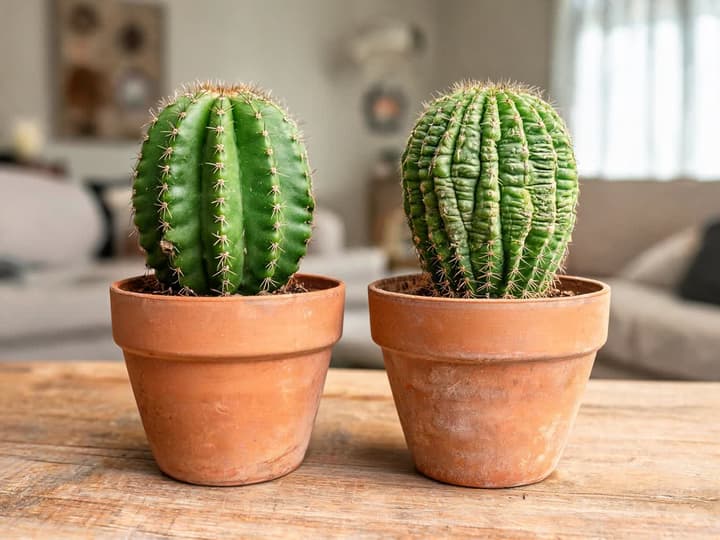
Planet Desert lists the signs of underwatering in a cactus: a wrinkled or wilted appearance, a dry and brittle stem, slower growth. None of them involve color.
What you see | What it is | What to do |
|---|---|---|
Wrinkled stem, skewer comes out dry from the base, firm plant base | Underwatering. The interval is too long | Water thoroughly until runoff drains out, and shorten the interval next time |
Wrinkled stem, skewer comes out damp, firm base | Compromised root: it can no longer absorb water | Do not water. Let it dry and check the root |
Soft, dark, or translucent base, with or without an odor | Active root rot has set in | Do not water. Treat the roots |
Stem with a vertical split after watering | Too much water at once. Cambridge notes that overwatered succulents split | Return to the previous interval. The split will leave a permanent scar |
A soft base indicates that root damage has already progressed, and recovery requires intervention, not schedule adjustments. Both conditions that cause this stage have dedicated guides covering rescue steps and healing timelines.
Once roots have rotted, the procedure shifts: unpot the plant, cut away black or mushy roots, and repot in dry mix. Timelines and steps are detailed in the root rot guide.
A soft, yellowing stem is never a sign of thirst: it indicates overwatering, and the correct response is strictly to withhold water. When choosing between two issues that trigger similar wrinkling, a photo provides far better clarity than a written description. Bloom, an iOS app, identifies species from photos and compares your plant's symptoms against cataloged cases in its Premium tier.
How long can a cactus go without water?
It depends on size and temperature, not on a set number of days. Planet Desert frames the two extremes: small specimens go weeks without watering, and large ones survive an entire winter without moisture. A 5 cm cactus in a small coffee-sized pot has little storage capacity and little soil around it; a 40 cm cactus in a 20 cm pot has both.
The limit is not in days, it is in roots. The Henry Shaw Cactus and Succulent Society warns that letting the roots dry out completely costs roots and puts the plant's health at risk. A plant that went three months without water can come out alive on the other side with part of its root system lost.
When traveling, base your plan on your plant's regular cycle. Water deeply until it runs through the drainage holes on the day you leave and move the pot away from direct sun, which naturally slows evaporation. Being away for two to three weeks fits comfortably within the growing-season schedule of a mature cactus in a snug pot.
How to find your cactus's schedule in two waterings
The exact interval for your plant, in your pot, in your home, requires just two consecutive waterings with recorded dates.
Water until moisture drains out of the bottom hole, then record the date. Wait for excess water to drain fully, then empty the drip tray.
Starting on day five, test with a skewer every three days. Push the skewer straight to the bottom, leave it for one minute, and pull it out. As long as it comes up dark and damp, do nothing.
On the day the skewer comes out clean and dry, squeeze the stem. If it gives slightly, water thoroughly and record the date. The number of days between these two dates is the true schedule for that plant in that spot.
Repeat the process once. Two cycles that land on the same number of days provide an interval you can rely on for that season.
This test also evaluates your soil, not just your watering cadence. If the potting mix takes more than seven days to dry in a snug pot during the growing season, it holds too much water for a cactus. In winter dormancy, slower drying is completely normal. The soil mix is what needs adjusting, not the watering method: Boyce Thompson uses this seven-day window as a benchmark. Recalibrate the interval whenever seasons change, after repotting, or if you move the plant to a new location.
Frequently asked questions
How do you know when a cactus needs water?
Look for two signs on the exact same day. A wooden skewer inserted to the bottom of the pot comes out dry, and the stem gives slightly when squeezed between your fingers. A firm, swollen stem means the plant still has water stored. A damp skewer paired with a soft stem points to root problems, not dehydration.
How long can a cactus survive without water?
From a few weeks to an entire winter, depending on size and ambient temperature. Small cacti in small pots store few reserves and reach their limit within two to three weeks in hot weather. Allowing the roots to dry out completely leads to root death, so "surviving" is not the same as staying healthy.
Should you mist a cactus with water?
No. Misting wets the stem and leaves the roots dry, which is where the plant drinks. The New York Botanical Garden prefers bottom watering because splashing water on the cactus can mark the stem. The same page recommends keeping air humidity below 30%. Wet the soil in the pot, not the plant.
How often to water a cactus in winter?
Every 7 to 14 days if it spends the winter at normal room temperature, and about 30 days if it stays in a cold spot, between 4 and 7 °C. In Brazil, dormancy runs from April to August. The dormancy amount is the minimum that keeps the stem from wrinkling.
Does bottom watering work for cacti?
It works, and it is the preferred method of several collections, because it does not wet the stem. The choice between watering from above and leaving the pot in a basin changes the technique, not the interval: both only happen when the potting soil is dry all the way to the bottom.
In summary
The watering frequency for a potted desert cactus shifts with the seasons:
Growing season: every 7 to 21 days.
Winter dormancy (April to August): every 14 to 42 days if the plant stays in a cool spot, or every 7 to 14 days in a heated room. Water just enough to keep the stem from wrinkling.
Where your plant lands within that range depends on your pot, light levels, and indoor temperature. Instead of relying on dates, water when two signs appear together: the skewer emerges dry from the base of the pot, and the stem yields slightly to a gentle squeeze. A wrinkled stem sitting in damp soil indicates the opposite problem: damaged roots, where watering must stop.
To find your plant's exact schedule, water until moisture drains freely, note the date, and count the days until both signs appear. Repeat the test once. If both cycles match, you have found its true schedule for that season.
Related articles
How to Care for a Maidenhair Fern: Light, Water, and Revival Tips
Learn how to care for a maidenhair fern indoors: bright indirect light, consistently moist soil, high humidity, and how to revive it if it dries out completely.
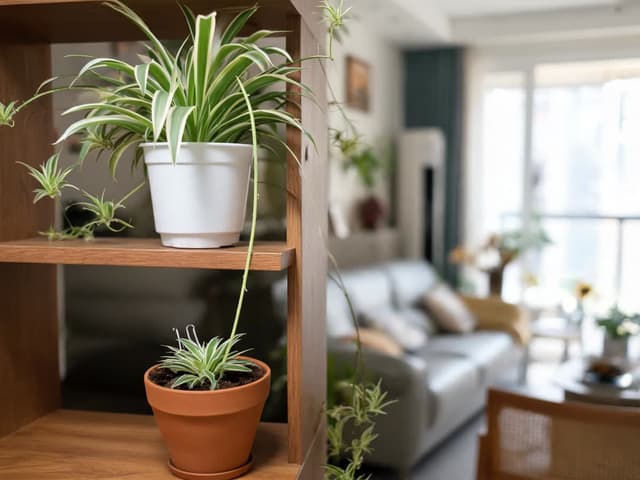
How to Propagate Spider Plants: Root the Pup Before Cutting
The safest spider plant cutting comes from a pup still attached to the mother plant: rest the plantlet on soil in a small pot, wait for roots to establish, and only then cut the stolon. Learn when the pup is ready, whether rooting in water is worth it, how to divide the clump, and why plants fail to produce babies.
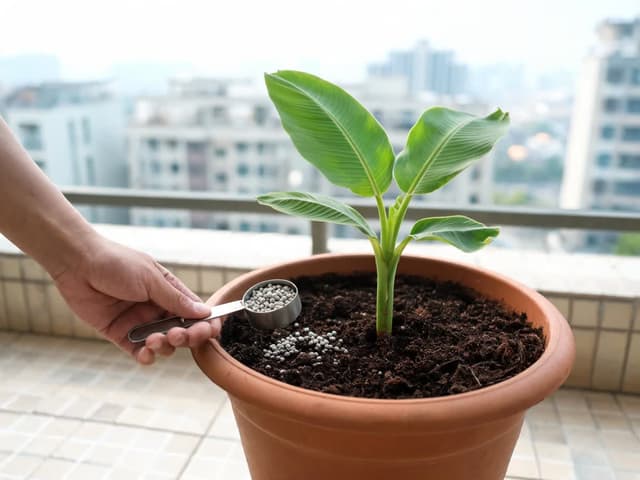
Banana plant fertilizer: fertilizing potted and backyard plants
Banana plant fertilizer needs more potassium than nitrogen, in a 3-1-6 ratio. For a potted plant on a balcony, use the label dose in spring and summer. In the backyard, fertilize every 2 months, adjusting the amount by mat age. Learn the formula, timing in Brazil, and signs of deficiency or excess.