Is Dipladenia (Mandevilla) Toxic to Dogs and Cats? What the Sources Say
Did your dog or cat chew on a dipladenia? Here is what the ASPCA, UF/IFAS, and PubMed say about the plant, what the sap does, and what to do now.
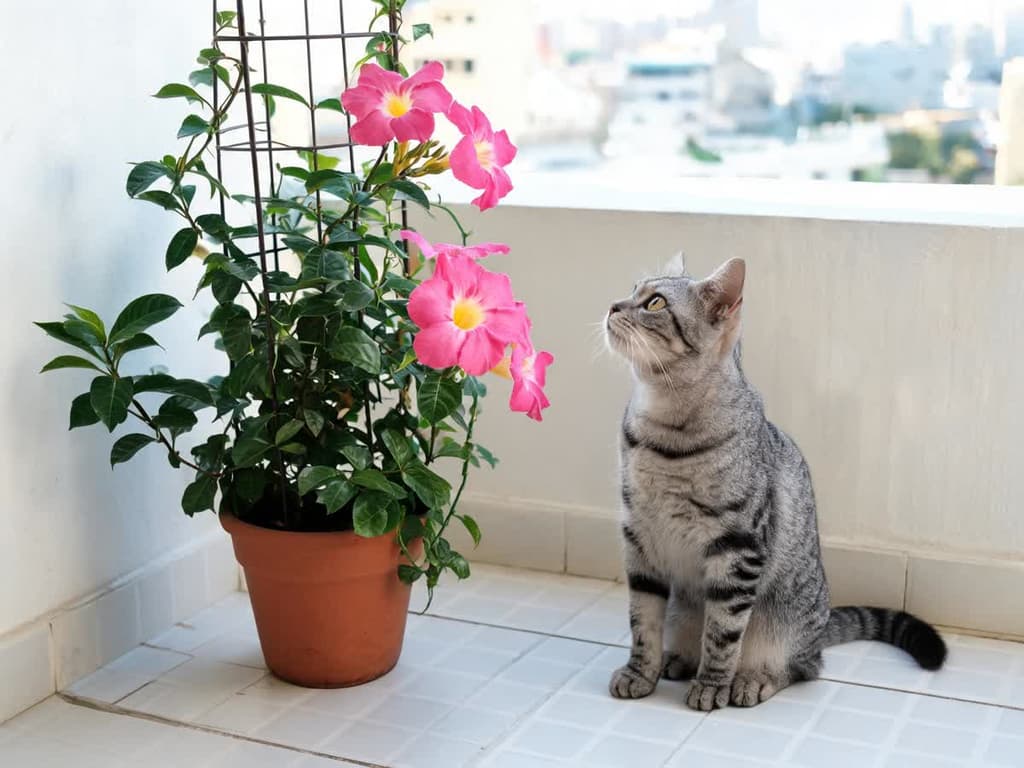
None of the veterinary toxicology institutions we consulted classifies dipladenia (mandevilla) as toxic or safe for dogs and cats. The ASPCA, the American association that maintains a public database of toxic and non-toxic plants for animals, has no entry for the plant. The only institutional source addressing the topic is UF/IFAS, the University of Florida Extension. According to them, the milky sap can irritate the skin and may be toxic if ingested.
If your dog or cat chewed a leaf and is acting normally, call the vet and give them the name of the plant. Go straight to the clinic if the animal is unconscious, having trouble breathing, bleeding, or having seizures, as advised by the ASPCA.
Quick summary:
The ASPCA and Pet Poison Helpline, two animal poison control centers in the United States, have no record for dipladenia.
UF/IFAS warns that the milky sap can irritate the skin and may be toxic if ingested. UF/IFAS does not state the severity or name any animal.
In the scientific database PubMed, an October 2026 search found no reports of dipladenia poisoning in dogs, cats, or humans.
Dipladenia belongs to the same family as oleander, but the family does not decide the issue: the ASPCA lists both toxic and non-toxic plants from this family.
Do not induce vomiting at home. The veterinarian decides the treatment.
What the ASPCA and other sources say about dipladenia and pets
Dipladenia appears as "poisonous" in 7 out of 8 gardening guides we read, and none of them cites an institution. We checked the databases that classify plants for animals and university extension fact sheets in October 2026:
Source | What it says about dipladenia (Mandevilla) |
|---|---|
ASPCA Animal Poison Control | Has no entry. The plant is not on the toxic list nor on the non-toxic list. |
Pet Poison Helpline | A search for "mandevilla" yields no results. |
UF/IFAS (University of Florida) | The milky sap can irritate the skin and may be toxic if ingested. |
NC State Extension | The fact sheet for the genus Mandevilla (the group encompassing all dipladenia species) does not include a toxicity field. |
Clemson University (fact sheet HGIC 1109) | The fact sheet makes no mention of toxicity, sap, pets, or children. |
PubMed (scientific articles) | No reports of poisoning. The 5 articles that cross-reference Mandevilla with toxicity study the medicinal use of wild species. |
The lack of an entry means the ASPCA database has no data on dipladenia, not that the plant is safe. That is why this article does not claim that dipladenia is safe for pets.
The only effect backed by an institutional source is skin irritation from the sap. None of the consulted sources describes severe poisoning in animals or people. The statement from UF/IFAS regarding ingestion says "may be toxic," without listing symptoms or severity.
Mandevilla sanderi, splendens, or × amabilis: does the species change the answer?
The species does not change the answer: no source classifies any of the three. The ASPCA has no entry for Mandevilla sanderi, Mandevilla splendens, or Mandevilla × amabilis. The other sources in the table refer to the entire genus.
Potted dipladenia is also rarely a pure species. According to the NC State Extension, nursery plants are usually hybrids, meaning crosses of more than one species. Dipladenia is the old name for the genus, and today both words name the same plant. The answer in this article applies to dipladenia of any color you purchased, whether compact or climbing.
Watering, light, and pruning instructions are in the dipladenia guide, using Mandevilla sanderi as a reference.
Dipladenia belongs to the oleander family: does that make it poisonous?
Being related to oleander does not prove that dipladenia is poisonous. Both belong to the Apocynaceae family, and the ASPCA itself places plants from this family on both sides of the list:
Toxic: oleander (Nerium oleander) and desert rose (Adenium obesum), due to cardiac glycosides, substances that alter the heart's rhythm. Periwinkle (Vinca rosea), due to substances called vinca alkaloids.
Non-toxic: star jasmine (Trachelospermum jasminoides), for dogs, cats, and horses.
In each entry, the ASPCA names the substance responsible for the classification. None of the consulted sources attributes the cardiac glycosides of oleander to dipladenia. The signs that the ASPCA lists for oleander (drooling, abdominal pain, diarrhea, lethargy, and death) belong to that plant and cannot be transferred to dipladenia. The lack of data also does not show that dipladenia is safe.
The desert rose is a plant in the family that has an entry: the ASPCA names the substance and lists the clinical signs. In the consulted sources, dipladenia has neither.
Does the milky sap of dipladenia irritate the skin?
The milky sap of dipladenia can irritate the skin, according to UF/IFAS. It leaks out whenever a stem, leaf, or flower breaks. During pruning, you come into closer contact with the sap.
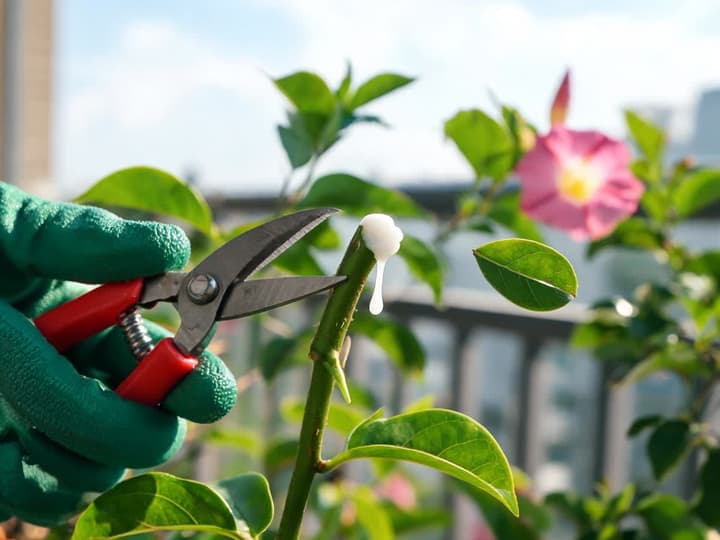
Wear gloves to prune, take stem cuttings for propagation, or repot dipladenia. If the sap gets on your skin, wash it off with soap and water. UF/IFAS does not mention animal eyes or mouths. If your pet's mouth turns red or starts drooling after chewing the plant, notify your vet.
Dog or cat chewed dipladenia: what to do right now
Follow the ASPCA steps for any plant an animal has chewed:
Move the animal away from the dipladenia and pick up any pieces from the floor.
Observe whether the animal is acting normally or has vomiting or diarrhea, and report what you see to the vet over the phone. If there is another animal in the home, observe it as well.
Call the veterinarian and state the name of the plant. Send a photo of the dipladenia if the veterinarian requests one.
Go straight to the clinic if the animal is unconscious, struggling to breathe, bleeding, or having seizures.
Do not induce vomiting at home. The ASPCA advises against home remedies: large amounts of salt can raise sodium levels in the animal's blood and cause tremors, seizures, and coma. If vomiting is necessary, the veterinarian decides how to induce it.
No veterinary source describes the signs of a dog or cat that ate dipladenia. No source links neurological signs (of the nervous system), such as seizures and tremors, to dipladenia. This does not prove they do not occur: if they appear, treat them as an emergency and take the animal to the clinic.
Is dipladenia toxic to children and adults?
For people, the source is the same: UF/IFAS says the sap can irritate the skin and may be toxic if ingested. If a child or an adult ate part of the plant, call Anvisa's Poison Control hotline: 0800-722-6001, toll-free and 24 hours.
Where to place dipladenia in a home with a dog or cat
In Brazil, dipladenia usually sits on the porch, against a wall, or in a garden bed, attached to a trellis. Three precautions reduce the chance of a dog or cat chewing on the plant:
Train the stems upward along the trellis and trim those hanging down to the ground.
Clean up fallen leaves, flowers, and pruned stems on the same day. Cut stems continue releasing sap.
If your cat chews on plants, keep dipladenia in a hanging planter or on a balcony the cat cannot enter.
For other common household plants and their specific risks to dogs and cats, see the list of toxic plants for pets.
Frequently asked questions
Can dipladenia kill a dog or cat?
There is no record of a dog or cat dying from dipladenia in any of the consulted sources. The ASPCA and Pet Poison Helpline do not include the plant in their databases, and PubMed reports no poisoning cases. UF/IFAS only states that the sap may be toxic if ingested. If your pet chewed the plant, call the veterinarian.
Which part of dipladenia is toxic?
The only part cited by an institution is the milky sap, which oozes from broken stems, leaves, and flowers. UF/IFAS notes it can irritate the skin and may be toxic if ingested. No institutional source separates leaf, flower, or root. Therefore, treat any chewed plant part the same way: call the vet.
Are dipladenia and mandevilla the same plant?
They are the same plant. Dipladenia is the former name of the genus, which is now called Mandevilla, according to NC State Extension. Compact varieties, such as those in the Sun Parasol series, were once classified as Dipladenia and later returned to the genus Mandevilla, UF/IFAS explains. The guidance regarding pets is identical for compact and climbing types.
How can I tell if my plant is a dipladenia and not an oleander?
The leaf of an oleander is narrow, measuring 10 to 18 cm long and less than 2.5 cm wide, and often grows in whorls of 3 or 4 leaves at the same node on the stem. The leaf of a dipladenia is dark green and glossy, growing in opposite pairs across from each other on the stem. Both descriptions come from NC State. This difference changes the answer, because the ASPCA classifies oleander as toxic to dogs, cats, and horses. When in doubt, Bloom (available for iOS) identifies the plant from a photo.
What to do now
If your pet chewed dipladenia and is acting normally, call your veterinarian. If the pet is unconscious, struggling to breathe, bleeding, or having seizures, head straight to the clinic.
Do not induce vomiting at home and do not administer home remedies.
Wear gloves when pruning and discard cut stems on the same day.
Related articles
Cyclamen with Yellow Leaves: Causes and What to Do
A cyclamen with yellow leaves might just be going dormant. Learn how the tuber and the time of year tell dormancy apart from rot, heat, thirst, and mites, and what to do in each case.
How to Water Cyclamen: Bottom Watering, Edge Watering, and the Wilt Test
How to water cyclamen without rotting the tuber: when the soil surface dries out, from below for 15 minutes or around the edge, never in the center. Plus the test to tell wilting from thirst apart from rot.
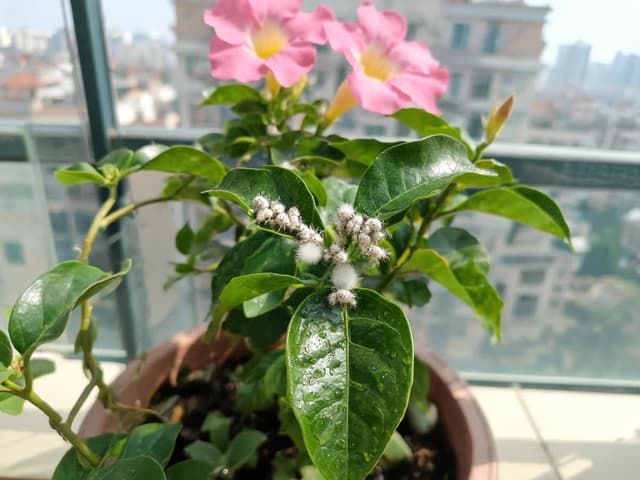
Dipladenia with Sticky White Dots: Which Pest Is It?
A sticky white dot on a dipladenia is almost always a mealybug, but whiteflies, aphids, spider mites, and the plant's own sap leave similar marks. See the test that separates each one and the source-backed treatment.