How to Care for Desert Rose: Sun, Dormancy, and Caudex
Desert rose needs six hours of direct sun and loses all its leaves in winter without being sick. Discover when to water, when to stop watering, and what fattens the caudex.
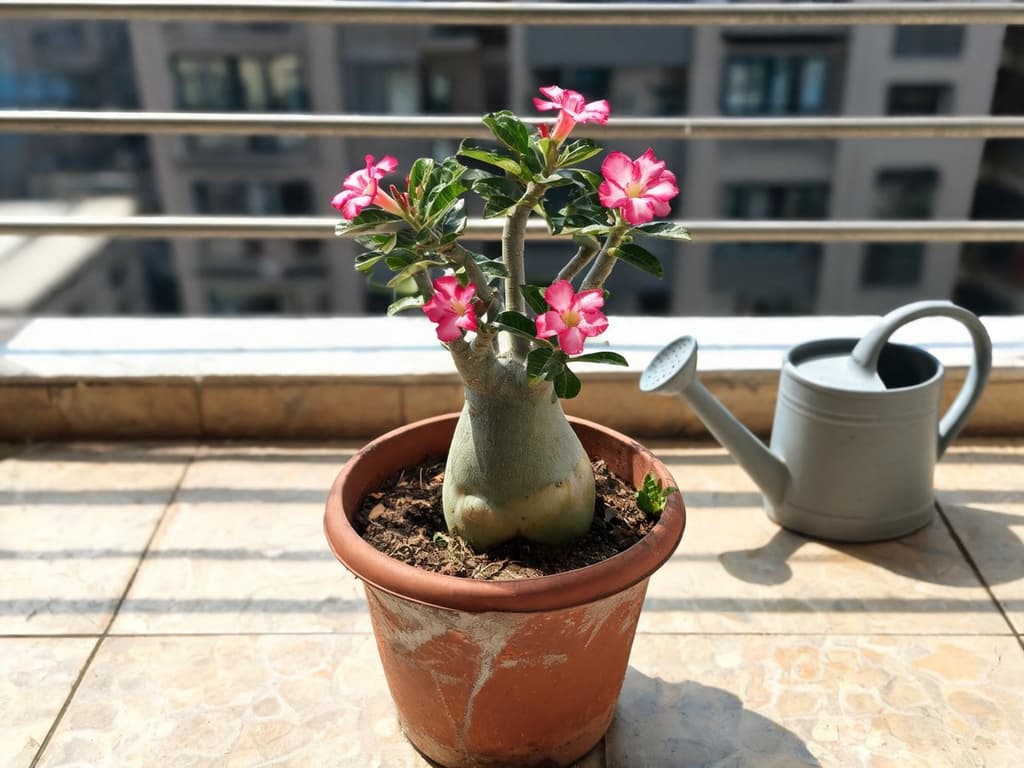
Caring for desert rose (Adenium obesum) depends on three things: six hours of direct sunlight a day, potting mix that dries quickly in the pot, and watering that shifts rhythm in winter. It is a succulent in the Apocynaceae family, native to arid regions of Africa and the Arabian Peninsula, and is not related to roses. The fat base that gives the plant its distinctive look has a name, caudex, and it is a water reservoir. It exists to get the plant through months of drought. That is why desert rose dies far more often from too much water than from too little.
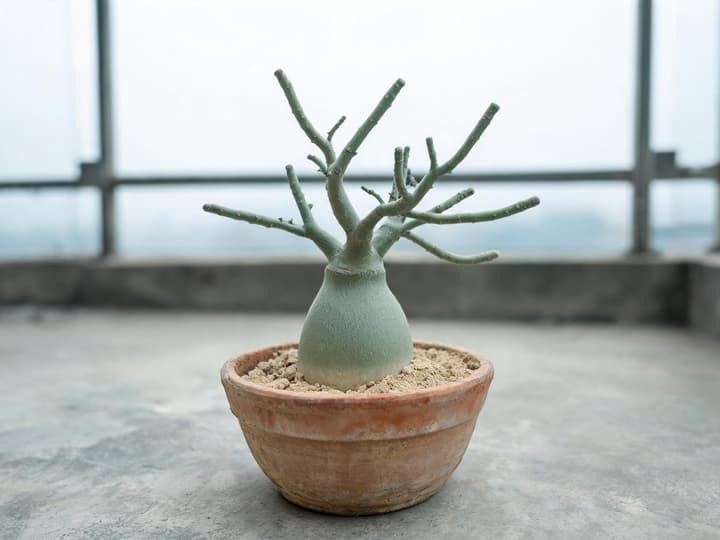
During the dry winter, between June and August in Southeastern and Southern Brazil, the plant enters dormancy and drops all its leaves. This leaf drop is a normal cycle for the species, not a disease. Anyone who waters a leafless desert rose, in cold soil, rots the caudex. The University of Arizona Extension names the two windows of risk. Root rot takes hold when adenium is watered during dormancy, or watered too early in spring.
Quick summary:
Direct sun for six hours or more per day. Below that, desert rose will not bloom and branches grow thin and leggy.
In the warm season, water when the potting mix dries out completely. This usually means an interval of 7 to 14 days. Between June and August, stop.
Leaves yellowing and dropping in winter with a firm base means dormancy. A soft, dark base near the soil line is rot, and then the day you take action changes the outcome.
It is worth reading any desert rose care sheet with a caveat. Published watering intervals describe the growing season, with the plant in the sun and with leaves. In winter, watering leaves that equation.
Leaves are dropping: is it dormancy or is the plant dying?
Desert rose drops leaves for different reasons, and what separates them all is the caudex. Press the base of the plant with your thumb before deciding anything. A firm caudex with leaves falling in the cold is dormancy. A firm caudex with soil that has been wet for days is overwatering. A soft caudex is rot.
What you see | What it is | What to do |
|---|---|---|
Leaves turn yellow and fall between June and August, firm caudex, dry soil | Winter dormancy | Stop watering. Foliage returns in spring. |
Leaves turn yellow and fall outside of winter, firm caudex, soil damp for days | Overwatering | Hold off on watering until the soil dries completely and check that the drainage hole is clear. |
Soft, dark, or sunken caudex near the soil line | Caudex and root rot | Take the plant out of the pot today, cut away the rotted tissue, and keep the rest dry. |
The UF/IFAS cultivation sheet for Adenium obesum is straightforward. Withhold water in the cool months and let the plant rest for three to four months. All leaves and flowers drop, and this is part of the species' natural cycle. UF/IFAS Charlotte County says the same in a short sentence. Do not be alarmed by significant leaf loss during winter, because this is normal.
Overwatering is the other scenario, and it appears outside of cold weather. A reader asked UF/IFAS Nassau County why his desert rose was yellowing on a full-sun porch. He was watering every other day. The recommendation was to switch to once every one to two weeks. The same text summarizes the species like this: the only problems with desert rose are too much water, too much fertilizer, and too little light.
Rot is the only one of the three that cannot wait, and the plant can survive it. Arizona Extension describes the procedure. Rotted areas should be cut away as soon as they are noticed, and the remaining tissue needs to be kept dry. The same text records the prognosis. If enough of the plant is healthy, the adenium can recover even after losing a large part of its roots and caudex.
Ground cinnamon appears in almost every homemade recipe for this situation, and there is no published measurement of its effect on the caudex. The treatment is to take the plant out of wet soil and cut away what is soft.
A fourth case appears after moving the plant, and it is milder. A temperature drop produces the same effect. UF/IFAS records yellowing and leaf drop on desert rose exposed to cold between 13 °C and 2 °C, without the plant being sick. Low light drops leaves the same way. In both cases, the plant regrows foliage when conditions return, and no extra watering speeds this up.
Pests are rarely the primary cause of leaf drop in this species. When they do appear, NC State Extension lists mealybugs, aphids, and scale insects. UF/IFAS Charlotte County points to oleander caterpillar as the worst insect it has seen on the plant. Desert rose is related to oleander, and the caterpillar moves from one to the other. Mealybugs appear as white cottony spots in branch crotches, and aphids cluster on new tips and leave leaves sticky. Arizona Extension notes that these insects do not thrive on plants that lose their leaves in winter.
If the plant arrived as a gift and you do not know its name, identifying the species is the first step in diagnosis. A soft caudex on a desert rose and a soft stem on a cactus call for different responses. Bloom handles this identification from a photo. For other species, the guide to yellow leaves on potted plants and the symptom-based diagnostic guide cover the rest.
Direct sun: six hours, and what happens below that
Desert rose needs full sun, which NC State Extension defines as six hours or more of direct light per day. The UF/IFAS care sheet uses the same number and links it to blooming. The plant needs high light, six hours or more per day, to maintain summer flowering, and does not bloom in low light.
Below that number, desert rose changes shape instead of dying. Branches grow thin and long, leaves become spaced farther and farther apart, and flower buds stop opening. A branch that has already grown thin stays thin after sunlight increases, and only new growth comes in thick. This stretching happens to any succulent getting less light than it needs.
Moving to full sun must be gradual. Arizona Extension notes that adenium scorches if moved from a dark spot straight into strong light, without transition. A plant bought in an indoor nursery or one that spent the winter indoors is in this situation. Increase exposure over two weeks instead of changing locations all at once.
Indoors, six hours of direct sun only exist at the sunniest window, the one that gets direct sun for much of the day (in Brazil, almost always the north-facing one), with no curtain and with the pot right against the glass. Any deeper into the room, desert rose survives for months without opening a single bloom.
Watering: the caudex is the reservoir, and in winter it does not drink
During the growing season, water until it drains out the bottom of the pot. Wait for the soil to dry out completely before watering again. In a pot in the sun, this usually means an interval of 7 to 14 days. The number shifts with heat, pot size, and rain. Dry soil on the surface does not mean dry soil at the bottom, which is where roots rot, and the chopstick test solves this.
In winter the routine is different, and it is more radical than it seems. UF/IFAS directs withholding water for three to four months and letting the plant rest. Arizona Extension writes the same instruction in different words. Dormant adenium should be kept dry and unwatered, and this applies even to the minority of plants that produce flowers during winter.
The exception is a small plant, under a year old, and one that spends the winter in a warm, sunny spot. For these two cases, Arizona allows light watering. This watering moistens only the top two or three centimeters of soil and never soaks the pot.
Resume watering when nights no longer drop below 10 °C and the plant starts putting out new leaves. Both conditions apply together. New leaves without nighttime warmth are still not a sign to resume watering. Arizona is explicit about the risk of watering too early in spring.
UF/IFAS Charlotte County notes that desert rose tolerates heavy rain above 27 °C, provided the soil drains well. What favors rot is the combination of cold and moisture. A pot with a clogged drain hole changes this entire equation, because water then sits stagnant at any temperature.
Care sheets often publish a fixed interval, something like ten days between waterings. This number describes the warm season, with the plant in the sun and with leaves. Between June and August, it turns into zero watering on an adult plant, which is the shift in rhythm that any succulent in dormancy requires.
Soil and pot: how it differs from common succulents
Use a cactus and succulent mix in a pot with a large drainage hole. UF/IFAS Charlotte County recommends this for desert rose in containers. The pot needs to be wide enough to accommodate the caudex, which thickens year after year.
Arizona Extension discusses pre-bagged store mixes. Houseplant soil is usually too rich in organic matter to serve as the main ingredient in an adenium mix. That holds true even when the bag is labeled as cactus mix. In practice, cut the bagged mix with coarse sand or perlite (a white, lightweight, porous mineral sold at garden centers) until water drains freely through your fingers.
One source diverges, and it is worth explaining which one and why. The UF/IFAS cultivation sheet for Florida foliage production calls for rich soil based on peat or bark, along with regular watering. That text describes a commercial greenhouse, with controlled watering and no rain falling on the plant. For a balcony pot in Brazil that gets summer rain, the two drainage recommendations are more relevant.
Clay or terracotta pots help in a way plastic cannot match. The porous sides let the potting mix dry out faster. That is why Arizona Extension calls this type of pot ideal for adenium.
Do not put organic mulch around the plant. UF/IFAS Charlotte County advises against bark, wood chips, and dry leaves on desert rose, because moisture held by mulch encourages rot. Ordinary garden soil alone also does not work in pots: it compacts and holds water, which is the most common mistake that kills succulents in pots.
Why your desert rose is not blooming
Blooms fail for three reasons, in order of frequency: low light, winter without dormancy, and too much fertilizer.
Light resolves most cases on its own. UF/IFAS writes that desert rose does not flower in low light. It takes six hours or more of direct sunlight daily to maintain summer flowering. No fertilizer compensates for a dark window.
A winter rest is the second reason. UF/IFAS describes the full cycle: with warmth returning, you water and fertilize, and flowers and foliage reappear. A plant watered all winter never closes this cycle. It reaches spring without the dry period that precedes flower buds.
Fertilizer comes in last, and from excess. UF/IFAS Nassau County lists three problems for the species, and excess fertilizer is one of them. The other two are excess water and low light. Arizona Extension recommends a formula lower in nitrogen and higher in potassium for adenium. That is the opposite of the foliage fertilizer most people have at home, and succulent fertilizer follows its own logic.
Sources disagree on peak blooming. Arizona Extension records spring as the main season for most adeniums, and NC State records summer. Both descriptions cover the same warm half of the year, which in Brazil runs from September to March.
The caudex: what makes it thicker and what thins it
The caudex is the swollen stem at the base of the plant, and it gives the desert rose its miniature tree look. NC State describes the structure: from the succulent, thick, grayish-green stem emerge branches with clusters of leaves at the tips. Arizona Extension adds that not every adenium forms a caudex, and the ones that do define the image of the entire group.
What thickens the caudex is time spent in full sun and water during the proper season. It is storage tissue: it only fills out when the plant has light to produce and water to store. What thins it is shade, which directs growth upward instead of to the base.
Propagation method also plays a role, and that decision comes before any daily care. Arizona Extension explains why grafting exists in this species. Cultivar is the name given to a variety selected for a specific trait, such as flower color. A cultivar with beautiful flowers and a weak caudex can be grafted onto a rootstock, which is the lower plant providing the roots and caudex. Over time, the union stops being visible.
Repotting the plant slightly higher with every pot change is the technique collectors use to display more caudex and roots. Arizona Extension notes the secondary effect that matters most: elevating these parts helps protect them from rot. UF/IFAS calls the practice lifting, and says specimens of Adenium obesum go through it multiple times.
Pruning is minimal and has a set time. UF/IFAS Charlotte County writes that desert rose generally does not require much pruning. If you prune to encourage a more branched plant, do so at the start of the growing season with sanitized shears.
The sap is toxic: what this means in practice
The ASPCA classifies desert rose (Adenium obesum) as toxic to dogs, cats, and horses, and names the toxic principle: cardiac glycosides, substances that affect heart rhythms. The clinical signs it lists are vomiting, diarrhea, loss of appetite, depression, irregular heartbeat, and death.
NC State adds two details that change daily handling. Latex, the technical name for the milky sap, causes contact dermatitis, and all parts of the plant are poisonous if ingested, from the bark to the seeds.
Toxicity translates into three habits. Wear gloves when pruning, taking cuttings, and repotting, because these are the three times milky sap runs. Wash hands and shears afterward. If the plant shares a home with cats, dogs, or small children, keep it where they cannot reach it.
The relationship hidden by the common name helps explain the risk. UF/IFAS Charlotte County describes desert rose as a relative of allamanda, plumeria, oleander, and natal plum, rather than of true roses. It belongs to the same botanical family of plants known for their milky sap.
The desert rose calendar in Brazil
All adenium cultivation literature comes from the northern hemisphere, where winter falls in December and January. The table shows the months inverted for Southeastern and Southern Brazil.
Season | Sun | Watering | Fertilizer | Pruning |
|---|---|---|---|---|
September to November | 6 hr or more of direct sun | Resume when nights stay above 10 °C and new leaves emerge | Resume along with watering | This is the time, if pruning |
December to March | 6 hr or more of direct sun | When soil dries out completely, every 7 to 14 days | Maintain, with low nitrogen | No |
April to May | 6 hr or more of direct sun | Space out waterings as nights turn cooler | Stop | No |
June to August | Available sunlight, protected below 10 °C | No watering on adult plants | None | No |
In the North and Northeast, where nights do not drop below 10 °C, desert rose may not enter dormancy. Arizona Extension notes that some plants retain their foliage even during the rest period. If yours stays leafy and keeps growing in July, follow warm-season watering year-round. Base decisions on the potting mix, not the calendar month.
Cold is the cutoff that closes the calendar. NC State advises bringing the plant indoors when outdoor temperatures reach 13 °C. Arizona Extension notes that Adenium obesum is particularly sensitive to cold and can show damage below 10 °C. UF/IFAS Charlotte County is more specific: below 4 °C, damage appears on branch tips. The three thresholds differ, and the safest one for the plant is the highest. Bring it inside at 13 °C, because below that point sources already begin reporting damage. Frost kills the entire plant.
Frequently asked questions
How often should I water a desert rose?
From December to March, water when the potting mix dries out completely, every 7 to 14 days for a pot in full sun. From September to November, resume watering only when nights stay above 10 °C and new leaves appear. From June to August, on adult plants, do not water: UF/IFAS recommends three to four months without water.
Can a desert rose stay indoors?
Yes, if it gets six hours of direct sunlight hitting it. That means the sunniest window in the house, the one that gets direct sun for much of the day (in Brazil, almost always the north-facing one), with no curtain and with the pot right against the glass. UF/IFAS notes that the species does not bloom in low light. In any darker spot, it becomes a leggy plant with stretched leaves and no flowers.
What should I put at the bottom of a desert rose pot?
Nothing. Stones, gravel, and expanded clay pebbles at the bottom do not improve drainage. They also reduce the volume of soil available for roots, for the same reason that applies to any succulent. What matters is a well-draining mix and a clear pot drainage hole.
How do I care for a desert rose seedling or cutting?
The seedling follows the adult plant's rules with one difference. Arizona Extension allows light winter watering for plants under one year old. This watering moistens only the top two or three centimeters of soil. The seedling does not yet have a caudex full enough to get through three to four dry months.
What month does the desert rose start blooming?
In Brazil, flowering follows the warm half of the year, from September to March. Arizona Extension records spring as the peak for most adeniums, and NC State records summer. Budding depends on direct sun and a dry winter beforehand.
Where to start
Fix the light before changing anything else. Most desert rose problems that look like watering issues stem from sunlight. Six hours of direct light a day dictates whether the plant blooms and whether the caudex fattens. After that, blend coarse sand or perlite into the soil until it drains quickly, and let watering match the season. In June, when leaves start to yellow and drop, stop watering and wait for September.
Other plants require the same direct sun as a desert rose and do well outdoors. The following groups bring together species with this light profile.
Related articles
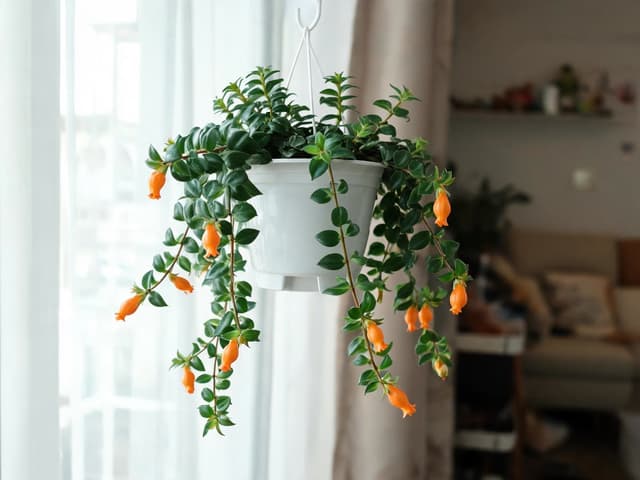
How to Care for a Goldfish Plant: Light, Watering, and Blooms
How to care for a goldfish plant: bright light without strong sun, water when the soil surface dries, and humid air. Learn how to tell a Nematanthus from a Columnea, why it drops leaves, and how to get it to bloom again.
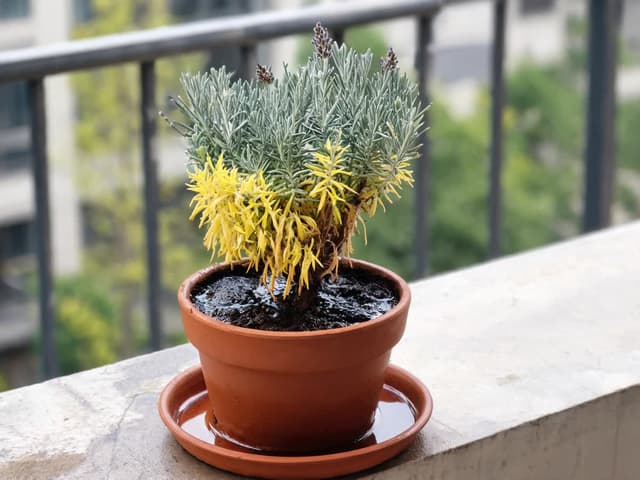
Lavender Leaves Turning Yellow: Where the Yellowing Starts Shows the Cause
Lower leaves turning yellow with moist soil means overwatered roots, the most common cause. Old leaves drying one by one on woody stems is normal. Take the stem and root test, see if your plant can still be saved, and find out what to do today.
How to Propagate Lavender: Where to Cut and Why Cuttings Rot
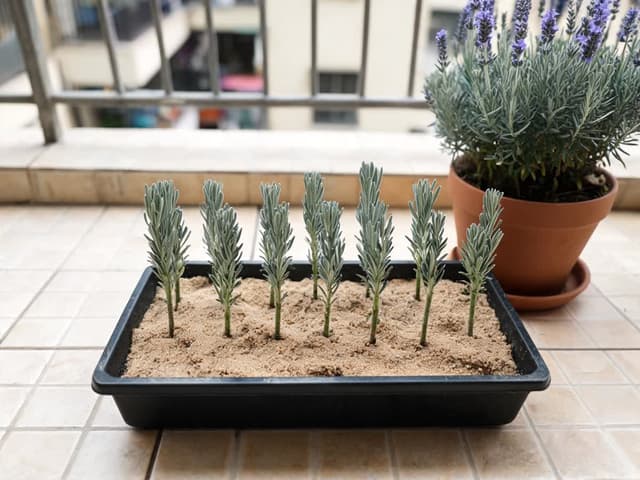
A lavender cutting comes from a non-flowering branch tip, about 4 inches long, planted in sandy soil that never stays soggy. Learn where to cut, rooting times, seasonality in Brazil, and what to do if the base turns black.