Sunflower Care: Pots, Watering, and the Flower Cycle
Sunflowers need direct sunlight, moist soil without waterlogging, and a deep pot. They live about 3 months, set seed, and die. Learn how long the bloom lasts, why the head droops, and what to do when it dies.
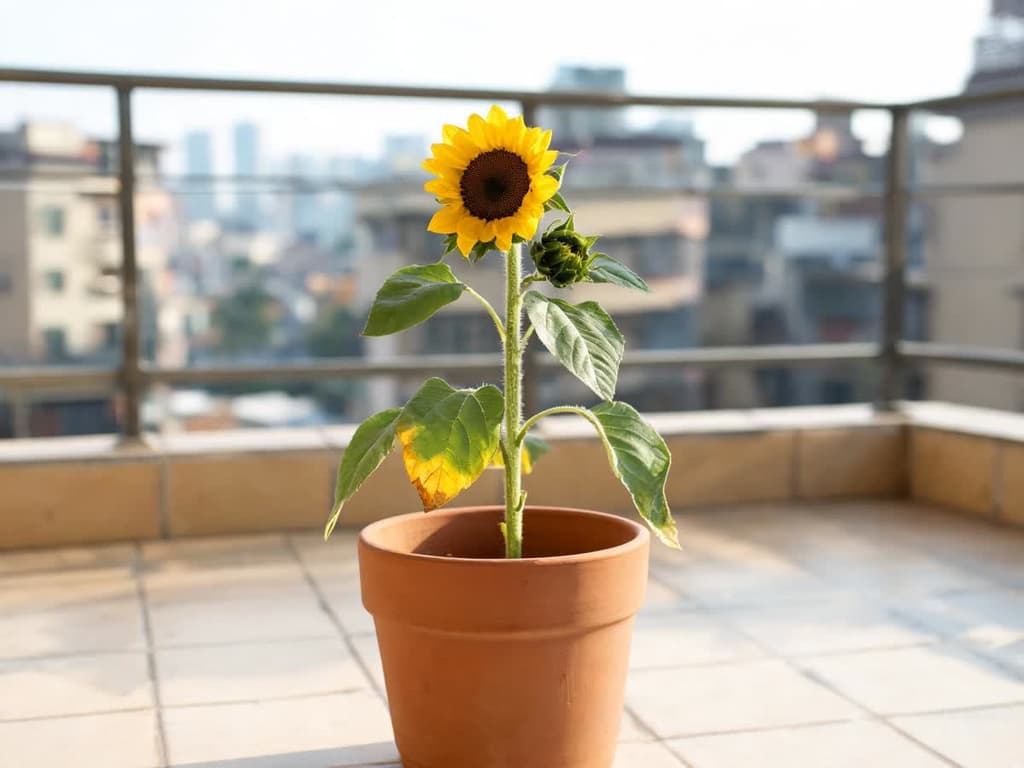
To care for a sunflower, keep the plant where it gets direct sun for at least 6 hours a day. Water when the top layer of soil feels dry, until water drains through the hole in the pot. Use the deepest pot you can fit, because sunflower roots grow straight down.
The sunflower (Helianthus annuus) is an annual plant: it sprouts, flowers, sets seed, and dies in the same cycle, which takes about 3 months. When the plant dries up after blooming, its end is natural and does not mean you made a care mistake. This guide applies both to dwarf potted sunflowers, sold in flower shops and supermarkets, and to garden sunflowers grown from seed.
Quick summary:
From seed to bloom, a sunflower takes 50 to 80 days, depending on the variety (Virginia Cooperative Extension).
Each bloom stays open for 10 to 15 days, lasting longer on cool, cloudy days (Embrapa Meio-Norte).
Seeds mature 70 to 100 days after planting. After that, the plant dries up and dies (Iowa State University and Clemson).
In a study on commercial potted sunflowers, plants grew in pots of 0.65 to 1.2 liters (HortTechnology, 1998). The soil in a pot that size dries out quickly in the sun.
The period when a lack of water hurts sunflowers most runs from 10 to 15 days before flowering until 10 to 15 days after (Embrapa Meio-Norte).
How long a sunflower lives
A sunflower lives about 3 months, from seed to plant death. Clemson Cooperative Extension defines the sunflower as an annual plant. It "completes its life cycle, from germination to seed production, in one growing season." Once the seeds mature, the plant dries up, bloom and all, and will not bloom again.
Phase | How long it takes | Source |
|---|---|---|
Seed to seedling emerging from soil | 1 to 2 weeks | Iowa State University |
Seed to first bloom | 50 to 80 days | Virginia Cooperative Extension |
Open bloom (single head) | 10 to 15 days | Embrapa Meio-Norte |
Seed to mature seed | 70 to 100 days | Iowa State University |
A sunflower flower is actually a head filled with tiny florets. The florets in the center turn into seeds after pollination. The florets open from the edge toward the center, at a rate of 3 to 4 rings per day. That is what the chapter on sunflowers published by INMET and Embrapa records.
A sunflower bought already in bloom is in the middle of this cycle. If the flower was already open at the store, only a few weeks of green plant remain. No amount of care changes that timeline. Good care lets the flower last its 10 to 15 days and allows the seeds to mature.
Some branching varieties produce multiple heads on the same stalk, one after the other. Virginia Cooperative Extension lists 'Sonja', 'Soraya', and 'Teddy Bear' as examples. On these, plant flowering lasts for several weeks, though each individual head still lasts 10 to 15 days.
Potted, garden, or oilseed sunflower: which one do you have?
Sunflowers sold in pots belong to dwarf varieties. Virginia Cooperative Extension classifies varieties under 90 cm (3 feet) as dwarf, such as 'Teddy Bear' and 'Sunspot'. Illinois Extension points to 'Junior' and 'Sunny Smile', which reach around 30 cm and fit well in pots.
Commercial potted sunflowers can also stay short due to growth treatments. A study published in HortTechnology in 1998 tested products that reduce height on 'Pacino' sunflowers. The plants were grown in 650 ml and 1.2-liter pots, typical florist pot sizes.
Garden and cut sunflowers grow from 60 cm to 3 m (2 to 10 feet), according to NC State Extension. Oilseed sunflowers are field crops, grown for oil and animal feed. Embrapa Soja recommends 40,000 to 45,000 plants per hectare for this type of farming. All three are the same species, and the care instructions in this guide apply to all of them.
How to care for a potted sunflower
A potted sunflower needs three things: direct sun, a pot with drainage holes, and frequent watering. The soil in a 1-liter pot dries out in a single sunny day, and the plant can wilt before you notice.
Where to place your sunflower at home
Keep your sunflower on a balcony, in the yard, or on your sunniest windowsill. Penn State Extension recommends 6 to 8 hours of direct sun per day for flowers and vegetables. Inside a room, far from a window, a sunflower stretches, leans toward the light, and its bloom does not last as long.
NC State Extension notes that sunflowers grow best between 21 °C and 29 °C (70 to 85 °F) and cannot tolerate frost. On frosty nights, bring the pot indoors and set it back out in the sun the next morning.
Which pot to use
Use a pot with a drainage hole at the bottom, choosing the deepest container that fits your space. Sunflowers grow a taproot: a thick main root that goes straight down, with smaller roots branching off it. In the field, in moist soil, most roots stay within the top 40 cm, according to Embrapa Meio-Norte.
None of the consulted extension services publishes a minimum pot size for sunflowers. The safest option for the plant is the deepest pot you have room for. A pot 30 cm deep dries out much more slowly than a 1-liter florist pot.
Repotting a blooming sunflower is risky. Illinois Extension warns that sunflowers "do not like having their roots disturbed." If your purchased sunflower is still just a bud and the soil dries out every day, move the plant to a larger pot. Keep the root ball intact with the clinging soil around it without breaking it apart. If it is already in bloom, leave it in its pot and water more often.
Soil and fertilizer
Use loose, well-draining soil mixed with a bit of organic compost. Do not place stones in the bottom of the pot: the drainage hole is what lets water out.
Avoid fertilizers high in nitrogen. Iowa State University explains that high-nitrogen fertilizer causes the plant to produce foliage at the expense of flowering. A potted sunflower bought in bloom needs no fertilizer: the flower is already formed. For sunflowers started from seed, Clemson recommends soil rich in organic matter and a slow-release fertilizer.
How often to water a sunflower
Water your sunflower when the top 2 to 3 cm of soil are dry, adding water until it drains out through the bottom hole. Empty the saucer afterward. In a small pot under summer sun, this can happen every day. In a garden bed, an established plant can go longer without water, and Illinois Extension advises watering during dry spells.
The difference comes down to the root system. In the ground, sunflower roots reach down deep seeking water. That is why NC State Extension considers them drought-tolerant once established. In a 1-liter pot, the roots have nowhere to go, leaving the plant completely dependent on the water you provide.
Watering matters most around blooming time. Embrapa Meio-Norte measures the period most vulnerable to water stress as lasting from 10 to 15 days before flowering until 10 to 15 days after. Iowa State University urges not letting sunflowers suffer from drought stress during flowering and seed development.
Keeping the soil wet all the time, with standing water in the saucer, rots the roots. Misting the leaves with water is no substitute for watering, because the plant takes up the moisture it needs through its roots.
Potted sunflower head drooping: thirsty or mature bloom?
A sunflower head droops for two reasons, and the rest of the plant tells you which one it is.
Thirst: the leaves are also soft and wilted, and the soil is dry. Water thoroughly until it drains out the bottom. If the plant perks up after watering, thirst was the cause.
Maturing seeds: the leaves stay firm, the flower has been open for over 2 weeks, and the petals are wilting. The head bends down under the weight of the seeds. Illinois Extension describes a harvest-ready head as dry, yellow-brown, and nodding downward. In this case, the plant will not stand back up, and extra watering will not help.
If the soil is wet yet the entire plant has wilted, suspect root rot. Slip the plant out of the pot and check the roots: healthy roots are light and firm, while rotted roots are dark and mushy.
A tall plant bending at the stem is a different matter. Iowa State University recommends staking tall varieties to support heavy heads against the wind.
Yellow lower leaves on a sunflower
In sunflowers, bottom leaves naturally yellow and dry out as the plant ages. The sunflower chapter from INMET and Embrapa describes leaf death starting before flowering. After flowering, it becomes the plant's main process.
Three clues reveal whether yellow leaves are part of the life cycle or a problem:
Natural cycle: the flower has opened, yellowing works its way slowly from the bottom up, and newer leaves stay green. Remove dry leaves and let the plant finish its cycle.
Water: yellowing occurs alongside a drooping head and dry soil, or with soil that stays constantly wet. Adjust your watering based on how deep the soil has dried.
Rust: the leaf has 1 to 2 mm spots, orange to black, that shed powder. Embrapa Meio-Norte notes that sunflower rust starts on lower leaves and moves upward.
In other potted plants, yellow lower leaves almost always point to watering issues. The guide on yellow leaves on houseplants explains how to distinguish overwatering, underwatering, and nutrient issues in 3 questions. On a sunflower whose flower opened weeks ago, plant aging comes before these other causes.
Do sunflowers follow the sun?
Only young sunflowers, while still in the bud stage, track the sun. A study by the University of California, published in Science in 2016, measured this movement. The young plant tracks west throughout the day and resets back toward the east during the night. Once the flower opens, the head stops moving and faces east.
Embrapa Meio-Norte describes the same in Brazil. The movement continues until flowering begins, and after that, the head faces "in most cases, toward the east." Illinois Extension summarizes the reason the study found. The east-facing head warms up earlier and received 5 times more visits from pollinating insects than the west-facing head.
You do not need to turn a potted sunflower in bloom to track the sun. If possible, position the open head facing east, the direction it naturally settles into.
What to do when a sunflower bloom dies
Once the petals drop, the sunflower begins setting seed. The plant will not bloom again. You have two choices: harvest the seeds, or cut down the plant and start another.
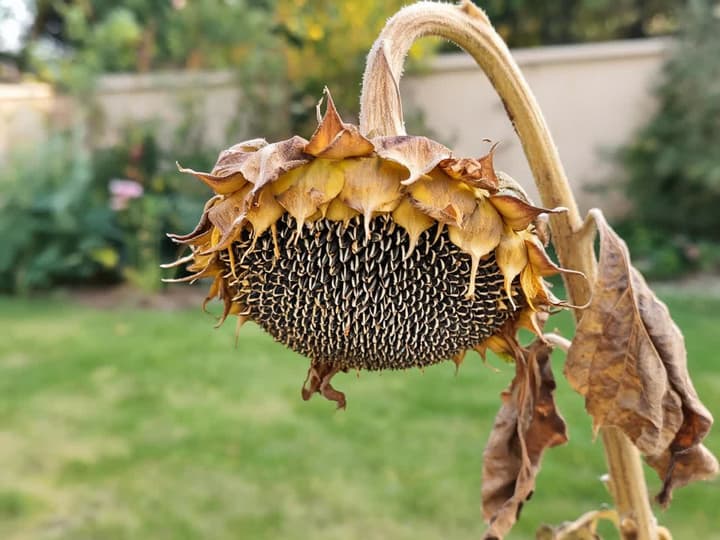
To harvest the seeds:
Wait until the back of the head turns yellow and the seeds take on a brownish tint. That is the sign of maturity given by Colorado State University.
If birds start feeding on them first, tie a perforated plastic bag over the head, as recommended by Colorado State.
Cut the head with about 30 cm of stem attached and hang it upside down in a warm, dry, well-ventilated spot. Illinois Extension notes that drying can take several weeks.
Once the head is dry, the seeds rub out easily by hand. Colorado State emphasizes that seeds must be completely dry before storage.
To keep sunflowers in bloom longer, plant them in staggered rounds. Illinois Extension recommends succession planting: sowing a few seeds every 1 to 3 weeks. That way, as one plant finishes, the next is opening its bloom.
When to plant sunflowers
Plant sunflowers when there is no longer any risk of frost and the soil has warmed up. Clemson calls for soil above 10 °C (50 °F). In the Northern Hemisphere, this happens in the spring, after the last frost. In Brazil, in the Southern Hemisphere, that same point arrives in September in the South of the country, and where it does not freeze, sowing is possible almost year-round.
Embrapa Soja records this difference in the field. In Rio Grande do Sul, sunflowers are planted as a first crop, during spring and summer. In the Central-West, they enter as a second crop (safrinha), planted after soybeans. In the Meio-Norte region, Embrapa observed less disease when flowering occurs at the end of the rainy season.
How to sow seeds:
Bury the seed 2.5 to 5 cm (1 to 2 inches) deep, as directed by Iowa State University. Place 2 or 3 seeds per hole, matching the practice of Embrapa Meio-Norte.
Keep the soil moist until seedlings emerge, which takes 1 to 2 weeks.
About 10 to 15 days after emergence, thin each spot down to the single strongest seedling, as recommended by Embrapa Meio-Norte.
In garden beds, leave about 60 cm between tall varieties, following Iowa State's spacing advice.
Sow directly in the permanent spot whenever possible. Iowa State notes that sunflower seedlings "do not transplant well." If you must start in small cups, use paper or peat pots that can be planted whole directly into the ground.
Thick-stemmed volunteer plant in your yard: is it a sunflower?
It might be. Sunflower seeds dropped from last year's flowers or spilled from bird feeders sprout readily. NC State Extension warns that sunflowers self-seed easily. Check your plant for these four signs:
Leaf: large, heart-shaped or lance-shaped, rough and hairy, with serrated margins.
Stem: thick, rough, and covered in hairs.
Bud: a green ball at the tip of the stem, surrounded by pointed leaf-like bracts.
Branching: most varieties produce a single stem with one head at the top.
Watch out for castor bean (Ricinus communis), which also pops up uninvited in empty lots and yards. Castor bean leaves are glossy and palmately lobed, shaped like an open hand with 5 to 11 lobes. Its fruit is a spiky ball.
NC State Extension rates castor bean as extremely toxic: swallowing just a few seeds can be fatal to humans. Handling the foliage can irritate skin. If the volunteer plant has hand-shaped lobed leaves, keep children and pets away and pull it out using gloves.
Sunflower pests and diseases
In gardens, the biggest sunflower troubles are birds and powdery mildew, according to Iowa State University. Powdery mildew (a fungal disease) forms a white dust on the leaves. NC State Extension adds caterpillars, slugs, snails, and beetles chewing foliage, along with leaf spot and rust.
In Brazil, Embrapa Meio-Norte identifies the sunflower patch caterpillar (Chlosyne lacinia saundersii) as the pest requiring the most attention. It is black with orange spots on its back and feeds on leaves in groups. The cucurbit beetle (Diabrotica speciosa), a small green and yellow beetle, bores holes in the leaves.
On potted plants, handpick caterpillars while wearing gloves. Pests showing up when the plant is already drying up after blooming need no treatment. Embrapa Meio-Norte notes that leaf loss at this stage no longer affects the plant.
Sunflower rust is shown in the card below:
Unidentified spots, coatings, or bugs call for diagnosis before applying any treatment. The guide what is wrong with my plant narrows down causes through 3 questions. They cover where symptoms appear, their visual pattern, and root and soil conditions.
How long cut sunflowers last in water
Cut sunflowers last about 1 to 2 weeks in a vase with water. A 2023 study published in the Canadian Journal of Plant Science evaluated cut sunflower vase life. The best result reached 13 days, when stems were held at 5 °C for 3 days before placing in water.
To help sunflower bouquets last longer:
Cut the base of each stem at a sharp angle, as recommended by Illinois Extension. An angled cut keeps the stem from resting flush against the vase bottom and improves water intake.
Strip off leaves that would sit underwater. Illinois Extension suggests removing most of the leaves.
Are sunflowers harmful to dogs or cats?
The ASPCA Animal Poison Control Center lists sunflowers as non-toxic to dogs, cats, and horses. However, the ASPCA profile gives Helianthus angustifolius as the scientific name, a different sunflower species, rather than the potted Helianthus annuus. If your pet consumed a large amount of the plant, consult a veterinarian.
Frequently asked questions
Do sunflowers bloom again after the flower dies?
No. Sunflowers are annual plants: once the bloom produces seeds, the plant dries up and dies. Branching varieties send out multiple flowers on a single stalk, one after another, but they also die at the end of their cycle. To keep blooming sunflowers around, sow new seeds every 1 to 3 weeks.
How long do potted sunflowers last?
From seed to death, a sunflower lives around 3 months. The flower on each head remains open for 10 to 15 days, according to Embrapa Meio-Norte. A sunflower purchased already in flower lasts a few weeks at home. After that, it sets seed and dries out, even with proper watering and sunlight.
Do sunflowers like sun or shade?
Sunflowers need direct sunlight. Penn State Extension advises 6 to 8 hours of sun daily for garden flowers. In the shade, sunflowers grow weak and leggy, bend toward light sources, and their blooms fade faster. A balcony or your sunniest window is the best place for a pot.
Can sunflowers stay indoors?
They can stay indoors for a few days right by a window getting direct sun. Farther into a room, light levels are too weak for sunflowers: stems stretch, lean over, and flowers wilt prematurely. If a potted sunflower sits in your living room, move it to a balcony or sunny window whenever you can.
How do you prune potted sunflowers?
Sunflowers do not require pruning. Simply snip away dry bottom leaves and dead blooms using clean shears if you do not plan to harvest seeds. Cutting the top off a single-stem sunflower will not encourage new flowers: that top bud is the plant's only flower head.
In summary
Sunflower care comes down to providing direct sun, watering based on dry soil, and embracing the plant's natural life span. Sunflowers live about 3 months, with individual blooms lasting 10 to 15 days. When the head nods down while foliage remains firm, collect the seeds and plant anew.
Sources
Ribeiro, J. L. Sunflower crop management in the Mid-North region of Brazil. Embrapa Meio-Norte, Circular Técnica 48, 2008: ainfo.cnptia.embrapa.br. Accessed on September 21, 2026.
Ungaro, M. R. G., Castro, C., Farias, J. R. B. et al. Girassol. In: Agrometeorologia dos cultivos, INMET, 2009: alice.cnptia.embrapa.br. Accessed on September 21, 2026.
Embrapa Soja, Sunflower page: embrapa.br. Accessed September 21, 2026.
Iowa State University Extension, Growing Sunflowers and Their Varieties: yardandgarden.extension.iastate.edu. Accessed on September 21, 2026.
University of Illinois Extension, How to grow sunflowers at home: extension.illinois.edu. Accessed September 21, 2026.
Clemson Cooperative Extension, Home & Garden Information Center, Let's Grow Sunflowers: hgic.clemson.edu. Accessed on September 21, 2026.
Virginia Cooperative Extension, Sunflowers: ext.vt.edu. Accessed September 21, 2026.
Colorado State University Extension, PlantTalk, Harvesting and Roasting Sunflower Seeds: planttalk.colostate.edu. Accessed on September 21, 2026.
North Carolina State Extension Gardener Plant Toolbox, Helianthus annuus and Ricinus communis profiles: plants.ces.ncsu.edu and plants.ces.ncsu.edu. Accessed on September 21, 2026.
Penn State Extension, Planting and Growing: extension.psu.edu. Accessed September 21, 2026.
Atamian, H. S. et al. Circadian regulation of sunflower heliotropism, floral orientation, and pollinator visits. Science, vol. 353, 2016: doi.org. Accessed September 21, 2026.
Whipker, B. E. and Dasoju, S. Potted sunflower growth and flowering responses to foliar applications of daminozide, paclobutrazol, and uniconazole. HortTechnology, v. 8, 1998: doi.org. Accessed September 21, 2026.
Postharvest handling and vase life of cut sunflower. Canadian Journal of Plant Science, 2023: doi.org. Accessed on September 21, 2026.
ASPCA Animal Poison Control, Sunflower entry: aspca.org. Accessed on September 21, 2026.
Related articles
How to Care for a Maidenhair Fern: Light, Water, and Revival Tips
Learn how to care for a maidenhair fern indoors: bright indirect light, consistently moist soil, high humidity, and how to revive it if it dries out completely.
How to Propagate Spider Plants: Root the Pup Before Cutting
The safest spider plant cutting comes from a pup still attached to the mother plant: rest the plantlet on soil in a small pot, wait for roots to establish, and only then cut the stolon. Learn when the pup is ready, whether rooting in water is worth it, how to divide the clump, and why plants fail to produce babies.
Banana plant fertilizer: fertilizing potted and backyard plants
Banana plant fertilizer needs more potassium than nitrogen, in a 3-1-6 ratio. For a potted plant on a balcony, use the label dose in spring and summer. In the backyard, fertilize every 2 months, adjusting the amount by mat age. Learn the formula, timing in Brazil, and signs of deficiency or excess.