Apocynaceae
Adenium (Desert Rose): Care Guide
Adenium
Full sun plant requiring infrequent watering and well-draining sandy soil. Highly drought tolerant. Enters winter dormancy with minimal water needs. SEVERELY toxic to cats, dogs, and humans — handle with gloves.
Every 12 days
Direct sun
13° - 38°C
20% - 50%
Categories
What is Desert Rose (genus)?
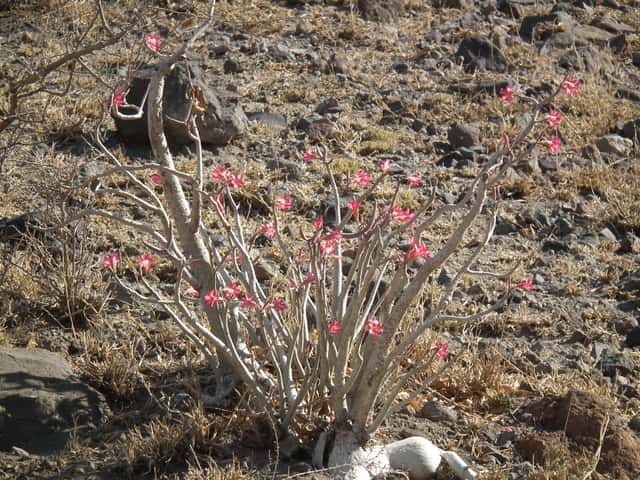
Desert Rose (genus) (Adenium) is a medium-care plant from the Apocynaceae family. Adenium is a genus of succulent shrubs and small trees native to arid regions of Africa and the Arabian Peninsula. Famous for their swollen, water-storing caudex (trunk base) and showy trumpet-shaped flowers in shades of pink, red, and white. The most widely cultivated species is A. obesum.
Desert Rose (genus) grows up to 3.0m, spread of 150cm, watering every 12 days, 13°C – 38°C, 20–50% humidity. It is suitable for indoor environments and not safe for pets.
Without precautions, ingestion can cause irritation in pets. Keep out of reach of cats and dogs. Without adequate drainage, root rot can develop within 24 days.
How to Care for Desert Rose (genus)?
TLDR: Desert Rose (genus) needs Direct sun, watering every 12 days, and temperatures between 13-38°C with 20-50% humidity.
How Often Should You Water Desert Rose (genus)?
Water every 10-14 days in summer, only when soil is completely dry. During winter dormancy, reduce to near zero — just enough to prevent caudex shriveling.
How Much Light Does Desert Rose (genus) Need?
Requires full sun — minimum 6 hours of direct sunlight daily. Indoors, place at the sunniest window available. Insufficient light prevents flowering.
What Is the Best Soil for Desert Rose (genus)?
Use cactus/succulent mix or a blend of 50% coarse sand and 50% potting soil. Excellent drainage is non-negotiable — waterlogged roots rot rapidly.
What Pot Should You Use for Desert Rose (genus)?
Terracotta or clay pots are ideal — they allow excess moisture to evaporate and help regulate root temperature. Always ensure drainage holes.
Care Schedule
Fertilize
Every 30 days
Repot
Every 730 days
What Is Desert Rose (genus) and Where Does It Come From?
Adenium is a genus of succulent shrubs and small trees native to arid regions of Africa and the Arabian Peninsula. Famous for their swollen, water-storing caudex (trunk base) and showy trumpet-shaped flowers in shades of pink, red, and white. The most widely cultivated species is A. obesum.
How to Propagate Desert Rose (genus)?
Seed propagation
Use fresh seeds for best germination rates. Avoid overwatering seedlings.
- 1 Sow in moist sandy mix
- 2 Keep at 25-30°C
- 3 Maintain slight moisture until germination (2-4 weeks)
- 4 Transplant after 2-3 months
Materials needed:
Stem cutting
Always let the cutting callous before planting to prevent rot.
- 1 Cut healthy stem 10-15 cm long
- 2 Allow cut end to dry/callous for 1-2 days
- 3 Plant in dry sandy mix
- 4 Water lightly after 1 week
Materials needed:
How Big Does Desert Rose (genus) Grow?
TLDR: Desert Rose (genus) can reach up to 3.0m tall with Slow growth rate.
Max height
3.0m
Spread
1.5m
Growth rate
Slow
Foliage
Deciduous
Warning: Toxic Plant
This plant can be toxic if ingested. Keep out of reach of:
Plant Uses
Ornamental
Great for decoration
Is your plant showing symptoms?
Click on the symptom to discover possible causes:
What Diseases Commonly Affect Desert Rose (genus)?
TLDR: Desert Rose (genus) is susceptible to 6 known diseases. Monitor regularly for early detection.
Root Rot
Root rot is a serious fungal disease that affects the root system of plants, causing them to decay and die. It is primarily caused by overwatering, poor drainage, or soil-borne fungi such as Pythium, Phytophthora, Rhizoctonia, and Fusarium. The disease thrives in waterlogged conditions where roots are deprived of oxygen, making them susceptible to fungal infection.
Overwatering
Overwatering occurs when plants receive too much water, depriving roots of oxygen and causing root rot. This environmental stress is one of the most common causes of houseplant death, as waterlogged soil prevents roots from breathing and functioning properly.
Mealybugs
Mealybugs are small, soft-bodied insects covered with a white, waxy, cottony material. They are common pests of houseplants and outdoor plants in mild climates. These sap-sucking insects feed on plant tissue, causing damage, stunted growth, and can lead to plant death if left untreated. They produce sticky honeydew which attracts sooty mold.
Scale Insects
Scale insects are small sap-sucking pests that appear as brown, shell-like bumps on plant stems and leaves. There are over 25 species, divided into armored (hard) and unarmored (soft) scales. They feed by piercing plant tissue and extracting sap, which weakens the plant and can lead to yellowing, stunted growth, and even death if left untreated. They also excrete honeydew, which attracts ants and promotes sooty mold growth.
Meaning & Symbolism
Resilience, beauty in adversity, perseverance.
Fun Facts
Adenium sap has been historically used as arrow poison in parts of Africa due to its cardiac glycosides.
The swollen caudex stores water and nutrients, allowing the plant to survive months of drought.
Adeniums can live for decades, developing sculptural caudexes that resemble living bonsai.
In Thailand and tropical Asia, Adeniums are prized as collector plants with thousands of named hybrid varieties.
Frequently asked questions
How often should I water Adenium?
Is Adenium toxic to pets?
Can Adenium grow indoors?
Why is my Adenium dropping leaves?
What is the best soil for Adenium?
Compare with similar plants
| Attribute | Difficulty | Light | Watering | Pet Safe |
|---|---|---|---|---|
| Dark Fieldcap | Medium | Low light | 2d | ⚠️ |
| Azalea | Medium | Partial shade | 3d | ⚠️ |
| Bougainvillea | Medium | Direct sun | 7d | ⚠️ |
| Wild Lettuce | Medium | Direct sun | 7d | ⚠️ |



