Asteraceae
String of Pearls: Low Water Needs
Senecio rowleyanus
A drought-tolerant succulent that thrives with bright indirect light and infrequent watering. Allow soil to dry completely between waterings. Keep humidity low (below 40%) and maintain temperatures between 18-29°C. Avoid misting as it can cause disease.
Every 14 days
Bright indirect
18° - 29°C
30% - 40%
Categories
What is String of Pearls?
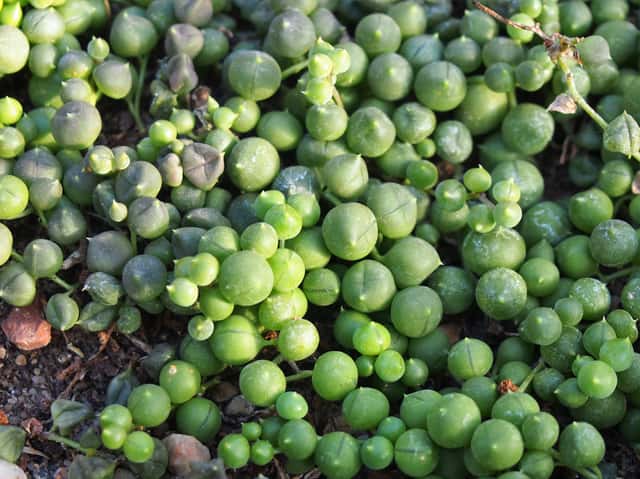
String of Pearls (Senecio rowleyanus) is a medium-care plant from the Asteraceae family. String of Pearls is a unique trailing succulent native to South Africa, featuring long, slender stems adorned with small, spherical bead-like leaves that resemble a string of green pearls. These modified leaves have evolved to store water, allowing the plant to thrive in arid conditions. It belongs...
String of Pearls grows up to 60cm, spread of 90cm, watering every 14 days, 18°C – 29°C, 30–40% humidity. It is suitable for indoor environments and not safe for pets.
Without precautions, ingestion can cause irritation in pets. Keep out of reach of cats and dogs. Without adequate drainage, root rot can develop within 28 days.
How to Care for String of Pearls?
TLDR: String of Pearls needs Bright indirect, watering every 14 days, and temperatures between 18-29°C with 30-40% humidity.
How Often Should You Water String of Pearls?
Use the soak and dry method - water thoroughly when soil is completely dry, then wait until it dries out again. Water weekly in spring/summer, every 2-3 weeks in winter. Overwatering causes root rot.
How Much Light Does String of Pearls Need?
Provide bright indirect light. South or west-facing windows are ideal. Avoid harsh midday direct sun which can scorch the beads. Use grow lights if natural light is insufficient.
What Is the Best Soil for String of Pearls?
Use well-draining cactus or succulent mix with extra perlite or coarse sand. A 1:1 ratio of cactus mix and perlite works well. Choose shallow pots with drainage holes - clay pots are preferred.
What Pot Should You Use for String of Pearls?
Use shallow clay or terracotta pots with drainage holes. Clay allows evaporation through sides, preventing overwatering. Hanging baskets showcase the trailing habit beautifully.
Care Schedule
Fertilize
Every 28 days
Repot
Every 730 days
What Is String of Pearls and Where Does It Come From?
String of Pearls is a unique trailing succulent native to South Africa, featuring long, slender stems adorned with small, spherical bead-like leaves that resemble a string of green pearls. These modified leaves have evolved to store water, allowing the plant to thrive in arid conditions. It belongs to the Asteraceae family and is popular as a hanging houseplant.
How to Propagate String of Pearls?
Stem cuttings
The layering method is most effective - coil cuttings on soil
- 1 Cut a healthy stem 4-5 inches long
- 2 Let the cut end callous for 1-2 days
- 3 Place stem on moist succulent soil
- 4 Coil or lay flat on soil surface
- 5 Mist lightly and wait for roots (2-3 weeks)
Materials needed:
Water propagation
Ensure good light during rooting
- 1 Take 4-5 inch stem cuttings
- 2 Place in water with nodes submerged
- 3 Change water weekly
- 4 Wait until roots are 1 inch long
- 5 Transfer to soil
Materials needed:
How Big Does String of Pearls Grow?
TLDR: String of Pearls can reach up to 60cm tall with Fast growth rate.
Max height
60cm
Spread
90cm
Growth rate
Fast
Foliage
Evergreen
Warning: Toxic Plant
This plant can be toxic if ingested. Keep out of reach of:
Plant Uses
Ornamental
Great for decoration
Is your plant showing symptoms?
Click on the symptom to discover possible causes:
What Diseases Commonly Affect String of Pearls?
TLDR: String of Pearls is susceptible to 26 known diseases. Monitor regularly for early detection.
Root Rot
Root rot is a serious fungal disease that affects the root system of plants, causing them to decay and die. It is primarily caused by overwatering, poor drainage, or soil-borne fungi such as Pythium, Phytophthora, Rhizoctonia, and Fusarium. The disease thrives in waterlogged conditions where roots are deprived of oxygen, making them susceptible to fungal infection.
Crown Rot
Crown rot is a serious fungal disease that attacks the crown (base) of the plant where the stem meets the soil. It is caused by various fungal pathogens including Phytophthora, Fusarium, and Rhizoctonia. The disease thrives in waterlogged conditions and can quickly spread to kill the entire plant if not addressed promptly.
Pythium Root Rot
Pythium root rot is a serious fungal disease caused by various Pythium species including P. aphanidermatum, P. ultimum, and P. irregulare. These water molds are present in practically all cultivated soils and attack plant roots under wet conditions, causing rapid wet rot that can extend into the stem. The disease is favored by poor drainage, overwatering, and specific temperatures depending on the species.
Phytophthora Root Rot
Disease caused by fungus-like organisms (oomycetes) that live in soil and can survive for years. It affects roots, stem, and crown of plants, being especially severe in waterlogged or poorly drained soils. It is the second most common cause of root rot in trees and shrubs.
Meaning & Symbolism
Symbolizes uniqueness and unconventional beauty due to its distinctive bead-like appearance.
Compare with similar plants
| Attribute | Difficulty | Light | Watering | Pet Safe |
|---|---|---|---|---|
| Dark Fieldcap | Medium | Low light | 2d | ⚠️ |
| Azalea | Medium | Partial shade | 3d | ⚠️ |
| Bougainvillea | Medium | Direct sun | 7d | ⚠️ |
| Cushion Bush | Easy | Direct sun | 14d | ✓ |




