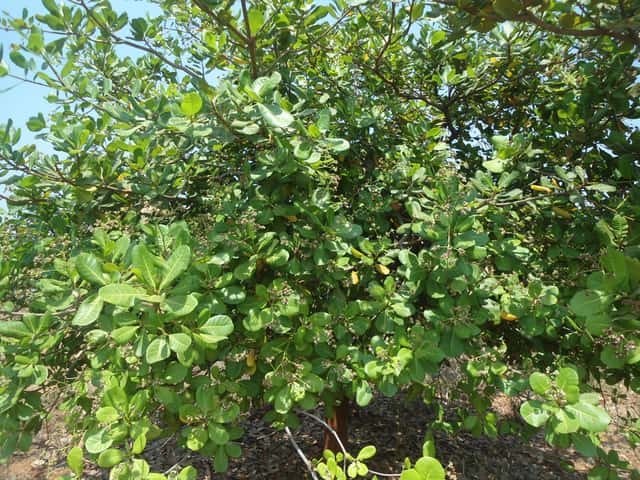
Anacardiaceae
Cashew Tree (Anacardium occidentale): Complete Growing Guide
Anacardium occidentale
Hardy and drought-tolerant once established. Requires full sun and well-draining soil. Water sparingly for mature trees (every 2 weeks). Fertilize quarterly during active growth. Light pruning to shape canopy and remove dead wood.
Every 14 days
Direct sun
18° - 38°C
50% - 80%
Categories
What is Cashew?
Cashew (Anacardium occidentale) is a medium-care plant from the Anacardiaceae family. The cashew tree (Anacardium occidentale) is a tropical fruit tree native to northeastern Brazil, now cultivated worldwide in over 30 countries. It produces the cashew apple (a fleshy pseudofruit) and the cashew nut — one of the world's most popular snacks. Trees can grow up to 20 meters tall with a...
Cashew grows up to 20.0m, spread of 1200cm, watering every 14 days, 18°C – 38°C, 50–80% humidity. It is not suitable for indoor environments and safe for pets.
Unlike many popular species, Cashew is safe to keep around pets.
How to Care for Cashew?
TLDR: Cashew needs Direct sun, watering every 14 days, and temperatures between 18-38°C with 50-80% humidity.
How Often Should You Water Cashew?
Water mature trees every 14 days. Newly planted trees need watering every 3 days for the first 2 months. Avoid waterlogging — roots are sensitive to overwatering. Increase frequency during extreme drought.
How Much Light Does Cashew Need?
Requires full direct sunlight — minimum 6 hours per day. Does not tolerate shade. Best suited for open gardens, rural areas and tropical landscapes with full sun exposure.
What Is the Best Soil for Cashew?
Prefers well-draining, slightly acidic soil (pH 5.5–6.5). Tolerates sandy, nutrient-poor soils typical of tropical coastal regions. Add organic compost at planting for better early development.
What Pot Should You Use for Cashew?
Not suitable for container growing. The cashew tree is a large tree that can reach 20 meters with a deep taproot system. It must be planted directly in the ground with at least 7 meters of spacing.
Care Schedule
Fertilize
Every 90 days
What Is Cashew and Where Does It Come From?
The cashew tree (Anacardium occidentale) is a tropical fruit tree native to northeastern Brazil, now cultivated worldwide in over 30 countries. It produces the cashew apple (a fleshy pseudofruit) and the cashew nut — one of the world's most popular snacks. Trees can grow up to 20 meters tall with a dense, spreading canopy. Small pink-white flowers bloom in the dry season, attracting bees and birds. The raw shell contains urushiol (a skin irritant related to poison ivy), but roasted cashew nuts are completely safe to eat.
How to Propagate Cashew?
Direct seeding
The seed of the cashew tree is the nut itself. Use fresh, unroasted nuts only. Avoid transplanting once established, as the taproot grows deep quickly and is highly sensitive to disturbance.
- 1 Select fresh, healthy cashew nuts from productive trees
- 2 Plant directly in the final location at 5 cm depth
- 3 Keep soil moist for the first 15 days until germination
- 4 Transplant only if necessary, keeping the root ball intact
Materials needed:
Grafting
Grafting ensures the characteristics of the parent clone are maintained, resulting in earlier fruiting and higher productivity compared to seed-grown trees.
- 1 Select a vigorous 6-month-old rootstock
- 2 Perform cleft or bud grafting at the top of the rootstock
- 3 Wrap with grafting tape and keep in partial shade
- 4 Once bud breaks, remove wrapping and gradually expose to full sun
Materials needed:
How Big Does Cashew Grow?
TLDR: Cashew can reach up to 20.0m tall with Fast growth rate.
Max height
20.0m
Spread
12.0m
Growth rate
Fast
Foliage
Evergreen
Warning: Toxic Plant
This plant can be toxic if ingested. Keep out of reach of:
Plant Uses
Edible
Can be consumed
Ornamental
Great for decoration
Medicinal
Medicinal properties
Medicinal Uses
- Bark and leaves used in folk medicine to treat diabetes, infections and inflammation
- Cashew Nut Shell Liquid (CNSL) has antimicrobial and anti-inflammatory properties
- Leaf tea used for blood sugar control in traditional communities
Culinary Uses
- Fresh cashew apple — eaten raw or juiced
- Roasted cashew nuts — worldwide popular snack
- Cashew wine, cashew vinegar, cajuína (traditional Brazilian fermented drink)
- Cashew nuts used in cooking: sauces, desserts, vegan cuisine, nut butter
Is your plant showing symptoms?
Click on the symptom to discover possible causes:
What Diseases Commonly Affect Cashew?
TLDR: Cashew is susceptible to 12 known diseases. Monitor regularly for early detection.
Anthracnose
Anthracnose is a fungal disease caused by fungi in the genus Colletotrichum that affects many plants, including vegetables, fruits, and trees. The disease thrives in cool, wet conditions, causing dark, sunken lesions on leaves, stems, flowers, and fruits.
Powdery Mildew
Powdery mildew is a common fungal disease caused by various fungi species including Erysiphe, Podosphaera, Oïdium, and Leveillula. It affects over 10,000 plant species worldwide. The disease thrives in warm, dry climates with high humidity and appears as a distinctive white powdery coating on plant surfaces.
Thrips
Thrips are tiny cigar-shaped insects (1/25-inch long) that damage plants by sucking plant juices and scraping at fruits, flowers, and leaves. With over 6,000 species and rapid reproduction (lifecycle as short as 14 days), they can quickly infest plants and transmit viruses like tomato spotted wilt virus.
Bacterial Leaf Spot
Bacterial leaf spot is a plant disease caused by bacteria in the Xanthomonas and Pseudomonas genera that affects various ornamental and edible plants. The bacteria infect leaves through wounds or natural openings, causing characteristic lesions that can lead to premature leaf drop and plant weakening.
Meaning & Symbolism
In Brazil, the cashew tree symbolizes resilience, generosity and the richness of tropical culture, especially in the northeastern semi-arid region.
Fun Facts
The world's largest cashew tree is in Pirangi, Brazil, covering 8,400 m² — larger than a football pitch
Brazil is the world's third-largest cashew nut producer
The cashew 'fruit' we eat is technically a pseudofruit; the true botanical fruit is the nut
A dwarf cashew tree can produce up to 80 cashew apples per year from its second year of life
Frequently asked questions
How often should I water a cashew tree?
Can cashew trees grow in containers?
Are raw cashews toxic?
When does a cashew tree start producing fruit?
What are the main diseases of the cashew tree?
Compare with similar plants
| Attribute | Difficulty | Light | Watering | Pet Safe |
|---|---|---|---|---|
| Dark Fieldcap | Medium | Low light | 2d | ⚠️ |
| Azalea | Medium | Partial shade | 3d | ⚠️ |
| Bougainvillea | Medium | Direct sun | 7d | ⚠️ |
| Wild Lettuce | Medium | Direct sun | 7d | ⚠️ |




