Rosaceae
Japanese Cherry Blossom: Edible Plant
Prunus serrulata
Requires full sun to bloom well and fertile soil with excellent drainage. It needs a period of winter chill to break the dormancy of the flower buds.
Every 7 days
Direct sun
-15° - 30°C
40% - 70%
Categories
What is Japanese Cherry Blossom?
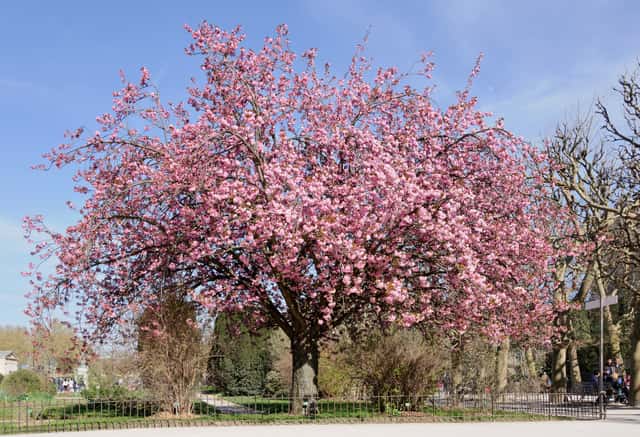
Japanese Cherry Blossom (Prunus serrulata) is a medium-care plant from the Rosaceae family. Prunus serrulata, widely known as Sakura or Japanese Cherry Blossom, is a deciduous tree of incomparable beauty, native to Japan, Korea, and China. It is famous for its ephemeral and exuberant blooming that occurs in early spring, covering bare branches with dense clusters of pink or white flowers....
Japanese Cherry Blossom grows up to 5.0m, spread of 600cm, watering every 7 days, -15°C – 30°C, 40–70% humidity. It is not suitable for indoor environments and not safe for pets.
Without precautions, ingestion can cause irritation in pets. Keep out of reach of cats and dogs.
How to Care for Japanese Cherry Blossom?
TLDR: Japanese Cherry Blossom needs Direct sun, watering every 7 days, and temperatures between -15-30°C with 40-70% humidity.
How Often Should You Water Japanese Cherry Blossom?
Water young trees regularly; established trees tolerate short periods of drought but prefer consistent moisture.
How Much Light Does Japanese Cherry Blossom Need?
Plant in a location with direct sun exposure for at least 6 to 8 hours daily to ensure dense flowering.
What Is the Best Soil for Japanese Cherry Blossom?
Avoid heavy clay soils that retain too much moisture, as the roots are sensitive to rot.
What Pot Should You Use for Japanese Cherry Blossom?
Not recommended for permanent pots; it should be planted directly in the ground to reach its full potential.
Care Schedule
Fertilize
Every 60 days
What Is Japanese Cherry Blossom and Where Does It Come From?
Prunus serrulata, widely known as Sakura or Japanese Cherry Blossom, is a deciduous tree of incomparable beauty, native to Japan, Korea, and China. It is famous for its ephemeral and exuberant blooming that occurs in early spring, covering bare branches with dense clusters of pink or white flowers. Its serrated leaves emerge after the flowers and take on bronze tones before turning green, eventually becoming yellow or reddish in the fall.
How to Propagate Japanese Cherry Blossom?
Grafting
- Keep cutting tools extremely sharp and sterilized.
- Winter grafting (cleft grafting) is the most common for this species.
- 1 Rootstock Selection
Choose a healthy and compatible wild cherry sapling.
- 2 Scion Cutting
Cut a young branch of Prunus serrulata with dormant buds.
- 3 Joining
Make a cleft cut in the rootstock and insert the scion, aligning the cambium.
- 4 Protection
Seal the union with grafting tape and wax to prevent dehydration.
Materials needed:
Seeds
- Seeds may not produce plants identical to the parent plant due to hybridization.
- Stratification simulates the winter necessary for germination.
- 1 Cleaning
Remove the fruit pulp and wash the seeds thoroughly.
- 2 Cold Stratification
Place the seeds in moist sand in the refrigerator for 90 to 120 days.
- 3 Planting
Sow in light substrate after the cold period.
Materials needed:
How Big Does Japanese Cherry Blossom Grow?
TLDR: Japanese Cherry Blossom can reach up to 5.0m tall with Medium growth rate.
Max height
5.0m
Spread
6.0m
Growth rate
Medium
Foliage
Deciduous
Warning: Toxic Plant
This plant can be toxic if ingested. Keep out of reach of:
Plant Uses
Ornamental
Great for decoration
Edible
Can be consumed
Culinary Uses
- Pickled flowers (Sakurazuke)
- Salted leaves for wrapping sweets (Sakuramochi)
Is your plant showing symptoms?
Click on the symptom to discover possible causes:
What Diseases Commonly Affect Japanese Cherry Blossom?
TLDR: Japanese Cherry Blossom is susceptible to 14 known diseases. Monitor regularly for early detection.
Aphids
Aphids are small, soft-bodied, pear-shaped insects (1/16 to 1/8 inch long) that feed by sucking nutrient-rich sap from plants. They reproduce rapidly and can quickly weaken plants, causing distorted growth and transmitting plant viruses. Aphids come in various colors including green, black, red, yellow, brown, and gray. They secrete honeydew, a sticky substance that attracts ants and encourages sooty mold growth.
Scale Insects
Scale insects are small sap-sucking pests that appear as brown, shell-like bumps on plant stems and leaves. There are over 25 species, divided into armored (hard) and unarmored (soft) scales. They feed by piercing plant tissue and extracting sap, which weakens the plant and can lead to yellowing, stunted growth, and even death if left untreated. They also excrete honeydew, which attracts ants and promotes sooty mold growth.
Leaf Curl Virus
Leaf curl virus is a serious viral disease caused by begomoviruses, transmitted by whiteflies (Bemisia tabaci). It affects various plants including tomatoes, peppers, and ornamentals, causing significant yield losses and plant decline. Once infected, plants cannot be cured and management focuses on prevention and vector control.
Bacterial Canker
Serious bacterial disease affecting stone fruits and tomatoes caused by Pseudomonas syringae or Clavibacter michiganensis. Creates sunken lesions that ooze sap.
Meaning & Symbolism
Symbolizes renewal, hope, and the ephemeral nature of life (Mono no aware).
Compare with similar plants
| Attribute | Difficulty | Light | Watering | Pet Safe |
|---|---|---|---|---|
| Dark Fieldcap | Medium | Low light | 2d | ⚠️ |
| Azalea | Medium | Partial shade | 3d | ⚠️ |
| Bougainvillea | Medium | Direct sun | 7d | ⚠️ |
| Wild Lettuce | Medium | Direct sun | 7d | ⚠️ |



