Onagraceae
Honeysuckle Fuchsia (Fuchsia triphylla): Complete Care Guide
Fuchsia triphylla
Grow in bright indirect light with consistently moist, well-drained soil. Provide high humidity and keep temperatures between 50-75°F. Fertilize every 3 weeks during the growing season and prune lightly after flowering to encourage new growth.
Every 7 days
Partial shade
10° - 24°C
60% - 80%
Categories
What is Honeysuckle Fuchsia?
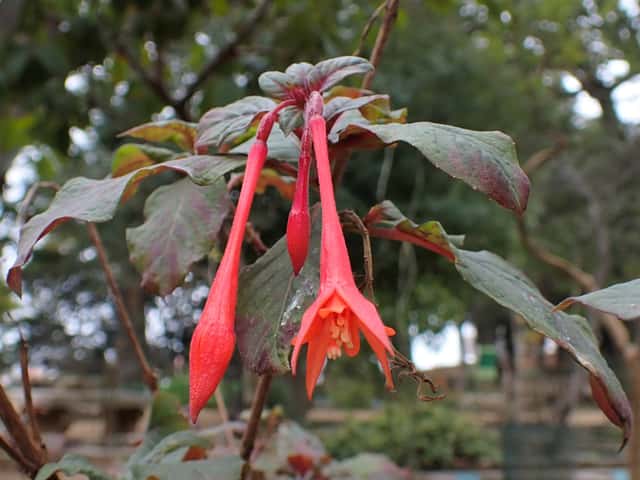
Honeysuckle Fuchsia (Fuchsia triphylla) is a medium-care plant from the Onagraceae family. Honeysuckle Fuchsia (Fuchsia triphylla) is a striking ornamental plant native to the Caribbean island of Hispaniola. It produces long, tubular orange-red flowers in pendant clusters that are irresistible to hummingbirds. The dark green leaves with bronze undertones provide an elegant backdrop for it...
Honeysuckle Fuchsia grows up to 60cm, spread of 60cm, watering every 7 days, 10°C – 24°C, 60–80% humidity. It is suitable for indoor environments and safe for pets.
Unlike many popular species, Honeysuckle Fuchsia is safe to keep around pets. Without adequate drainage, root rot can develop within 14 days.
How to Care for Honeysuckle Fuchsia?
TLDR: Honeysuckle Fuchsia needs Partial shade, watering every 7 days, and temperatures between 10-24°C with 60-80% humidity.
How Often Should You Water Honeysuckle Fuchsia?
Water weekly, keeping soil evenly moist but never waterlogged. Avoid wetting foliage to prevent fungal issues. Reduce watering in winter during dormancy.
How Much Light Does Honeysuckle Fuchsia Need?
Place in bright indirect light or dappled shade with 2-6 hours of morning sun. Protect from harsh afternoon sun. Near east or north-facing windows is ideal indoors.
What Is the Best Soil for Honeysuckle Fuchsia?
Use rich, well-draining soil with a pH of 6.0-8.0. A mix of quality potting soil with perlite ensures good drainage while retaining adequate moisture.
What Pot Should You Use for Honeysuckle Fuchsia?
Clay or ceramic pots with drainage holes are ideal. Hanging baskets beautifully showcase the pendulous flowers in their most natural, spectacular form.
Care Schedule
Fertilize
Every 21 days
Misting
Every 3 days
Rotate
Every 30 days
Repot
Every 365 days
What Is Honeysuckle Fuchsia and Where Does It Come From?
Honeysuckle Fuchsia (Fuchsia triphylla) is a striking ornamental plant native to the Caribbean island of Hispaniola. It produces long, tubular orange-red flowers in pendant clusters that are irresistible to hummingbirds. The dark green leaves with bronze undertones provide an elegant backdrop for its vivid blooms, making it a prized choice for hanging baskets, containers, and shaded garden borders.
How to Propagate Honeysuckle Fuchsia?
Stem Cutting
Use clean, sharp tools. Maintain high humidity by covering with a clear plastic bag. Change water every 2-3 days if using the water method.
- 1 Cut a healthy stem with 2-3 pairs of leaves just below a node
- 2 Remove lower leaves and dip the base in rooting hormone
- 3 Plant in moist, well-draining medium or place in water until roots emerge
- 4 Keep in a warm location with bright indirect light
- 5 Transplant to a permanent pot after 3-4 weeks when roots are 2-3 cm long
Materials needed:
Seeds
Seed propagation is slower and less predictable. Stem cuttings are strongly recommended for faster, more reliable results.
- 1 Sow seeds in fine, moist seed-starting mix at 70-75°F
- 2 Cover lightly and keep consistently moist
- 3 Wait for germination in 21-28 days
- 4 Transplant seedlings once they have 2-3 sets of true leaves
Materials needed:
How Big Does Honeysuckle Fuchsia Grow?
TLDR: Honeysuckle Fuchsia can reach up to 60cm tall with Medium growth rate.
Max height
60cm
Spread
60cm
Growth rate
Medium
Foliage
Semi-evergreen
Plant Uses
Ornamental
Great for decoration
Is your plant showing symptoms?
Click on the symptom to discover possible causes:
What Diseases Commonly Affect Honeysuckle Fuchsia?
TLDR: Honeysuckle Fuchsia is susceptible to 8 known diseases. Monitor regularly for early detection.
Whiteflies
Whiteflies are small, soft-bodied, winged insects closely related to aphids and mealybugs. They are moth-like in appearance, about 1/16 inch long, triangular in shape, and gray-white in color. These sap-sucking pests feed on plant tissue, causing yellowing, stunted growth, and wilting. They also excrete honeydew, which attracts ants and promotes sooty mold growth. Whiteflies can transmit serious plant viruses.
Aphids
Aphids are small, soft-bodied, pear-shaped insects (1/16 to 1/8 inch long) that feed by sucking nutrient-rich sap from plants. They reproduce rapidly and can quickly weaken plants, causing distorted growth and transmitting plant viruses. Aphids come in various colors including green, black, red, yellow, brown, and gray. They secrete honeydew, a sticky substance that attracts ants and encourages sooty mold growth.
Spider Mites
Spider mites are tiny arachnids (less than 1/20 inch long) related to spiders and ticks that feed on plant sap. They thrive in hot, dry conditions and can cause significant damage to ornamental and vegetable plants. During severe infestations, crop losses can reach 14% or higher as these pests disrupt vital plant processes including photosynthesis, carbon dioxide absorption, and transpiration.
Gray Mold (Botrytis Blight)
Gray mold, caused by the fungus Botrytis cinerea, is one of the most common fungal diseases in plants. It affects over 200 plant species, including ornamentals, vegetables, fruits, and houseplants. The disease thrives in cool, humid conditions with poor air circulation, causing grayish spots and soft rot on infected tissues.
Meaning & Symbolism
Elegance, passionate love, and delicate grace
Fun Facts
It is the type species of the Fuchsia genus, first described in 1703 by botanist Charles Plumier on the island of Hispaniola
Its tubular orange-red flowers are perfectly adapted for hummingbird pollination, one of the few fuchsias with this distinct characteristic
The epithet "triphylla" means "three leaves" in Latin, referring to the leaves arranged in whorls of three along the stems
Unlike most fuchsias, Fuchsia triphylla is notably resistant to fuchsia rust, one of the most feared diseases of the genus
Frequently asked questions
How often should I water Honeysuckle Fuchsia?
Is Honeysuckle Fuchsia toxic to pets?
Why has my Fuchsia stopped blooming?
Can I grow Honeysuckle Fuchsia indoors?
How do I propagate Honeysuckle Fuchsia?
Compare with similar plants
| Attribute | Difficulty | Light | Watering | Pet Safe |
|---|---|---|---|---|
| Dark Fieldcap | Medium | Low light | 2d | ⚠️ |
| Azalea | Medium | Partial shade | 3d | ⚠️ |
| Bougainvillea | Medium | Direct sun | 7d | ⚠️ |
| Wild Lettuce | Medium | Direct sun | 7d | ⚠️ |



