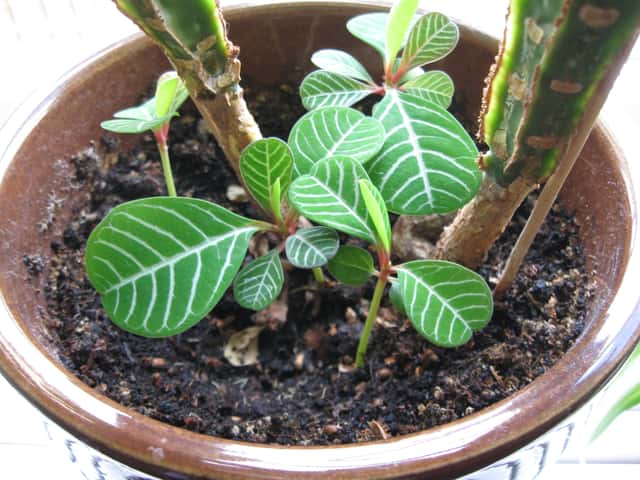
Euphorbiaceae
Madagascar Jewel (Euphorbia leuconeura) — Complete Care Guide
Euphorbia leuconeura
Madagascar Jewel is a low-maintenance plant suited to bright indirect light. Water every 7-14 days, allowing the top inch of soil to dry between waterings. Use well-draining soil and avoid waterlogging. Keep above 14°C and fertilize monthly in spring and summer.
Every 10 days
Partial shade
14° - 32°C
30% - 60%
Categories
What is Madagascar Jewel?
Madagascar Jewel (Euphorbia leuconeura) is a medium-care plant from the Euphorbiaceae family. Euphorbia leuconeura, commonly known as Madagascar Jewel, is a striking semi-succulent houseplant native to Madagascar. It features an upright, angular stem with attractive white-veined leaves that give it an exotic appearance. As a member of the Euphorbiaceae family, it produces a toxic milky sap a...
Madagascar Jewel grows up to 1.5m, spread of 60cm, watering every 10 days, 14°C – 32°C, 30–60% humidity. It is suitable for indoor environments and not safe for pets.
Without precautions, ingestion can cause irritation in pets. Keep out of reach of cats and dogs. Without adequate drainage, root rot can develop within 20 days.
How to Care for Madagascar Jewel?
TLDR: Madagascar Jewel needs Partial shade, watering every 10 days, and temperatures between 14-32°C with 30-60% humidity.
How Often Should You Water Madagascar Jewel?
Water thoroughly every 10 days in spring and summer, allowing the top 2-3 cm of soil to dry out first. Reduce to every 14-20 days in autumn and winter. Always empty the saucer after watering to prevent root rot.
How Much Light Does Madagascar Jewel Need?
Place in a bright spot with indirect light — an east or north-facing window is ideal. Avoid harsh afternoon direct sun which can scorch the leaves. The plant will naturally lean toward the light source, so rotate regularly.
What Is the Best Soil for Madagascar Jewel?
Use a well-draining mix: combine standard potting soil with perlite or coarse sand (2:1 ratio), or use a cactus/succulent mix. Ensure the pot has drainage holes. Add a layer of expanded clay at the bottom for extra drainage.
What Pot Should You Use for Madagascar Jewel?
Terracotta pot with drainage hole — excellent moisture regulation prevents root rot. Choose a pot only slightly larger than the root ball.
Care Schedule
Fertilize
Every 30 days
Rotate
Every 21 days
Repot
Every 730 days
What Is Madagascar Jewel and Where Does It Come From?
Euphorbia leuconeura, commonly known as Madagascar Jewel, is a striking semi-succulent houseplant native to Madagascar. It features an upright, angular stem with attractive white-veined leaves that give it an exotic appearance. As a member of the Euphorbiaceae family, it produces a toxic milky sap and can explosively disperse its seeds several metres away — a remarkable adaptation known as ballochory.
How to Propagate Madagascar Jewel?
Seed propagation
Seeds are self-dispersed explosively — cover ripening pods with a mesh bag to collect them. Keep substrate moist but not soggy during germination.
- 1 Collect seeds from the explosive seed pods (use a bag over the pod to catch them)
- 2 Sow seeds on the surface of moist, well-draining substrate
- 3 Cover lightly and maintain at 20°C
- 4 Seeds germinate in 3-4 weeks
- 5 Transplant seedlings once they have 2-3 sets of leaves
Materials needed:
Stem cutting
Always wear gloves when handling cuttings — the milky sap is a skin irritant. Do not water until roots have established (4-6 weeks).
- 1 Cut a healthy stem section of approximately 10 cm
- 2 Allow the cut end to dry for 24 hours to prevent sap bleeding
- 3 Dip in rooting hormone powder
- 4 Insert into slightly moist, well-draining substrate
- 5 Maintain at 22-25°C in bright indirect light
Materials needed:
How Big Does Madagascar Jewel Grow?
TLDR: Madagascar Jewel can reach up to 1.5m tall with Medium growth rate.
Max height
1.5m
Spread
60cm
Growth rate
Medium
Foliage
Evergreen
Warning: Toxic Plant
This plant can be toxic if ingested. Keep out of reach of:
Plant Uses
Ornamental
Great for decoration
Is your plant showing symptoms?
Click on the symptom to discover possible causes:
What Diseases Commonly Affect Madagascar Jewel?
TLDR: Madagascar Jewel is susceptible to 5 known diseases. Monitor regularly for early detection.
Root Rot
Root rot is a serious fungal disease that affects the root system of plants, causing them to decay and die. It is primarily caused by overwatering, poor drainage, or soil-borne fungi such as Pythium, Phytophthora, Rhizoctonia, and Fusarium. The disease thrives in waterlogged conditions where roots are deprived of oxygen, making them susceptible to fungal infection.
Overwatering
Overwatering occurs when plants receive too much water, depriving roots of oxygen and causing root rot. This environmental stress is one of the most common causes of houseplant death, as waterlogged soil prevents roots from breathing and functioning properly.
Mealybugs
Mealybugs are small, soft-bodied insects covered with a white, waxy, cottony material. They are common pests of houseplants and outdoor plants in mild climates. These sap-sucking insects feed on plant tissue, causing damage, stunted growth, and can lead to plant death if left untreated. They produce sticky honeydew which attracts sooty mold.
Spider Mites
Spider mites are tiny arachnids (less than 1/20 inch long) related to spiders and ticks that feed on plant sap. They thrive in hot, dry conditions and can cause significant damage to ornamental and vegetable plants. During severe infestations, crop losses can reach 14% or higher as these pests disrupt vital plant processes including photosynthesis, carbon dioxide absorption, and transpiration.
Meaning & Symbolism
Resilience and exotic beauty; its distinctive white-veined leaves symbolize elegance and uniqueness among plant enthusiasts.
Fun Facts
Euphorbia leuconeura can shoot its seeds several metres away using an explosive seed-dispersal mechanism called ballochory.
Despite resembling a cactus, it is not a succulent — it belongs to the Euphorbiaceae family, the same as poinsettias.
The plant is self-pollinating and will readily self-seed indoors if conditions are right.
Its angular, twisted woody trunk stores water, allowing it to survive short periods of drought.
Frequently asked questions
How often should I water Madagascar Jewel?
Is Madagascar Jewel toxic to pets?
Why are the leaves of my Madagascar Jewel turning yellow?
How much light does Madagascar Jewel need?
Why is it called the Spitting Palm?
Compare with similar plants
| Attribute | Difficulty | Light | Watering | Pet Safe |
|---|---|---|---|---|
| Dark Fieldcap | Medium | Low light | 2d | ⚠️ |
| Azalea | Medium | Partial shade | 3d | ⚠️ |
| Bougainvillea | Medium | Direct sun | 7d | ⚠️ |
| Wild Lettuce | Medium | Direct sun | 7d | ⚠️ |



