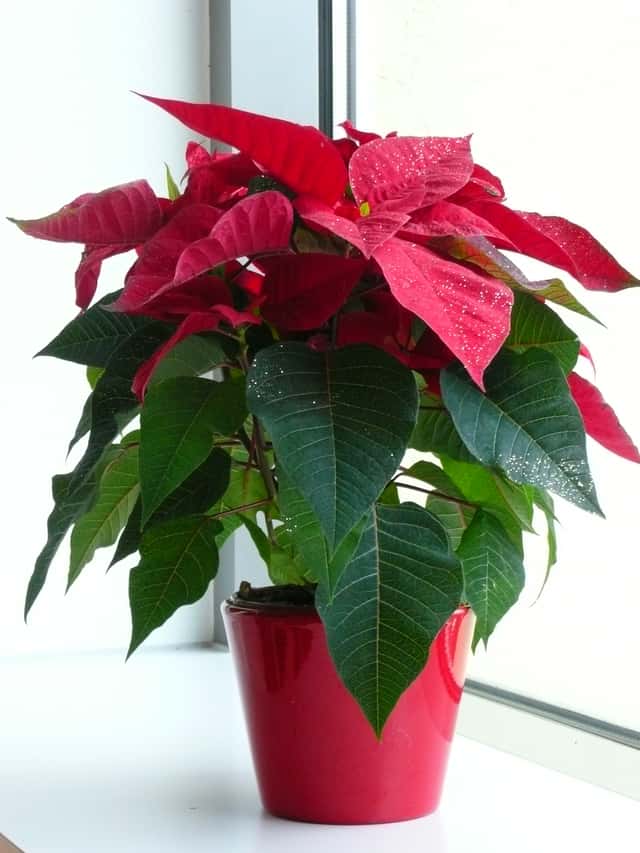
Euphorbiaceae
Poinsettia: Complete Care Guide
Euphorbia pulcherrima
A medium-difficulty plant that prefers bright indirect light and moderate watering. Avoid waterlogging and keep temperatures between 15-25°C (59-77°F). In winter, it needs 12 hours of darkness to rebloom.
Every 7 days
Partial shade
15° - 25°C
50% - 70%
Categories
What is Poinsettia?
Poinsettia (Euphorbia pulcherrima) is a medium-care plant from the Euphorbiaceae family. Euphorbia pulcherrima, commonly known as the poinsettia, is a tropical shrub native to Mexico and Central America. Celebrated for its vibrant colored bracts that appear in winter, it is the quintessential Christmas plant worldwide. It can grow up to 2 meters tall when planted outdoors in warm climat...
Poinsettia grows up to 2.0m, spread of 100cm, watering every 7 days, 15°C – 25°C, 50–70% humidity. It is suitable for indoor environments and not safe for pets.
Without precautions, ingestion can cause irritation in pets. Keep out of reach of cats and dogs. Without adequate drainage, root rot can develop within 14 days.
How to Care for Poinsettia?
TLDR: Poinsettia needs Partial shade, watering every 7 days, and temperatures between 15-25°C with 50-70% humidity.
How Often Should You Water Poinsettia?
Water when the top of the soil feels dry to the touch. Reduce frequency in winter. Never let the plant sit in standing water, as this leads to root rot.
How Much Light Does Poinsettia Need?
Place in bright indirect light. Avoid intense direct sun, which can fade the bracts. To rebloom, provide 12 hours of uninterrupted darkness daily for 6-8 weeks.
What Is the Best Soil for Poinsettia?
Use a well-draining, slightly acidic mix. A combination of peat moss, perlite, and organic matter works well. Ideal pH is 5.5 to 7.0.
What Pot Should You Use for Poinsettia?
Plastic or ceramic pot with drainage holes. A medium-sized pot (15-20 cm) is sufficient for store-bought plants.
Care Schedule
Fertilize
Every 30 days
Repot
Every 365 days
What Is Poinsettia and Where Does It Come From?
Euphorbia pulcherrima, commonly known as the poinsettia, is a tropical shrub native to Mexico and Central America. Celebrated for its vibrant colored bracts that appear in winter, it is the quintessential Christmas plant worldwide. It can grow up to 2 meters tall when planted outdoors in warm climates.
How to Propagate Poinsettia?
Stem cutting
Wear gloves when handling, as the latex sap can irritate skin. Cut in the morning when the plant is well-hydrated.
- 1 Cut a healthy stem of 10-15 cm in early summer
- 2 Dip the base in warm water to stop the latex flow
- 3 Apply rooting hormone to the base
- 4 Plant in a moist mix of peat and perlite
- 5 Keep in a warm, humid spot with indirect light
Materials needed:
How Big Does Poinsettia Grow?
TLDR: Poinsettia can reach up to 2.0m tall with Medium growth rate.
Max height
2.0m
Spread
1.0m
Growth rate
Medium
Foliage
Semi-evergreen
Warning: Toxic Plant
This plant can be toxic if ingested. Keep out of reach of:
Plant Uses
Ornamental
Great for decoration
Medicinal Uses
- Traditional indigenous use as an antipyretic and galactagogue
Is your plant showing symptoms?
Click on the symptom to discover possible causes:
What Diseases Commonly Affect Poinsettia?
TLDR: Poinsettia is susceptible to 11 known diseases. Monitor regularly for early detection.
Root Rot
Root rot is a serious fungal disease that affects the root system of plants, causing them to decay and die. It is primarily caused by overwatering, poor drainage, or soil-borne fungi such as Pythium, Phytophthora, Rhizoctonia, and Fusarium. The disease thrives in waterlogged conditions where roots are deprived of oxygen, making them susceptible to fungal infection.
Gray Mold (Botrytis Blight)
Gray mold, caused by the fungus Botrytis cinerea, is a widespread necrotrophic pathogen affecting over 1,400 plant species. It thrives in cool, humid conditions and attacks weakened or aging plant tissues, causing soft rot and characteristic gray fuzzy growth.
Powdery Mildew
Powdery mildew is a common fungal disease caused by various fungi species including Erysiphe, Podosphaera, Oïdium, and Leveillula. It affects over 10,000 plant species worldwide. The disease thrives in warm, dry climates with high humidity and appears as a distinctive white powdery coating on plant surfaces.
Whiteflies
Whiteflies are small, soft-bodied, winged insects closely related to aphids and mealybugs. They are moth-like in appearance, about 1/16 inch long, triangular in shape, and gray-white in color. These sap-sucking pests feed on plant tissue, causing yellowing, stunted growth, and wilting. They also excrete honeydew, which attracts ants and promotes sooty mold growth. Whiteflies can transmit serious plant viruses.
Meaning & Symbolism
Widely associated with Christmas and the holiday season. In Mexican culture, known as Nochebuena, symbolizing purity and the Star of Bethlehem.
Fun Facts
The Aztecs called the plant Cuetlaxochitl and used its bracts as red dye
The colorful parts are not flowers but bracts — modified leaves that surround the tiny yellow true flowers
It was introduced to the US by Joel Roberts Poinsett, the American ambassador to Mexico, in 1825
December 12 is National Poinsettia Day in the United States
Frequently asked questions
How do I make my poinsettia rebloom?
Is the poinsettia poisonous?
Why are my poinsettia leaves dropping?
Compare with similar plants
| Attribute | Difficulty | Light | Watering | Pet Safe |
|---|---|---|---|---|
| Dark Fieldcap | Medium | Low light | 2d | ⚠️ |
| Azalea | Medium | Partial shade | 3d | ⚠️ |
| Muriel's Bamboo | Medium | Partial shade | 3d | ✓ |
| Bougainvillea | Medium | Direct sun | 7d | ⚠️ |




