Fabaceae
New Guinea Creeper (Mucuna bennettii)
Mucuna bennettii
Full sun plant requiring moderate watering every 7 days. Prefers well-draining soil with pH 6.0-7.5. Thrives in warm, humid environments (humidity above 60%). Not frost-tolerant. Fertilize monthly during the growing season.
Every 7 days
Direct sun
18° - 35°C
60% - 90%
Categories
What is New Guinea Creeper?
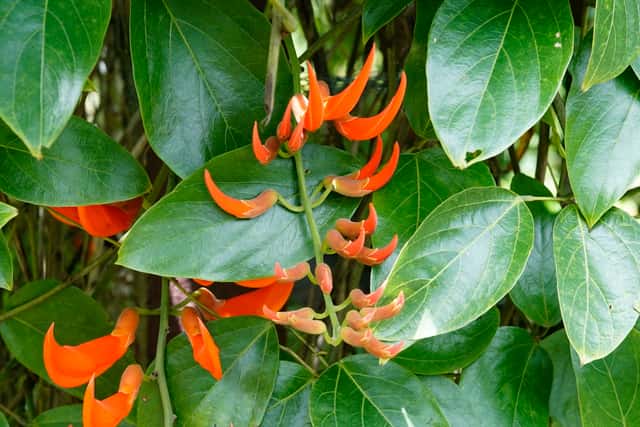
New Guinea Creeper (Mucuna bennettii) is a medium-care plant from the Fabaceae family. The New Guinea Creeper (Mucuna bennettii) is one of the most spectacular tropical vines in the world. Native to Papua New Guinea and surrounding islands, this vigorous liana of the Fabaceae family produces long pendulous clusters of claw-shaped, fiery scarlet flowers. A fast-growing climber capable...
New Guinea Creeper grows up to 6.0m, spread of 365cm, watering every 7 days, 18°C – 35°C, 60–90% humidity. It is not suitable for indoor environments and safe for pets.
Unlike many popular species, New Guinea Creeper is safe to keep around pets.
How to Care for New Guinea Creeper?
TLDR: New Guinea Creeper needs Direct sun, watering every 7 days, and temperatures between 18-35°C with 60-90% humidity.
How Often Should You Water New Guinea Creeper?
Water deeply every 7 days, allowing the soil to dry slightly between waterings. In cooler or rainy periods, reduce frequency to prevent waterlogging and root rot.
How Much Light Does New Guinea Creeper Need?
Plant in full sun for maximum flowering. While it tolerates partial shade, blooming is most abundant with at least 6 hours of direct sunlight per day.
What Is the Best Soil for New Guinea Creeper?
Use rich, well-draining soil such as a mix of garden soil, coarse sand, and perlite. Avoid heavy or compacted soils that retain too much moisture.
What Pot Should You Use for New Guinea Creeper?
As a vigorous climber, it is best suited for in-ground cultivation in tropical gardens, supported by pergolas, sturdy trellises, or large trees. If container-grown, use a very large pot (minimum 50L) with good drainage.
Care Schedule
Fertilize
Every 30 days
Misting
Every 7 days
Repot
Every 730 days
What Is New Guinea Creeper and Where Does It Come From?
The New Guinea Creeper (Mucuna bennettii) is one of the most spectacular tropical vines in the world. Native to Papua New Guinea and surrounding islands, this vigorous liana of the Fabaceae family produces long pendulous clusters of claw-shaped, fiery scarlet flowers. A fast-growing climber capable of reaching 20 feet in length, it creates a stunning focal point on pergolas, fences, and large trees in tropical gardens.
How to Propagate New Guinea Creeper?
Seed Sowing
Scarification is essential as seeds have a hard seed coat. Keep substrate moist but not waterlogged during germination.
- 1 Scarify seeds with fine sandpaper to aid germination
- 2 Soak seeds in warm water for 24 hours
- 3 Sow in moist, well-draining substrate at 1-2 cm depth
- 4 Keep in a warm location (25-30°C) with high humidity
- 5 Transplant to final location when seedling reaches 15-20 cm
Materials needed:
Stem Cutting
Use a humidity chamber or plastic bag to maintain high humidity. Check for rooting after 4-6 weeks before transplanting.
- 1 Take semi-hardwood cuttings 15-20 cm in length
- 2 Remove lower leaves, keeping 2-3 leaves at the top
- 3 Apply rooting hormone to the base of the cutting
- 4 Insert in moist, porous substrate
- 5 Keep in a warm location with high humidity until rooting
Materials needed:
How Big Does New Guinea Creeper Grow?
TLDR: New Guinea Creeper can reach up to 6.0m tall with Fast growth rate.
Max height
6.0m
Spread
3.6m
Growth rate
Fast
Foliage
Evergreen
Warning: Toxic Plant
This plant can be toxic if ingested. Keep out of reach of:
Plant Uses
Ornamental
Great for decoration
Is your plant showing symptoms?
Click on the symptom to discover possible causes:
What Diseases Commonly Affect New Guinea Creeper?
TLDR: New Guinea Creeper is susceptible to 4 known diseases. Monitor regularly for early detection.
Root Rot
Root rot is a serious fungal disease that affects the root system of plants, causing them to decay and die. It is primarily caused by overwatering, poor drainage, or soil-borne fungi such as Pythium, Phytophthora, Rhizoctonia, and Fusarium. The disease thrives in waterlogged conditions where roots are deprived of oxygen, making them susceptible to fungal infection.
Spider Mites
Spider mites are tiny arachnids (less than 1/20 inch long) related to spiders and ticks that feed on plant sap. They thrive in hot, dry conditions and can cause significant damage to ornamental and vegetable plants. During severe infestations, crop losses can reach 14% or higher as these pests disrupt vital plant processes including photosynthesis, carbon dioxide absorption, and transpiration.
Whiteflies
Whiteflies are small, soft-bodied, winged insects closely related to aphids and mealybugs. They are moth-like in appearance, about 1/16 inch long, triangular in shape, and gray-white in color. These sap-sucking pests feed on plant tissue, causing yellowing, stunted growth, and wilting. They also excrete honeydew, which attracts ants and promotes sooty mold growth. Whiteflies can transmit serious plant viruses.
Scale Insects
Scale insects are small sap-sucking pests that appear as brown, shell-like bumps on plant stems and leaves. There are over 25 species, divided into armored (hard) and unarmored (soft) scales. They feed by piercing plant tissue and extracting sap, which weakens the plant and can lead to yellowing, stunted growth, and even death if left untreated. They also excrete honeydew, which attracts ants and promotes sooty mold growth.
Meaning & Symbolism
Symbol of tropical exuberance and rare beauty; its vivid scarlet blooms represent vitality and the richness of tropical biodiversity.
Fun Facts
Its scarlet flowers have a unique claw shape, adapted for pollination by bats and tropical birds.
Can grow over 20 feet in ideal tropical conditions, making it one of the most imposing climbers in Papua New Guinea flora.
It is considered a cousin of the famous blue Jade Vine (Strongylodon macrobotrys), sharing the same spectacular pendulous flower cluster form.
The seeds have such a hard seed coat that they require scarification to germinate — an evolutionary survival mechanism in tropical environments.
Frequently asked questions
How often should I water the New Guinea Creeper?
Is Mucuna bennettii toxic?
When does the New Guinea Creeper flower?
Can I grow Mucuna bennettii in a pot?
How do I encourage the New Guinea Creeper to flower?
Compare with similar plants
| Attribute | Difficulty | Light | Watering | Pet Safe |
|---|---|---|---|---|
| Dark Fieldcap | Medium | Low light | 2d | ⚠️ |
| Azalea | Medium | Partial shade | 3d | ⚠️ |
| Muriel's Bamboo | Medium | Partial shade | 3d | ✓ |
| Bougainvillea | Medium | Direct sun | 7d | ⚠️ |




