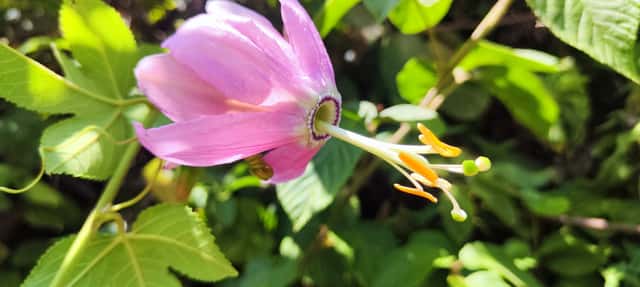
Passifloraceae
How to Care for Banana Poka (Passiflora tarminiana)
Passiflora tarminiana
Fast-growing vine requiring full sun, regular watering with excellent drainage, and a sturdy support structure. Fertilize every two weeks during the growing season and prune lightly every 3 months to manage vigor.
Every 4 days
Bright indirect
15° - 29°C
60% - 85%
Categories
What is Banana Poka?
Banana Poka (Passiflora tarminiana) is a medium-care plant from the Passifloraceae family. Passiflora tarminiana, commonly known as Banana Poka or banana passionfruit, is a vigorous climbing vine native to the Andes of Colombia, Ecuador, and Venezuela. It produces striking pink tubular flowers and elongated, aromatic fruits widely used in juices and desserts. Due to its rapid growth, it h...
Banana Poka grows up to 10.0m, spread of 450cm, watering every 4 days, 15°C – 29°C, 60–85% humidity. It is not suitable for indoor environments and safe for pets.
Unlike many popular species, Banana Poka is safe to keep around pets.
How to Care for Banana Poka?
TLDR: Banana Poka needs Bright indirect, watering every 4 days, and temperatures between 15-29°C with 60-85% humidity.
How Often Should You Water Banana Poka?
Water every 4 days, allowing the top layer of soil to dry between waterings. Avoid waterlogging — roots are sensitive to excess moisture.
How Much Light Does Banana Poka Need?
Requires full sun with at least 6 hours of direct light daily. In very hot climates, partial afternoon shade helps prevent leaf scorch.
What Is the Best Soil for Banana Poka?
Use fertile, well-draining soil with a slightly acidic to neutral pH (6.0–7.0). Add coarse sand or perlite to ensure good drainage and prevent root rot.
What Pot Should You Use for Banana Poka?
Large terracotta pot (minimum 40cm diameter) with good drainage. In the garden, prefers growing on structures like trellises and pergolas.
Care Schedule
Fertilize
Every 14 days
What Is Banana Poka and Where Does It Come From?
Passiflora tarminiana, commonly known as Banana Poka or banana passionfruit, is a vigorous climbing vine native to the Andes of Colombia, Ecuador, and Venezuela. It produces striking pink tubular flowers and elongated, aromatic fruits widely used in juices and desserts. Due to its rapid growth, it has become an invasive species in Hawaii and other tropical regions.
How to Propagate Banana Poka?
Seed Propagation
Use fresh seeds for best germination rates. Stored seeds may take up to 12 months to germinate.
- 1 Soak seeds in warm water for 24 hours
- 2 Sow in moist, well-draining seed mix
- 3 Keep in warm location at 19-24°C
- 4 Expect germination in 2-4 weeks
Materials needed:
Stem Cutting
Use sterilized tools. Keep substrate slightly moist during rooting.
- 1 Cut a healthy stem 15-20cm with 2-3 nodes
- 2 Remove lower leaves
- 3 Apply rooting hormone to the cut end
- 4 Plant in moist substrate and place in indirect light
Materials needed:
Ground Layering
Ideal for established garden plants.
- 1 Select a long, flexible stem
- 2 Bury a node in the soil without detaching from parent plant
- 3 Keep moist until rooted
- 4 Cut from parent plant once rooted
Materials needed:
How Big Does Banana Poka Grow?
TLDR: Banana Poka can reach up to 10.0m tall with Fast growth rate.
Max height
10.0m
Spread
4.5m
Growth rate
Fast
Foliage
Evergreen
Plant Uses
Ornamental
Great for decoration
Edible
Can be consumed
Culinary Uses
- Fruits used in juices, ice creams, jellies, and desserts. The aromatic pulp is highly prized in Andean and Colombian cuisine.
Is your plant showing symptoms?
Click on the symptom to discover possible causes:
What Diseases Commonly Affect Banana Poka?
TLDR: Banana Poka is susceptible to 7 known diseases. Monitor regularly for early detection.
Root Rot
Root rot is a serious fungal disease that affects the root system of plants, causing them to decay and die. It is primarily caused by overwatering, poor drainage, or soil-borne fungi such as Pythium, Phytophthora, Rhizoctonia, and Fusarium. The disease thrives in waterlogged conditions where roots are deprived of oxygen, making them susceptible to fungal infection.
Fusarium Wilt
Fusarium wilt is a serious fungal disease caused by the soil-borne fungus Fusarium oxysporum. The fungus invades roots and blocks the water-conducting vessels (xylem) of the plant, causing progressive wilting and eventual death. Host-specific forms of the pathogen exist that attack different plant species.
Aphids
Aphids are small, soft-bodied, pear-shaped insects (1/16 to 1/8 inch long) that feed by sucking nutrient-rich sap from plants. They reproduce rapidly and can quickly weaken plants, causing distorted growth and transmitting plant viruses. Aphids come in various colors including green, black, red, yellow, brown, and gray. They secrete honeydew, a sticky substance that attracts ants and encourages sooty mold growth.
Spider Mites
Spider mites are tiny arachnids (less than 1/20 inch long) related to spiders and ticks that feed on plant sap. They thrive in hot, dry conditions and can cause significant damage to ornamental and vegetable plants. During severe infestations, crop losses can reach 14% or higher as these pests disrupt vital plant processes including photosynthesis, carbon dioxide absorption, and transpiration.
Meaning & Symbolism
Symbol of passion, resilience, and abundance in Andean cultures. Its fruits are associated with prosperity and connection to the land.
Fun Facts
Considered one of the most problematic invasive species in Hawaii, where it outcompetes native plants.
Its fruits are the base of the popular curuba juice, widely consumed in Colombia and Ecuador.
The tubular flowers are pollinated by hummingbirds, attracting wildlife to the garden.
Frequently asked questions
How often should I water Banana Poka?
Is Banana Poka toxic to pets?
How much light does Banana Poka need?
Can I grow it in a container?
How fast does Banana Poka grow?
Compare with similar plants
| Attribute | Difficulty | Light | Watering | Pet Safe |
|---|---|---|---|---|
| Dark Fieldcap | Medium | Low light | 2d | ⚠️ |
| Azalea | Medium | Partial shade | 3d | ⚠️ |
| Muriel's Bamboo | Medium | Partial shade | 3d | ✓ |
| Bougainvillea | Medium | Direct sun | 7d | ⚠️ |




