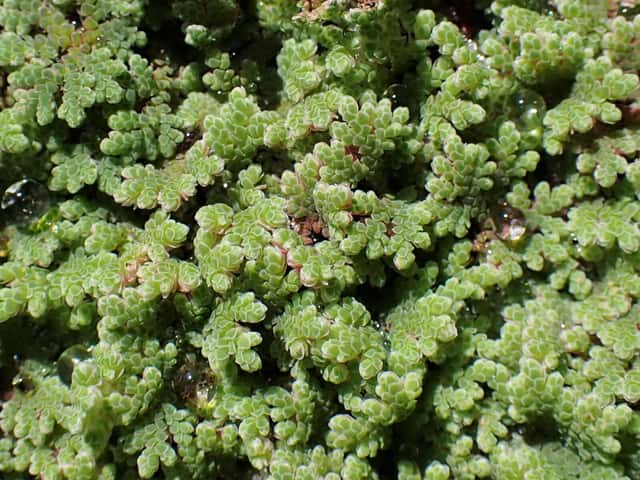
Salviniaceae
Carolina mosquitofern: Fast Growing
Azolla caroliniana
Float it on the surface of calm, fresh water in a pond, tub or aquarium. It grows best in about half sun or bright light; heavy shade almost stops growth. Keep the water roughly 18–28 °C (it survives down to about 5 °C and suffers in prolonged heat above 30 °C) and slightly acidic to neutral (pH 4.5–7.5). It makes its own nitrogen but needs some phosphorus and iron in the water. It spreads fast, so scoop out part of the mat every couple of weeks and never release it into the wild.
Every 7-10 days
Bright indirect
5° - 30°C
% - %
Categories
What is Carolina mosquitofern?
Carolina mosquitofern (Azolla caroliniana) is a easy-care plant from the Salviniaceae family. Azolla caroliniana is a tiny free-floating water fern native to the eastern Americas. Each plant is only about 1–2 cm across, made of small overlapping scale-like leaves on short branching stems, with fine roots hanging into the water. In still or slow water it multiplies quickly and can cover a pon...
Carolina mosquitofern grows up to 5°C – 30°C. It is suitable for indoor environments and safe for pets.
Unlike many tropical plants, Carolina mosquitofern tolerates watering mistakes. Best for beginners. Unlike many popular species, Carolina mosquitofern is safe to keep around pets.
How to Care for Carolina mosquitofern?
TLDR: Carolina mosquitofern needs Bright indirect, watering every 7 days, and temperatures between 5-30°C with 40-70% humidity.
How Often Should You Water Carolina mosquitofern?
This is an aquatic plant: it has to float on water at all times and dies within hours if it dries out. Top up evaporated water, keep the surface calm (strong filter flow or splashing that wets the top of the fronds causes rot) and avoid salty or hard, alkaline water.
How Much Light Does Carolina mosquitofern Need?
Give it bright light or partial sun — about half of full sunlight is ideal. Strong light turns the fronds red, which is normal. In deep shade or weak aquarium light it stops growing and the mat thins out.
What Is the Best Soil for Carolina mosquitofern?
It needs no soil; the roots hang free in the water. Growth depends on the water itself: slightly acidic to neutral pH, some phosphorus (red, stalled fronds signal a shortage) and a little iron (yellow fronds signal iron deficiency). In an aquarium, a light, regular dose of liquid fertilizer helps.
What Pot Should You Use for Carolina mosquitofern?
Any watertight container without drainage holes: a pond, a glazed bowl, a tub or an aquarium with a gentle filter. A wide, shallow surface works better than a deep, narrow one, and a few centimeters of water are enough.
What Is Carolina mosquitofern and Where Does It Come From?
Azolla caroliniana is a tiny free-floating water fern native to the eastern Americas. Each plant is only about 1–2 cm across, made of small overlapping scale-like leaves on short branching stems, with fine roots hanging into the water. In still or slow water it multiplies quickly and can cover a pond surface with a velvety mat. The fronds are green in shade and turn pink, orange or rusty red in strong light, cold weather or when phosphorus runs low. Inside its leaves lives a cyanobacterium (Anabaena azollae) that fixes nitrogen from the air, which is why Azolla is used as a green manure in rice paddies and as feed for ducks, chickens and fish. The name is debated: many botanists now treat it as Azolla filiculoides, and some as Azolla cristata, so the same plant may be sold under any of these names.
How to Propagate Carolina mosquitofern?
Division of the floating mat
- Azolla is grown from pieces of the plant, not from seed.
- Never dump surplus plants into natural waterways; compost them instead.
- 1 Scoop a portion
Lift a handful of healthy green plants from the mat with a net or strainer.
- 2 Check for hitchhikers
Look for snails, snail eggs and caterpillars and remove them before moving the plants.
- 3 Float them
Lay the plants on the surface of the new container, right side up, without submerging them.
- 4 Let it multiply
Keep the water in bright light at 18–28 °C; the stems break apart on their own and the plants double quickly.
Materials needed:
How Big Does Carolina mosquitofern Grow?
TLDR: Carolina mosquitofern can reach up to ?cm tall with Fast growth rate.
Growth rate
Fast
Plant Uses
Ornamental
Great for decoration
Is your plant showing symptoms?
Click on the symptom to discover possible causes:
What Diseases Commonly Affect Carolina mosquitofern?
TLDR: Carolina mosquitofern is susceptible to 6 known diseases. Monitor regularly for early detection.
Caterpillars
Caterpillars are the larval stage of moths and butterflies that feed voraciously on plant foliage, stems, flowers, and fruits. Common species include cabbage loopers, tomato hornworms, armyworms, and cutworms. These pests can cause extensive damage by consuming large amounts of plant tissue in a short time. They vary in size from small (1/4 inch) to large (5 inches), with colors ranging from green to brown, often featuring stripes or spots. Caterpillars are highly mobile and can quickly spread throughout gardens, making them one of the most destructive common pests.
Slugs and Snails
Slugs and snails are mollusks that feed on plant tissue, causing irregular holes in leaves and damage to young seedlings. They are most active at night and in moist conditions, leaving characteristic silvery slime trails. These pests can quickly devastate gardens, especially during wet seasons.
Curculionidae
Curculionidae (weevils) are small beetles that feed on plants. Adults chew leaf margins, leaving crescent-shaped notches, primarily at night. The larvae live in the substrate and consume roots, causing decline, yellowing, and wilting even when the substrate is moist, and in severe cases, plant death. They frequently affect ornamentals and garden plants such as strawberries, citrus, roses, hydrangeas, azaleas, blueberries, begonias, and many potted plants.
Phosphorus Deficiency
Phosphorus deficiency is a common nutritional problem that hinders healthy plant growth. Phosphorus is essential for root development, flowering, fruiting, and energy metabolism. When deficient, plants exhibit stunted growth and leaves with purple or reddish coloration, especially on older leaves.
Compare with similar plants
| Attribute | Difficulty | Light | Watering | Pet Safe |
|---|---|---|---|---|
| Field Maple | Easy | Bright indirect | 14d | ✓ |
| Iberian Houseleek | Easy | Direct sun | 14d | ✓ |
| Silver Birch | Easy | Direct sun | 14d | ✓ |
| Common Blanketflower | Easy | Direct sun | 10d | ✓ |





