Amaryllidaceae
Common Snowdrop (Galanthus nivalis)
Galanthus nivalis
Plant under deciduous trees or shrubs in soil that stays moist in winter and spring. Let the leaves die down on their own, and lift and divide crowded clumps just after flowering, while the leaves are still green.
Every 7 days
Partial shade
-30° - 25°C
40% - 80%
Categories
What is Common Snowdrop?
Common Snowdrop (Galanthus nivalis) is a easy-care plant from the Amaryllidaceae family. Common snowdrop (Galanthus nivalis) is a small bulb in the amaryllis family, native to much of Europe from Spain to Ukraine. It is one of the first flowers of the year, opening in late winter, often through snow. Each bulb sends up two or three narrow grey-green leaves and a stem about 10-15 cm tall...
Common Snowdrop grows up to 15cm, spread of 10cm, watering every 7 days, -30°C – 25°C, 40–80% humidity. It is not suitable for indoor environments and not safe for pets.
Unlike many tropical plants, Common Snowdrop tolerates watering mistakes. Best for beginners. Without precautions, ingestion can cause irritation in pets. Keep out of reach of cats and dogs.
How to Care for Common Snowdrop?
TLDR: Common Snowdrop needs Partial shade, watering every 7 days, and temperatures between -30-25°C with 40-80% humidity.
How Often Should You Water Common Snowdrop?
Keep the soil moist from autumn to late spring. In summer the bulbs are dormant and need no watering, but they should not bake completely dry.
How Much Light Does Common Snowdrop Need?
Full sun to partial shade in winter and spring; light shade from trees in summer is ideal.
What Is the Best Soil for Common Snowdrop?
Moist, well-drained soil rich in leaf mould or compost. It tolerates clay and occasional wet spots.
What Pot Should You Use for Common Snowdrop?
Grows best in the ground. For a winter display, plant bulbs in a wide, shallow pot with drainage holes, keep it outdoors, and plant the clump in the garden after flowering.
What Is Common Snowdrop and Where Does It Come From?
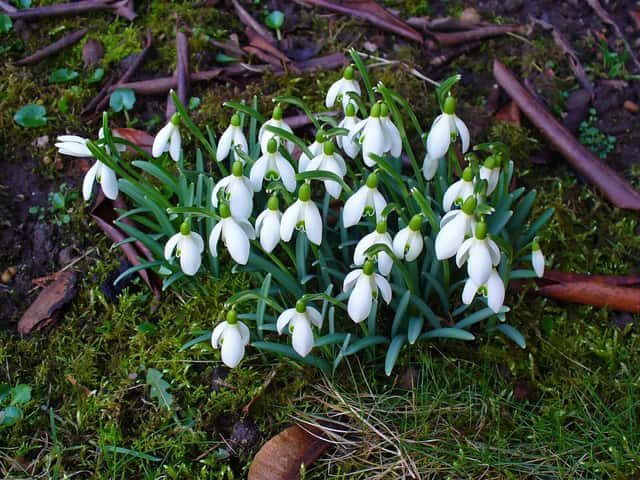
Common snowdrop (Galanthus nivalis) is a small bulb in the amaryllis family, native to much of Europe from Spain to Ukraine. It is one of the first flowers of the year, opening in late winter, often through snow. Each bulb sends up two or three narrow grey-green leaves and a stem about 10-15 cm tall carrying a single nodding white flower. The three outer petals are longer; the three short inner ones have a green mark at the tip. After flowering the leaves feed the bulb and die back by early summer. Over the years it spreads by offsets and seed into white carpets under trees.
How to Propagate Common Snowdrop?
Division in the green
Do this every 3-5 years when clumps flower less. Dry bulbs bought in autumn often fail; plants moved in leaf establish much better.
- 1 Lift a crowded clump just after flowering, while the leaves are still green
- 2 Gently pull it apart into small groups of 3-5 bulbs
- 3 Replant at the same depth, 7-10 cm deep
- 4 Water in well
Materials needed:
Seed
Seed needs a cold spell to germinate. Ants also spread the seed in the garden.
- 1 Collect the seed pods when they turn yellow and soften
- 2 Sow fresh seed at once in pots of gritty compost
- 3 Leave the pots outdoors over winter so the seed gets cold
- 4 Keep moist and wait for seedlings in spring
Materials needed:
How Big Does Common Snowdrop Grow?
TLDR: Common Snowdrop can reach up to 15cm tall with Medium growth rate.
Max height
15cm
Spread
10cm
Growth rate
Medium
Foliage
Deciduous
Warning: Toxic Plant
This plant can be toxic if ingested. Keep out of reach of:
Plant Uses
Ornamental
Great for decoration
Is your plant showing symptoms?
Click on the symptom to discover possible causes:
What Diseases Commonly Affect Common Snowdrop?
TLDR: Common Snowdrop is susceptible to 5 known diseases. Monitor regularly for early detection.
Gray Mold (Botrytis Blight)
Gray mold, caused by the fungus Botrytis cinerea, is a widespread necrotrophic pathogen affecting over 1,400 plant species. It thrives in cool, humid conditions and attacks weakened or aging plant tissues, causing soft rot and characteristic gray fuzzy growth.
Red Blotch (Stagonospora curtisii)
A common fungal disease affecting bulbous plants such as Amaryllis. It is characterized by elongated, bright red lesions that can deform leaves and stems, eventually weakening the bulb over time.
Ramularia Leaf Spot
Ramularia is a fungal disease (leaf spot) that affects foliage. It begins as small, sharply defined spots, often light green or yellow, which turn brown or gray and may develop a pale border. A fine, grayish-white powdery layer of spores can be seen on the underside of the leaves. Leaves yellow and wither more rapidly during severe infestations. The disease thrives in cool, damp weather and spreads via water splashes, dense plant growth, and infected cuttings or seeds. In home gardens, it is particularly common on geraniums (Pelargonium) and beets/chard; in agriculture, it is well-known for affecting barley.
Root-Knot Nematodes
Root-knot nematodes (Meloidogyne species) are microscopic roundworms that parasitize plant roots, causing characteristic galls or knots. These soil-borne pests are among the most economically damaging plant pathogens worldwide, affecting a wide range of ornamental and edible plants. The nematodes inject enzymes into root cells, causing abnormal swelling and disrupting water and nutrient uptake.
Meaning & Symbolism
A symbol of hope and of light returning after winter; in Britain it is linked to Candlemas on 2 February.
Fun Facts
The name Galanthus comes from the Greek for milk flower.
The epithet nivalis means of the snow.
Galantamine, a drug used for Alzheimer's disease, was first isolated from snowdrops.
People who collect snowdrop varieties are called galanthophiles.
Frequently asked questions
When is the best time to plant snowdrops?
Are snowdrops poisonous?
Should I cut back snowdrop leaves after flowering?
Why are my snowdrops not flowering?
What is the difference between snowdrops and snowflakes?
Compare with similar plants
| Attribute | Difficulty | Light | Watering | Pet Safe |
|---|---|---|---|---|
| Field Maple | Easy | Bright indirect | 14d | ✓ |
| Iberian Houseleek | Easy | Direct sun | 14d | ✓ |
| Silver Birch | Easy | Direct sun | 14d | ✓ |
| Common Blanketflower | Easy | Direct sun | 10d | ✓ |





