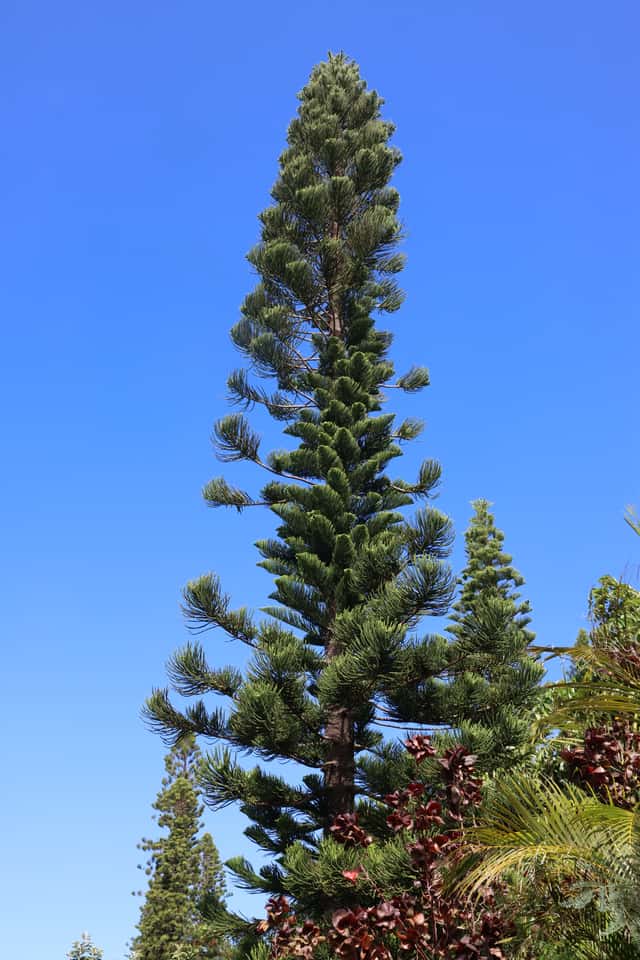
Araucariaceae
Cook Pine (Araucaria columnaris)
Araucaria columnaris
Plant in full sun with well-draining soil. Water every 10 days, allowing the top layer of soil to dry slightly between waterings. Fertilize every 6 months during spring and summer. Rotate the pot every 3 months to ensure even growth.
Every 10 days
Direct sun
10° - 38°C
30% - 60%
Categories
What is Cook Pine?
Cook Pine (Araucaria columnaris) is a medium-care plant from the Araucariaceae family. The Cook Pine (Araucaria columnaris) is a majestic conifer native to New Caledonia, renowned for its distinctive columnar silhouette and a fascinating biological quirk: its trunk tilts toward the equator, regardless of which hemisphere it grows in. A slow-growing tree that can reach 60 meters in the...
Cook Pine grows up to 60.0m, spread of 1200cm, watering every 10 days, 10°C – 38°C, 30–60% humidity. It is suitable for indoor environments and safe for pets.
Unlike many popular species, Cook Pine is safe to keep around pets. Without adequate drainage, root rot can develop within 20 days.
How to Care for Cook Pine?
TLDR: Cook Pine needs Direct sun, watering every 10 days, and temperatures between 10-38°C with 30-60% humidity.
How Often Should You Water Cook Pine?
Water every 10 days, allowing the top few centimeters of soil to dry out between waterings. Avoid waterlogging — Cook Pine does not tolerate saturated soil. Reduce watering frequency in winter.
How Much Light Does Cook Pine Need?
Requires full sun for healthy growth. Place in a location that receives at least 6 hours of direct sunlight per day. Indoors, position near a south-facing window.
What Is the Best Soil for Cook Pine?
Prefers well-draining, slightly acidic to neutral soil (pH 5.5–7.0). Amend with sand or perlite to improve drainage. Avoid clay or compacted soils.
What Pot Should You Use for Cook Pine?
Terracotta or ceramic pot with drainage hole. For young indoor specimens, use tall, narrow pots to support vertical growth. Repot every 2 years in spring.
Care Schedule
Fertilize
Every 180 days
Rotate
Every 90 days
Repot
Every 730 days
What Is Cook Pine and Where Does It Come From?
The Cook Pine (Araucaria columnaris) is a majestic conifer native to New Caledonia, renowned for its distinctive columnar silhouette and a fascinating biological quirk: its trunk tilts toward the equator, regardless of which hemisphere it grows in. A slow-growing tree that can reach 60 meters in the wild, it typically stays 15-20 meters in cultivation. Widely used as an ornamental tree in coastal and subtropical gardens.
How to Propagate Cook Pine?
Stem Cutting
Propagation by cutting is difficult for this species. Use young shoots from the top of the plant for best results. Keep humidity consistent but avoid waterlogging.
- 1 Cut a healthy branch 15-20 cm long
- 2 Remove lower branches, keeping only the top ones
- 3 Apply rooting hormone to the cut base
- 4 Plant in well-draining substrate (50% perlite, 50% potting mix)
- 5 Keep in indirect light with high humidity
- 6 Wait 6-8 weeks for rooting
Materials needed:
Seed Propagation
Use freshly harvested seeds as they lose germination potential quickly. Keep substrate moist but not waterlogged.
- 1 Use fresh seeds — they lose viability quickly
- 2 Sow in moist, well-draining substrate
- 3 Cover lightly with fine substrate
- 4 Maintain temperature between 20-25°C
- 5 Expect germination in 3-6 weeks
Materials needed:
How Big Does Cook Pine Grow?
TLDR: Cook Pine can reach up to 60.0m tall with Slow growth rate.
Max height
60.0m
Spread
12.0m
Growth rate
Slow
Foliage
Evergreen
Plant Uses
Ornamental
Great for decoration
Is your plant showing symptoms?
Click on the symptom to discover possible causes:
What Diseases Commonly Affect Cook Pine?
TLDR: Cook Pine is susceptible to 6 known diseases. Monitor regularly for early detection.
Root Rot
Root rot is a serious fungal disease that affects the root system of plants, causing them to decay and die. It is primarily caused by overwatering, poor drainage, or soil-borne fungi such as Pythium, Phytophthora, Rhizoctonia, and Fusarium. The disease thrives in waterlogged conditions where roots are deprived of oxygen, making them susceptible to fungal infection.
Scale Insects
Scale insects are small sap-sucking pests that appear as brown, shell-like bumps on plant stems and leaves. There are over 25 species, divided into armored (hard) and unarmored (soft) scales. They feed by piercing plant tissue and extracting sap, which weakens the plant and can lead to yellowing, stunted growth, and even death if left untreated. They also excrete honeydew, which attracts ants and promotes sooty mold growth.
Mealybugs
Mealybugs are small, soft-bodied insects covered with a white, waxy, cottony material. They are common pests of houseplants and outdoor plants in mild climates. These sap-sucking insects feed on plant tissue, causing damage, stunted growth, and can lead to plant death if left untreated. They produce sticky honeydew which attracts sooty mold.
Rust
Rust is a common fungal disease caused by fungi in the order Pucciniales that affects a wide variety of plants. The disease gets its name from the characteristic orange, yellow, or reddish-brown pustules that appear on leaves, resembling metal rust. This obligate fungal parasite requires living plants to survive and can cause significant economic losses in agricultural crops.
Meaning & Symbolism
Symbol of longevity, majesty, and distinction. In New Caledonia, it is an iconic tree, famous for its equatorial lean — a rare phenomenon in the plant kingdom.
Fun Facts
The Cook Pine naturally leans its trunk toward the equator — specimens in the northern hemisphere lean south, and vice versa, making it one of the most unique plants on Earth.
In its native New Caledonia, this tree can reach 60 meters tall, making it one of the tallest conifers in the Pacific.
The name "Cook" honors British explorer James Cook, who encountered this species during his Pacific voyages in the 18th century.
It is often confused with the Norfolk Island Pine (Araucaria heterophylla), but is distinguished by its more columnar form and shorter leaves.
Frequently asked questions
How often should I water Cook Pine?
Can Cook Pine be grown in a pot?
Is Cook Pine toxic to pets?
Why is my Cook Pine leaning?
How often should I fertilize Cook Pine?
Compare with similar plants
| Attribute | Difficulty | Light | Watering | Pet Safe |
|---|---|---|---|---|
| Dark Fieldcap | Medium | Low light | 2d | ⚠️ |
| Azalea | Medium | Partial shade | 3d | ⚠️ |
| Muriel's Bamboo | Medium | Partial shade | 3d | ✓ |
| Bougainvillea | Medium | Direct sun | 7d | ⚠️ |




