Iridaceae
Crocus
Crocus
Plant corms in autumn, 6 to 8 weeks before hard frost, 8-10 cm deep and 8-10 cm apart, in groups. Give full sun (light shade is fine) and well-drained soil; waterlogging rots the corms. Water during growth only when it does not rain, and stop once the leaves turn yellow. Crocuses need a cold winter to flower, so they struggle in warm climates. Leave the foliage until it dies back: it recharges the corm for next year.
Every 7 days
Bright indirect
-20° - °C
% - %
Categories
What is Crocus?
Crocus (Crocus) is a easy-care plant from the Iridaceae family. Crocus is a genus of about 200 species in the iris family (Iridaceae), native from Europe and North Africa east to western China, with the Balkans holding the most species. Crocuses grow from small, round corms wrapped in a fibrous tunic and produce narrow, grass-like leaves with a silver central st...
Crocus grows up to 15cm, spread of 8cm, watering every 7 days. It is not suitable for indoor environments and not safe for pets.
Unlike many tropical plants, Crocus tolerates watering mistakes. Best for beginners. Without precautions, ingestion can cause irritation in pets. Keep out of reach of cats and dogs.
How to Care for Crocus?
TLDR: Crocus needs Bright indirect, watering every 7 days, and temperatures between -20-30°C with 40-70% humidity.
How Often Should You Water Crocus?
Water well right after planting. From autumn to spring, water about once a week if there is no rain and the soil is dry 3 cm down. Once the leaves yellow in late spring, stop watering: dormant corms rot in damp summer soil.
How Much Light Does Crocus Need?
Full sun, 6 or more hours a day, so the flowers open fully; in shade the stems flop and the flowers stay closed. Light shade under deciduous trees works well.
What Is the Best Soil for Crocus?
Light, well-drained soil of average fertility with a near-neutral pH. In clay, mix in coarse grit; in containers, use bulb compost with a third of sand or perlite.
What Pot Should You Use for Crocus?
A wide, shallow pot (15 cm deep is enough) with good drainage holes. Keep it outdoors over winter: the corms need the cold to flower.
What Is Crocus and Where Does It Come From?
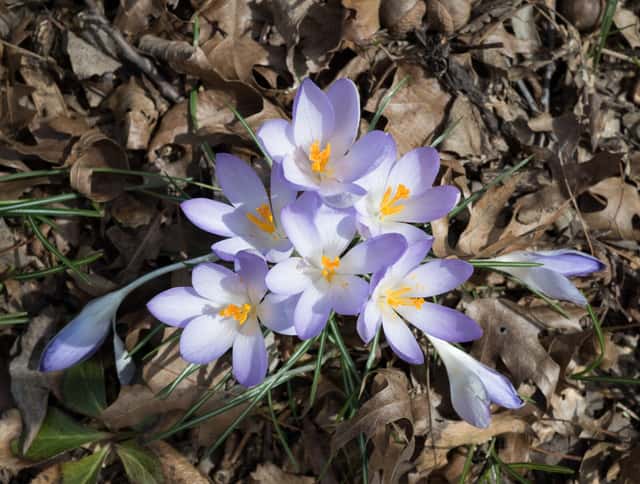
Crocus is a genus of about 200 species in the iris family (Iridaceae), native from Europe and North Africa east to western China, with the Balkans holding the most species. Crocuses grow from small, round corms wrapped in a fibrous tunic and produce narrow, grass-like leaves with a silver central stripe. The goblet-shaped flowers, 8 to 15 cm tall, sit almost at ground level in purple, lilac, white, yellow or striped forms. In gardens the most planted are the spring crocuses (C. vernus, C. tommasinianus, C. chrysanthus, C. flavus), which open from late winter to early spring; a few species bloom in autumn, such as C. speciosus and saffron crocus (C. sativus), the source of the spice. After flowering the leaves yellow and the corm goes dormant for the summer.
How to Propagate Crocus?
Separating cormlets
Divide clumps every 3 to 5 years, when flowering declines. Discard soft or spotted corms.
- 1 Wait until the foliage has fully died back in late spring
- 2 Lift the clump with a garden fork without damaging the corms
- 3 Separate the cormlets formed around the main corm
- 4 Store in a dry, airy place until autumn or replant right away
- 5 Plant 8-10 cm deep with the pointed end up
Materials needed:
Sowing seed
Seed needs winter cold to germinate. Hybrids do not come true from seed.
- 1 Leave spent flowers on the plant to form seed capsules
- 2 Collect seed when the capsules split in early summer
- 3 Sow in autumn in gritty compost, covering lightly
- 4 Keep the pot outdoors over winter
- 5 Keep moist until germination in spring
Materials needed:
How Big Does Crocus Grow?
TLDR: Crocus can reach up to 15cm tall with Medium growth rate.
Max height
15cm
Spread
8cm
Growth rate
Medium
Foliage
Deciduous
Warning: Toxic Plant
This plant can be toxic if ingested. Keep out of reach of:
Plant Uses
Ornamental
Great for decoration
Is your plant showing symptoms?
Click on the symptom to discover possible causes:
What Diseases Commonly Affect Crocus?
TLDR: Crocus is susceptible to 8 known diseases. Monitor regularly for early detection.
Root Rot
Root rot is a serious fungal disease that affects the root system of plants, causing them to decay and die. It is primarily caused by overwatering, poor drainage, or soil-borne fungi such as Pythium, Phytophthora, Rhizoctonia, and Fusarium. The disease thrives in waterlogged conditions where roots are deprived of oxygen, making them susceptible to fungal infection.
Fusarium Wilt
Fusarium is a soil-borne fungus that primarily attacks the roots and vascular tissues of plants. It enters through small wounds or stressed roots, is favored by warm temperatures and waterlogging, and then obstructs the flow of sap. Symptoms include yellowing, often on only one side of the plant, wilting even with moist soil, stunted growth, and, when cutting the stem, internal brown streaks. It frequently affects tomatoes, peppers, eggplants, basil, cucumbers, and zucchini, as well as ornamentals like carnations and cyclamen. In potted plants, it can manifest as root rot with a darkened crown.
Grey Mould
Mosaic Virus
Mosaic virus is a group of plant viruses that cause mottled, patchy patterns on leaves and can affect a wide variety of plants. The virus creates characteristic yellow, white, and green mosaic patterns, often accompanied by stunted growth and deformed plant parts. This highly contagious disease spreads rapidly through insect vectors and contaminated tools.
Meaning & Symbolism
A symbol of spring and renewal as one of the first flowers to open after winter; also linked to cheerfulness and hope.
Fun Facts
The genus has about 200 species, but only around 30 are grown as ornamentals.
Saffron comes from the stigmas of a single species, C. sativus: about 60,000 flowers make 1 kg.
The flowers close on cloudy days and at night and reopen in sunshine.
The name comes from the Greek krokos, linked to the Semitic word for saffron.
Frequently asked questions
When should I plant crocus corms?
Will crocuses flower in a warm climate?
Are crocuses toxic to cats and dogs?
Can I cut the leaves after flowering?
Why do my crocus corms disappear?
Compare with similar plants
| Attribute | Difficulty | Light | Watering | Pet Safe |
|---|---|---|---|---|
| Field Maple | Easy | Bright indirect | 14d | ✓ |
| Iberian Houseleek | Easy | Direct sun | 14d | ✓ |
| Silver Birch | Easy | Direct sun | 14d | ✓ |
| Common Blanketflower | Easy | Direct sun | 10d | ✓ |