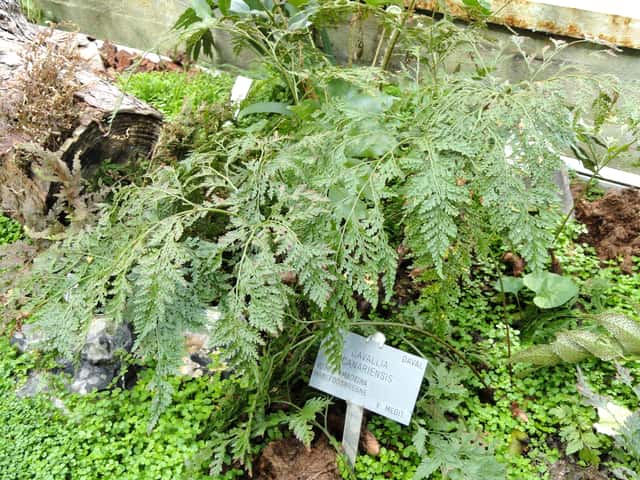
Davalliaceae
Hare's-foot Fern: the complete care guide for Davallia canariensis
Davallia canariensis
Keep the substrate lightly moist but never waterlogged. Mist the rhizomes regularly and provide bright indirect light. Avoid cold drafts and heating vents. Fertilize every two weeks in spring and summer with diluted liquid fertilizer.
Every 7 days
Partial shade
10° - 27°C
60% - 80%
Categories
What is Hare's-foot Fern?
Hare's-foot Fern (Davallia canariensis) is a medium-care plant from the Davalliaceae family. Davallia canariensis, commonly known as the Hare's-foot Fern or Deer's-foot Fern, is a captivating epiphytic fern native to the Canary Islands and the Iberian Peninsula. Its most distinctive feature is the thick, furry rhizomes covered in reddish-brown scales that creep over the edge of the pot, res...
Hare's-foot Fern grows up to 60cm, spread of 100cm, watering every 7 days, 10°C – 27°C, 60–80% humidity. It is suitable for indoor environments and safe for pets.
Unlike many popular species, Hare's-foot Fern is safe to keep around pets. Without adequate drainage, root rot can develop within 14 days.
How to Care for Hare's-foot Fern?
TLDR: Hare's-foot Fern needs Partial shade, watering every 7 days, and temperatures between 10-27°C with 60-80% humidity.
How Often Should You Water Hare's-foot Fern?
Water every 6-8 days when the top of the substrate is slightly dry. The best method is to submerge the pot in water for a few minutes, allowing the rhizomes and roots to absorb moisture evenly. Use filtered or rainwater to avoid lime buildup.
How Much Light Does Hare's-foot Fern Need?
Prefers bright indirect light. It tolerates shadier spots but grows best near north- or east-facing windows. Avoid direct sunlight which can scorch the delicate fronds.
What Is the Best Soil for Hare's-foot Fern?
Use a light, well-draining mix: combine peat moss, coarse sand and potting soil (50:25:25). The epiphytic rhizomes prefer an airy, organic-rich medium. Avoid heavy, compacted soils.
What Pot Should You Use for Hare's-foot Fern?
Hanging baskets or wire baskets lined with sphagnum moss are ideal. Unglazed terracotta pots also work well as they regulate moisture around the rhizomes.
Care Schedule
Fertilize
Every 30 days
Misting
Every 3 days
Repot
Every 540 days
What Is Hare's-foot Fern and Where Does It Come From?
Davallia canariensis, commonly known as the Hare's-foot Fern or Deer's-foot Fern, is a captivating epiphytic fern native to the Canary Islands and the Iberian Peninsula. Its most distinctive feature is the thick, furry rhizomes covered in reddish-brown scales that creep over the edge of the pot, resembling the fuzzy feet of a hare. The finely divided, triangular fronds create a lush, cascading display, making it an exceptional choice for hanging baskets and decorative arrangements.
How to Propagate Hare's-foot Fern?
Rhizome Division
Do not bury the rhizomes — they must sit on top of the substrate. Sphagnum moss can be used to anchor them in place.
- 1 Carefully remove the plant from its pot
- 2 Identify sections of rhizome with at least one healthy frond
- 3 Cut with a sterilized pair of scissors
- 4 Place the segment on top of slightly moist substrate
- 5 Keep in a warm, humid location until rooted
Materials needed:
How Big Does Hare's-foot Fern Grow?
TLDR: Hare's-foot Fern can reach up to 60cm tall with Fast growth rate.
Max height
60cm
Spread
1.0m
Growth rate
Fast
Foliage
Evergreen
Plant Uses
Ornamental
Great for decoration
Is your plant showing symptoms?
Click on the symptom to discover possible causes:
What Diseases Commonly Affect Hare's-foot Fern?
TLDR: Hare's-foot Fern is susceptible to 9 known diseases. Monitor regularly for early detection.
Root Rot
Root rot is a serious fungal disease that affects the root system of plants, causing them to decay and die. It is primarily caused by overwatering, poor drainage, or soil-borne fungi such as Pythium, Phytophthora, Rhizoctonia, and Fusarium. The disease thrives in waterlogged conditions where roots are deprived of oxygen, making them susceptible to fungal infection.
Scale Insects
Scale insects are small sap-sucking pests that appear as brown, shell-like bumps on plant stems and leaves. There are over 25 species, divided into armored (hard) and unarmored (soft) scales. They feed by piercing plant tissue and extracting sap, which weakens the plant and can lead to yellowing, stunted growth, and even death if left untreated. They also excrete honeydew, which attracts ants and promotes sooty mold growth.
Mealybugs
Mealybugs are small, soft-bodied insects covered with a white, waxy, cottony material. They are common pests of houseplants and outdoor plants in mild climates. These sap-sucking insects feed on plant tissue, causing damage, stunted growth, and can lead to plant death if left untreated. They produce sticky honeydew which attracts sooty mold.
Fungus Gnats
Fungus gnats are small, gray-to-black mosquito-like insects (1/8 to 1/10 inches long) commonly found in indoor plants. Adult gnats are mostly a nuisance, but their larvae feed on plant roots and organic matter in soil, potentially causing serious damage to young or vulnerable plants. The larvae are translucent white with distinctive black heads and can leave slime trails on the soil surface in heavy infestations.
Meaning & Symbolism
Symbolizes freedom, resilience and a wild spirit — its wandering rhizomes evoke an untamed connection to nature.
Fun Facts
The creeping rhizomes of Davallia canariensis can extend over 1 meter outside the pot over the years
In the wild, this fern grows as an epiphyte on trees and rocks without needing deep soil
The Canary Islands and the Iberian Peninsula are the only natural habitat of this species in the world
Frequently asked questions
How often should I water my Hare's-foot Fern?
Is the Hare's-foot Fern toxic to pets?
Why are my Hare's-foot Fern rhizomes drying out?
Can I grow the Hare's-foot Fern in a hanging basket?
Compare with similar plants
| Attribute | Difficulty | Light | Watering | Pet Safe |
|---|---|---|---|---|
| Dark Fieldcap | Medium | Low light | 2d | ⚠️ |
| Azalea | Medium | Partial shade | 3d | ⚠️ |
| Muriel's Bamboo | Medium | Partial shade | 3d | ✓ |
| Bougainvillea | Medium | Direct sun | 7d | ⚠️ |




