Lamiaceae
Jerusalem sage (Phlomis fruticosa)
Phlomis fruticosa
Easy to grow: full sun, well-drained soil and little water once established. Prune in late spring, after the first flush of flowers, to keep it compact. It survives frosts to about -10 °C if the soil does not stay wet.
Every 10 days
Direct sun
-10° - °C
30% - 60%
Categories
What is Jerusalem sage?
Jerusalem sage (Phlomis fruticosa) is a easy-care plant from the Lamiaceae family. Jerusalem sage (Phlomis fruticosa) is an evergreen shrub in the mint family from the eastern Mediterranean: Greece, Turkey, Italy, Albania and Cyprus. It forms a mound 0.5 to 1.3 m tall and up to 1.5 m wide. The leaves are grey-green, wrinkled and woolly with white undersides, and smell of sage when...
Jerusalem sage grows up to 1.3m, spread of 150cm, watering every 10 days, 30–60% humidity. It is not suitable for indoor environments and safe for pets.
Unlike many tropical plants, Jerusalem sage tolerates watering mistakes. Best for beginners. Unlike many popular species, Jerusalem sage is safe to keep around pets.
How to Care for Jerusalem sage?
TLDR: Jerusalem sage needs Direct sun, watering every 10 days, and temperatures between -10-30°C with 30-60% humidity.
How Often Should You Water Jerusalem sage?
Water regularly in the first year only. Once established, water every 10-14 days in a dry summer and hardly at all in winter. Wet soil harms it more than drought.
How Much Light Does Jerusalem sage Need?
Needs full sun, at least 6 hours a day. In shade the stems get long and floppy and it flowers poorly.
What Is the Best Soil for Jerusalem sage?
Any well-drained soil works: sandy, chalky, gravelly or poor. Avoid heavy clay that stays wet in winter.
What Pot Should You Use for Jerusalem sage?
A large terracotta pot (40 cm or more) with drainage holes, a layer of gravel at the bottom and gritty compost. In a pot it needs a little more water in summer.
What Is Jerusalem sage and Where Does It Come From?
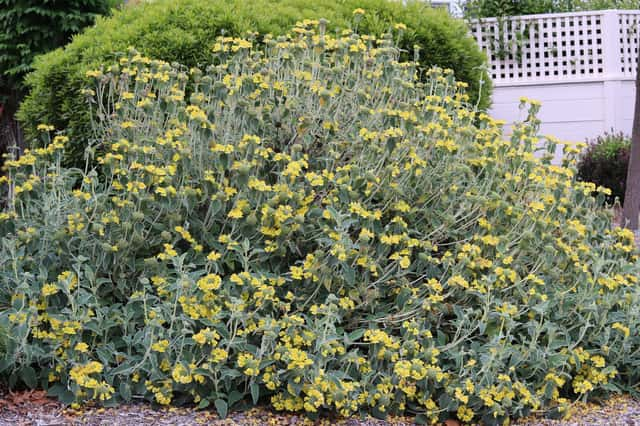
Jerusalem sage (Phlomis fruticosa) is an evergreen shrub in the mint family from the eastern Mediterranean: Greece, Turkey, Italy, Albania and Cyprus. It forms a mound 0.5 to 1.3 m tall and up to 1.5 m wide. The leaves are grey-green, wrinkled and woolly with white undersides, and smell of sage when bruised. From late spring through summer it carries hooded, golden-yellow flowers in tiers along the stems. Bees and butterflies visit the flowers.
How to Propagate Jerusalem sage?
Softwood cuttings
Do not let the compost stay soggy; the cuttings rot easily.
- 1 Cut 8-10 cm tips from new, non-flowering shoots
- 2 Strip the leaves from the lower half
- 3 Insert into gritty, moist compost
- 4 Keep in light shade until rooted, then move to sun
Materials needed:
Division
Works best on young plants; old woody clumps take poorly.
- 1 In spring, dig up a rooted section of the clump
- 2 Split it into pieces that each have roots and shoots
- 3 Replant in well-drained soil and water in
Materials needed:
How Big Does Jerusalem sage Grow?
TLDR: Jerusalem sage can reach up to 1.3m tall with Medium growth rate.
Max height
1.3m
Spread
1.5m
Growth rate
Medium
Foliage
Evergreen
Plant Uses
Ornamental
Great for decoration
Aromatic
Pleasant fragrance
Is your plant showing symptoms?
Click on the symptom to discover possible causes:
What Diseases Commonly Affect Jerusalem sage?
TLDR: Jerusalem sage is susceptible to 1 known diseases. Monitor regularly for early detection.
Fun Facts
Phlomis comes from the Greek for flame: the felted leaves were once used as lamp wicks.
It holds the Royal Horticultural Society Award of Garden Merit.
Deer and rabbits usually leave it alone.
Frequently asked questions
Is Jerusalem sage the same as culinary sage?
When should I prune Jerusalem sage?
Is it frost hardy?
Is Jerusalem sage toxic to cats and dogs?
Compare with similar plants
| Attribute | Difficulty | Light | Watering | Pet Safe |
|---|---|---|---|---|
| Field Maple | Easy | Bright indirect | 14d | ✓ |
| Iberian Houseleek | Easy | Direct sun | 14d | ✓ |
| Silver Birch | Easy | Direct sun | 14d | ✓ |
| Common Blanketflower | Easy | Direct sun | 10d | ✓ |





