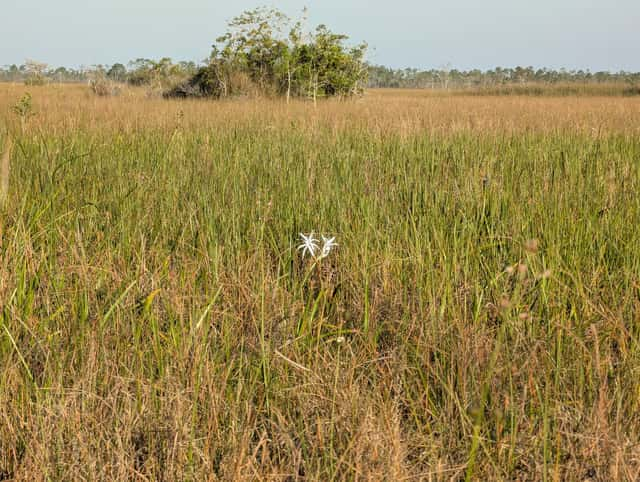
Amaryllidaceae
Southern Swamp Lily (Crinum americanum)
Crinum americanum
Full sun to part shade, rich soil that stays moist to wet, slightly acidic. Great for ponds, rain gardens and bog edges. Leave the bulbs undisturbed once planted. All parts are poisonous if eaten.
Every 2 days
Bright indirect
° - °C
% - %
Categories
What is Southern Swamp Lily?
Southern Swamp Lily (Crinum americanum) is a easy-care plant from the Amaryllidaceae family. Crinum americanum is a perennial bulb in the Amaryllidaceae family, native to swamps, marshes and stream banks of the southeastern United States, Mexico and the western Caribbean. It forms upright clumps 60 to 90 cm tall with long strap-like leaves rising straight from the bulb. From summer into fal...
Southern Swamp Lily grows up to 91cm, spread of 61cm, watering every 2 days. It is not suitable for indoor environments and not safe for pets.
Unlike many tropical plants, Southern Swamp Lily tolerates watering mistakes. Best for beginners. Without precautions, ingestion can cause irritation in pets. Keep out of reach of cats and dogs.
How to Care for Southern Swamp Lily?
TLDR: Southern Swamp Lily needs Bright indirect, watering every 2 days, and temperatures between 15-30°C with 40-70% humidity.
How Often Should You Water Southern Swamp Lily?
Keep the soil constantly moist; once established it tolerates wet feet and can sit in 2 to 5 cm of water at the pond edge. In containers water every 1 to 2 days in hot weather and never let it dry out. Newly planted bulbs should not sit under water.
How Much Light Does Southern Swamp Lily Need?
Flowers most heavily in full sun as long as water is plentiful. In very hot inland gardens, light shade keeps the leaves from scorching.
What Is the Best Soil for Southern Swamp Lily?
Rich, organic soil (sand, loam or clay) with a slightly acidic to neutral pH (6.0 to 7.5). Cover the bulb with only a thin layer of damp soil.
What Pot Should You Use for Southern Swamp Lily?
A large, deep pot only about 5 cm wider than the bulb; drainage is not critical. Aquatic planting baskets or pond pots also work.
What Is Southern Swamp Lily and Where Does It Come From?
Crinum americanum is a perennial bulb in the Amaryllidaceae family, native to swamps, marshes and stream banks of the southeastern United States, Mexico and the western Caribbean. It forms upright clumps 60 to 90 cm tall with long strap-like leaves rising straight from the bulb. From summer into fall, reddish stems carry umbels of 2 to 6 fragrant white flowers with narrow recurved petals and long purple stamens that attract moths, bees, butterflies and hummingbirds.
How to Propagate Southern Swamp Lily?
Clump division
Divided plants bloom sooner than small offsets. Don't divide often: a disturbed bulb can take 2 to 3 years to bloom again.
- 1 Lift the clump in early spring
- 2 Separate rooted bulbs with a clean knife
- 3 Replant each bulb covered with only a thin layer of damp soil
- 4 Keep the soil constantly moist until new growth appears
Materials needed:
Seed
The large fleshy seeds don't tolerate drying out. Seed-grown plants can take 3 to 8 years to flower.
- 1 Collect capsules once they turn brown
- 2 Sow the fleshy seeds right after harvest, pressed onto moist mix
- 3 Keep the mix moist in a bright spot
Materials needed:
How Big Does Southern Swamp Lily Grow?
TLDR: Southern Swamp Lily can reach up to 91cm tall with Fast growth rate.
Max height
91cm
Spread
61cm
Growth rate
Fast
Warning: Toxic Plant
This plant can be toxic if ingested. Keep out of reach of:
Plant Uses
Ornamental
Great for decoration
Is your plant showing symptoms?
Click on the symptom to discover possible causes:
What Diseases Commonly Affect Southern Swamp Lily?
TLDR: Southern Swamp Lily is susceptible to 6 known diseases. Monitor regularly for early detection.
Mealybugs
Mealybugs are small, soft-bodied insects covered with a white, waxy, cottony material. They are common pests of houseplants and outdoor plants in mild climates. These sap-sucking insects feed on plant tissue, causing damage, stunted growth, and can lead to plant death if left untreated. They produce sticky honeydew which attracts sooty mold.
Spider Mites
Spider mites are tiny arachnids (less than 1/20 inch long) related to spiders and ticks that feed on plant sap. They thrive in hot, dry conditions and can cause significant damage to ornamental and vegetable plants. During severe infestations, crop losses can reach 14% or higher as these pests disrupt vital plant processes including photosynthesis, carbon dioxide absorption, and transpiration.
Root-Knot Nematodes
Root-knot nematodes (Meloidogyne species) are microscopic roundworms that parasitize plant roots, causing characteristic galls or knots. These soil-borne pests are among the most economically damaging plant pathogens worldwide, affecting a wide range of ornamental and edible plants. The nematodes inject enzymes into root cells, causing abnormal swelling and disrupting water and nutrient uptake.
Slugs and Snails
Slugs and snails are mollusks that feed on plant tissue, causing irregular holes in leaves and damage to young seedlings. They are most active at night and in moist conditions, leaving characteristic silvery slime trails. These pests can quickly devastate gardens, especially during wet seasons.
Fun Facts
It's nicknamed 'seven sisters' because each stem often carries about seven flowers.
The flowers smell strongest at night and are pollinated by sphinx moths.
The name Crinum comes from the Greek krinon, meaning lily, though it isn't a true lily.
Frequently asked questions
How often should I water a swamp lily?
Is Crinum americanum toxic to cats and dogs?
When does the swamp lily bloom?
Why isn't my crinum flowering?
Compare with similar plants
| Attribute | Difficulty | Light | Watering | Pet Safe |
|---|---|---|---|---|
| Field Maple | Easy | Bright indirect | 14d | ✓ |
| Iberian Houseleek | Easy | Direct sun | 14d | ✓ |
| Silver Birch | Easy | Direct sun | 14d | ✓ |
| Common Blanketflower | Easy | Direct sun | 10d | ✓ |





