Alismataceae
Radican Sword: Ground Cover Plant
Aquarius cordifolius
A hardy and easy-to-grow plant, suitable for both planted aquariums (submerged form) and paludariums or ornamental ponds in warm climates (emerged form). It requires a nutrient-rich substrate, moderate to strong light, and warm water; it tolerates a wide range of pH and hardness but grows more vigorously with regular fertilization and, when submerged, with CO2 injection.
Every 1 days
Bright indirect
18° - 28°C
80% - 100%
Categories
What is Radican Sword?
Radican Sword (Aquarius cordifolius) is a easy-care plant from the Alismataceae family. The Radican Sword (Aquarius cordifolius, formerly classified as Echinodorus cordifolius) is a perennial aquatic/marsh plant from the Alismataceae family, native to swamps, marshes, and muddy banks of the southeastern United States, Mexico, Central America, and northern South America. Its heart-shape...
Radican Sword grows up to 1.0m, spread of 60cm, watering every 1 days, 18°C – 28°C, 80–100% humidity. It is suitable for indoor environments and safe for pets.
Unlike many tropical plants, Radican Sword tolerates watering mistakes. Best for beginners. Unlike many popular species, Radican Sword is safe to keep around pets. Without adequate drainage, root rot can develop within 7 days.
How to Care for Radican Sword?
TLDR: Radican Sword needs Bright indirect, watering every 1 days, and temperatures between 18-28°C with 80-100% humidity.
How Often Should You Water Radican Sword?
It is an aquatic/marsh plant: the roots and crown must always remain soaked or submerged, never dry. In an aquarium, maintain a stable water level and perform weekly partial water changes; in a paludarium or pot, keep the substrate constantly saturated or with a shallow layer of water.
How Much Light Does Radican Sword Need?
Prefers moderate to strong light, between 8 and 12 hours daily. Low light results in small leaves and slow growth; strong, constant light stimulates larger leaves and, eventually, emerged growth above the water.
What Is the Best Soil for Radican Sword?
Use a nutrient-rich substrate—a mix of sand, clay, and organic material (peat)—to support its heavy appetite for nutrients. Supplementing with root tabs or iron-rich liquid fertilizer promotes greener leaves and vigorous growth.
What Pot Should You Use for Radican Sword?
In an aquarium, plant directly into the tank substrate without a pot, leaving the crown above the substrate line to prevent rot. In a paludarium or as a pond margin plant, use a wide, shallow pot without mandatory drainage holes, kept partially submerged.
Care Schedule
Fertilize
Every 14 days
Repot
Every 365 days
What Is Radican Sword and Where Does It Come From?
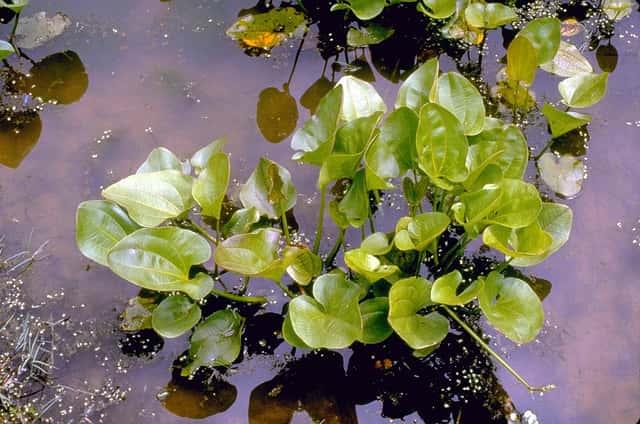
The Radican Sword (Aquarius cordifolius, formerly classified as Echinodorus cordifolius) is a perennial aquatic/marsh plant from the Alismataceae family, native to swamps, marshes, and muddy banks of the southeastern United States, Mexico, Central America, and northern South America. Its heart-shaped (cordate) leaves, bright green and marked by clearly visible translucent veins, can be kept fully submerged in an aquarium or grown out of the water in a paludarium/emerged setup, where the plant becomes considerably larger and more robust, potentially exceeding 3 feet (1 meter) in height. It is a highly versatile amphibious species: under strong light and long photoperiods, it produces arched flower stalks with white flowers and forms adventitious plantlets along these stalks, which root and give rise to new specimens.
How to Propagate Radican Sword?
Rhizome division
Wait for the mother plant to be well-established and healthy before dividing, and always use sterilized tools to prevent rot.
- 1 Carefully remove the mother plant from the substrate, preserving as many roots as possible
- 2 Locate branching points on the rhizome with their own leaves and roots
- 3 Cut the rhizome with a clean, sharp blade, separating the sections
- 4 Replant each section in rich substrate, keeping the crown above the substrate
Materials needed:
Adventitious plantlets on flower stalks
Do not separate the plantlets too early; the more roots they have before cutting, the higher the survival rate.
- 1 Wait for adventitious plantlets to form along the emerged flower stalk
- 2 Allow the plantlets to develop some of their own roots while still attached to the stalk
- 3 Cut the stalk near the already rooted plantlet, separating it from the mother plant
- 4 Plant the new offset in rich substrate or leave it floating until it roots better
Materials needed:
How Big Does Radican Sword Grow?
TLDR: Radican Sword can reach up to 1.0m tall with Medium growth rate.
Max height
1.0m
Spread
60cm
Growth rate
Medium
Foliage
Evergreen
Plant Uses
Ornamental
Great for decoration
Ground Cover
Soil coverage
Is your plant showing symptoms?
Click on the symptom to discover possible causes:
What Diseases Commonly Affect Radican Sword?
TLDR: Radican Sword is susceptible to 5 known diseases. Monitor regularly for early detection.
Root Rot
Root rot is a serious fungal disease that affects the root system of plants, causing them to decay and die. It is primarily caused by overwatering, poor drainage, or soil-borne fungi such as Pythium, Phytophthora, Rhizoctonia, and Fusarium. The disease thrives in waterlogged conditions where roots are deprived of oxygen, making them susceptible to fungal infection.
Iron Deficiency
Iron deficiency, commonly known as iron chlorosis, is a nutrient deficiency disorder where plants cannot access sufficient iron from the soil. While iron is typically abundant in soil, various soil conditions can limit plant uptake, resulting in characteristic yellowing of leaves while veins remain green.
Animal Feeding Damage
Damage to plants caused by the feeding activities of animals such as insects, slugs, snails, or rodents. This weakens the plant and creates entry points for secondary diseases.
Transplant Shock
Transplant shock is a stress response that occurs when plants are abruptly moved from one environment to another. This environmental condition affects plants during repotting, moving between indoor/outdoor locations, or transplanting from nursery pots to gardens. Root damage during the move is the primary cause, making it nearly impossible to completely avoid some degree of stress.
Compare with similar plants
| Attribute | Difficulty | Light | Watering | Pet Safe |
|---|---|---|---|---|
| Field Maple | Easy | Bright indirect | 14d | ✓ |
| Silver Birch | Easy | Direct sun | 14d | ✓ |
| Common Blanketflower | Easy | Direct sun | 10d | ✓ |
| Cushion Bush | Easy | Direct sun | 14d | ✓ |





