Onagraceae
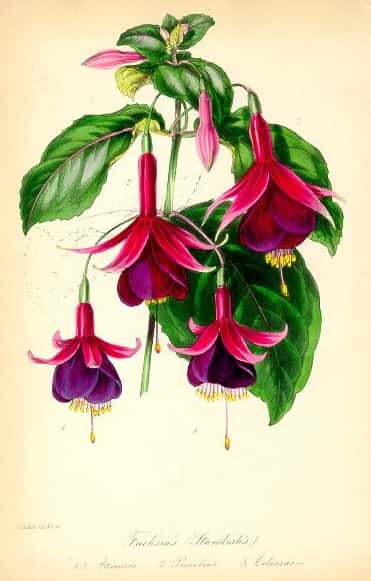
Standish's Fuchsia (Fuchsia × standishii)
Fuchsia × standishii
Plant in bright indirect light or partial shade. Water every 3 days keeping soil moist but not waterlogged. Fertilize every 2 weeks during the growing season. Prune hard in spring to encourage bushy growth.
Every 3 days
Partial shade
5° - 22°C
50% - 75%
Categories
What is Standish's Fuchsia?
Standish's Fuchsia (Fuchsia × standishii) is a medium-care plant from the Onagraceae family. Fuchsia × standishii is a historic 19th-century hybrid resulting from the cross between F. lycioides and F. magellanica. It produces pendulous tubular flowers in shades of red, purple, and pink, blooming abundantly in spring and summer. A classic choice for hanging baskets and ornamental pots.
Standish's Fuchsia grows up to 1.5m, spread of 120cm, watering every 3 days, 5°C – 22°C, 50–75% humidity. It is suitable for indoor environments and safe for pets.
Unlike many popular species, Standish's Fuchsia is safe to keep around pets. Without adequate drainage, root rot can develop within 7 days.
How to Care for Standish's Fuchsia?
TLDR: Standish's Fuchsia needs Partial shade, watering every 3 days, and temperatures between 5-22°C with 50-75% humidity.
How Often Should You Water Standish's Fuchsia?
Water every 3 days, keeping soil evenly moist. Always check that the top layer of soil is slightly dry before watering again to prevent root rot.
How Much Light Does Standish's Fuchsia Need?
Thrives in bright indirect light or partial shade. Avoid intense direct afternoon sun, which can scorch its delicate flowers and foliage.
What Is the Best Soil for Standish's Fuchsia?
Use well-draining soil rich in organic matter, pH 6.0–6.5. Mix potting soil with perlite and compost for optimal drainage.
What Pot Should You Use for Standish's Fuchsia?
Ceramic or terracotta pot with drainage hole. Hanging baskets are ideal to showcase the pendulous flowers.
Care Schedule
Fertilize
Every 14 days
Misting
Every 3 days
Rotate
Every 30 days
Repot
Every 730 days
What Is Standish's Fuchsia and Where Does It Come From?
Fuchsia × standishii is a historic 19th-century hybrid resulting from the cross between F. lycioides and F. magellanica. It produces pendulous tubular flowers in shades of red, purple, and pink, blooming abundantly in spring and summer. A classic choice for hanging baskets and ornamental pots.
How to Propagate Standish's Fuchsia?
Stem Cutting
Use sterilized pruning shears. Keep substrate moist but not soggy. Best rooting temperature is 18-22°C.
- 1 Cut a healthy stem 8-10 cm long with 2-3 leaf pairs
- 2 Remove lower leaves and apply rooting hormone to the base
- 3 Insert into moist, well-draining propagation mix
- 4 Keep in a shaded, humid spot until roots develop
Materials needed:
How Big Does Standish's Fuchsia Grow?
TLDR: Standish's Fuchsia can reach up to 1.5m tall with Medium growth rate.
Max height
1.5m
Spread
1.2m
Growth rate
Medium
Foliage
Deciduous
Plant Uses
Ornamental
Great for decoration
Is your plant showing symptoms?
Click on the symptom to discover possible causes:
What Diseases Commonly Affect Standish's Fuchsia?
TLDR: Standish's Fuchsia is susceptible to 6 known diseases. Monitor regularly for early detection.
Rust
Rust is a common fungal disease caused by fungi in the order Pucciniales that affects a wide variety of plants. The disease gets its name from the characteristic orange, yellow, or reddish-brown pustules that appear on leaves, resembling metal rust. This obligate fungal parasite requires living plants to survive and can cause significant economic losses in agricultural crops.
Gray Mold (Botrytis Blight)
Gray mold, caused by the fungus Botrytis cinerea, is one of the most common fungal diseases in plants. It affects over 200 plant species, including ornamentals, vegetables, fruits, and houseplants. The disease thrives in cool, humid conditions with poor air circulation, causing grayish spots and soft rot on infected tissues.
Root Rot
Root rot is a serious fungal disease that affects the root system of plants, causing them to decay and die. It is primarily caused by overwatering, poor drainage, or soil-borne fungi such as Pythium, Phytophthora, Rhizoctonia, and Fusarium. The disease thrives in waterlogged conditions where roots are deprived of oxygen, making them susceptible to fungal infection.
Aphids
Aphids are small, soft-bodied, pear-shaped insects (1/16 to 1/8 inch long) that feed by sucking nutrient-rich sap from plants. They reproduce rapidly and can quickly weaken plants, causing distorted growth and transmitting plant viruses. Aphids come in various colors including green, black, red, yellow, brown, and gray. They secrete honeydew, a sticky substance that attracts ants and encourages sooty mold growth.
Meaning & Symbolism
Hospitality, elegance and love
Fun Facts
A historic 19th-century hybrid named in honour of horticulturist John Standish
Its pendulous tubular flowers attract hummingbirds and butterflies
Closely related to F. magellanica, one of the hardiest fuchsias known
Frequently asked questions
How often should I water Standish's Fuchsia?
What light does Fuchsia × standishii need?
Is Standish's Fuchsia toxic to pets?
When does Standish's Fuchsia bloom?
How do I propagate Standish's Fuchsia?
Compare with similar plants
| Attribute | Difficulty | Light | Watering | Pet Safe |
|---|---|---|---|---|
| Dark Fieldcap | Medium | Low light | 2d | ⚠️ |
| Azalea | Medium | Partial shade | 3d | ⚠️ |
| Muriel's Bamboo | Medium | Partial shade | 3d | ✓ |
| Bougainvillea | Medium | Direct sun | 7d | ⚠️ |




