Rhamnaceae
Ventilago (Supplejack): The Tropical Climbing Genus of Rhamnaceae
Ventilago
A robust tropical climber preferring full sun to partial shade. Water moderately, allowing soil to dry slightly between waterings. Well adapted to warm, humid climates; frost-sensitive.
Every 4 days
Bright indirect
15° - 38°C
50% - 80%
Categories
What is Supplejack?
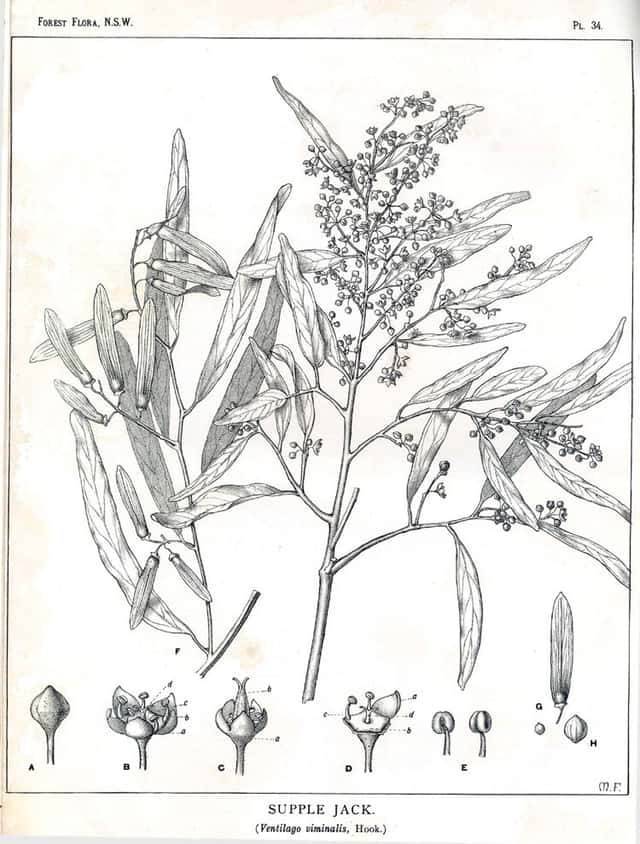
Supplejack (Ventilago) is a medium-care plant from the Rhamnaceae family. Ventilago is a genus of approximately 40 species of evergreen climbing vines and scandent shrubs in the family Rhamnaceae. Native to tropical South and Southeast Asia, Australasia, Africa, and Madagascar, they bear small greenish-yellow axillary flowers and distinctive single-seeded winged samaras....
Supplejack grows up to 7.0m, spread of 300cm, watering every 4 days, 15°C – 38°C, 50–80% humidity. It is not suitable for indoor environments and safe for pets.
Unlike many popular species, Supplejack is safe to keep around pets.
How to Care for Supplejack?
TLDR: Supplejack needs Bright indirect, watering every 4 days, and temperatures between 15-38°C with 50-80% humidity.
How Often Should You Water Supplejack?
Water every 3–5 days in summer, keeping soil evenly moist but not waterlogged. Reduce to once weekly in cooler months.
How Much Light Does Supplejack Need?
Prefers full sun to partial shade (20,000–80,000 lux). Position in a well-lit spot; tolerates filtered light but flowers best with direct sun.
What Is the Best Soil for Supplejack?
Use well-draining, slightly acidic to neutral soil (pH 6.5–7.5). A sandy loam mix with organic compost works well. Avoid compacted soils.
What Pot Should You Use for Supplejack?
Terracotta pot or wide container with good drainage for container growing
Care Schedule
Fertilize
Every 30 days
Misting
Every 7 days
Repot
Every 730 days
What Is Supplejack and Where Does It Come From?
Ventilago is a genus of approximately 40 species of evergreen climbing vines and scandent shrubs in the family Rhamnaceae. Native to tropical South and Southeast Asia, Australasia, Africa, and Madagascar, they bear small greenish-yellow axillary flowers and distinctive single-seeded winged samaras. Some species develop a tree-like form when mature, reaching up to 7 meters.
How to Propagate Supplejack?
Seed Sowing
Use fresh seeds for best germination rates. Maintain consistent warmth.
- 1 Sow seeds in well-draining substrate 1–2 cm deep
- 2 Keep soil moist in a warm location (20–25°C)
- 3 Expect germination in 2–4 weeks
- 4 Transplant seedlings when they reach 10 cm
Materials needed:
Stem Cutting
Keep in indirect light until rooted. Check moisture regularly.
- 1 Take a healthy semi-hardwood cutting 10–15 cm long
- 2 Remove lower leaves
- 3 Dip base in rooting hormone
- 4 Plant in moist substrate and cover with plastic bag to retain humidity
Materials needed:
How Big Does Supplejack Grow?
TLDR: Supplejack can reach up to 7.0m tall with Medium growth rate.
Max height
7.0m
Spread
3.0m
Growth rate
Medium
Foliage
Evergreen
Plant Uses
Ornamental
Great for decoration
Medicinal
Medicinal properties
Medicinal Uses
- Bark and root infusions used in traditional Aboriginal medicine to treat skin ailments, bruises, and rheumatism
Is your plant showing symptoms?
Click on the symptom to discover possible causes:
What Diseases Commonly Affect Supplejack?
TLDR: Supplejack is susceptible to 5 known diseases. Monitor regularly for early detection.
Root Rot
Root rot is a serious fungal disease that affects the root system of plants, causing them to decay and die. It is primarily caused by overwatering, poor drainage, or soil-borne fungi such as Pythium, Phytophthora, Rhizoctonia, and Fusarium. The disease thrives in waterlogged conditions where roots are deprived of oxygen, making them susceptible to fungal infection.
Powdery Mildew
Powdery mildew is a common fungal disease caused by various fungi species including Erysiphe, Podosphaera, Oïdium, and Leveillula. It affects over 10,000 plant species worldwide. The disease thrives in warm, dry climates with high humidity and appears as a distinctive white powdery coating on plant surfaces.
Leaf Spot
Leaf spot is a common fungal disease caused by various pathogens including Alternaria, Ascochyta, Colletotrichum, Septoria, and Venturia. It primarily affects leaves, causing discolored spots that can lead to premature leaf drop if left untreated.
Aphids
Aphids are small, soft-bodied, pear-shaped insects (1/16 to 1/8 inch long) that feed by sucking nutrient-rich sap from plants. They reproduce rapidly and can quickly weaken plants, causing distorted growth and transmitting plant viruses. Aphids come in various colors including green, black, red, yellow, brown, and gray. They secrete honeydew, a sticky substance that attracts ants and encourages sooty mold growth.
Meaning & Symbolism
Resilience and adaptability across tropical landscapes
Fun Facts
The Ventilago genus contains around 40 species distributed across the tropical Indo-Pacific region
Indigenous Australians used Ventilago viminalis bark and root infusions to treat skin diseases and rheumatism
Ventilago fruits are winged samaras dispersed by wind, enabling colonisation of new areas
Ventilago vanuatuana roots produce a crimson-red dye used to pattern traditional textiles in Vanuatu
Frequently asked questions
How often should I water Ventilago?
Does Ventilago need a lot of sun?
Is Ventilago toxic?
How do I propagate Ventilago?
Can Ventilago tolerate cold?
Compare with similar plants
| Attribute | Difficulty | Light | Watering | Pet Safe |
|---|---|---|---|---|
| Dark Fieldcap | Medium | Low light | 2d | ⚠️ |
| Azalea | Medium | Partial shade | 3d | ⚠️ |
| Muriel's Bamboo | Medium | Partial shade | 3d | ✓ |
| Bougainvillea | Medium | Direct sun | 7d | ⚠️ |




