Fungus Gnats: Pest Control | Identify & Treat
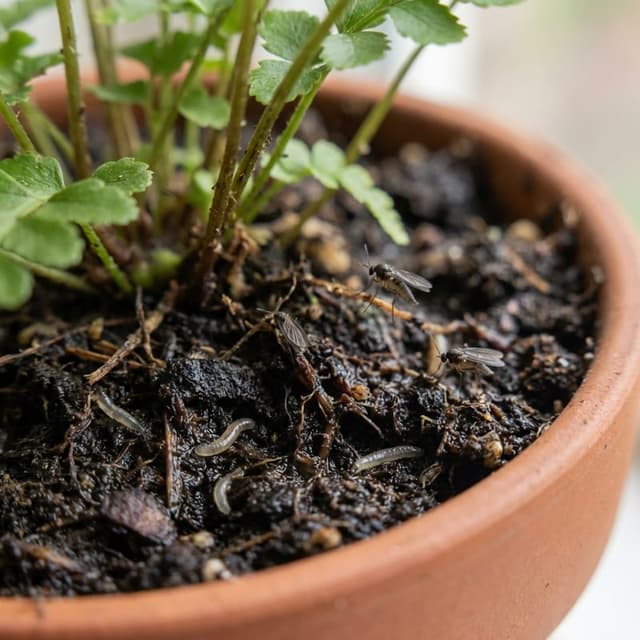
Fungus gnats are small, gray-to-black mosquito-like insects (1/8 to 1/10 inches long) commonly found in indoor plants. Adult gnats are mostly a nuisance, but their larvae feed on plant roots and organic matter in soil, potentially causing serious damage to young or vulnerable plants. The larvae are translucent white with distinctive black heads and can leave slime trails on the soil surface in heavy infestations.
Fast
14 days
What is Fungus Gnats?
Fungus Gnats is a pest condition with moderate severity that affects plants. Fungus gnats are small, gray-to-black mosquito-like insects (1/8 to 1/10 inches long) commonly found in indoor plants. Adult gnats are mostly a nuisance, but their larvae feed on plant roots and organic matter in soil, potentially causing serious damage to young or vulnerable plants. The larvae are...
Fungus Gnats is a pest disease with moderate severity that spreads at a fast rate. Recovery typically takes approximately 14 days with proper treatment. It affects 10 plant species in our database. This condition is contagious and can spread between plants.
Unlike fungal diseases, Fungus Gnats can be controlled quickly with integrated management. Without immediate action, the infestation spreads to nearby plants. Without isolation, nearby plants can become infected within days.
🔍 What Are the Symptoms of Fungus Gnats?
TLDR: Fungus Gnats presents 8 main symptoms. Early identification is crucial for effective treatment.
Main Symptoms
- ! Small dark flying insects resembling mosquitoes hovering around plants
- ! Translucent white larvae (5mm) with black heads visible in soil
- ! Slime trails on soil surface in severe infestations
- ! Yellowing leaves without obvious cause
- ! Stunted or slow growth
- ! Wilting despite adequate watering
- ! Root damage visible when plant is unpotted
- ! Seedlings or cuttings failing to thrive
Visual Signs
❓ What Causes Fungus Gnats in Plants?
- → Overwatering creating persistently moist soil conditions
- → Organic-rich potting mixes that retain excessive moisture
- → Poor drainage in containers
- → Presence of decaying organic matter in soil
- → Bringing infested plants indoors
- → Using contaminated potting soil
- → High humidity combined with wet soil
- → Lack of air circulation around plants
💊 How to Treat Fungus Gnats?
TLDR: Treat Fungus Gnats with 7 days of quick treatment or 14 days of organic treatment. Full recovery takes approximately 14 days.
Quick Fixes
~7 days
Step 1
Remove top 1-2 inches of infested soil and replace with fresh sterile potting mix
Step 2
Apply hydrogen peroxide solution (1 part 3% peroxide to 4 parts water) as soil drench
Step 3
Set up multiple yellow sticky traps around affected plants immediately
Step 4
Stop watering for 3-5 days to kill larvae and eggs
Step 5
Apply BTi mosquito dunk solution for immediate larvae control
Materials needed:
Organic Treatment
~14 days
Step 1
Allow soil to dry completely between waterings to disrupt larvae lifecycle
Step 2
Apply food-grade diatomaceous earth (1/4 inch layer) on soil surface
Step 3
Water plants with BTi (Bacillus thuringiensis israelensis) solution using mosquito dunks
Step 4
Sprinkle cinnamon powder on topsoil as natural fungicide
Step 5
Place yellow sticky traps near plants to capture adult gnats
Step 6
Introduce beneficial nematodes (Steinernema feltiae) to soil for larvae control
Materials needed:
Expert Treatment
~21 days
Step 1
Conduct soil moisture audit and adjust watering schedule to prevent overwatering
Step 2
Apply commercial-grade BTi larvicide through drip irrigation or soil drench
Step 3
Release predatory mites (Hypoaspis/Stratiolaelaps) and rove beetles (Dalotia coriaria)
Step 4
Implement integrated pest management with yellow sticky cards for monitoring
Step 5
Apply beneficial nematode solution (minimum 50 million nematodes per plant)
Step 6
Treat soil with diatomaceous earth barrier and natural fungicides (cinnamon/chamomile)
Step 7
Improve drainage and aeration with perlite or sand amendments if needed
Step 8
Monitor population weekly using sticky trap counts and adjust treatments accordingly
Step by Step
- 1
Stop overwatering immediately and allow top 1-2 inches of soil to dry
- 2
Apply Bti product (Mosquito Bits or Gnatrol) as soil drench following label instructions
- 3
Place yellow sticky traps horizontally at soil surface to monitor and trap adults
- 4
Remove any standing water from saucers or trays
- 5
Introduce beneficial nematodes to soil for biological control
- 6
Apply hydrogen peroxide solution (1:4 ratio) as soil drench if infestation is severe
- 7
Add 1/2 inch layer of sand or diatomaceous earth on soil surface
- 8
Repeat Bti treatment every 5-7 days for 2-3 weeks to break lifecycle
- 9
Monitor population with sticky traps and continue until no adults are caught for one week
🧪 Natural vs Chemical: Which Treatment Works for Fungus Gnats?
🌱 Natural Solutions
- ✓ Bacillus thuringiensis israelensis (Bti) - Apply as soil drench (e.g., Mosquito Bits, Gnatrol) to kill larvae
- ✓ Beneficial nematodes (Steinernema feltiae) - Parasitize and kill larvae in soil
- ✓ Hydrogen peroxide solution (1 part 3% H2O2 to 4 parts water) - Kills larvae and eggs on contact
- ✓ Yellow sticky traps - Place horizontally at soil level to catch egg-laying adults
- ✓ Apple cider vinegar trap - Mix equal parts vinegar and water with dish soap to trap adults
- ✓ Neem oil soil drench - Disrupts larvae development
- ✓ Diatomaceous earth - Sprinkle food-grade DE on soil surface
- ✓ Chamomile or cinnamon - Natural fungicides that eliminate gnats food source
- ✓ Bottom watering - Keeps soil surface dry to discourage egg-laying
💉 Chemical Solutions
- ✓ Pyrethrin-based insecticides - Spray for adult gnats
- ✓ Imidacloprid soil drench - Systemic insecticide for larvae control
- ✓ Permethrin sprays - Contact insecticide for flying adults
Treatment Comparison
| Type | Estimated time | Steps | Difficulty | Best For |
|---|---|---|---|---|
| ⚡Quick | ~7 days | 5 | Advanced | Urgent cases |
| 🌿Organic | ~14 days | 6 | Advanced | Indoor plants |
| 🔬Expert | ~21 days | 8 | Advanced | Severe infections |
🛡️ How to Prevent Fungus Gnats?
TLDR: Prevent Fungus Gnats with 9 essential care practices. Regular monitoring is key for early detection.
- ✓ Allow soil to dry to 1-2 inches depth between waterings
- ✓ Use well-draining potting mixes
- ✓ Ensure pots have adequate drainage holes
- ✓ Inspect new plants thoroughly before bringing them home
- ✓ Remove dead leaves and plant debris from soil surface
- ✓ Avoid overwatering, especially in winter months
- ✓ Cover soil surface with sand or gravel to deter egg-laying
- ✓ Quarantine new plants for 2-3 weeks before placing near others
- ✓ Improve air circulation around plants
🔗Related Diseases
Whitefly
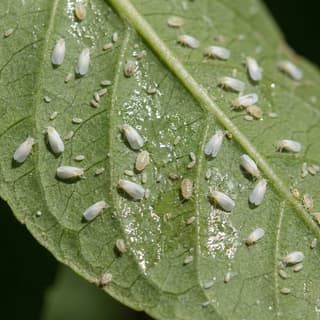
Whiteflies (family Aleyrodidae) are tiny, sap-sucking insects that thrive in warm, still air. They are common on houseplants, greenhouse crops, and garden plants such as tomatoes, peppers, cucumbers, fuchsias, hibiscus, poinsettias, citrus, and many herbs. You’ll often see small white adults flutter up when you touch the plant, sticky honeydew on leaves or nearby surfaces, black sooty mould growing on that honeydew, and leaves that yellow, curl, or drop. Check the undersides of leaves for pale, scale-like nymphs and tiny eggs laid in small arcs. Heavy infestations weaken plants and slow growth.

Woolly Beech Aphid
Phyllaphis is a genus of woolly aphids that primarily attack beech (Fagus), typically common beech and copper beech in hedges and as trees. They suck plant sap from young shoots and the undersides of leaves in spring and early summer. Signs of infestation include curled or rolled leaves, sticky honeydew, black sooty mold, and a white, cottony coating around the colonies. The plants usually survive, but heavy infestations can weaken new growth and make the hedge sticky and unsightly. The aphids often overwinter as eggs on thin twigs near buds.
Flea beetle damage
MediumFlea beetles are small, jumping insects that feed on the leaves of many vegetable crops. They chew numerous small, circular holes, creating a characteristic 'shothole' appearance. While established plants can often tolerate the damage, young seedlings are highly susceptible and can be stunted or killed if the infestation is severe.
Woolly Aphid
Prociphilus is a genus of woolly aphids that feed by sucking sap from plants. They produce a fluffy, white, cotton-like coating on leaves, shoots, or sometimes roots. Signs include sticky honeydew, black sooty mold growing on the honeydew, leaf curling or distortion, and clusters of tiny, soft-bodied insects hidden in the "wool." Ants are often active around them because they feed on the honeydew. These aphids commonly affect alder and maple (woolly alder aphid) and ash (woolly ash aphid). They rarely kill established trees, but they can stress young plants and create a messy, sticky problem.