Water Deficiency in Plants — Causes, Symptoms & Treatment
Water deficiency occurs when a plant cannot absorb enough moisture to meet its transpiration and metabolic demands. Also known as drought stress or underwatering, this condition deprives cells of turgor pressure, leading to wilting, leaf scorch, and — if prolonged — permanent root and tissue damage. It is one of the most common causes of houseplant decline and is fully reversible when caught early.
7 days
What is Underwatering?
Underwatering is a environmental condition with moderate severity that affects plants. Water deficiency occurs when a plant cannot absorb enough moisture to meet its transpiration and metabolic demands. Also known as drought stress or underwatering, this condition deprives cells of turgor pressure, leading to wilting, leaf scorch, and — if prolonged — permanent root and tissue damage....
Underwatering is a environmental disease with moderate severity. Recovery typically takes approximately 7 days with proper treatment. It affects 1 plant species in our database.
Unlike infectious diseases, Underwatering is caused by environmental conditions. Without correcting the environment, symptoms return even after treatment. Unlike many common diseases, Underwatering is not contagious between plants.
🔍 What Are the Symptoms of Underwatering?
TLDR: Underwatering presents 8 main symptoms. Early identification is crucial for effective treatment.
Main Symptoms
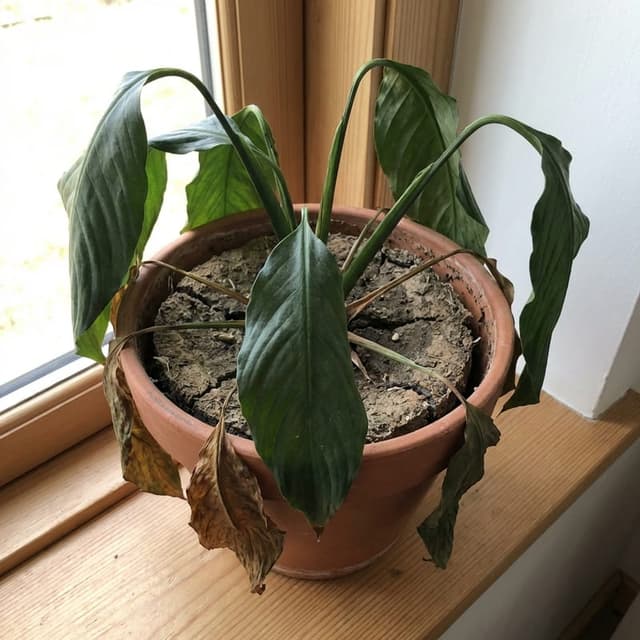
- ! Wilting or drooping stems and leaves that feel limp
- ! Leaf edges and tips turning brown and crispy
- ! Leaves curling inward to reduce surface area and conserve moisture
- ! Dry, pulling-away-from-pot-edges soil
- ! Yellowing older leaves followed by premature leaf drop
- ! Flower buds dropping before opening
- ! Stunted or halted new growth
- ! Lightweight pot compared to when freshly watered
Visual Signs
❓ What Causes Underwatering in Plants?
- → Infrequent or forgotten watering
- → Pot too small for the root system, drying out too quickly
- → Fast-draining or sandy soil with low water-retention capacity
- → High temperatures, low humidity, or strong airflow increasing transpiration
- → Root-bound plants unable to retain sufficient moisture
- → Seasonal heat spikes not compensated with extra watering
💊 How to Treat Underwatering?
Step by Step
- 1
Step 1: Confirm diagnosis — check soil dryness 2 cm deep and lift pot (underwatered pots feel unusually light).
- 2
Step 2: Bottom-water the plant by submerging the pot up to its rim in room-temperature water for 15–30 minutes.
- 3
Step 3: Remove pot and allow excess water to drain completely through drainage holes (10–15 minutes).
- 4
Step 4: Lightly mist the leaves to aid surface rehydration.
- 5
Step 5: Move the plant to indirect light or shade to reduce transpiration stress during recovery.
- 6
Step 6: Monitor over 24–48 hours — most plants show visible improvement (leaves lifting) within hours.
- 7
Step 7: Once recovered, establish a regular watering schedule and adjust substrate if drying was too rapid.
- 8
Step 8: Resume normal care (fertilization, bright light) only after full recovery.
🧪 Natural vs Chemical: Which Treatment Works for Underwatering?
🌱 Natural Solutions
- ✓ Deep soak: set pot in a basin of room-temperature water for 15–30 minutes until soil is fully saturated, then drain completely — this reverses compaction and ensures uniform rehydration
- ✓ Mist foliage lightly after soaking to help leaves rehydrate faster
- ✓ Move plant to a shaded, cooler spot temporarily to reduce transpiration during recovery
- ✓ Top-dress with compost to improve water retention long-term
💉 Chemical Solutions
- ✓ Not applicable — water is the solution. Avoid fertilizing stressed plants; wait until full recovery before resuming feeding schedules.
🛡️ How to Prevent Underwatering?
TLDR: Prevent Underwatering with 6 essential care practices. Regular monitoring is key for early detection.
- ✓ Establish a consistent watering schedule matched to the season (more frequent in summer)
- ✓ Use a moisture meter or finger-test (insert 2 cm into soil) before watering
- ✓ Add organic mulch (2–4 cm layer) on top of soil to slow evaporation
- ✓ Use self-watering pots with built-in reservoirs for forgetful owners
- ✓ Upgrade to a substrate with added perlite, coco coir, or compost to improve moisture retention
- ✓ Group plants together to raise ambient humidity and slow drying
🔗Related Diseases
Severe Defoliation
HighThis condition involves a sudden and massive loss of leaves caused by adverse environmental factors. The plant sheds its foliage in an attempt to survive extreme stress, such as abrupt temperature changes, improper watering, or transplant shock. If the underlying cause is not addressed, the plant may completely wither and die.
Severe Defoliation and Dormancy
HighThis condition is triggered by extreme environmental stress, such as sudden temperature fluctuations, insufficient light, or improper watering. In an effort to survive, the plant sheds its leaves and enters a dormant state to conserve energy.
Leaf Drop (Environmental Stress)
MediumLeaf drop occurs when a plant undergoes sudden environmental changes, such as insufficient light, excessive wind, or temperature fluctuations. It is not a fungal disease, but rather a physical response to stress.
Physical Leaf Damage
LowThis is not an infectious disease, but rather the result of external mechanical or environmental factors. It occurs due to rough handling, strong winds, hail, or pets. Leaves exhibit tears, cuts, or frayed edges, but the rest of the plant typically remains healthy and green.