African Violet Yellow Leaves: Causes and What to Do
Yellow leaves on an African violet usually stem from overwatering, and the first place to check is the center of the plant. Losing one lower leaf at a time is normal. Identify whether age, watering, cold water, sunlight, cold drafts, or fertilizer is the culprit based on the yellowing pattern, and see what to do today.
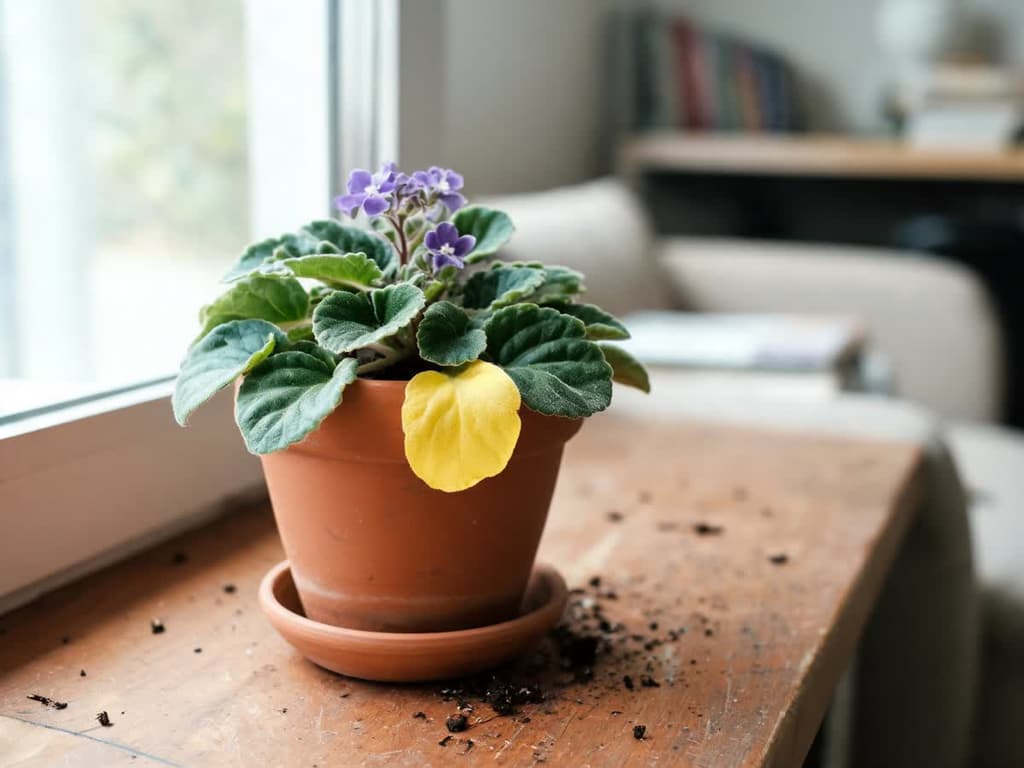
Yellow leaves on an African violet, when they start at the bottom and feel soft, usually point to overwatering. According to Iowa State Extension, lower leaves that turn yellow and droopy suggest root rot. This root rot typically results from excessive watering.
One leaf yellowing at a time on the bottom row, with the rest of the plant staying firm, is normal. The violet sheds its oldest lower leaves while producing fresh new leaves in the center.
What sets the causes apart is where the yellowing appears and how the leaf feels. Soft yellowing at the bottom indicates overwatering. A pale ring where a droplet fell points to cold water. A pale yellow wash on the outer leaves, the ones furthest from the center and closest to the window, signals too much sun.
Before watering, fertilizing, or repotting, gently press the center of the plant with your finger. Check whether it feels firm or mushy. This five-second test reveals if the African violet's growing point is still alive.
African violet yellow leaves: what the yellowing pattern tells you
Each cause turns a different part of the African violet (Streptocarpus ionanthus, still sold under its older name Saintpaulia ionantha) yellow. Find the row in the table that describes your plant.
What you see | Most likely cause | What to do today |
|---|---|---|
One leaf on the bottom row turns yellow at a time, the rest stays firm, new leaves emerge in the center | Normal aging | Remove the yellow leaf at the base of the petiole |
Three or more bottom leaves turn yellow in the same month, growth slows down, almost no new leaves emerge in the center | Underfertilizing | Resume fertilizing at one-fourth the package strength |
Lower leaves turn yellow, soft, and droopy; the top inch of soil does not dry out | Overwatering, accompanied by root rot | Empty the saucer and only water once the top inch of soil has dried out |
A pale ring or spot (yellowish, whitish, or light green) where water dropped | Cold water on the leaf | Water with room-temperature water without wetting the leaves. Leave the leaf on the plant |
Outer leaves look pale, yellowish green, small, and stiff | Too much light, with direct sunlight | Move away from direct sunlight or hang a sheer curtain on the window |
Yellow edges or yellow spots on older leaves, white crust on the pot | Overfertilizing and salt accumulation in the soil | Water from above until water drains through the drainage hole |
Leaves turn pale green and curl downward after cold nights | Cold temperatures below 60 °F (15.5 °C) | Move the pot away from the windowpane at night |
The causes listed in each row are sourced in the sections below. The complete list of causes for yellow leaves on an African violet also covers pests and diseases less common to the species. These include thrips and mealybugs, tiny insects that suck sap.
In other plant species, yellowing between leaf veins (the fine lines running through the leaf) often indicates a nutrient deficiency. The guide on yellow leaves on any plant sorts these causes by the pattern of yellowing across the leaf.
Address one cause at a time. If two rows in the table seem to fit, start with overwatering, as that is the cause that can kill the plant.
Gently press the center of the rosette before anything else
The center of the African violet shows whether the plant can still recover. This center is the crown: the point, flush with the soil line, from which all leaves in the rosette, the plant's circle of leaves, grow.
Gently press the crown with your finger.
Firm and dry, with fresh green leaves in the center: the crown is alive, even if multiple outer leaves are yellow. Proceed to find the cause in the table. If the soil is wet, check the roots as well, as explained in the overwatering section.
Water-soaked in appearance, soft, or dark: this is crown rot. Iowa State Extension describes the main stem and lower leaves taking on a water-soaked appearance, wilting, and dying.
According to the same source, crown rot usually kills the plant. A firm leaf from the ailing violet, however, can still produce a new plant. Cut the leaf with a 1 to 1.5-inch (2.5 to 4 cm) petiole, the slender stalk connecting the leaf to the center. Insert the petiole into a light, moist potting mix. The propagation method and measurements come from Iowa State Extension.
Rot spreads upward from the roots and crown into the leaves, and the care sheet on rot in African violets outlines the symptoms of each stage.
Iowa State Extension highlights two primary causes of crown rot: overwatering and recent repotting. If your violet was repotted in recent weeks, check the center first.
One bottom leaf at a time: aging or underfertilizing
A yellow leaf on the bottom tier is either aging or a lack of fertilizer. What separates the two is the speed of yellowing and the condition of the center of the plant.
Normal aging. Iowa State Extension notes that as the African violet grows, the lower leaves die and drop off. The plant produces new leaves in the center while shedding its oldest ones below.
Underfertilizing. Clemson Cooperative Extension describes the same location with a different cause. Older, lower leaves turning yellow along with slower growth indicate a lack of fertilizer.
The two sources do not contradict each other, but neither provides a specific count of leaves. The rule of thumb below serves as a practical guide: count the yellow leaves and observe whether the center continues to put out new growth.
One yellow leaf at a time with the center continuing to grow: this is natural aging. Remove the yellow leaf at the base of the petiole and change nothing else.
Three or more yellow leaves in the same month, with no new leaves in the center: this can indicate underfertilizing. Check the soil and the crown first. Waterlogged soil and a soft crown point to overwatering, and applying fertilizer to unhealthy roots damages them further.
If the soil dries out in the top inch (2.5 cm) between waterings and the crown feels firm, resume fertilizing. Use a balanced fertilizer: the three numbers on the label (nitrogen, phosphorus, and potassium) should be similar, such as the 20-20-20 formula cited by UGA Extension.
For the dosage, the African Violet Society of America recommends one-fourth of the monthly package rate applied weekly. Iowa State Extension accepts either half or one-fourth strength. This article follows the one-fourth recommendation, as it is the gentlest option for the root system.
The same society, cited by Penn State Extension, advises avoiding fertilizers containing urea, a nitrogen source that can burn African violet roots. Check the ingredient label to see if the word urea appears.
Growers often say that an African violet leaf lives for about a year. None of the university extensions consulted for this article publish that figure. Use the pace of new leaf emergence in the center as your indicator rather than a fixed timeline.
Soft, yellow lower leaves: overwatering your African violet
A yellow, soft, droopy lower leaf accompanied by waterlogged soil means overwatering. Iowa State Extension outlines the progression. First, the lower leaves turn yellow and become droopy. Then they turn brown and mushy, and the problem moves upward to the top leaves.
In soil kept wet for extended periods, root-rot fungi steadily destroy the root system, according to the same source. Clemson Cooperative Extension summarizes it clearly: African violets are very susceptible to root and crown rot when overwatered.
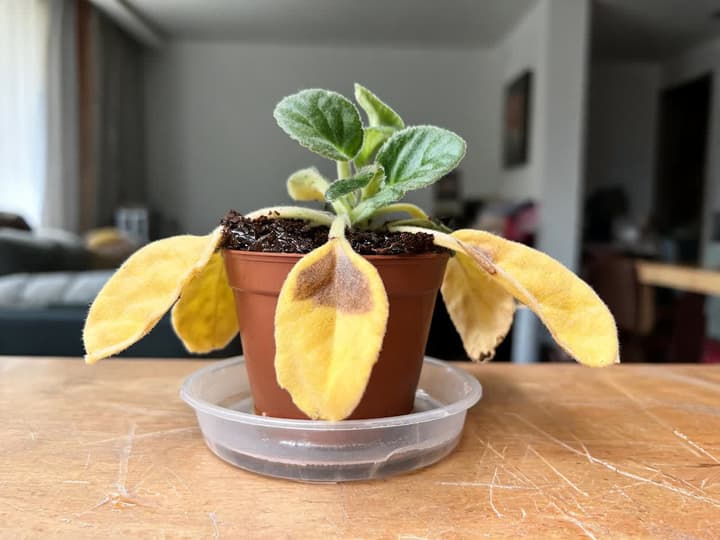
What to do today, in this order:
Empty the saucer and hold off on watering until the top inch (2.5 cm) of soil dries out. The measurement comes from Iowa State Extension.
Trim the soft leaves at the base of the petiole, close to the center of the plant, using clean scissors.
If the soil stays soaked after three days, remove the plant from its pot and inspect the roots. Firm, light-colored roots are still functional: return the plant to its pot and let the soil dry out. Brown roots that disintegrate between your fingers cannot recover: trim these roots away and repot, as outlined in the section on repotting.
Do not fertilize. Damaged roots cannot take up fertilizer, and UGA Extension notes that accumulated fertilizer salts in the soil injure the root system.
When the roots are already dark and soft, the problem has a specific name and treatment:
Once the top inch (2.5 cm) of soil is dry, water from the bottom. Set the pot in a saucer filled with room-temperature water and leave it until the soil surface feels moist. Wisconsin Horticulture suggests about 30 minutes. Afterward, discard any remaining water in the saucer. Iowa State Extension warns that African violets can rot if left standing in saucers of water for long periods.
Yellow spot or ring where water hit: cold water damage
A pale ring or spot where a droplet fell is cold water damage. Clemson Cooperative Extension describes yellow or white rings and lines on the leaf caused by contact with cold water.
UGA Extension specifies the temperature. Water at 55 °F (12.8 °C) or colder splashed onto foliage causes light-green, ring-shaped spots. A temperature difference of just 10 °F (5.5 °C) between the leaf and the water is enough to cause damage. According to the same source, using room-temperature water prevents spotting.
The spotting comes strictly from the temperature of the water, and neither extension source cites fungi or bacteria. Because of this, it does not spread to other leaves. Keep the marked leaf on the plant as long as it remains firm, because the green portions continue to feed the violet.
To prevent new spots, fill your watering can and let the water sit indoors for several hours before use. Water from the saucer as described in the previous section, or point the spout directly at the soil surface without wetting the foliage.
Iowa State Extension warns that water temperature matters more in winter. In Brazil, winter runs from June to August.
Pale yellow outer leaves: too much light, not too little
Pale, yellowish-green leaves on the parts of the plant most exposed to the window indicate excessive light. UGA Extension describes an African violet receiving too much sunlight this way: pale, yellowish-green leaves, sometimes with faded or scorched patches. Iowa State Extension adds that excessive light stunts the plant, leaving leaves small, crinkled, stiff, and yellow.
Insufficient light produces the opposite effect on an African violet. According to Iowa State Extension and Clemson Cooperative Extension, plants in low light develop thin, dark green leaves on elongated petioles. If your violet is turning pale, moving it closer to the window will worsen the issue.
The African Violet Society of America uses the same guideline. Foliage losing its deep color points to light that is too intense, while leaves stretching their petioles upward indicate a lack of light.
Iowa State Extension, in the United States, recommends a north- or east-facing window. In Brazil, the orientation is reversed. Here, a north-facing window receives direct sun for the most hours throughout the year. Here, a south- or east-facing window is usually the right choice for an African violet.
UGA Extension recommends a sheer curtain to reduce light intensity when window sunlight is too strong. What to do today: move the plant out of direct sun or hang a sheer curtain between the plant and the glass. The pale leaves will stay pale. Watch the new center leaves to see if the adjustment is working.
Yellow margins on older leaves: excess fertilizer and salt buildup
Yellow speckling or yellow edges on older leaves indicate overfertilizing. The African Violet Society of America notes this symptom and advises reducing the dosage. UGA Extension explains why: African violets are very sensitive to fertilizer salts that build up in the soil. These salts damage the roots.
UGA also cautions that excess fertilizer can produce symptoms that mimic nutrient deficiencies. That is why you should inspect the pot before drawing a conclusion. A white crust on the rim of the pot or across the soil surface is the telltale sign of salt buildup. Clemson Cooperative Extension notes that a leaf petiole resting against the rim of an unglazed clay pot can collapse from these salts.
When the white crust is already thick, the problem has its own name:
To remove built-up salts:
Scrape off the white crust from the pot rim.
Water from the top, aiming the spout directly onto the soil, until water freely drains out of the bottom hole. Use room-temperature water and keep the foliage dry.
Discard the runoff collected in the saucer.
For the next feeding, apply one-fourth of the monthly package dosage, no more than once a week.
Iowa State Extension recommends occasional top watering with room-temperature water to wash out accumulated salts, keeping leaves dry in the process. Those who water exclusively from the bottom never leach out these salts. Top watering once a month until water runs out the drainage hole is a practical schedule.
Pale green leaves in winter: cold near the window
Foliage turning pale green, curling downward, or becoming brittle following cold nights is cold damage. UGA Extension notes that below 60 °F (15.5 °C), African violets deform: leaves cup downward, curl under, and turn brittle. The same source notes that foliage can turn light green at low temperatures, even under proper light levels.
UGA also notes that leaves touching cold window glass suffer damage. Iowa State Extension adds that below 50 °F (10 °C), leaves darken, wilt, and take on a water-soaked appearance.
Keep the African violet between 18 °C and 27 °C, the range recommended by Iowa State Extension. In Brazil, the risk of cold is highest from June to August, during cold nights in the South and in mountainous regions. At night, move the pot away from window glass and drafty doors.
Should I cut off yellow African violet leaves?
Remove a yellow leaf when it feels soft or turns completely yellow. Leave any leaf on the plant that remains firm and still retains green tissue. The guideline is based on the condition of each individual leaf, not the number of leaves removed.
Cut today: soft, rotting, or wilted leaves.
Cut whenever you like: completely yellow leaves on the bottom tier. They will not turn green again.
Leave on the plant: leaves with pale water spots, or bleached from sun, as long as they stay firm and contain green areas.
Never cut: the tiny new leaves in the center of the rosette. That is where all new plant growth originates.
Snip with clean shears at the base of the petiole, close to the center of the plant.
If you removed several lower leaves and left a bare neck exposed beneath the rosette, Iowa State Extension recommends repotting the violet deeper. Bury the stem up to the lowest row of leaves, provided the plant is free of root rot and not waterlogged.
Should I repot my African violet right now?
Repot your African violet right now only under two conditions: rotted roots or soil that remains soggy three days after you stopped watering. In all other scenarios, address the underlying cause first and keep the plant in its pot.
Repotting also carries risks. Iowa State Extension links crown rot to recent repotting as well as overwatering. According to the African Violet Society of America, leaves commonly droop for 2 to 7 days following repotting. They recover after that period.
If you must repot, use fresh, lightweight potting mix formulated for African violets, along with a container of the same size or smaller that has drainage holes. Trim off any soft, dark roots before planting. Following repotting, wait for the top inch (2.5 cm) of soil to dry out before giving the plant its first bottom watering.
Frequently asked questions
Will a yellow African violet leaf turn green again?
Generally, no. A leaf that turned yellow from aging, overwatering, or cold water spots does not regain its green color. What recovers is the plant itself, through new leaves emerging from the center. Once you fix the cause, monitor the central growth: it should emerge firm and green.
Should I water my yellowing African violet more or less?
Evaluate the soil alongside the foliage. Wet soil with soft lower leaves: wait until the top inch (2.5 cm) dries out before watering again. Dry soil shrinking away from the pot wall: bottom water from the saucer. Adjusting watering up and down every few days muddies the diagnosis. Maintain each adjustment for two weeks, unless the soil remains waterlogged for three days straight.
Do coffee grounds help an African violet with yellow leaves?
There is no evidence that they help. New Mexico State University Extension notes that almost no published research exists regarding the use of coffee grounds in containerized houseplants. Washington State University Extension reports that coffee grounds can be toxic to various plants and advises against using them directly in potting mixes or as mulch. For nutrient deficiencies, use a diluted, balanced fertilizer.
What to do today with an African violet showing yellow leaves
Follow these steps in order. First, gently press the center of the rosette: a firm center means the crown is alive. Next, locate the row in the table that matches where the yellowing appears. Finally, correct only that specific issue and wait two weeks before making another adjustment.
If you inherited the plant and do not know the species, Bloom (available for iOS) identifies plants from a photo. Knowing the species comes before diagnosing care issues, since other plants with fuzzy leaves require different care routines.
Sources
Iowa State University Extension and Outreach, The lower leaves on my African violet have turned yellow and become droopy. What could be wrong?, updated on August 28, 2024: yardandgarden.extension.iastate.edu. Accessed on October 26, 2026.
Iowa State University Extension and Outreach, All About African Violets: yardandgarden.extension.iastate.edu. Accessed on October 26, 2026.
Iowa State University Extension and Outreach, How can I propagate an African violet?: yardandgarden.extension.iastate.edu. Accessed on October 26, 2026.
University of Georgia Extension, circular C660 Growing African Violets, revised by Bodie V. Pennisi, published with a full review on June 18, 2026: extension.uga.edu. Accessed on October 26, 2026.
Clemson Cooperative Extension, Home & Garden Information Center, HGIC 1550 African Violet, by Nancy Doubrava and Robert F. Polomski: hgic.clemson.edu. Accessed on October 26, 2026.
Wisconsin Horticulture, Division of Extension, African Violets: hort.extension.wisc.edu. Accessed on October 26, 2026.
African Violet Society of America, Violets 101 and frequently asked questions: africanvioletsocietyofamerica.org. Accessed on October 26, 2026.
Penn State Extension, Why Isn't My African Violet Flowering?, by Sandy Feather: extension.psu.edu. Accessed on October 26, 2026.
Washington State University Extension, Using Coffee Grounds in Gardens and Landscapes (FS207E): pubs.extension.wsu.edu. Accessed October 26, 2026.
New Mexico State University Extension, Southwest Yard & Garden, Can I discard spent coffee grounds in my houseplant pots? (11/14/2020): swyg.nmsu.edu. Accessed October 26, 2026.
Related articles

Do Ferns Like Sun or Shade? It Depends on the Type
Ferns prefer bright shade: plenty of light, but no direct sun on their fronds. Tuberous sword fern is the exception that handles sun. Here is the ideal light for each type, where to place pots, and how fronds show too much or too little light.
How to Repot Lucky Bamboo in Water and Soil
How to repot lucky bamboo: in water, clean pot and pebbles plus rainwater or distilled water; in soil, a pot 2 inches wider, with drainage. See when to repot, how to handle roots and braided stalks, and how to tell normal stress from rot.
Tulip Leaves Turning Yellow: Normal or a Problem?
Tulip leaves turning yellow after the flower drops are part of the bulb's normal cycle, and the foliage stays until it dries out. Before blooming, a soft stem base, brown spots, or pale stretched leaves mean a problem. Learn how to tell them apart and what to do today.