Tulip Leaves Turning Yellow: Normal or a Problem?
Tulip leaves turning yellow after the flower drops are part of the bulb's normal cycle, and the foliage stays until it dries out. Before blooming, a soft stem base, brown spots, or pale stretched leaves mean a problem. Learn how to tell them apart and what to do today.
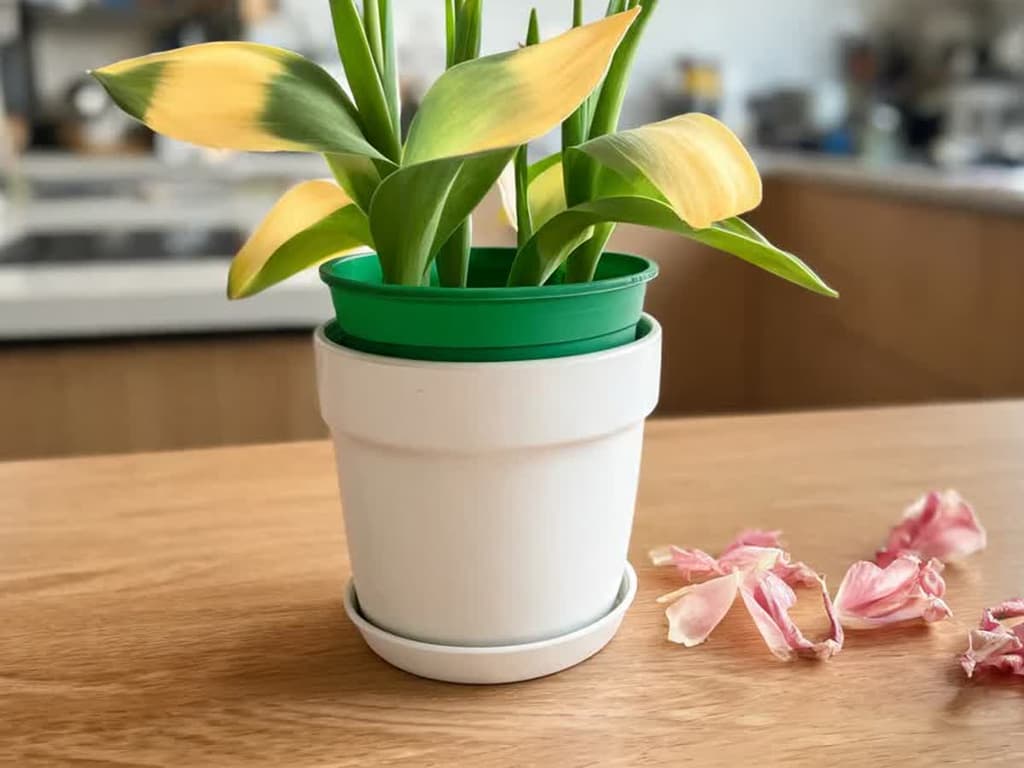
Tulip leaves turning yellow after the flower drops are part of the normal cycle. The bulb, the part of the plant underground, stores food for the following year, and the leaves must stay in the pot until they dry out. If the leaves turn yellow before the flower blooms, or if there is a soft stem base, brown spots, or pale and long leaves, it is a problem.
To tell within 1 minute, gently squeeze the base of the stem right at the soil line. A firm base with a faded flower means the bulb cycle. A soft, dark, or foul-smelling base indicates a rotting bulb, and it cannot recover. If the base leaves any doubt, take the plant out of the pot and press the bulb with your thumb. A bulb that is soft or covered in blue or white mold is rotten, according to the RHS.
What you see | When it appears | Likely cause | What to do today |
|---|---|---|---|
Leaves with a smooth, uniform yellow starting at the tip, with no spots | After the flower drops | Normal bulb cycle | Leave the leaves until they turn straw-colored |
Yellow leaves and waterlogged soil, with standing water in the cachepot | Before or during bloom | Overwatering | Empty the water from the cachepot (decorative pot without drainage) and water only when the soil surface dries out |
Soft, dark, or foul-smelling stem base | Before or during bloom | Rotten bulb | Discard the bulb along with the potting soil |
Brown spots, distorted leaves, and gray mold | In humid weather | Tulip fire (fungus) | Remove the diseased plant and throw it in the trash |
Pale, long, floppy leaves with thin, bent stems | Days after purchase, away from the window | Low light and too much heat | Move near a bright window out of direct sun |
Wilting leaves with dry soil | In a warm home | Underwatering | Water until water drains through the hole |
Leaves with yellow flecks or streaks and broken flower colors | At any stage | Virus | Discard the plant |
Tulip leaves turning yellow after blooming: the bulb cycle
The tulip (Tulipa gesneriana) stores food in a bulb, a type of underground fleshy storage organ. After blooming, the green leaves continue producing food through photosynthesis, and that energy moves into the bulb. Purdue Extension, the gardening service of Purdue University, explains that the health of these leaves determines how much food the bulb stores.
Once the bulb finishes filling its reserves, the foliage yellows, starting from the tip, and dries out. The Royal Horticultural Society (RHS), the UK horticultural society, states that leaves yellow about 6 weeks after flowering finishes. Clemson Extension, part of Clemson University, calls for the same minimum 6-week timeframe.
Cut off the withered flower stem and leave the foliage intact. Do not bend or braid the leaves: Purdue warns that foliage tied inside a bundle does not receive light. Keep the pot in a bright spot near a window, and continue watering when the soil surface dries out as long as the leaves stay green. When they begin to yellow, space out waterings until they dry up, as advised by Iowa State University Extension for potted tulips.
Sources differ on the exact moment to remove the foliage. The RHS points to 6 weeks, while Iowa State directs you to wait until the leaves die and turn completely brown. This guide relies on the leaf condition, which both reference. Remove the foliage when it is straw-colored (pale yellow and dry) and pulls away with a gentle tug. When in doubt, wait until the leaf turns brown, as Iowa State advises. The RHS describes this stage as when the leaves can be removed without cutting.
Once the foliage is dry, the bulb can come out of the soil. Out of the ground, it dries in the shade for 2 to 3 weeks before storage, according to Iowa State. The step-by-step guide to storing the bulb after blooming shows each stage. Even when stored well, a tulip bought already in bloom rarely flowers again in Brazil. Iowa State says most forced tulips do not bloom a second time. The bulb only forms a flower after 12 to 16 weeks of cold, according to Iowa State, and the Brazilian winter does not provide that chill. The guide to making a tulip bloom again explains how to use the refrigerator.
Yellow leaves before blooming: check the water and the bulb
Yellowing leaves before blooming, or while the bud is still closed, can indicate root or bulb trouble. Iowa State links yellowed foliage and stunted plants to bulb rot. It explains that cold, waterlogged soil encourages the fungal pathogens responsible for this decay.
On a potted tulip, the cachepot (a decorative container without drainage holes) and wrapping foil trap runoff water. Because of this, the bottom layer of soil stays soggy without you noticing. Iowa State advises never letting the pot sit in standing water. No study has measured the specific yellowing rate of tulips in standing cachepot water. The safest move for the bulb is to empty the cachepot and let the soil dry.
Follow this inspection checklist in this exact order:
Remove the plastic nursery pot from the cachepot or foil. If there is water pooled at the bottom, dump it out.
Touch the surface of the soil with your finger. Soil that feels wet to the touch means the plant does not need water right now.
Squeeze the stem base right at the soil level. A firm base means the bulb is still alive. A soft, dark, or foul-smelling base points to bulb rot.
If the base is firm, let the soil surface dry before your next watering. Then, water over a sink until moisture flows freely from the drainage hole. Wait for dripping to stop before returning the pot to its cachepot.
Iowa State recommends this watering method for potted tulips bought in flower. In a warm home, potting soil dries out faster, and the guide on how often to water tulips breaks down the timing.
A rotten bulb cannot recover. Iowa State describes an infected bulb as discolored, mushy, and occasionally carrying a foul smell or black or bluish mold. Penn State Extension, part of Pennsylvania State University, highlights basal rot caused by the fungus Fusarium. This rot creates dark brown lesions and white or pinkish mold on the bulb, causing foliage to die prematurely. The PNW Handbook is a plant disease guide for the Pacific Northwest United States. It outlines what happens when a bulb carrying Fusarium is forced in a greenhouse: the plant remains stunted, produces yellow leaves within a few weeks, and generally dies before blooming.
If the bulb feels soft, discard both the bulb and all the soil in the pot. Iowa State directs throwing out the diseased bulb along with surrounding soil. In a small pot, this means the entire volume of soil. Wash the container thoroughly before reusing it.
Freshly purchased tulips with pale, floppy leaves
A tulip that develops pale, long, and drooping leaves just a few days after purchase is usually receiving too little light and too much heat. This florist or supermarket tulip is forced: the grower chilled the bulb to make the flower bloom out of season. Indoors, the leaves and stems continue to grow.
Mississippi State University Extension notes that forced tulips kept in a bright, cool environment grow shorter and sturdier. Heat and dry indoor air cause the plant to decline much faster than outdoors in a garden bed. University of New Hampshire Extension discusses flowering gift plants in general, noting that insufficient light causes yellowing foliage and weak, leggy stems. While neither source directly measured tulip pallor, both advise the same corrective steps.
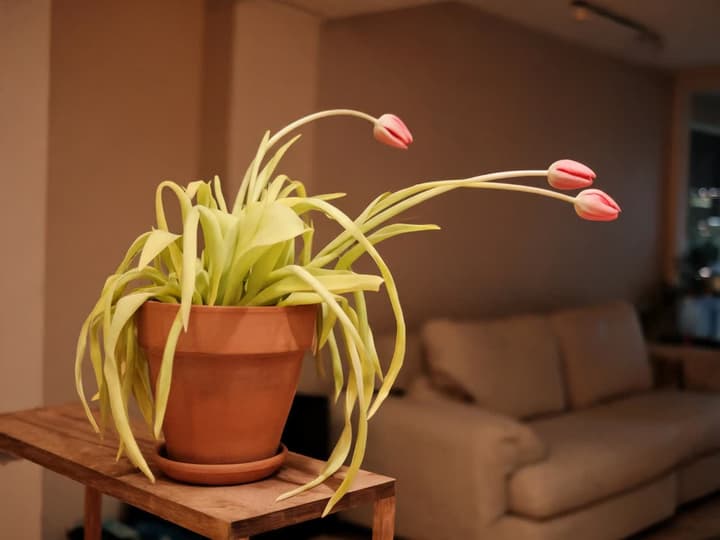
What to do today:
Light: move the pot close to a bright window, safely out of direct sun. Iowa State recommends bright, indirect light for forced tulips.
Temperature: during daytime hours, place the pot in the coolest bright room in the house, far from stovetops and the top of the refrigerator. Iowa State advises 15 to 18 °C (60 to 65 °F).
Nighttime: shift the pot into your coolest room overnight and return it in the morning, as suggested by Mississippi State.
Leaning stems: give the pot a half-turn once a day so the stems do not tip toward the window glass.
Leaves that have already stretched will stay long. Moving the plant helps only the new growth that emerges over the following days. A cooler room also extends flower longevity, according to Mississippi State. The guide on how to care for potted tulips gathers light, watering, and temperature guidelines into a handy reference.
Wilting leaves paired with dry soil are a different issue: drought stress. In a warm room, a small florist pot dries out very quickly. UNH Extension explains that under hot conditions, roots cannot absorb moisture fast enough to replace what leaves lose to transpiration, leading to wilt. Water thoroughly until moisture runs out the drainage hole, and check the soil daily.
Brown spots and gray mold on the foliage: tulip fire
Tulip leaves marked by brown spots, twisted shapes, and fuzzy gray mold point to tulip fire, a fungal infection caused by Botrytis tulipae. The RHS explains the common name: severe infections leave the plant looking scorched as if by fire. Lesions appear shortly after leaves emerge and expand until large portions of the leaf tissue dry up. In moist conditions, a gray furry mold covers the dead areas.
Penn State notes that necrotic spots can also turn white or yellowish, dotted with tiny black sclerotia inside. Because of this, tulip fire can also show up as leaf yellowing. The telltale difference from normal aging is the spotting: natural senescence features smooth, spot-free yellowing.
The fungus spreads most readily during extended damp weather and in overcrowded plantings, according to the RHS. Iowa State advises removing infected plant parts as soon as symptoms appear, preferably when foliage is dry, to avoid spreading fungal spores. The RHS warns that no chemical control against tulip fire is licensed for home garden use. Lacking home remedies, this guide goes beyond Iowa State and recommends removing the entire plant to protect neighboring specimens:
Enclose the infected plant inside a plastic bag while it is still in the pot to stop spores from dispersing. Spores are the microscopic particles fungi release to reproduce.
Dispose of the sealed bag in household trash. University of Maryland Extension instructs discarding infected parts in the garbage.
Space remaining plants apart so air circulates freely between containers.
The Botrytis fungus has its own profile detailing tulip symptoms and treatment options:
Leaves displaying yellow speckling or striping without scorched lesions suggest a viral issue. Penn State describes mottled foliage, showing yellow flecks or streaks, accompanied by color-broken flowers. The RHS notes that viral diseases have no cure and instructs gardeners to destroy affected plants to prevent spread to other tulips. According to the PNW Handbook, aphids transmit the virus from one tulip to another.
The tulip yellow leaves troubleshooting list gathers other potential causes, such as aphids, spider mites, and root rot diseases, together with the symptoms of each.
When to remove yellow tulip leaves
Only cut off tulip foliage once it has turned completely yellow and dry. South Dakota State University Extension explains that remaining green tissue continues to feed the bulb. Iowa State cautions that cutting back leaves too early disrupts bulb development and cuts down on next season's blooms.
Trimming only the yellow tip does not help the bulb. The yellowed tip has ceased photosynthesis, while the remaining green tissue continues nourishing the bulb underground. If the declining foliage looks untidy, shift the pot to a less visible area that still receives bright light while the leaves finish drying down.
Disease is the clear exception. Foliage carrying tulip fire spots or mold must be removed immediately along with the entire plant, following the disposal steps. UNH Extension, discussing purchased potted flowering plants, suggests trimming yellowing foliage for appearance. This guide aligns with Iowa State and the RHS instead, as both focus specifically on the tulip bulb's requirements. UNH Extension focuses on gift plants more broadly.
Is your plant definitely a tulip?
Cyclamen and amaryllis are also commonly sold blooming in pots, and the timelines in this guide do not apply to them. Tulips feature broad, smooth leaves rising from a bulb and a single cup-shaped blossom atop each stem. If you received an unlabeled gift plant, Bloom (available for iOS) can identify the species from a single photo. The free tier includes 2 plant identifications per month. For other varieties, the guide to yellow leaves helps diagnose causes based on yellowing patterns.
Frequently asked questions
How can I tell if my tulip has too much or too little water?
Feel the soil surface and squeeze the base of the stem. Damp soil paired with yellow foliage indicates overwatering. If the stem base also feels soft, the bulb has already rotted. Dry soil with wilting leaves points to underwatering. When uncertain, hold off on watering: Iowa State warns that tulips cannot tolerate waterlogged conditions, and a rotten bulb will not recover.
Can a yellow tulip leaf turn green again?
No, not when the yellowing is part of the bulb's natural life cycle. The RHS notes that yellow, straw-colored foliage has ceased producing energy for the bulb. No study has evaluated whether leaves paled by low light can regain their green pigment. Any leaf tissue that remains green is still nourishing the bulb, so leave the entire foliage on the plant until it dries out completely.
How long does it take for tulip foliage to die back after blooming?
At least 6 weeks, according to the RHS and Clemson Extension. Iowa State instructs waiting until the foliage turns brown, which can take longer. Timing varies with indoor room temperatures and the specific plant. Because of this, evaluate the leaf's physical state rather than counting calendar days: it is ready for removal when it turns straw-colored and pulls loose with a gentle tug.
Can cut tulips in a vase with yellow leaves be saved?
Cut flowers in a bouquet have no bulb to protect, so you can strip yellowing foliage away without worry. Iowa State, when prepping cut tulips for a water vase, instructs removing stem leaves. None of the research sources in this guide explain why foliage turns yellow on cut stems.
Summary
A tulip showing yellow foliage after petal drop is simply completing its natural cycle: let leaves remain until they turn straw-colored, which takes roughly 6 weeks. Before blooming, test the stem base with a gentle squeeze. A mushy base indicates bulb rot, requiring both the bulb and soil to go straight into the trash. Brown spotting with gray fuzz signals tulip fire. Elongated, pale leaves call for a brighter window and cooler room temperatures.
With Bloom Premium, you can snap a photo of your tulip leaves to cross-reference disease symptoms and receive step-by-step guidance.
Sources
Iowa State University Extension: Care of spring-flowering bulbs after bloom
Iowa State University Extension: How to manage potential problems growing tulips
Iowa State University Extension: I received potted forced spring bulbs as a gift
Iowa State University Extension: Is it possible to save tulip bulbs that have been forced indoors?
Iowa State University Extension: How do you force tulip bulbs indoors?
Purdue Extension: Clean up bulbs to encourage next year's blooms
South Dakota State University Extension: Tulips bring early season color to the garden each year
Mississippi State University Extension: Forcing cold-hardy bulbs indoors
University of New Hampshire Extension: Care of flowering gift plants in the home
University of Maryland Extension: Production of tulips as cut flowers
Related articles

Do Ferns Like Sun or Shade? It Depends on the Type
Ferns prefer bright shade: plenty of light, but no direct sun on their fronds. Tuberous sword fern is the exception that handles sun. Here is the ideal light for each type, where to place pots, and how fronds show too much or too little light.

African Violet Yellow Leaves: Causes and What to Do
Yellow leaves on an African violet usually stem from overwatering, and the first place to check is the center of the plant. Losing one lower leaf at a time is normal. Identify whether age, watering, cold water, sunlight, cold drafts, or fertilizer is the culprit based on the yellowing pattern, and see what to do today.
How to Repot Lucky Bamboo in Water and Soil
How to repot lucky bamboo: in water, clean pot and pebbles plus rainwater or distilled water; in soil, a pot 2 inches wider, with drainage. See when to repot, how to handle roots and braided stalks, and how to tell normal stress from rot.