How to Repot Lucky Bamboo in Water and Soil
How to repot lucky bamboo: in water, clean pot and pebbles plus rainwater or distilled water; in soil, a pot 2 inches wider, with drainage. See when to repot, how to handle roots and braided stalks, and how to tell normal stress from rot.
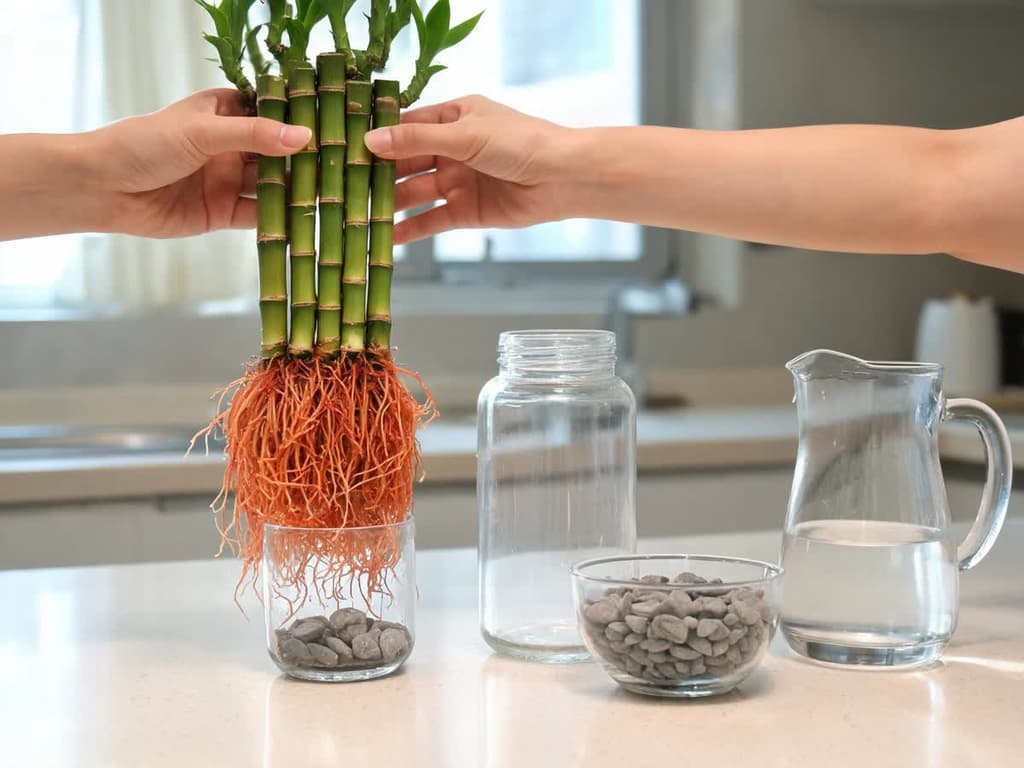
To learn how to repot lucky bamboo, first check whether it lives in water or soil. In water, repotting means switching to a clean container and fresh pebbles, inspecting the roots, and topping off with rainwater or distilled water. The water should cover the roots and at least 1 inch (2.5 cm) of the cane, the green stalk with rings. In soil, repotting means moving it to a pot 2 inches (5 cm) wider, with a drainage hole at the bottom and houseplant potting mix.
The right time is when roots crowd the container, grow out through the drainage hole, or wrap tightly around the stones. A plant that arrived in your home less than 4 weeks ago should not go into a new pot yet. Continue your regular weekly water changes in glass vases as usual.
Lucky bamboo is not a true bamboo. It is a dracaena (Dracaena sanderiana), and dracaena care rules apply to it.
Quick summary:
Repot when the plant shows signs: roots crowding the pot, roots pushing through the drainage hole, or a pot with no hole.
In water, use rainwater or distilled water. Letting tap water sit evaporates chlorine, but it does not remove fluoride.
Reddish-orange roots are normal for this plant. Trim only roots that are mushy, dark, or foul-smelling.
Move braided or spiral arrangements into the new pot as a single unit without unraveling them.
In soil, use a pot with drainage holes, 2 inches wider, with no gravel layer at the bottom.
Wilting leaves after repotting usually resolve within a few weeks. A stalk yellowing from the base upward indicates rot.
When to repot lucky bamboo
Repot when the plant shows one of these signs. A rigid "once a year" schedule has no support in dracaena sources.
What you see | What to do |
|---|---|
Roots filling the glass container and wrapping around the rocks | Move to a larger glass vase, or transfer to soil |
Roots growing out through the drainage hole of a potted plant | Move to a pot 2 inches wider |
Potted plant in a container without a drainage hole | Switch to a pot with drainage (wait 4 weeks if the plant is new) |
A top-heavy arrangement tipping over in its glass vase | Add more pebbles to the bottom to weight the vase down |
A stalk that feels mushy or turns yellow at the base | Rescue repotting (see dedicated section below) |
University of Illinois Extension (the university service that advises the public on plants) gives the two classic signals for potted plants: roots emerging from drainage holes, or a pot that lacks drainage entirely. The Royal Horticultural Society (RHS) notes that a store-bought dracaena can stay in its original container for years. They recommend repotting once roots fill the pot, and every 2 to 3 years after that.
When not to repot
Hold off on newly arrived plants. The University of Florida dracaena production guide (UF/IFAS) recommends waiting roughly 4 weeks before repotting or fertilizing a plant after it enters your home. Adapting to a new environment is enough stress for that period.
A bigger pot will not speed up growth if the current one is not root-bound. Flower Shop Network, an American florist network, notes in an advice column that moving to a larger container only helps when the current pot has truly become too small.
Best time of year to repot
In soil, repot in spring, as recommended by the RHS. In Brazil, that runs from September to November.
In water containers, repotting does not depend on the season. It is the same procedure as routine cleaning: remove the stalks, wash the container and pebbles, and add fresh water. The New York Botanical Garden (NYBG) does this cleaning every 1 to 2 weeks, and NC State, every week. Follow the weekly change, which is the university extension recommendation.
Lucky bamboo roots: what is healthy and what to trim
Red or orange roots are common on lucky bamboo grown in water. The horticulturist behind Joy Us Garden documents this coloration and notes that it does not point to a problem. None of the technical sources consulted address root color for this species. Use color only as a clue, and judge root health primarily by touch and smell.
Firm roots that spring back when pressed are healthy and alive. They can be white, cream, red, or orange.
Mushy roots that collapse between your fingers, turn dark, or smell rotten are dead. Trim them away with clean shears, flush against healthy tissue.
Tangled roots do not need aggressive pruning before a repot. Flower Shop Network advises gently loosening tangled roots with your fingers, much like detangling hair. If you must cut any, make cuts far from the cane so each stalk keeps enough root mass.
How to repot lucky bamboo in water
Gather a glass vase slightly wider than the current one, rinsed stones or pebbles, and rainwater or distilled water. Then follow these steps:
Scrub the new container clean with water and a brush.
Gently lift the canes out of the old container, holding them near the base.
Rinse the old stones thoroughly or use clean, pre-washed replacement stones.
Inspect the roots and snip off anything mushy or foul-smelling.
Spread an initial layer of stones across the bottom of the new vase.
Hold the canes upright and fill pebbles around them until they stand firmly supported.
Pour in water until all roots and at least 1 inch (2.5 cm) of the cane are covered.
According to NC State Extension, stones at the base serve two purposes: they give roots an anchor to grow around and add weight to keep top-heavy arrangements upright. Clemson Cooperative Extension and NYBG define the proper water level: roots must remain completely submerged, with at least 1 inch of the cane under water.
Missouri Botanical Garden explains that allowing tap water to sit out allows chlorine to dissipate, but does not remove fluoride. Dracaenas rank among the few houseplants especially sensitive to fluoride, which causes leaf tips to turn brown. Burned leaf tips will not turn green again.
In Brazil, a 1974 federal law mandates the fluoridation of treated water wherever a water treatment plant exists. For lucky bamboo containers, use rainwater or distilled water, as recommended by NYBG and Missouri Botanical Garden.
Braided or spiral arrangements: repot without taking them apart
Braided arrangements feature interwoven stems, while spiral arrangements have canes shaped into spring-like curls. Move the entire arrangement into its new home as a single, intact unit. Do not untangle the braided canes or attempt to unbend spiral stems.
Once undone, the shape will not return on its own. Horticulturist Larry Hodgson of Laidback Gardener explains that spirals are trained by growers over many months. The grower places the cane on its side and gradually rotates it toward a light source so it curls as it grows toward the light. Replicating that process at home takes years. Any fresh growth produced in your home will simply grow straight up.
NYBG emphasizes that each stalk in an arrangement is an individual plant. Twisting and bending stems restricts the transport of water and nutrients from roots to leaves. No research has tested unraveling established arrangements, so the safest path is to leave every stem undisturbed.
Two common challenges when unpotting an arrangement:
Containers with an opening narrower than the base. Flower Shop Network compares removing roots from this shape to sliding a ring off a swollen finger. Pull gently while rocking the arrangement side to side until the root ball gradually slides free.
Ties or wires securing the canes. No formal studies have examined whether binding ties should stay or go. If the arrangement needs the binding to remain upright, leave it on. If wire has begun cutting into a cane, loosen it slightly without removing it completely.
How to repot lucky bamboo in soil
Pick a container with drainage holes that is about 2 inches (5 cm) wider than the existing one. University of Illinois Extension explains why sizing matters: oversized pots hold more moisture than roots can absorb, inviting root rot. The RHS issues the same warning for dracaenas: step up only slightly in container size.
Use standard potting soil formulated for houseplants or tropical plants, as recommended by Clemson. Read the ingredient list and skip mixes with high proportions of perlite (the small white granules). Clemson's dracaena factsheet cautions that perlite can release fluoride into the soil.
Skip drainage layers of gravel or rocks at the bottom of the pot. According to Illinois Extension, gravel layers do not improve drainage and can actually hinder moisture movement. A 2025 study in PLOS ONE observed different water distribution, but tested bare containers without plants. Follow Illinois Extension advice: drainage holes let excess water out, and each inch of gravel simply steals root space. In water vases, rocks serve a completely different role: anchoring the canes.
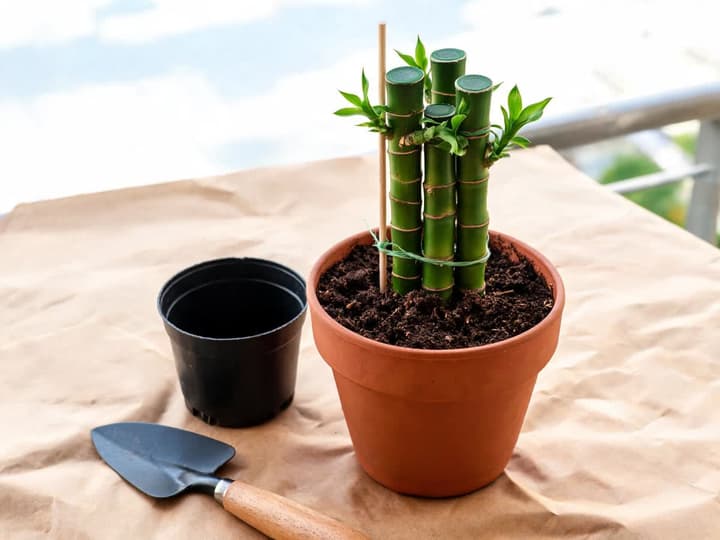
These instructions draw from University of Illinois Extension, Clemson, and Joy Us Garden. The only variation among them involves pre-watering: Joy Us Garden waters 3 to 5 days ahead, whereas here we follow the 1-hour pre-soak advised by Illinois Extension.
Water the plant 1 hour before repotting so the roots enter the new pot fully hydrated.
Add potting mix to the bottom of the new pot until the base of the stems sits at the same depth as before.
Free the root ball from the old pot by gently squeezing the sides of the container.
Loosen roots wrapping around the perimeter of the root ball using your fingers.
Center the plant and fill soil around the sides, firming it lightly with your hands.
Leave about 1 inch (2.5 cm) of space between the top of the soil and the rim of the pot.
Water thoroughly until moisture runs out the drainage hole. After 20 minutes, empty any water collected in the saucer.
If the canes are tall, stake them lightly until new roots establish themselves in the mix.
From here on, water whenever the top inch (2.5 cm) of soil feels dry to the touch, following Clemson's guidance.
Moving lucky bamboo from water to soil, or soil to water
Clemson outlines lucky bamboo care both in water culture and in soil. In water, maintenance centers on weekly water changes. In soil, care relies on pots with drainage holes and watering when the top layer dries. Only the water-to-soil transition has published horticultural instructions.
Water to soil. Roots developed in water are thicker and brittle, adapting poorly to potting soil, according to Iowa State University Extension. Newly potted plants frequently wilt, drop leaves, develop brown patches, or suffer tip burn. Per the same source, consistent care helps the plant recover over several weeks. Follow the standard soil repotting steps and bury each cane to the depth formerly covered by water.
Soil to water. None of the consulted horticultural sources document this transition for lucky bamboo. The safest method is to rinse every trace of soil from the roots under gentle running water and prune any mushy strands. Then set up the water vase according to our step-by-step water guide, and change the water weekly.
Yellow canes or wilting leaves after repotting: transplant shock or rot
The cane holds the answer. Gently squeeze each stem right above the soil line or water level. A firm, green stem points to transplant shock (stress from repotting), which typically clears up. A yellow, soft, or squishy stem indicates rot, and that section will never turn green again.
What you see | Likely cause | What to do |
|---|---|---|
Wilted, drooping leaves or brown tips; firm, green stalk | Transplant shock (Iowa State) | Bright indirect light; in soil, water only when top inch dries; in water, change weekly |
Stalk yellowing from the base upward, soft to the touch | Moisture stress or root rot (NC State) | Rescue repotting |
A single yellow cane within a multi-stalk arrangement | Rotten or exhausted individual stalk | Remove that cane and change the water (NYBG) |
NC State notes that overwatering causes leaf yellowing and stem rot in this species. When yellowing creeps up a cane after transferring into soil, NC State attributes the problem to excess water. Verify that the pot has open drainage holes and that the saucer is never left holding standing water.
Post-repotting care: light, water, and fertilizer during the first weeks
Set the plant back in a spot with bright, indirect light, shielded from harsh direct sunlight. Clemson points out that direct sun scorches foliage brown.
In water vases, replace all the water once a week, as recommended by NC State. The same source notes that regular weekly water changes prevent mosquitoes from breeding in stagnant water.
Hold off on fertilizing immediately after repotting. Iowa State Extension advises waiting to resume feedings until the plant has fully settled into its new container, which takes several weeks. After that, apply lucky bamboo fertilizer at rates suited to your growing medium, whether water or soil.
Rescue repotting: soft stems or rotting roots
The UF/IFAS dracaena guide links diseased roots and compacted, oxygen-starved potting media to the same remedy: repotting into fresh soil. For lucky bamboo, rescue repotting follows four steps:
Remove the plant from its container and rinse the root system thoroughly under running water.
Gently squeeze each cane from the base upward until you reach firm, healthy tissue.
Cut across the cane with clean shears slightly above the softened area. Discard the rotted base and any decayed roots.
Disinfect the vase and pebbles, or use fresh soil mix, and repot only the firm, undamaged portions.
Our guide to lucky bamboo root rot breaks down early symptoms and targeted care steps:
If only the upper tip remains green and firm, you can root it as a new start. NYBG suggests taking a 4-inch (10 cm) top cutting that includes at least one intact node (the raised ring on the cane). Strip away all but a few upper leaves and place the cutting in distilled water. The guide on yellow leaves on lucky bamboo helps distinguish rot from other causes of discoloration.
Frequently asked questions
Does lucky bamboo need soil to survive?
No. Clemson describes lucky bamboo as an adaptable plant that grows successfully in both water and potting mix. In water, keep the root system and 1 inch of the cane submerged, changing the water weekly. In soil, use a pot with drainage holes and houseplant potting mix, watering whenever the top inch feels dry.
How long does a lucky bamboo arrangement last?
Potted or trained arrangements often have a limited lifespan. NYBG explains that arrangements with stripped lower foliage and contorted stems grown purely in water gradually deplete their internal reserves. As a result, many decline within 2 years or less. When the top of a cane remains healthy and firm, cutting and propagating that tip produces a vigorous new plant.
Can you separate lucky bamboo stalks when repotting?
Yes, provided the stalks are straight and loose. NYBG reminds growers that every stalk is an individual plant. Untangle the root system gently using your fingers, as advised by Flower Shop Network, and prune roots sparingly far from the stem base. Do not attempt to separate braided or tightly curled spiral arrangements.
How often should lucky bamboo be repotted?
In soil, repot whenever roots pack the container tightly. The RHS suggests this happens roughly every 2 to 3 years after the initial repot. In water, move to a roomier container once roots crowd the glass. Weekly cleaning of the vase and pebbles continues uninterrupted alongside your regular water changes.
What to do with your lucky bamboo today
Check the roots through the glass or via the pot's drainage holes. If roots do not crowd the container, skip repotting: simply refresh the water or verify soil moisture. If roots are congested and the plant has been in your home for more than 4 weeks, pick your growing medium and follow its steps. If it arrived more recently, give it time to acclimate.
Before switching containers, gently pinch each stalk near its base. If any stem yields softly to your touch, start with the rescue repotting steps. If you are unsure what a yellowing stalk or leaf is telling you, photograph your plant with Bloom (available for iOS). The photo diagnostic tool on the Premium plan checks visible symptoms against known issues for this species.
Sources
Clemson Cooperative Extension, Home & Garden Information Center: How to Grow and Care for Lucky Bamboo and Dracaena.
NC State Extension Gardener Plant Toolbox: Dracaena sanderiana.
New York Botanical Garden, Plant Information Service: How can I save my lucky bamboo plant that is yellowing?.
McConnell, Chen, Henny, and Everitt, Cultural Guidelines for Commercial Production of Interiorscape Dracaena, UF/IFAS Extension (EP149).
Royal Horticultural Society: How to grow dracaena.
University of Illinois Extension: Tips for repotting houseplants.
Iowa State University Extension: How to Propagate Houseplants by Stem Tip Cuttings.
Missouri Botanical Garden: How to Water Indoor Plants.
Larry Hodgson, Laidback Gardener: How to Create Your Own Spiral Lucky Bamboo.
Flower Shop Network: Transplanting Lucky Bamboo and Repot Lucky Bamboo with tangled roots.
Joy Us Garden: Repotting Lucky Bamboo Plants: A Step By Step Guide.
Rowe A. (2025), Effect of drainage layers on water retention of potting media in containers, PLOS ONE 20(2).
Brazil, Law No. 6,050, of May 24, 1974.
Related articles
How to Care for Hibiscus: Sun, Watering, Fertilizer, and Pruning for Flowers
How to care for hibiscus: 6 hours of direct sun, evenly moist soil without waterlogging, half-strength fertilizer in spring and summer, and pruning in early spring. Find out why the flower lasts one day and why buds drop before opening.
Do Ferns Like Sun or Shade? It Depends on the Type
Ferns prefer bright shade: plenty of light, but no direct sun on their fronds. Tuberous sword fern is the exception that handles sun. Here is the ideal light for each type, where to place pots, and how fronds show too much or too little light.
African Violet Yellow Leaves: Causes and What to Do
Yellow leaves on an African violet usually stem from overwatering, and the first place to check is the center of the plant. Losing one lower leaf at a time is normal. Identify whether age, watering, cold water, sunlight, cold drafts, or fertilizer is the culprit based on the yellowing pattern, and see what to do today.