Do Ferns Like Sun or Shade? It Depends on the Type
Ferns prefer bright shade: plenty of light, but no direct sun on their fronds. Tuberous sword fern is the exception that handles sun. Here is the ideal light for each type, where to place pots, and how fronds show too much or too little light.
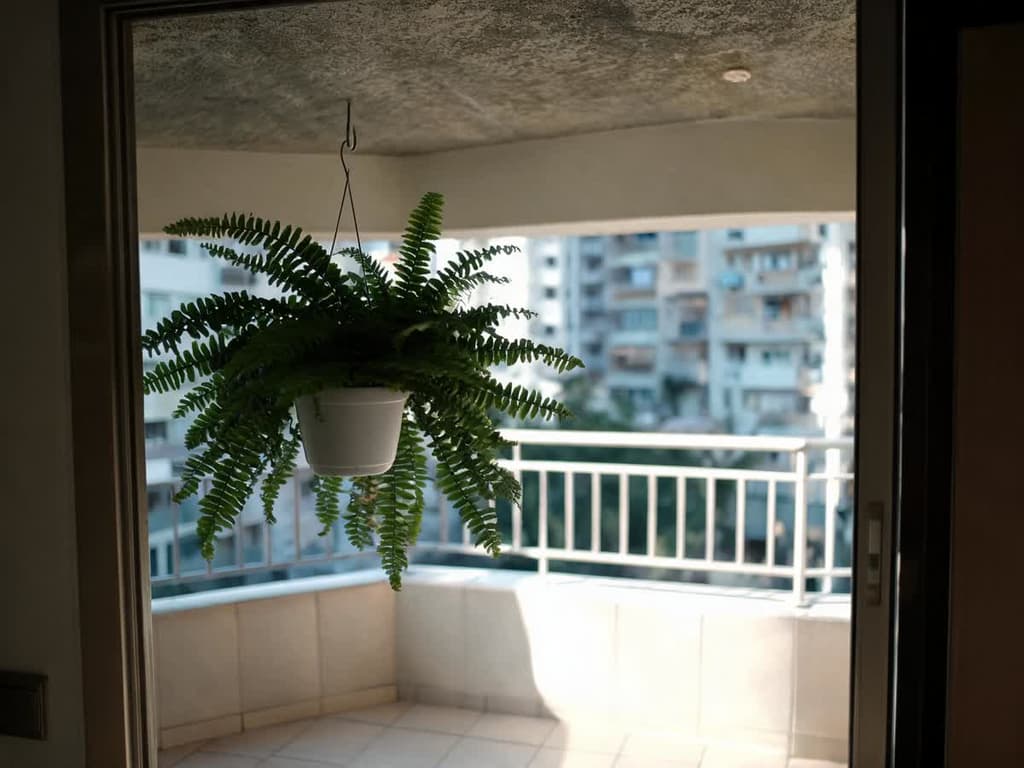
Ferns like bright shade, not sun: they want a spot with plenty of light, but without direct sun hitting the fronds. A dark corner will not work either, because the plant weakens there. The Boston fern (Nephrolepis exaltata) calls for "bright indirect light," according to the NC State Extension. The NC State Extension is the public outreach service of North Carolina State University, in the United States.
The exception is the tuberous sword fern (Nephrolepis cordifolia). NC State notes that, unlike other ferns, it tolerates full sun as well as dry, poor soil. Gentle morning sun, like the light from an east-facing window, works for Boston ferns. Midday and afternoon sun do not.
Quick summary:
Boston fern, maidenhair fern, bird's-nest fern, and staghorn fern: plenty of light, without direct midday or afternoon sun.
Tuberous sword fern: tolerates full sun outdoors; indoors, it also grows best in bright indirect light.
Pale fronds (the fern's long leaves) and a small, compact plant indicate too much light. Long, weak, drooping fronds indicate too little light.
More light dries out the pot faster: on a balcony or patio, check the soil with your finger every day during hot weather.
What indirect light means for ferns
Bright indirect light is a bright spot where the sun does not hit the foliage. Iowa State Extension offers a simple test: light is bright enough when it casts a distinct shadow of your hand, with no sunbeam touching the plant. For ferns, "shade" means this bright shade, not a dark corner of the room.
Some say "sun" and others say "shade" for ferns, and both sides are partly right. Ferns want plenty of bright light, but not sun beating directly down on the fronds. In the garden, UF/IFAS (University of Florida) describes Boston fern growing in partial shade to deep shade. NC State cites light filtered through the tree canopy.
Ferns are not full-sun plants. Basil needs 6 hours or more of direct sunlight a day, and jaboticaba produces more fruit in full sun. A fern is more like lucky bamboo, whose foliage also burns in direct sun.
How much sun each fern variety tolerates
Each fern variety tolerates a different amount of sun. Because of this, find out which fern you have before picking a spot for the pot. The table below covers the most common indoor types, along with the source for each row.
Type | Light requirements | Direct sun | Source |
|---|---|---|---|
Boston fern (Nephrolepis exaltata) | Bright indirect light indoors; outdoors, light filtered by trees and even deep shade | No; only weak morning sun through a window | NC State; Wisconsin Extension |
Tuberous sword fern (Nephrolepis cordifolia) | Indoors, bright indirect light | Tolerates full sun outdoors, unlike the others | NC State |
Bird's-nest fern (Asplenium nidus) | Bright light or light shade | Too much sun yellows the fronds and stunts growth | NC State |
Delta maidenhair fern (Adiantum raddianum) | Partial to full shade | Loses vigor in full sun and also in deep shade | NC State |
Staghorn fern (Platycerium bifurcatum) | Filtered light to partial shade | No | NC State |
Asparagus fern (Asparagus setaceus), which is not a true fern | Bright indirect light | Does not tolerate intense light | NC State |
Maidenhair fern loses vigor both in full sun and in deep shade. The watering and humidity it requires are covered in the guide on how to care for maidenhair ferns.
If you bought a "sun fern," check if it is a tuberous sword fern. Among the Nephrolepis common in Brazil, it is the only one NC State records as tolerating full sun. It has more erect fronds than the Boston fern. The confirming trait is the root: the tuberous sword fern forms small round tubers attached to its roots.
If you do not know which fern you have, Bloom (available for iOS) identifies the species from a photo of your plant. Take this step before deciding on a spot, because maidenhair ferns and tuberous sword ferns have opposite sun tolerances.
The five ferns in the table (asparagus fern is not a true fern), along with care sheets for each:
Where to place your fern: windows and balconies in Brazil
The best spot is near a bright window where direct sun does not reach the plant or only reaches it in the early morning. The university sources in this text are from the US, in the Northern Hemisphere, where the window with the most sun faces south. In Brazil, the window that receives sun for most of the day faces north. East- and west-facing windows do not change.
For Boston ferns indoors, Wisconsin Extension recommends an east-facing window, or a sheer curtain on windows with strong sun. Window by window:
Windows receiving only morning sun (east-facing): the pot can sit close to the glass.
Windows receiving strong sun most of the day (in Brazil, north-facing): use a sheer curtain between the glass and the plant. Or move the pot back until the sun does not reach the leaves.
Windows receiving afternoon sun (west-facing): use a sheer curtain or move the pot back for the same reason. Iowa State cautions that light from this exposure can be too intense for some houseplants.
Windows with no direct sun (in Brazil, south-facing): Iowa State recommends them for plants that tolerate low light. Ferns need more light: place the pot right against the glass and move it to a brighter window if the fronds grow long and limp.
Iowa State notes that light levels drop rapidly as you move away from a window. Just a few steps from the glass, light is often already too low for most houseplants. The sides of a window frame are also darker than they appear to the human eye.
On the balcony, the same rule applies. A balcony with afternoon sun (west-facing) calls for the pot in the back, under the covered section, where light arrives without direct sun. A balcony with sun for most of the day (in Brazil, north-facing) calls for the same. On a balcony with sun only in the morning (east-facing), the fern can sit closer to the edge. On a balcony without direct sun (in Brazil, south-facing), the fern can also sit closer to the edge. Outdoors, Wisconsin recommends full to partial shade for the Boston fern.
Too much sun or too little light: how fronds signal the problem
Frond color and plant shape show whether the light is right. In Boston ferns, too much light turns fronds light green, and too little light makes fronds long, weak, and floppy. This is the description from UF/IFAS in its commercial production guide for the plant.
A 2022 study measured the same effect. Researchers grew 12 varieties of Nephrolepis in a greenhouse under shade cloths that blocked 0% to 86% of light. The more light, the smaller and more compact the plant became, and the lower the chlorophyll content (the green pigment in the leaf). The study was published in the scientific journal HortScience.
What you see | Likely cause | What to do |
|---|---|---|
Light green fronds, compact growth | Too much light | Move the pot away from direct sun |
Dry, straw-colored or brown spots, only on the side facing the sun | Sunburn | Move it out of the sun today; prune off only fronds that dry out completely later |
Fronds long, weak, floppy, dark green, and sparse | Too little light | Move the pot closer to the window |
Many small leaflets dropping right after changing the pot's location | Abrupt change in light | Keep it in the new spot if it has bright light without direct sun |
Dry, brown tips all the way around the plant | Dry air or soil that dried out too much, not the sun | Insert your finger 2 cm into the soil and water if it feels dry; if it feels moist, increase air humidity |
A pale frond color is interpreted in opposite ways depending on the source. For houseplants in general, Iowa State cites pale growth as a sign of low light. For Boston ferns, however, UF/IFAS and the 2022 study describe the opposite: fronds lighten under too much light. This guide follows the research focused specifically on the plant itself. If your fern looks pale and compact, reduce sun exposure before adjusting watering.
Each symptom has a dedicated page covering other possible causes: slow growth, leaf spots, and leaf drop.
Fern turning yellow near a window: light or water?
If your fern turns yellow uniformly across the entire plant, watering is the most likely cause rather than light. Light issues affect the side exposed to the sun: fronds facing the glass turn pale or scorch first, while those at the back stay green. Yellowing that starts on older bottom fronds and spreads usually points to waterlogged or severely dried-out soil.
A fern purchased at a supermarket or garden center typically comes from a nursery greenhouse covered with shade cloth. UF/IFAS warns that such plants can burn if left in full sun during transit or unloading. At home, direct sun streaming through window glass can scorch top fronds in the exact same way.
To tell the two causes apart, inspect the pattern and the soil:
Yellowing or scorch only on the window side, soil is moist: it is a light issue. Move the pot away from direct sun or install a sheer curtain.
Yellowing across the entire plant, soil is soggy or bone-dry and hard: it is a watering issue. Insert your finger 2 cm into the potting mix and water only when it feels dry at that depth.
The progression of yellowing across plants in general is detailed in yellow leaves, and causes specific to ferns are outlined in fern with yellow leaves.
Sunburned fern: move it or leave it?
Move it today. A Boston fern hung on a balcony exposed to direct sun all day will continue burning as long as it stays there. Move the pot to a bright, covered section of the balcony where light arrives without direct sun.
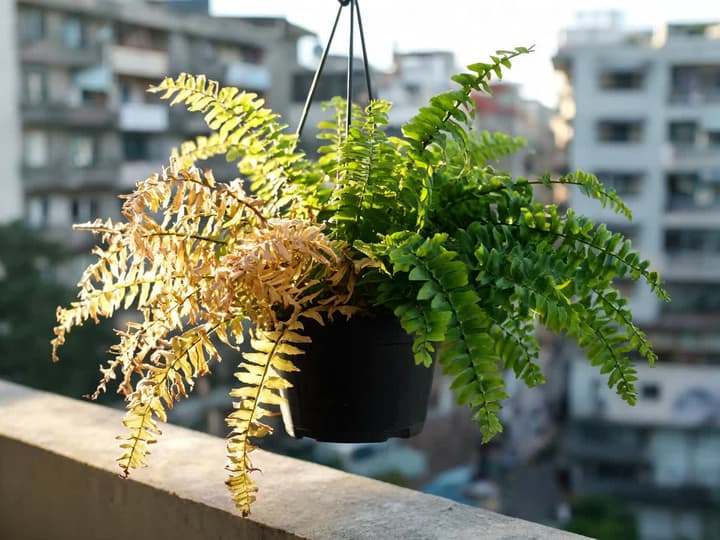
Sunburned tissue will not turn green again. Iowa State compares leaf scorch to human sunburn, noting that the tissue damage is permanent. What changes is new growth: any fronds that emerge in the new spot will develop without burns.
After moving the plant, cut back only entirely dried-out fronds, trimming flush with the crown. Leave fronds that still have green sections intact. A few leaflets may shed during the first few weeks: Iowa State notes that sudden light shifts cause leaf drop. Dropping leaflets is not a reason to move the pot back into the sun.
When moving a fern from a dim area to a brighter spot, Iowa State recommends transitioning it gradually over several weeks. According to the same source, sunburn typically results from an abrupt shift into much stronger light.
More light demands more water
The more light and heat a plant receives, the faster the potting mix dries out. Iowa State notes that soil in hanging baskets is lightweight and drains rapidly. On hot, sunny days, it may need water every day. A fern hanging on a balcony fits this scenario on hot, sunny days.
Wisconsin Extension points out that the Boston fern is the most drought-tolerant among common ferns. Even so, in a small container outdoors during hot weather, potting mix dries fast and keeping it consistently moist is difficult. Let the soil guide you, not a fixed calendar: insert your finger 2 cm into the soil and water when it feels dry at that depth, until water runs freely from the drainage hole.
Dry air causes frond tips to dry out even with the right light. Iowa State points to low humidity as the most likely cause of brown tips on houseplants. If brown tips appear all around the plant, check the air humidity and feel the soil with your finger before changing watering.
How much light a fern needs, in numbers
Indoors, Boston ferns maintain good health under 540 to 2,150 lux. UF/IFAS recommends 50 to 200 foot-candles (the standard American unit for illuminance) for plants once situated in a buyer's home. The conversion to lux, the measurement used by smartphone light meter apps, is ours: 1 foot-candle equals roughly 10.8 lux.
In commercial production, the plant tolerates substantially higher light levels. In greenhouses, UF/IFAS records that it grows well under 1,500 to 3,000 foot-candles (roughly 16,000 to 32,000 lux). Peak quality develops around 2,000 foot-candles (roughly 21,500 lux). During summer, growers shade greenhouses with cloth that blocks 30% to 60% of incoming light.
The 2022 study measured light through a different metric. The authors recommend 10 to 12 mol per square meter per day for production. This number represents the daily light integral (DLI), the total usable light received by the plant across an entire day. In their greenhouse, this corresponded to shade cloth blocking between 26% and 42% of light.
To measure light at home, Iowa State suggests using smartphone apps that read illuminance. Take measurements at midday, right at leaf level. Between two spots free of direct sun on the fronds, pick the one with higher lux. If fronds begin to pale in the new position, light intensity is too high.
Frequently asked questions
Can ferns take morning sun?
Yes, provided it is gentle early morning sun. Wisconsin Extension recommends an east-facing window, which gets only early sun, for Boston ferns. Midday and afternoon sun scorch fronds. Tuberous sword fern is the only fern in the table capable of handling full outdoor sun.
Where is the best place to put a fern?
Place your fern near a bright window where direct rays do not strike the foliage, or only reach it during early morning hours. On a balcony or patio, position the pot beneath covered shade at the back. NC State suggests kitchens and bathrooms, where air humidity runs higher, as long as the room features a bright window.
Can a fern survive in a room with no windows?
No. NC State notes that Boston ferns tolerate deep shade, but only outdoors. Iowa State emphasizes that even the brightest indoor room receives significantly less light than any outdoor location. For a windowless space, choose one of these plants that tolerate low light.
What do ferns dislike?
Ferns dislike direct midday and afternoon sun, which bleaches and burns fronds. Dark corners cause fronds to grow sparse, weak, and floppy. Dry air turns frond tips brown. Furthermore, NC State warns that overwatering leads to root rot.
What to do today
First, identify which fern you have, since tuberous sword ferns tolerate sun while maidenhair ferns do not. Next, observe where direct sun hits the container during midday and afternoon hours. If it strikes the fronds, move the plant to a bright location without direct sun. Finally, check the soil with your finger before adjusting how you water.
Bloom identifies the species from a photo and opens its care guide.
Sources
NC State Extension Gardener Plant Toolbox, plant profiles for Nephrolepis exaltata, Nephrolepis cordifolia, Asplenium nidus, Adiantum raddianum, Platycerium bifurcatum, and Asparagus setaceus. Accessed on October 26, 2026.
UF/IFAS Extension: Schall, Huo, and Chen, Cultural Guidelines for Commercial Production of Boston Fern; Gilman, Klein, and Hansen, Nephrolepis exaltata, Boston Fern, Sword Fern. Accessed on October 26, 2026.
Seltsam, L. and Owen, W. G. (2022). Photosynthetic Daily Light Integral Influences Growth, Morphology, Physiology, and Quality of Swordfern Cultivars (Daily cumulative light influences growth, form, physiology, and quality of fern cultivars). HortScience 57(12): 1564–1571.
Iowa State University Extension and Outreach, Yard and Garden: houseplant care, diagnosing problems from environmental conditions, brown leaf tips and edges, and watering hanging baskets. Accessed October 26, 2026.
Susan Mahr, University of Wisconsin–Madison, Wisconsin Horticulture, Boston Fern, Nephrolepis exaltata 'Bostoniensis'. Accessed October 26, 2026.
Related articles

How to Care for Hibiscus: Sun, Watering, Fertilizer, and Pruning for Flowers
How to care for hibiscus: 6 hours of direct sun, evenly moist soil without waterlogging, half-strength fertilizer in spring and summer, and pruning in early spring. Find out why the flower lasts one day and why buds drop before opening.

African Violet Yellow Leaves: Causes and What to Do
Yellow leaves on an African violet usually stem from overwatering, and the first place to check is the center of the plant. Losing one lower leaf at a time is normal. Identify whether age, watering, cold water, sunlight, cold drafts, or fertilizer is the culprit based on the yellowing pattern, and see what to do today.
How to Repot Lucky Bamboo in Water and Soil
How to repot lucky bamboo: in water, clean pot and pebbles plus rainwater or distilled water; in soil, a pot 2 inches wider, with drainage. See when to repot, how to handle roots and braided stalks, and how to tell normal stress from rot.