Agapanthus Bloom: When It Flowers and How to Make It Bloom
In Brazil, agapanthus blooms from late spring to summer, and the flower bud begins forming in May. Learn why it only produces leaves, what to do each month, and how to fertilize and divide the clump without losing flowers.
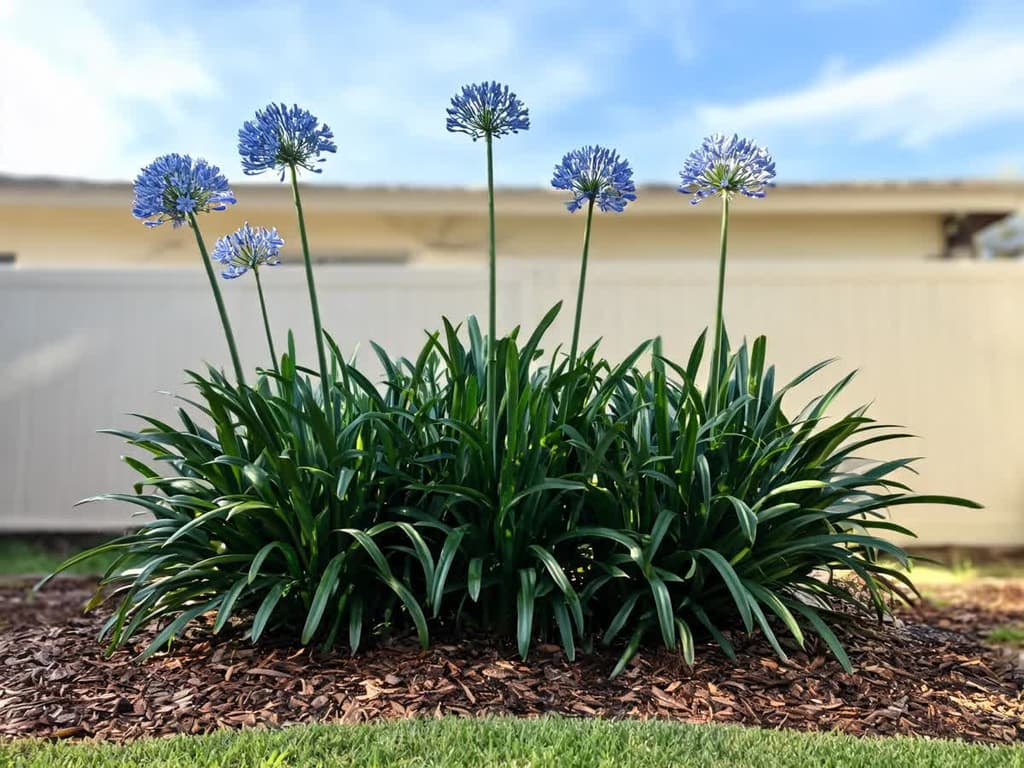
In Brazil, agapanthus blooms from late spring to summer: in Curitiba, a PUCPR study monitored flowers from October to January. When agapanthus only produces leaves, the RHS, the British horticultural society, points to common causes. These include shade, unprotected cold, an excessively warm winter, a pot that is too large or too tight, and an overdivided clump (the cluster of shoots growing together). Young plants also take time: UF/IFAS notes it takes 2 to 3 years to reach peak flowering.
The December flower bud starts forming inside the plant in May, at the end of autumn. Because of this, to get agapanthus to bloom, your care from February to July determines whether you get flowers. Do not dig up the plant: shade, pot size, and the clump can all be fixed, and a young plant simply needs time. For sun, watering, and dried stalks (the stems that carry the blooms) during the rest of the year, see the guide on how to care for agapanthus.
Quick summary:
Agapanthus begins forming the following year's flower bud at the end of autumn. In Brazil, this happens in May, about 7 months before blooming.
Agapanthus blooms best with 6 hours or more of direct sun per day.
To encourage blooming, use a low-nitrogen fertilizer. No scientific study has determined the ideal formula for agapanthus.
When agapanthus blooms in Brazil and how long the flower lasts
Agapanthus blooms in Brazil from late spring to summer. In the study by PUCPR in Curitiba, flowers were observed from October to January. Each flower in the cluster opened around 8 a.m. and lasted 5 to 7 days. The flowers at the top of the cluster opened first, followed by the ones at the bottom.
In South Africa, where agapanthus is native and seasons match those in Brazil, the timing is similar. According to PlantZAfrica, the portal of the South African National Biodiversity Institute (SANBI), Agapanthus praecox blooms from December to February. According to the same source, nearly all evergreen agapanthus (which stays green year-round) cultivated worldwide is A. praecox or a hybrid of it.
Agapanthus not blooming: find the cause by reading the signs
An agapanthus that refuses to bloom displays one of three signs, with each sign pointing to a different cause. The table summarizes the sign, the probable cause, and the fix.
What you see | Probable cause | What to do |
|---|---|---|
Lots of leaves and no stalks, with under 6 hours of direct sun | Shade | Move the plant in March or April to a spot with 6 hours or more of direct sun |
No stalks on a plant put in less than 3 years ago (up to 5 if started from seed) | Plant is still establishing itself | Wait and leave the clump alone |
No stalks in a region with warm autumns and winters | Lack of cold needed for bud initiation | Keep the plant outdoors year-round |
Stalk emerges, but buds turn brown and fail to open | Fungus (botrytis) | Spray a garden fungicide at label rates while buds are closed and again once they open |
Fewer flowers each year in an overcrowded clump | Clump is too old and cramped | Divide right after blooming finishes |
Only leaves and no flower stalks
The first thing to check on agapanthus with foliage only is light. On a sunny day, note how many hours direct sun hits the clump. NC State Extension, from North Carolina State University, calls for full sun for best flowering. The RHS states that agapanthus flowers less in shade. Full sun means 6 hours or more of direct sun per day; in Brazil, the sunniest side is the one facing north.
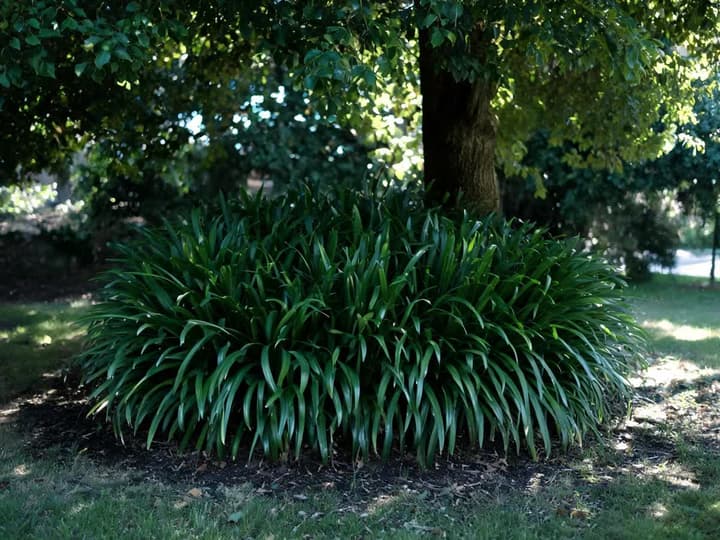
Another cause is the plant's age. UF/IFAS, the University of Florida extension, indicates 2 to 3 years for planted agapanthus to reach peak flowering. A seedling grown from seed can take up to 5 years for its first flower, according to NC State. Clemson Extension adds that not every shoot in the clump blooms: each shoot needs to reach a certain size before producing a stalk.
Watering more does not usually fix agapanthus with leaves only: according to the RHS, established plants need little water. The exception is container plants. The RHS warns that potted agapanthus must not dry out completely from summer to early autumn. During this phase, a lack of water disrupts bud formation for the following year. In Brazil, this phase runs from December to April.
The stalk emerges, but buds do not open
A bud that turns brown and fails to open can be a fungus. According to PlantZAfrica, botrytis, a fungus that causes brown spots, can attack the flowers and prevent them from opening. PlantZAfrica states that there is no cure after an attack. Prevention consists of spraying fungicide before and after the buds open.
In the United Kingdom, there is also a midge that deforms the buds from the inside, Enigmadiplosis agapanthi. According to the RHS and the European and Mediterranean Plant Protection Organization (EPPO), it is officially recorded only in the United Kingdom and on the island of Guernsey.
Sparse or undersized flowers
Fewer blooms each year in a crowded clump indicate that the plant needs division. According to the New York Botanical Garden (NYBG) library, agapanthus likes pot-bound roots. Over the years, however, it flowers much less or stops blooming altogether. PlantZAfrica recommends dividing evergreen agapanthus roughly every 4 years to ensure flowering.
Off-season heat also weakens flowering. The RHS states that an excessively warm winter triggers premature blooming with poor-quality flowers. In the experiment by Mori and Sakanishi (1989), heat after bud initiation accelerated flowering. Blooms emerged smaller and the stalks stayed shorter.
On old plants, virus disease is another possibility. According to a technical sheet from the Faculty of Agronomy at the University of the Republic in Uruguay, viruses can reduce mature agapanthus flowering after several years. Yellow streaks along the leaves can point to a viral infection. Do not propagate divisions from a plant showing this symptom.
When the agapanthus bud forms: the yearly calendar in Brazil
The agapanthus bud begins forming about 7 months before the flower opens. This measurement comes from a Japanese study on Agapanthus africanus grown outdoors in Osaka (Mori and Sakanishi, 1989). There, the shoot tip began turning into a flower in mid-November, which is the end of autumn in Japan. The flower opened in late June, during the Japanese summer.
Between these two moments, the bud stopped growing from the end of the year to the beginning of March, during the Japanese winter. The bud appeared among the leaves in early May, about 2 months before the flower opened. The same study showed that plants kept at 20 °C or higher from September, the beginning of autumn in Japan, did not form buds.
Brazil is in the opposite hemisphere, so the seasons arrive about 6 months apart. The conversion to Brazilian months is ours, and the study was not repeated here. It matches the October-to-January blooming observed in Curitiba. The table shows what happens inside the plant in each season and what to do to get agapanthus to bloom.
Season in Brazil | What happens inside the plant | What to do |
|---|---|---|
February and March | End of flowering | Fertilize in March; divide the clump if needed; do not let potted plants dry out completely |
April and May | In May, the shoot tip begins transforming into a flower | Keep the plant outdoors in the sun, exposed to autumn chill |
June to August | Bud growth stalls in the cold | In pots, water only when soil dries out entirely; do not divide or repot; protect from frost in the South |
September and October | First florets develop inside the bud | Fertilize again; resume regular watering |
November to January | Bud emerges above the foliage and florets open | Water potted plants whenever the top 2 cm (1 in) of soil dries out |
Fertilizer to help agapanthus bloom
To help agapanthus bloom, Clemson Extension from Clemson University recommends a low-nitrogen fertilizer, as nitrogen drives leaf production. The recommended feed is balanced (supplying nitrogen, phosphorus, and potassium) with phosphorus included, such as an NPK 5-10-15 or 8-8-8. In an NPK formula, the first number represents nitrogen, the second phosphorus, and the third potassium.
Clemson recommends fertilizing twice a year: right after flowering and in early spring. In Brazil, that means March and September. The NYBG library suggests another approach: high-potassium fertilizer, such as tomato fertilizer, twice a month during the growing season. In the RHS profile on Agapanthus africanus, the recommendation is liquid fertilizer once a month, from spring until flowering.
Recommendations differ: Clemson calls for low nitrogen with phosphorus, while NYBG calls for high potassium. No research has established the single ideal fertilizer formula for agapanthus. This guide follows Clemson, as it comes from a university extension service, applied at the label rate. To make sense of label instructions and dilute properly, check out our guide on how to fertilize plants.
Too much fertilizer can also cause problems. The University of the Republic profile cautions that heavy feeding harms agapanthus and can lead to salt accumulation in the soil. In garden beds, the RHS only advises fertilizing container plants, and PlantZAfrica notes that Agapanthus praecox grows even in poor soil. Clemson, writing for landscape settings, fertilizes in-ground plants and notes that in lean, sandy soil, agapanthus flowers poorly. If your in-ground agapanthus gets full sun but yields sparse blooms, follow Clemson and feed in March and September.
Snug pots and crowded clumps: when to divide without sacrificing flowers
Agapanthus blooms well when roots are restricted, but not choked. NC State notes that container plants flower best with bound roots. The RHS warns that an agapanthus excessively root-bound in a pot will flower poorly, as will one placed in an oversized pot. NYBG balances both viewpoints: tight roots help for several years until bloom counts begin falling. This guide follows NYBG: keep roots snug and divide once flowering drops off.
The signal to divide is a clump that once bloomed well and began producing fewer flowers each year. Divide evergreen agapanthus right after flowering. PlantZAfrica, which already writes for the Southern Hemisphere, recommends the beginning of March. According to them, evergreen types usually bloom best precisely in the first summer after division. Clemson also prefers early autumn to handle the clump, which in Brazil runs from March to April.
Deciduous agapanthus, which drops foliage in autumn, requires the opposite handling. PlantZAfrica advises leaving deciduous types alone for up to 6 years, noting they typically skip flowering the first year after division. NC State, addressing both types together, also warns that a divided plant may not bloom in year one.
Avoid dividing between May and October. According to the timeline in the study by Mori and Sakanishi, the following summer's flower bud is already forming inside the plant during this period. Dividing during these months risks that summer's bloom. The RHS and the Uruguayan factsheet also accept dividing in spring, in September and October in Brazil. This guide prefers the end of flowering, because by spring the bud is already formed.
When dividing evergreen agapanthus, PlantZAfrica cuts the leaves in half, removes two-thirds of the root length, replants immediately, and waters thoroughly.
Agapanthus in warm climates without winter chill
Agapanthus grows well in the heat, but needs a cool autumn to form buds. UF/IFAS recommends agapanthus for zones 9 through 11 on the United States Department of Agriculture (USDA) plant hardiness zone map. These are the mildest winter zones and include warm southern Florida. NC State gives zones 8 through 11.
Across the studies reviewed, the warmth that impedes blooming is autumn and winter heat. In Mori and Sakanishi's study, plants kept at 20 °C (68 °F) or warmer from early autumn failed to set buds. Those transferred to 10 °C or 15 °C (50 °F or 59 °F) initiated buds successfully. In a Japanese summer trial (Matsubara et al., 2003), a 5 °C temperature increase slowed the unfurling of new agapanthus leaves. Agapanthus flowering did not show a decline in that trial.
Where frost is absent, keep agapanthus outside year-round in the brightest spot. Do not move the plant indoors for winter: living spaces are warmer and darker than an open yard. The guide on agapanthus winter care outlines frost protection measures and the consequences of warm winters.
If nights from March to July in your city stay above 20 °C (68 °F), agapanthus may flower poorly. In this case, the climate may be the cause rather than your care. No one has measured this effect in Brazil, and the Japanese experiment did not test hot days with cool nights.
After the bloom: whether to cut or keep agapanthus stems
According to the RHS, removing spent stalks at their base prolongs flowering throughout that current summer. None of the sources referenced in this guide state that deadheading improves next year's bloom display. The RHS does mention that seed pods can be left intact to add winter interest to garden beds. For more blooms this season, cut the stem back; to enjoy the seed pods, leave them alone and prune the stalk once it dries out.
Near woods or natural areas, cut the stalk before the seed pods open. In New Zealand, the Auckland Council prohibits selling and planting Agapanthus praecox, except for varieties that produce few seeds. The control method recommended by the regional council is pulling out the plant and cutting off the seed heads. An archived assessment from the government of Victoria, Australia, calculated around 2,400 seeds on a plant with 4 flower stalks.
Frequently asked questions about agapanthus blooming
How long does it take for agapanthus to bloom after planting?
A newly planted agapanthus takes 2 to 3 years to reach peak flowering, according to UF/IFAS. Seed-grown plants can take up to 5 years before their initial flower, per NC State. If you bought an established plant already in bloom, the RHS suggests thorough watering until late summer so roots settle in the new location.
What should you put on agapanthus to make it bloom?
No product makes agapanthus bloom without sun. With 6 hours or more of direct sun, use a low-nitrogen fertilizer, such as the NPK 5-10-15 recommended by Clemson Extension. Fertilize 2 times a year in Brazil: in March, after flowering, and in September. Follow the label rate.
Does agapanthus bloom in the shade?
Agapanthus flowers poorly in shade. The RHS notes that bloom numbers decline in shady positions, and NC State calls for full sun for optimal performance. PlantZAfrica observes that certain Agapanthus praecox cultivars will flower in partial shade. For the most prolific bloom, give agapanthus 6 hours or more of direct sun daily.
Long strap leaves and a purple flower stalk: is it agapanthus?
Agapanthus features long, strap-shaped foliage emerging directly from the crown. Blooms appear in a spherical blue, purple, or white umbel atop a leafless stem. If the plant has not flowered yet, foliage alone can be tricky to diagnose because other landscape species look similar. Bloom (available for iOS) identifies plants from a photo, and the agapanthus care guide showcases the mature plant.
How to make agapanthus bloom: summary
Agapanthus blooms in Brazil from late spring to summer, and the flower bud begins forming in May. To bloom, it needs 6 hours or more of direct sun and a cool autumn. Fertilizer should be low in nitrogen, and a crowded clump should be divided right after flowering, in February or March.
Related articles
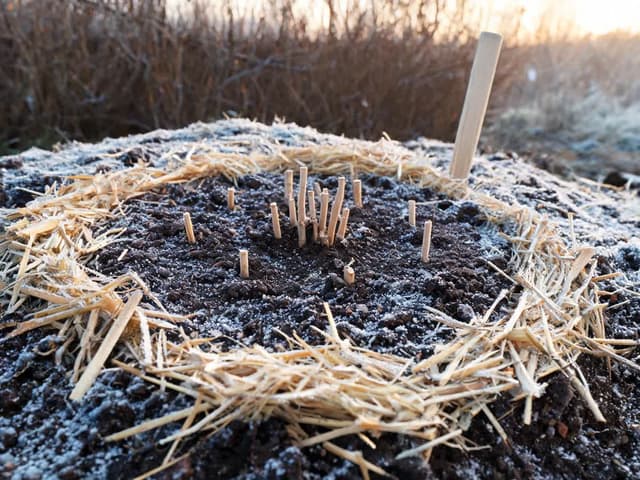
Peonies in Winter: Can They Handle Frost? Care by Type and in Pots
Peonies in winter: the herbaceous type tolerates lows of −15 to −20 °C, dies back above ground in winter and returns in spring, and tree peonies keep their branches. Cut dead foliage down to the ground, mulch the soil only in the first winter, protect the roots in pots, and cover the buds on frosty nights.
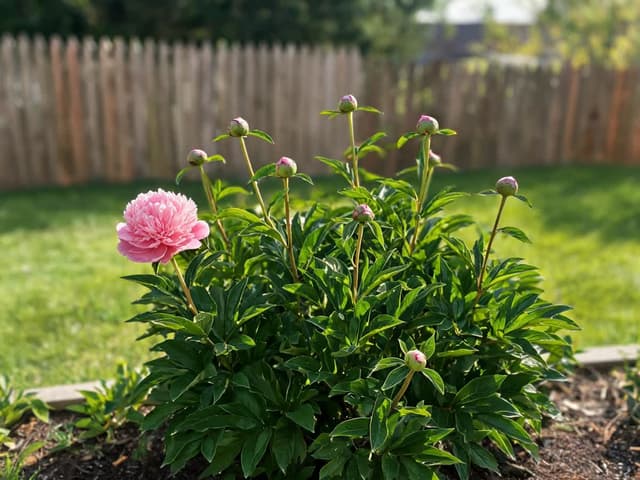
Peonies: How to Make Them Bloom and Why Buds Don't Open
Peonies: how to make them bloom. A peony that fails to bloom usually has buds buried too deep, too little sun, a warm winter, or is too young. Learn when it flowers, how long it takes to produce its first bloom, and how to identify the cause from the plant's symptoms.
How to Take Care of Peonies: Cold, Shallow Planting, Sun and Blooms
How to take care of peonies, from planting to bloom. They need full sun, buds (eyes) 1 to 2 inches below the surface, well-draining soil, and a cold winter to flower. See what changes for tree peonies, how to water, fertilize, stake, divide, and deal with powdery mildew and ants.