Agapanthus Yellow Leaves: What the Location of the Yellow Means
Agapanthus yellow leaves: the yellowed spot distinguishes natural aging leaves from improper watering, a root-bound pot, sunburn, pests, and viruses. See how to verify each cause, what to do, and when to cut the leaf.
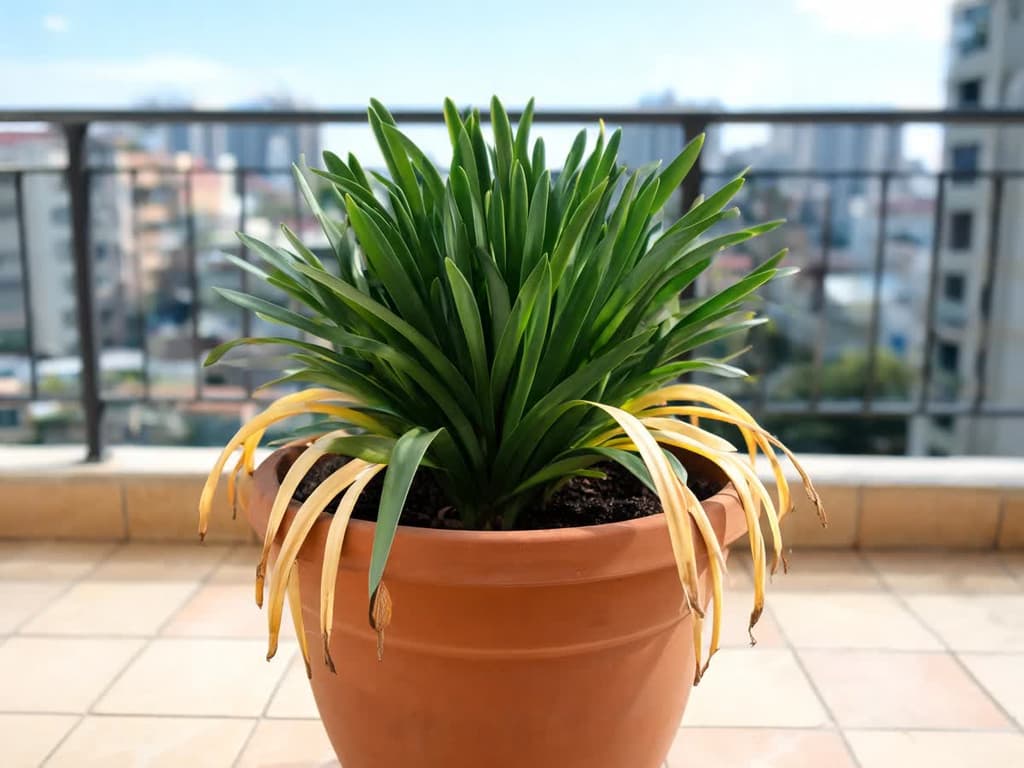
On agapanthus with yellow leaves, the location of the yellowing shows the cause. An outer leaf that gradually dries out is aging. According to the RHS, the British horticultural society, an occasional lower leaf turning yellow is normal on a mature plant. Many yellow leaves at the same time indicate another cause, such as watering, soil, sun, pests, or a virus. The exception is autumn, when deciduous agapanthus, which loses its leaves every year, turns completely yellow.
Before cutting any leaf, gently squeeze the base of the clump (the cluster of shoots growing together), right where the leaves emerge from the soil. A firm base means the rhizome, the thick underground stem, is alive and your plant is not dying. A soft base with a foul smell indicates rot; what to do is covered in the agapanthus care guide.
Where the agapanthus leaf turns yellow and what it means
Agapanthus leaves emerge from the center of the clump and get pushed outward. Because of this, the oldest leaf is always on the outside, and the newest is in the middle. Check where the yellowing started and compare it with the table.
What you see | Most likely cause | How to confirm | What to do |
|---|---|---|---|
One or two outer leaves drying slowly, green center | Old leaf | Firm base, new leaves emerging | Nothing; remove the leaf once it dries completely |
All the leaves turn yellow in late autumn (April and May in Brazil) | Deciduous agapanthus dormancy | The plant drops its leaves every year | Nothing; see the section on when it is normal |
Multiple outer leaves uniformly pale, plant in the same pot for years | Depleted potting mix or root-bound pot | Roots emerging from the drainage hole, soil drying out right after watering | Fertilize; if roots grow through the drainage hole, repot |
New central leaf yellow, with green stripes | Iron deficiency | High pH soil or waterlogged soil | Water only when the top 2 cm (0.8 in) of soil are dry and measure soil pH |
Soft base, constantly soggy soil | Root rot | Foul smell, dark rhizome | Check the agapanthus care guide |
Dry, brown tip, dry and hard soil | Underwatering | Small pot in a sunny spot | Water until it drains from the drainage hole |
Yellow tip turning brown after days above 32 °C | Heat | Happened after a heatwave | Nothing; new leaves will emerge healthy |
Pale or white patch on the sun-exposed side right after moving the plant | Sunburn | Only leaves facing the sun | Move the plant back into shade and increase sun exposure gradually, with a few hours per day at first |
Silvery or pale-yellow streaks | Thrips | Rice-grain-shaped insects seen with a magnifying glass | Water jet and insecticidal soap |
Fine yellow specks, webbing under the leaf | Spider mites | Magnifying glass on the underside of the leaf | Rinse every week |
Yellow rings, lines, and blotches on some leaves | Virus | New leaves emerge without blotches | Do not propagate this plant |
Soft, translucent, or black leaf after frost | Cold damage | Happened after a night of frost | Wait until spring to cut |
The agapanthus care guide already covers four causes from the table (rot, heat, dormancy, and frost) along with botrytis fungus.
When yellow leaves are normal on agapanthus
Yellow leaves are normal in two cases: an outer old leaf and the dormancy (the growth rest) of deciduous agapanthus, the type that loses its leaves every year. In both cases, the base of the clump remains firm. Old leaves yellow slowly, one at a time, and deciduous agapanthus turns all its leaves yellow in autumn.
Old leaves yellow one by one, always on the outer perimeter of the clump. Meanwhile, fresh green leaves keep emerging from the center. The RHS considers this yellowing normal when it affects only a few leaves, but a cultivation issue when it spreads across most of them.
Deciduous agapanthus turns all its leaves yellow at once in autumn. In Brazil, this happens between April and May, and the plant sprouts again in spring. According to the RHS, these leaves can be removed once they dry out. The guide on agapanthus in winter explains how to tell whether yours is evergreen (stays green year-round) or deciduous.
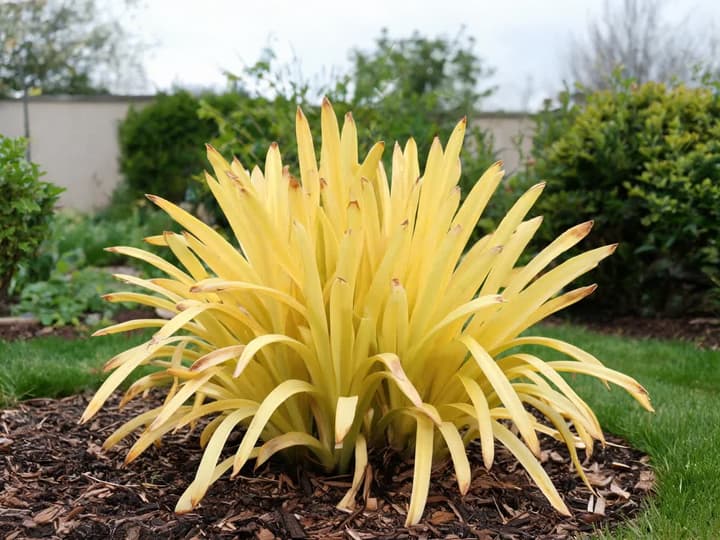
Evergreen agapanthus, the type that stays green all year, does not turn entirely yellow in autumn. If an evergreen agapanthus turned all its leaves yellow, something else caused it: inspect the soil, watering, sun exposure, and pests.
Outer and lower leaves yellowing: depleted potting mix or root-bound pot
When several outer leaves yellow evenly while the center remains green, a common cause in containers is nutrient deficiency. According to the University of Missouri Extension, a lack of nitrogen, phosphorus, or potassium appears first on older leaves. Because older leaves sit on the outside, the yellowing starts along the outer part of the clump.
Nutrient deficiencies happen more often in pots. The RHS states that fertilizing potted agapanthus pays off, because the plant has less soil from which to draw nutrients. In garden beds, the RHS does not call for fertilizer. Two German retailers disagree on the amount: Lubera says agapanthus is a heavy feeder, while Baldur-Garten claims it needs little. This guide follows the RHS, being a horticultural society where the other two are stores: fertilize only container plants. No studies have measured nutrient deficiencies specifically in agapanthus; the older-leaf pattern comes from university extensions covering plants in general.
A root-bound container causes the exact same yellowing. The roots crowd out the soil, water runs straight through without hydrating, and nutrients deplete fast. The warning signs are roots emerging from the drainage hole, a deformed pot, and soil drying out right after watering.
Changing your watering schedule will not resolve this yellowing, because the problem is not water volume. Follow these steps:
From spring to autumn, feed potted agapanthus with a liquid fertilizer using the dosage and frequency on the label. In winter, do not fertilize.
If the roots grew out through the drainage hole, repot into a container that is 2.5 to 5 cm (1 to 2 in) larger on each side, as the RHS recommends. Repot in early spring, from September to October in Brazil.
If the pot is already too large to repot, divide the clump right after flowering, in February or March in Brazil.
Too much fertilizer also yellows the leaves. Salt from the fertilizer builds up in the potting soil and forms a white or beige crust on the surface. According to Colorado State University, this salt yellows the leaves and burns the tips and margins. A saucer with standing water worsens the problem, because the salty water returns to the soil.
To flush out excess salts, water slowly until water drains out through the drainage hole, wait for the pot to stop dripping, and empty the saucer. The guide on plant fertilizer explains how to dilute fertilizers so salt buildup does not return.
New center leaf yellowing or striped
A new leaf that emerges yellow at the center of the clump points to an iron deficiency. According to the University of Missouri Extension, an iron deficiency appears first on the youngest leaves. According to Texas A&M, in long leaves with parallel veins, such as those of grasses, the yellowing occurs between the veins and the leaf appears striped. The agapanthus leaf also has parallel veins.
Iron can be in the soil and still remain out of reach of the root. According to the University of Maryland Extension, this happens in soil with a pH above 6.5, the index that measures soil acidity. According to the same extension, poorly drained soil and rotting roots also cause this yellowing.
To correct it, water only when the top 2 cm (0.8 in) of soil have dried and measure the pH with a kit purchased from a garden center. The Maryland extension highlights a common cause for high pH: growing plants right next to concrete foundations or walkways.
A yellow stripe is not always an iron deficiency. The 'Variegatus' cultivar naturally has striped leaves, according to UF/IFAS, the University of Florida extension. In this cultivar, all leaves are striped from the moment they emerge. Virus spotting appears on only some of the leaves, forming irregular rings and lines.
Yellow leaves on agapanthus from overwatering or underwatering
Overwatering and underwatering turn leaves yellow in different ways. Too much water leaves the base soft and the soil constantly soggy. Too little water dries out leaf tips, turning them brown and brittle.
Excess water is the most serious issue because it rots the rhizome. Leaves yellow suddenly, the base softens, and the soil smells foul. If that happens, follow the step-by-step rot treatment in the agapanthus care guide.
Underwatering happens most often in small containers kept on sunny balconies. According to the RHS, brown leaf tips or margins indicate underwatering far more frequently than overwatering. The RHS also advises never letting potted agapanthus dry out completely from summer through early autumn. That is the period when the plant sets its flower buds.
In the garden bed, mature agapanthus tolerates drought. According to the Clemson Extension, its thick, long roots make the plant drought-tolerant. Because of this, in an established bed, look for another cause before increasing watering.
To get container watering right, insert your finger into the soil. Water only when the top 2 cm (0.8 in) feel dry to the touch. Water thoroughly until liquid flows from the drainage hole, and empty the saucer afterward.
Harsh sun, heat, and frost on agapanthus foliage
Moving agapanthus from shade to direct sun all at once can burn its leaves. According to the University of Georgia extension, going straight from a dark spot into strong sunlight burns the foliage. According to Purdue University, sunburned leaves turn yellow or white and then brown.
Sunburn appears exclusively on foliage directly facing the sun, presenting as pale, dried patches. It typically happens to nursery starts moving out of shaded retail bays or potted plants brought outside from indoors. Purdue recommends acclimating the plant gradually, beginning with just a few hours of sun per day. Neither extension specifies how many days this transition period takes.
Intense heat also marks the leaf. Above 32 °C, the tip turns yellow and then brown, according to the LSU AgCenter, the extension service of Louisiana State University. The plant recovers on its own.
After a frost, the leaf turns soft, translucent, or black. Leave this leaf on the plant until spring, because it protects the new growth. The agapanthus winter guide shows how to protect the plant on frost nights, from June to August in Brazil.
Thrips and mites: the pests that turn agapanthus leaves yellow
According to PlantZAfrica, the plant website of South Africa's biodiversity institute, red spider mites, thrips, and mealybugs can attack agapanthus leaves. The same source states that spraying is only worthwhile when the infestation is severe.
Thrips are slender insects 1 to 2 mm long, shaped like a grain of rice, that scrape the leaf and suck the sap. According to the University of Maryland Extension, the pale dots from their feeding merge into silvery or pale yellow streaks. To confirm, examine the streaks with a magnifying glass and look for the insects.
The spider mite is a bug the size of a period that stays on the underside of the leaf. According to Washington State University, it leaves tiny yellow specks on the leaf and a fine webbing underneath. Damage appears first on leaves that are neither the newest nor the oldest.
Against both pests, start with the methods that stress the plant least:
Wash leaves thoroughly with a strong blast of water on both sides. The Washington extension recommends repeating this rinse at least once a week against spider mites.
If the infestation continues, use insecticidal soap, sold at garden centers, at the label rate. Iowa State advises against substituting dish soap for insecticidal soap, as it can harm the plant.
Trim heavily damaged leaves and throw them in the trash.
Thrips can also transmit plant viruses, according to the University of Maryland Extension. Aphids and scale insects attack agapanthus too, according to NC State. The agapanthus yellow leaves page lists all pests that turn this plant's foliage yellow.
Viruses in agapanthus: yellow rings and lines that will not fade
Yellow rings, lines, spots, and streaks on parts of the leaves can indicate a virus. In Tasmania, Australia, a Plant Disease journal report confirmed tomato spotted wilt virus (TSWV) in an agapanthus plant in 2000. The diseased plants stayed small and did not flower.
That same report describes the hallmark trait distinguishing viruses from other problems: the spotted leaves yellowed and died prematurely, while the new leaves that followed emerged completely unblemished. Because of this, an infected agapanthus can appear healthy for a period.
In southern France, a 2001 study summarized by the EPPO, the European plant protection organization, found 6 different viruses in agapanthus. The authors explain that the virus likely spreads when the clump is divided for propagation. Their recommendation is to start from a healthy mother plant.
None of the sources cited here offers a cure for viruses in agapanthus. To contain the spread:
Do not divide clumps showing viral symptoms for propagation or sharing.
Remove symptomatic leaves and control thrips, which can spread the virus between plants.
If your plant is stunted and has stopped blooming, replace it with a new nursery start.
Viruses also reduce flowering. The agapanthus blooming guide outlines other reasons why agapanthus fails to bloom.
Trimming yellow agapanthus leaves: when and how
Trim an agapanthus leaf only once it turns entirely yellow or dry. As long as any green remains, that leaf is still generating food for the plant.
The University of Missouri Extension provides this guidance for bulb plants. According to the extension, removing leaves prematurely reduces blooms the following season, and it is best to let the leaf die back on its own. Agapanthus has a rhizome, not a bulb, but the foliage works the same way.
Different situations call for different timing:
Entirely yellow or dry leaf: pull it away gently or cut it flush with the base. For evergreen agapanthus, the RHS permits removing unsightly leaves at any point. This guide follows the Missouri extension, waiting until leaves turn fully yellow because green tissue still nourishes the plant.
Leaves of deciduous agapanthus in autumn: remove them all once they dry out.
Soft leaves following frost: leave them attached until spring.
Leaf with spots from viruses, fungi, or pests: cut close to the base and throw it in the trash, not the compost bin. University of Missouri Extension explains that the dead leaf can spread disease.
Cutting agapanthus all the way down to the ground applies solely to deciduous varieties after their foliage dries. Evergreen agapanthus needs its green leaves throughout the year.
Frequently asked questions
Will a yellow agapanthus leaf turn green again?
A leaf that has turned completely yellow will not turn green again. Once you fix the underlying cause, improvement will appear on new leaves emerging from the center of the clump over several weeks. Keep the leaf on the plant while it still has green tissue, and remove it once it has turned completely yellow or dry.
Are yellow leaves on agapanthus normal in winter?
In deciduous agapanthus, yes: it loses its leaves in late fall, between April and May in Brazil, and spends the winter without them. In evergreen agapanthus, the leaves should stay green in winter. Soft, dark leaves after a frost indicate cold damage, and they should stay on the plant until spring.
My potted balcony agapanthus has yellow leaves. What should I check first?
Check the soil and the pot's drainage hole. Soggy soil and a soft base indicate overwatering. Hard, dry soil and desiccated tips point to underwatering. Roots poking through the drainage hole show a root-bound plant, and a white crust across the soil surface reveals fertilizer salts.
Do I need to repot my agapanthus when leaves turn yellow?
Only if roots are emerging through the drainage hole or if the soil dries out right after watering. In those cases, repot into a container 2.5 to 5 cm (1 to 2 in) larger on each side in early spring. If roots have not crowded the pot, fertilize and inspect watering habits before repotting.
If you are not sure whether the plant is actually an agapanthus, Bloom (available for iOS) identifies the plant from a photo. The agapanthus profile shows the mature plant, and the guide to yellow leaves explains the same symptom in other plants.
Agapanthus with yellow leaves: key takeaways
On agapanthus, old outer leaves turn yellow and dry on their own, while deciduous types turn yellow across the entire clump in autumn. Multiple pale outer leaves in a container call for fertilizer or repotting. Striped new leaves signal an iron deficiency, dry tips point to underwatering, and a soft base indicates rot. Silvery streaks, fine specks with webbing, and yellow rings point to thrips, spider mites, and viruses. Cut foliage away only once it has turned completely yellow or dry.
Related articles
Peonies in Winter: Can They Handle Frost? Care by Type and in Pots
Peonies in winter: the herbaceous type tolerates lows of −15 to −20 °C, dies back above ground in winter and returns in spring, and tree peonies keep their branches. Cut dead foliage down to the ground, mulch the soil only in the first winter, protect the roots in pots, and cover the buds on frosty nights.
Peonies: How to Make Them Bloom and Why Buds Don't Open
Peonies: how to make them bloom. A peony that fails to bloom usually has buds buried too deep, too little sun, a warm winter, or is too young. Learn when it flowers, how long it takes to produce its first bloom, and how to identify the cause from the plant's symptoms.
How to Take Care of Peonies: Cold, Shallow Planting, Sun and Blooms
How to take care of peonies, from planting to bloom. They need full sun, buds (eyes) 1 to 2 inches below the surface, well-draining soil, and a cold winter to flower. See what changes for tree peonies, how to water, fertilize, stake, divide, and deal with powdery mildew and ants.