Plant Fertilizer: How to Read the Label, How Much to Use, and When Not to Fertilize
The three numbers on the label are not straight nitrogen, phosphorus, and potassium: by law, the second and third are declared as oxides, which changes the math. See what each number really means, how to compare two bottles on the shelf, how much to dilute, the seasonal calendar, and the six situations where fertilizing harms the plant.
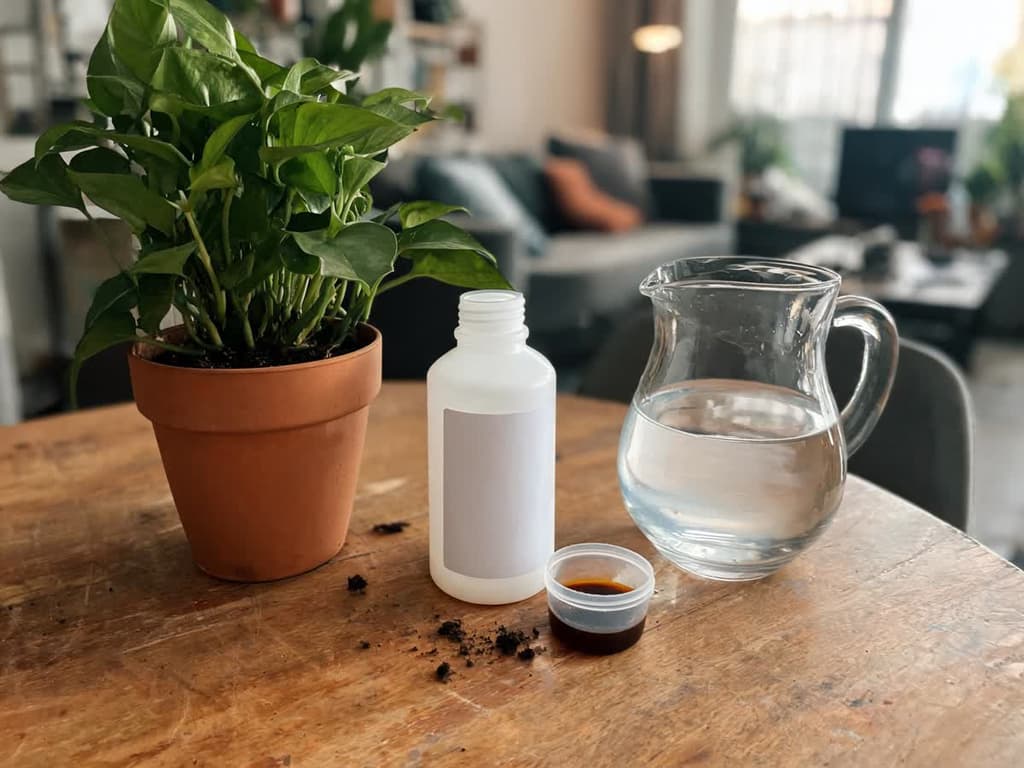
Before choosing any plant fertilizer, decide whether yours even needs it. Yellow leaves, dropping foliage, and stalled growth are often not a sign of nutrient hunger: they come down to light, water, or roots. When fertilizing is truly called for, a general-purpose liquid fertilizer diluted to half of what the label says solves almost everything. What separates success from damage is the dosage, not the brand.
This guide covers the fundamentals of the topic. It works for any species because it deals with what does not change from plant to plant. You will see what the three numbers on the label mean, how to compare two bottles, and how much to dilute. You will also see when to stop fertilizing and how to fix a pot that has already received too much fertilizer.
Quick summary:
The three numbers are not N, P, and K. The first is nitrogen, but the second is phosphorus pentoxide (P₂O₅) and the third is potassium oxide (K₂O). This is a requirement of Decree No. 4,954/2004, and it applies to every fertilizer sold in Brazil.
That is why a "10-10-10" is not balanced in actual elements: it contains 10% nitrogen, 4.4% phosphorus, and 8.3% potassium.
Dosage beats formula. If two labels call for the same application rate, a 10-10-10 diluted to one-quarter provides less nitrogen than a 4-14-8 applied at full strength.
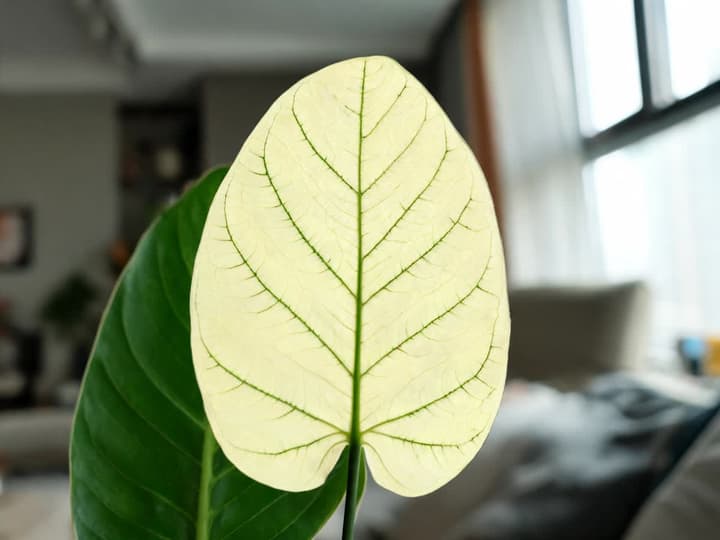
Yellow leaves with green veins are not a sign of fertilizer deficiency. That is iron chlorosis, the most common deficiency in indoor plants according to the University of Maryland Extension, and an NPK fertilizer will not fix it.
In Brazil, the fertilizing window runs from September to March. American sources say "March to September" because they are in the other hemisphere. A plant that keeps putting out new leaves in winter still needs fertilizer.
Brown leaf tips and a white crust on the potting mix (the soil in the pot) are signs of salt buildup, which means too much fertilizer. The fix is leaching the pot, not adding more fertilizer.
Does your plant need fertilizer right now?
Fertilizer replenishes nutrients. It does not correct insufficient light, dry out soggy roots, kill pests, or solve a pot that has become root-bound. When the problem is one of these four, fertilizing adds salts to a potting mix that is already stressing the plant, making things worse.
The first step is looking closely at the symptom, because each one points in a different direction.
What you see | Probable cause | Does fertilizer solve it? |
|---|---|---|
Entire leaf turning yellow, including veins, starting from the bottom leaves, plant growing slowly | nitrogen deficiency | Yes. This is the classic case for fertilizing. |
Yellow leaf with the veins still green | iron chlorosis: iron is present in the potting mix but unavailable, almost always due to high pH (insufficiently acidic soil) or waterlogged roots | No. NPK fertilizer contains no iron and does not adjust pH. |
Dry, brown leaf tips and margins | accumulated soluble salts, almost always from excess fertilizer | No. Here, fertilizing is precisely what caused it. |
Stretched stems, small leaves spaced far apart from one another | insufficient light | No. Nitrogen in this situation produces weak, leggy tissue. |
Yellow leaves with potting mix that stays constantly wet and smells moldy | overwatering, rotting roots | No. Fertilizer on diseased roots burns whatever remains. |
Plant in the same pot for over two years, roots growing out of the drainage hole, water running straight through | pot is too small and potting mix is depleted | Repot first. Fertilizer is just a temporary fix. |
The distinction between the first two lines is the most deceptive one. The University of Maryland Extension is direct. According to it, "iron chlorosis (yellow leaves with green veins) is the most common nutrient deficiency" in indoor plants (updated March 13, 2023). Uniform yellow calls for nitrogen; yellow outlining a green map of veins is iron locked in the potting mix, and regular NPK fertilizer does not fix that.
The fourth row also causes confusion. Regarding leggy plants, Iowa State University Extension states that "the typical cause of leggy growth is insufficient light" (Aaron Steil, January 2024). Anyone who responds to this with fertilizer gets the opposite of what they want: more weak foliage reaching for the same missing light.
If you do not know the species, the diagnosis becomes uncertain, because nutrient tolerance varies widely between a fern and a cactus. In Bloom (available for iOS), photo identification determines the plant's name.
The photo diagnosis compares the image of the symptom against the problem database for that species. This helps separate a deficiency from an excess before you buy any bottle. The diagnosis is part of the paid plan; the free version identifies the species and manages the watering schedule.
If the verdict was "this does not call for fertilizer," it pays to follow the trail of the symptom. The yellow leaves guide covers six distinct causes, and find out what is wrong with your plant walks through the entire diagnostic process.
The three numbers on the label: what N, P, and K mean
NPK is the acronym for the three primary macronutrients: nitrogen, phosphorus, and potassium. The three numbers printed prominently on the package are the product's guaranteed analysis, meaning the percentage by weight of each. A 10-10-10 fertilizer claims 10% of each. The remaining weight consists of water, filler materials, and secondary nutrients, if present.
Each one directs a different part of the plant:
Nitrogen (N) builds leaves and stems. It provides deep green color and vegetative growth. When lacking, the plant yellows from older leaves toward new ones and stops growing. In excess, it produces watery, soft, and stretched tissue.
Phosphorus (P) works on roots, flowers, and fruit. It is the nutrient that "bloom booster" formulas increase.
Potassium (K) regulates the plant's water balance and stress tolerance. It does not produce a distinct, easily recognizable visual symptom, which makes it the most overlooked of the three.
Of the five Brazilian guides on fertilizer that I gathered, I managed to read three in full: Petz, Globo Rural, and Trapp. None of the three explains what the numbers mean. The Petz article is literally called "Tipos de adubo" [Types of fertilizer]. It covers humus, bone meal, manure, liquid, tablets, and granules, but does not mention NPK a single time.
Why the numbers on the label mislead: P₂O₅ and K₂O
The second and third numbers are not pure phosphorus and potassium: they are oxides. An oxide is the element combined with oxygen, and the weight of that oxygen counts toward the declared percentage.
Decree No. 4,954/2004, which regulates the fertilizer law, defines primary macronutrients as "Nitrogen (N), Phosphorus (P), Potassium (K), expressed in the forms of Nitrogen (N), Phosphorus Pentoxide (P₂O₅), and Potassium Oxide (K₂O)" (Annex, art. 2, XIV, "a"). The same standard defines guarantee as "indication of the percentage quantity by weight of each chemical element, of its corresponding oxide" (item XXVIII). It is not the manufacturer's choice: it is how the law requires it to be declared.
The consequence comes down to arithmetic. In phosphorus pentoxide, phosphorus accounts for 43.6% of the mass; in potassium oxide, potassium accounts for 83% of the mass. Therefore:
On the label | What is actually inside |
|---|---|
10-10-10 | 10% nitrogen, 4.4% phosphorus, 8.3% potassium |
4-14-8 | 4% nitrogen, 6.1% phosphorus, 6.6% potassium |
20-20-20 | 20% nitrogen, 8.7% phosphorus, 16.6% potassium |
Two common interpretations are wrong. The first is that a "10-10-10" is a balanced fertilizer: in actual elements, it contains more than twice as much nitrogen as phosphorus. The second is that 4-14-8, sold as a flower and fruit fertilizer, is extremely rich in phosphorus. In practice, it contains 6.1% phosphorus, barely more than the 4.4% found in 10-10-10.
The products and recommendations you have read about still hold true. What changes is the naive reading of the numbers that most people make. With the conversion in hand, the question of which bottle has more of what gets answered right at the shelf.
How to compare two fertilizers on the shelf
With the guaranteed analysis decoded, the second factor comes in: dosage. What reaches the root is not the number printed on the label: it is the label number multiplied by the dilution rate you used.
Take two bottles that call for the same dose, 5 mL per liter of water: one is 10-10-10, the other 4-14-8. Dilute the first to one-quarter strength (1.25 mL per liter) and use the second at full strength. The mixture made with the "stronger" product ends up delivering less nitrogen: 10 × ¼ equals 2.5, versus 4 × 1 for the other. The bottle with the larger number delivered fewer nutrients.
Hence the practical rule that applies to any plant: buying the "right" fertilizer matters less than choosing your dilution. A general-purpose liquid covers practically everything inside an apartment, and adjusting dilution alone solves what the formula claimed to fix.
Different product formats change actual nutrition less than they change the degree of control you have over it.
Format | Dosage control | When it makes sense |
|---|---|---|
Liquid concentrate | High. You measure and adjust with every watering. | The standard for anyone keeping 3 to 10 potted plants. This is the format recommended here. |
Slow-release (coated granules) | Low. Once applied, it cannot be undone. | Large collections or outdoor pots, where watering is irregular. The University of Illinois Extension estimates 3 to 4 months of duration, varying with moisture and temperature (Container Gardens: Fertilizing). |
Spikes or tablets | Low, and they concentrate salts in a single spot in the pot. | Convenience for tough plants. Poor choice for small pots. |
Water-soluble granules | Medium. Depends on your weighing accuracy. | Growers who already own measuring spoons and care for multiple plants. |
Formulated organic: bokashi (fermented organic compost) or bone meal | Medium. Breaks down slowly, but the label declares the NPK. | Growers who want organic inputs with predictable dosing. |
Regarding that last row, two Brazilian sources claim that organic fertilizers carry no risks. Petz writes that "organic fertilizers have no contraindications," and Trapp states that this type "does not harm the plant." This statement is false as a general rule.
Excess nutrients become soluble salts in the moisture of the potting mix regardless of their origin, and those salts are what burn roots. Fresh manure in an indoor pot is one of the fastest ways to cause that exact damage.
How much to dilute and how often
A safe starting baseline is half the label dose. Fertilizer labels are written with commercial production in mind, targeting plants in greenhouses with full light and daily watering. Your plant lives in a room with a fraction of that light and grows at a fraction of that pace.
Anchor your feeding frequency to your watering, not the calendar, because watering directly reflects the plant's true growth rate. The University of Illinois Extension offers two equivalent methods for fertilizing potted plants. The first is applying liquid fertilizer every two weeks. The second is using a half-strength solution with every watering, always applying it to already damp potting mix "to prevent plant injury."
Group | Dilution | Frequency during the growing season |
|---|---|---|
Indoor foliage plants (pothos, monstera deliciosa, ZZ plant, snake plant) | half label rate | every 2 to 4 waterings |
Potted flowering plants | half label rate | every 2 weeks, as long as new buds or leaves are forming |
Succulents and cacti | half to one-quarter rate | every 3 to 4 waterings |
Newly purchased, recently repotted, sick, or dormant plants | none | do not fertilize |
The case for succulents has a primary source number: the Iowa State University Extension recommends "a general-purpose fertilizer in spring and summer at one-half to one-fourth the recommended rate" (Aaron Steil, reviewed in December 2024). The species breakdown is in the specific guides: fertilizer for succulents provides the calculation in mL and the six situations where you should not fertilize.
One final rule saves plants: always apply to pre-moistened potting mix. Applying fertilizer to dry mix concentrates salts right where the roots are thirstiest.
The fertilizing schedule in Brazil
Almost every reliable source on fertilizing indoor plants is American or European, and their calendar is inverted compared to ours. The University of Maryland Extension instructs to "fertilize from March to September." It explains that "during the winter months indoor plants don't need fertilizer because the reduction of light and temperature results in less growth" (updated March 10, 2023).
The principle is correct, but the months are inverted. Translated to Brazil, the active window runs from September through March. Winter, from June through August, is the time to stop or substantially cut back.
This seasonal window has two major exceptions. First, much of Brazil does not experience a winter cold enough to halt the growth of a tropical houseplant. In a warm apartment in Rio or Salvador, a pothos can easily continue pushing out new leaves in July. Any plant that produces foliage uses up nutrients.
The second exception is that certain species disregard thermal seasons and follow their own internal clock. The Thanksgiving cactus, for instance, has a fertilization schedule tied directly to bud formation rather than the calendar month, which is covered in detail in fertilizing Thanksgiving cactus.
The test that works at any latitude is watching the plant: fertilize while new leaves are emerging, and stop when growth halts.
When not to fertilize: six situations
Newly purchased plants. Nursery soil leaves the commercial greenhouse heavily charged with nutrients, and the plant is still adapting to the substantially lower light in your home. Wait 1 to 2 months.
Recently repotted plants. Fresh potting mix already contains nutrients, and roots disturbed by handling have a temporarily reduced absorption capacity. Wait 4 to 6 weeks.
Diseased plants or pest infestations. Fertilizer is not medicine. Applying nitrogen to a plant attacked by aphids or mealybugs forces tender new growth, which is precisely what pests target first.
Dry potting mix. Water first, fertilize later: dry potting soil concentrates salts right around thirsty roots.
Dormant plants outside their growing season. Without new foliage, nutrients sit unused: they accumulate as harmful salts.
Pots with a white crust on the surface or rim. This crust warns that excess salts have already accumulated. Your task here is flushing the pot, not adding more nutrients.
The white crust on pots: salt accumulation and how to leach
Every fertilizer, whether liquid or solid, dissolves into the water of the potting mix and becomes salt. The water evaporates and drains through the bottom hole; the salts, for the most part, stay behind. Over time, the concentration climbs. At a critical threshold, the soil begins pulling water away from the root instead of supplying moisture to it.
This explains why an over-fertilized plant wilts even while sitting in damp potting soil.
The signs, in the University of Maryland Extension's description, are "browning or dead leaf tips and leaf margins," along with "reduced growth, lower leaves dropping, dead root tips, and wilting" (updated March 13, 2023). The white crust appears on the potting mix surface, around the drainage hole, or on the outside of a clay pot.
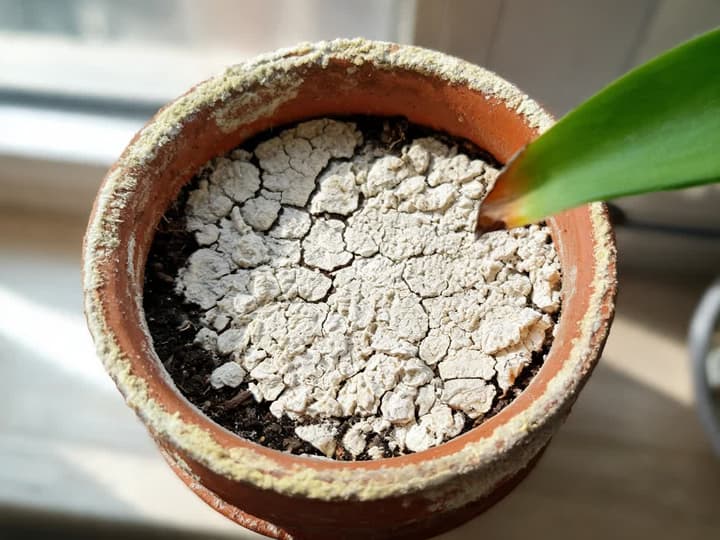
The remedy is leaching the potting mix. The same source outlines the procedure: irrigate with clean water, allow all excess to drain thoroughly through the bottom hole, and repeat the irrigation several times. For each cycle, use a volume of water at least equal to the pot's volume.
In practice, do this in four steps:
Scrape off the crust. If a white layer coats the surface, scoop it away with a spoon before watering. Also scrape away about an inch of the mix beneath the crust, and top it off with fresh potting mix afterward.
Take the pot to the sink or shower. Never do this with a saucer underneath: the drainage water must flow away completely.
Water slowly in two or three rounds, using an amount of water at least equal to the pot's volume for each round, letting it drain thoroughly between pours. For a 2-liter pot, use at least 4 liters of water in total.
Allow it to drain completely before returning the pot to its saucer, and skip fertilizer on the next watering.
If the pot is small and the crust is thick, replacing the entire potting mix is faster and safer than leaching. For regular maintenance, the University of Illinois Extension suggests "occasionally using only clear water to leach the container," which keeps salts from reaching this stage.
Homemade fertilizer: what holds up and what is myth
Homemade fertilizer is the single most common question about feeding potted plants. Recipe by recipe, here is what the evidence confirms.
Recipe | What the evidence shows | Verdict |
|---|---|---|
Aged compost and worm castings | Decomposed organic matter with nutrients already available for slow release. | Works. It forms the backbone of homemade feeding. |
Crushed eggshells | Calcium carbonate. In an Auburn University study cited by the Illinois Extension (Mitchell, 2005), coarsely ground eggshells were "not much better than nothing at all," whereas finely ground shells behaved like pure calcium; large fragments take at least a year to break down. | Only useful if ground into a fine powder, and even then it provides calcium, not NPK. |
Wood ash | The Iowa State University Extension describes wood ash as containing "5-8 percent potassium, up to 20 percent calcium, about 1 percent phosphate," with an approximate analysis of 0-1-3, and explicitly notes that "ashes are effective for raising the soil pH." | A source of potassium, but highly alkaline. In pots, the risk of overdosing is high. |
Banana peel tea | Supplies soluble potassium in an unmeasured, variable amount. Provides no meaningful nitrogen or phosphorus within a useful timeframe. | Harmless, but does not replace proper fertilizer. |
Coffee grounds | Fine particle texture that compacts potting soil and repels water when dry. | Better off in the compost bin than inside the pot. |
Two of these recipes circulate with inaccurate descriptions. The Globo Rural article describes ashes as rich in "calcium, phosphorus, magnesium, nitrogen." It also warns that, in excess, they "can make the potting soil acidic."
Ash is alkaline and raises the pH, the opposite of what Globo Rural wrote. Ash also contains practically no nitrogen, which is lost during burning (Aaron Steil and Linda Naeve, revised in February 2025).
The same article presents eggshells as an "excellent source of calcium and potassium." But potassium is not a significant component of eggshells (Illinois Extension, March 2018).
Species-specific homemade recipes, explaining what makes sense in each case, appear in homemade fertilizer for peace lilies. That guide tests six of the internet's most repeated recipes one by one.
Fertilizer by plant group
Feeding routines change depending on whether a plant grows quickly or slowly, produces flowers or foliage alone, and stores water or not. The three differences that matter most:
Foliage plants accept more nitrogen and more frequent feedings, because foliage is the entire goal.
Flowering plants respond better to proportionately less nitrogen. The University of Illinois Extension explains why: high-nitrogen fertilizers suit plants grown primarily for foliage. Flowers and vegetables perform better with formulas lower in nitrogen and higher in phosphorus.
Succulents and cacti require the lowest dosage and the lowest frequency of all, and they suffer from over-fertilization much more easily.
If you care for succulents, the succulent care guide covers the complete picture, from watering to lighting.
Frequently asked questions
What is the best fertilizer for plants?
A general-purpose liquid fertilizer, diluted to half the rate on the label. It covers foliage plants, flowering varieties, and succulents because you adjust the dilution for each group. Specialty formulas address niche needs, but none can compensate for the wrong dosage or improper timing.
What is the purpose of plant fertilizer?
To replenish nutrients in the potting mix that the plant consumes and that no natural process restores inside a pot. In outdoor ground soil, rainfall and decomposing organic matter replenish these elements on their own. In a pot, roots can only absorb what sits inside that confined volume of mix, and initial nutrients run out.
What are the 3 types of fertilizers?
By origin, the most common breakdown is organic (plant or animal-derived, slow-release), synthetic or mineral (formulated, fast-acting, with guaranteed analyses), and organo-mineral (a blend of both). By format, the three most common home choices are liquid, granular, and slow-release pellets.
What is the best homemade fertilizer?
Well-aged compost or worm castings. They are the only homemade options with immediately available nutrients that avoid the side effects of ad-hoc recipes. Eggshells only provide calcium, and solely when ground to a fine dust; wood ash provides potassium but spikes soil pH; coffee grounds ruin soil drainage and structure.
Which homemade fertilizer stimulates blooming?
No kitchen scrap supplies phosphorus in a reliable amount to induce flowering. What increases the chance of blooming is sufficient light. After that, a fertilizer with a lower proportion of nitrogen and a higher proportion of phosphorus, like a 4-14-8, helps during the species' proper season. A plant that does not bloom due to lack of light will not start blooming with any fertilizer.
Summary
Three clear decisions ensure proper feeding for any potted plant, and the brand on the bottle is none of them.
Diagnose before you buy: yellow leaves with green veins, perpetually soggy soil, and leggy stems indicate problems that regular fertilizer cannot solve. Read the label knowing that the second and third numbers are oxides, and focus your attention on proper dilution, which carries more weight than the formula itself. Finally, pause feeding at the right times, because an underfed plant recovers in a single season, while roots burned by accumulated salts often never recover.
When in doubt about whether to fertilize or not, do not fertilize.
Related articles
How to Care for a Goldfish Plant: Light, Watering, and Blooms
How to care for a goldfish plant: bright light without strong sun, water when the soil surface dries, and humid air. Learn how to tell a Nematanthus from a Columnea, why it drops leaves, and how to get it to bloom again.
Lavender Leaves Turning Yellow: Where the Yellowing Starts Shows the Cause
Lower leaves turning yellow with moist soil means overwatered roots, the most common cause. Old leaves drying one by one on woody stems is normal. Take the stem and root test, see if your plant can still be saved, and find out what to do today.
How to Propagate Lavender: Where to Cut and Why Cuttings Rot
A lavender cutting comes from a non-flowering branch tip, about 4 inches long, planted in sandy soil that never stays soggy. Learn where to cut, rooting times, seasonality in Brazil, and what to do if the base turns black.