Banana plant fertilizer: fertilizing potted and backyard plants
Banana plant fertilizer needs more potassium than nitrogen, in a 3-1-6 ratio. For a potted plant on a balcony, use the label dose in spring and summer. In the backyard, fertilize every 2 months, adjusting the amount by mat age. Learn the formula, timing in Brazil, and signs of deficiency or excess.
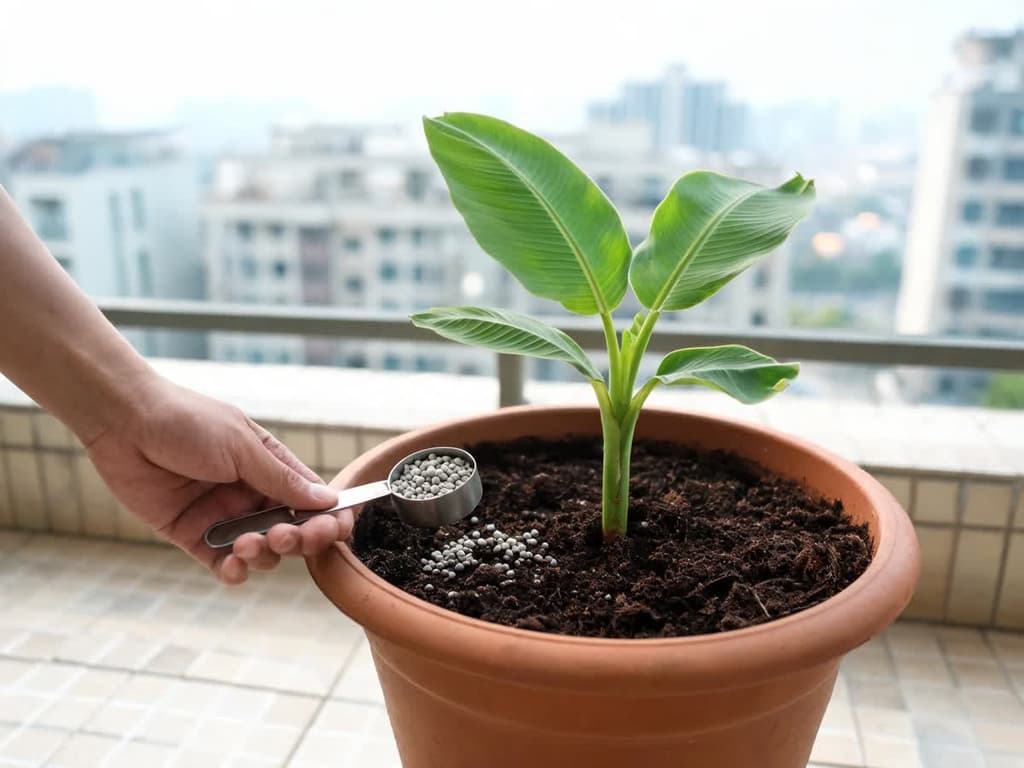
The best banana plant fertilizer contains potassium and nitrogen, with roughly twice as much potassium. Embrapa points to these two as the nutrients banana plants absorb the most. The University of Florida (UF/IFAS) recommends a 3-1-6 ratio for backyard banana plants: 3 parts nitrogen, 1 part phosphorus, and 6 parts potassium.
This guide applies to both types of banana plants kept at home. One is the potted banana plant, ornamental or dwarf. The other is the fruiting backyard mat. In a balcony pot, use fertilizer at the label rate during spring and summer. In the backyard, fertilize every 2 months around the mat (the mother plant with its pups), increasing the amount as the plant matures.
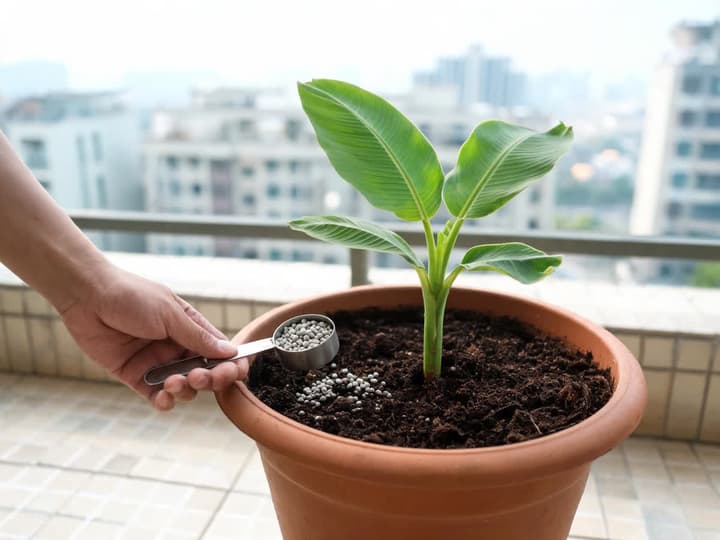
What is the best banana plant fertilizer
The best banana plant fertilizer is a complete fertilizer with more potassium than nitrogen and very little phosphorus. The ratio recommended by UF/IFAS is 3-1-6, such as a 6-2-12 fertilizer, preferably with 2 to 3% magnesium. Potassium is the nutrient banana plants absorb the most, according to Embrapa.
Each nutrient has a function in the plant. Nitrogen builds leaves and suckers, and matters most during the first 3 months after planting. Potassium participates in transporting sugar inside the plant and filling the fruit (Embrapa). Phosphorus is needed in small amounts.
On Brazilian labels, the three numbers stand for nitrogen (N), phosphorus (P), and potassium (K), in that order. A 14-07-28 formulation has twice as much potassium as nitrogen, like a 3-1-6, just with slightly more phosphorus. A 20-05-20 formula has equal parts potassium and nitrogen, delivering less potassium than a banana plant demands. Phosphorus and potassium are declared on labels as oxides (P₂O₅ and K₂O), so the number does not reflect pure elemental nutrient content. The guide on how to read fertilizer labels walks through the calculation.
UF/IFAS also recommends one spray per year on the leaves, with manganese and zinc (Balerdi and Crane, UF/IFAS, 2020). A micronutrient is a nutrient the plant needs in minimal quantities, such as manganese and zinc. In this case, spraying the leaves works, and the guide on foliar fertilizer shows how to dilute it without burning the leaf. Palm trees also require more potassium than nitrogen, along with magnesium, and palm fertilizer applies this formula to pots and gardens.
Can you use urea on banana plants?
Urea contains only nitrogen. It promotes leaf growth, but it delivers no potassium, which is the nutrient banana plants absorb the most. None of the consulted sources gives a urea dosage for backyard banana plants. For that reason, use the complete fertilizer from the chart on your mat. Do not use urea on potted plants: it is highly concentrated, and an incorrect dose burns roots with salts.
Which banana plant do you have?
The right dose depends on which banana plant you grow at home. There are three common situations:
Flowering banana (Musa ornata): according to NC State, it grows up to about 9 feet (2.7 m) tall. It produces orange flowers inside pink bracts (the colorful leaves enclosing the blossom) and small fruits with seeds. It is the ornamental banana plant sold as a potted plant.
Potted dwarf banana plant: a compact fruiting banana plant grown in a large container on a balcony or in a living room. It follows the potted plant rules.
Backyard mat: the banana plant planted in the ground, which forms a mother plant with suckers and yields a bunch.
Heliconias and bird of paradise have similar foliage, but they are not banana plants, and this guide does not apply to them.
How to fertilize a potted banana plant
A potted banana plant receives two types of fertilizer. When repotting, mix a slow-release fertilizer (which releases nutrients gradually) into the new soil. In spring and summer, supplement with liquid fertilizer at the dosage and frequency on the package. This is the recommendation of the Royal Horticultural Society (RHS, the British gardening charity). The RHS notes that a potted plant has less access to nutrients than one planted in the ground (RHS).
The pot's location changes the dose. On a sunny balcony, use the label dose. Indoors, Iowa State University recommends half or a quarter of the label dose. Start with half. The indoor plant grows slower than the outdoor plant (Iowa State).
The pink-flowered ornamental follows the same rule. NC State University recommends fertilizing Musa ornata regularly during the growing season. When it spends the winter indoors, the same source directs reducing water and fertilizer (NC State). The species profile provides the other care guidelines:
The golden pothos, an indoor foliage plant, receives fertilizer only every 2 months, and golden pothos fertilizer shows this lighter routine. The succulent sits at the opposite extreme: a high dose at short intervals damages it, as shown in succulent fertilizer.
How to fertilize a backyard banana plant
A backyard mat receives fertilizer every 2 months. In winter, the dosage drops or stops completely, depending on your region. The quantity increases with the age of the mat, which consists of the mother plant along with its pups. The UF/IFAS table was developed for Florida sandy, nutrient-poor soils using a 6-2-12 fertilizer. In more fertile ground, the plant requires less.
Age since planting the sucker | 6-2-12 fertilizer per mat every 2 months (UF/IFAS) | Estimated 14-07-28 equivalent |
|---|---|---|
1 to 6 months | 0.5 to 1 lb (230 to 450 g) | 3.5 to 6.7 oz (100 to 190 g) |
6 to 12 months | 1 to 2 lb (450 to 900 g) | 6.7 to 13.8 oz (190 to 390 g) |
12 to 18 months | 2 to 3 lb (900 g to 1.4 kg) | 13.8 to 20.5 oz (390 to 580 g) |
Over 18 months | 3 to 4 lb (1.4 to 1.8 kg) | 20.5 to 27.5 oz (580 to 780 g) |
The right-hand column is an estimate calculated by nitrogen content. A 14-07-28 blend contains 14% nitrogen, while 6-2-12 contains 6%. Therefore, the same quantity of nutrients fits into less than half the weight. UF/IFAS text notes amounts up to 5 to 6 lb (2.3 to 2.7 kg) of 6-2-12 during flowering, higher than the table. This guide follows the table, which represents the lower, safer dose.
Embrapa recommends spreading the fertilizer in a 4 to 8 in (10 to 20 cm) wide band, in a circle, 8 to 16 in (20 to 40 cm) away from the plant. This distance increases as the plant grows older. On an established mat, apply fertilizer in a half-moon pattern (a semi-circle) on the side where the daughter plant (the sucker replacing the mother) and granddaughter plant (its sucker) are developing.
Step-by-step instructions for a backyard mat:
Clear the area around the mat, removing any weeds.
Weigh out the dose from the table based on the age of the mat.
Scatter the fertilizer in a band 4 to 8 in (10 to 20 cm) wide, 8 to 16 in (20 to 40 cm) away from the plant. On an established mat, form a half-moon instead of a full circle. Keep fertilizer off the pseudostem.
Cover with soil or chopped dry leaves.
Water right away, unless it rains that same day.
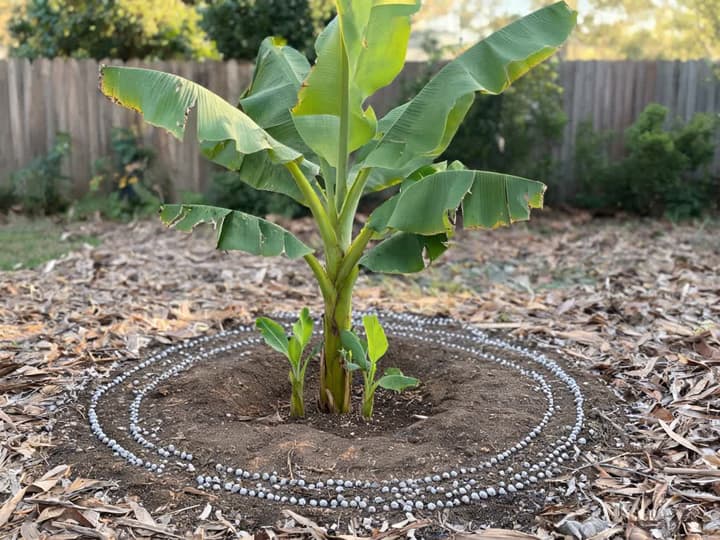
After the bunch, the stem that bore fruit dies, and the fertilizer goes to the daughter plant. NC State describes the same cycle in ornamental banana plants. The stem dies after flowering and fruiting, and the root produces pups that form a new stem.
When to fertilize banana plants in Brazil
Fertilize banana plants in spring and summer, from September to March, which is their period of active growth. October is therefore a prime month to fertilize. During the Brazilian winter, from June to August, reduce the application rate or stop entirely, depending on your region.
Temperature dictates the schedule. According to UF/IFAS, banana plants grow best between 78 and 82 °F (26 and 28 °C), slow down below 60 °F (16 °C), and stop growing at 50 °F (10 °C). A plant that is not growing cannot use fertilizer.
South and mountain regions: stop fertilizing from June to August, when night temperatures drop below 50 °F (10 °C). Resume in September.
North, Northeast, and warm coastal areas: banana plants grow year-round. Fertilize every 2 months throughout winter as well, using a reduced dose.
Indoor potted plants: fertilize only while new leaves are unfurling. If there is no new growth, do not fertilize.
Organic fertilizer for banana plants: manure, leaves, and peels
Well-rotted manure (fully decomposed) is the organic fertilizer Embrapa recommends when planting a banana plant. Per planting hole, use 10 to 15 liters of cattle manure or 3 to 5 liters of chicken manure. Fresh manure should never be used.
Mix the manure with the soil removed from the planting hole, instead of making a layer at the bottom. UF/IFAS advises against a compost layer under the plant and accepts mixing it with the native soil, up to half of each. Embrapa and UF/IFAS agree on mixing, and this guide follows both.
Banana leaves and pseudostems also provide plant nutrition. According to Embrapa, mulching the ground with banana leaves and chopped pseudostem sections boosts soil potassium and calcium. Chop dried leaves and harvested pseudostems, then spread them over the soil around the mat.
Wood ash contains 5 to 8% potassium, but it raises soil pH (making the soil less acidic). Both data points come from Iowa State (Steil and Naeve, revised in February 2025). None of the consulted sources provides an ash dosage for banana plants. Therefore, choose manure and chopped leaves in the backyard and avoid using ash in containers.
Banana peels contain potassium, but none of the consulted sources has measured how much nutrient a peel actually releases to a plant. They cannot replace real fertilizer. The guide to homemade peace lily fertilizer tests banana peel along with five other recipes, one by one.
Signs of nutrient deficiency in banana plants
Before fertilizing a banana plant showing yellow foliage, check the soil moisture. UF/IFAS describes two watering problems that cause leaves to turn yellow. In dry conditions, leaves fold along the midrib and turn light green or yellow. In waterlogged soil, foliage yellows and the plant stays stunted. In both situations, correct watering practices before applying fertilizer.
Once moisture is balanced, leaf color and posture reveal which nutrient is missing:
Potassium deficiency: tips and margins of older leaves turn yellow, then brown, and dry out. The leaf tears and curves downward. This is the description provided by Tamil Nadu Agricultural University (TNAU, in India).
Nitrogen deficiency: leaves of all ages turn light green. The midrib and leaf stalk turn pinkish, and new leaves emerge closer together (ProMusa).
Leaves yellowing sequentially from oldest to youngest until only the central spear leaf remains, accompanied by plant wilting, point to Panama disease (Fusarium wilt). According to UF/IFAS, this root disease has no chemical cure, and fertilizer will not help. The breakdown of causes of yellow leaves on ornamental banana plants helps differentiate other issues.
Dark spots on banana leaves: fungal infection or nutrient deficiency?
Dark spots with yellow margins typically indicate fungal disease, and fertilizer does not cure fungi. Sigatoka is one of the most critical foliar diseases affecting banana plants, according to UF/IFAS. It begins as tiny specks that enlarge into brown spots surrounded by a yellow halo. According to UF/IFAS, it worsens with heat, humidity, and continuous rain, triggering premature leaf drop without killing the plant outright.
Potassium deficiency does not produce spots. It scorches leaf tissue inward from the tip and edges, lacking any halo. If a leaf displays scattered spots across the blade, fungus is the probable cause, and fertilizer will not fix it.
If the spotting does not match either case, Bloom (available for iOS) provides photo-based plant disease diagnosis through its Premium plan.
Fertilizer burn on banana plants
Excess fertilizer yellows and scorches the edges of banana leaves. UF/IFAS describes this symptom in banana plants growing in saline ground, and every fertilizer deposits mineral salts in the soil. The University of Maryland adds that container plants show stunted growth, loss of lower foliage, and wilting despite moist potting mix.
Burnt margins also appear with potassium deficiency, but recent care history distinguishes them. If you fertilized in recent weeks, the soil surface has a white mineral crust, and the plant wilts in moist potting mix, it is fertilizer burn. If you have not fertilized in months, older leaves turn yellow from the tip and margins, and growth has stalled, it is a nutrient deficiency.
To flush out excess fertilizer, drench the root zone with fresh water multiple times until water drains freely through the drainage holes. The guide on dealing with white salt crust on potted plants provides full instructions. After leaching the container, skip the next scheduled fertilizer application.
When not to fertilize banana plants
Certain circumstances call for withholding fertilizer, even during the active growing season:
Cold temperatures below 50 °F (10 °C): banana plants cease growing and cannot take up nutrients.
Waterlogged potting mix or a soft pseudostem base: the core issue involves water and damaged roots. Adding fertilizer introduces more salt stress to struggling roots.
Newly planted suckers in the backyard: UF/IFAS states that the planting hole does not require fertilizer, while Embrapa permits well-rotted manure blended with the planting soil. The initial side-dressing (fertilizer spread on the soil surface) occurs 30 to 45 days after planting, according to Embrapa.
A pseudostem that has already fruited: it will die back naturally. Direct your fertilizer to the daughter plant.
Frequently asked questions
What should you put on a banana plant to make it fruit?
On a backyard mat, apply a potassium-rich fertilizer with twice as much potassium as nitrogen every 2 months. In containers, stick to the dose and frequency indicated on the product label. Potassium is directly tied to fruit filling, according to Embrapa. Maintain consistent watering as well: according to UF/IFAS, water stress at any stage reduces bunch size and fruit count.
Will a banana plant produce fruit without fertilizer?
It will in fertile soil, but bunches turn out smaller. Embrapa links nitrogen deficiency to stunted bunches with fewer hands. UF/IFAS notes that the initial 3 to 4 months of vegetative growth govern bunch weight. Consequently, fertilizer applied in those early months yields the highest return.
Does fertilizer make an ornamental banana plant bloom?
It helps, but fertilizer alone is not enough. The RHS explains that potassium-rich fertilizer can encourage flowering and fruiting. NC State notes that young banana plants will not flower until thoroughly established. A potted specimen cut back to the base every year may never bloom at all.
Can you use banana peels as fertilizer for banana plants?
Banana peels contain potassium, but no study has measured how much nutrition they actually transfer to a plant, and they do not replace standard fertilizer. To return potassium to the soil, Embrapa recommends mulching the root zone with shredded leaves and pseudostems from the banana plant itself.
Summary
Banana plant fertilizer should provide roughly twice as much potassium as nitrogen. For potted plants, apply the label rate outdoors on a balcony and reduce to half or a quarter strength indoors between September and March. In the backyard, fertilize every 2 months in a circular or semi-circular band around the mat, adjusting the amount to match its age. In southern and mountainous areas of Brazil, pause applications from June to August. Older leaves with burnt edges need potassium, provided you have not fertilized recently.
Related articles
How to Fertilize Rosemary: When, How Much, and Which Fertilizer
How to fertilize rosemary in pots and in the ground: rosemary needs very little fertilizer. Learn the right timing in Brazil, doses, coffee grounds, lime, and signs of overfertilizing.
How to Propagate Rosemary: Choosing the Right Stem, Soil vs. Water, and How Long It Takes
Rosemary cuttings come from a new, non-flowering stem tip about 4 inches long. Plant it in soil mixed with sand, in a bright spot out of direct sun. Learn where to cut without harming the mother plant, whether water rooting is worth it, if rooting hormone is needed, and how long roots take.
How to Make Rosemary Bloom: When It Flowers and Why Yours Doesn't
In Brazil, rosemary blooms mainly from August to December, and no source shows it needs cold. Discover 5 reasons for bloomless rosemary, when to prune, and more.