Christmas Cactus: Sun or Shade? Bright Light All Day, Direct Sun Only in the Morning
Christmas cacti need bright indirect light all day long and direct sun only before 10 AM. Learn where to place your pot, how to read light stress on the segments, and why artificial light at night prevents blooming.

The ideal light for a Christmas cactus is bright shade: strong, indirect light all day long, with no direct sun hitting the plant after 10 AM. If you have to choose between sun and shade, go with shade, as long as it is a highly luminous spot. One or two hours of gentle morning sun is beneficial, but the midday and afternoon sun will scorch the segments.
While plenty of daytime light keeps the plant alive and growing, it is not what triggers blooming. To set buds, a Christmas cactus also needs long, completely dark nights for several consecutive weeks. If you only focus on the daytime light, you will end up with a plant that looks green and healthy but never produces a single flower for years.
Quick summary:
For growth: bright, indirect light all day. Direct sun only in the morning, for no more than 2 hours.
For blooming: uninterrupted nights with 12 to 16 hours of darkness for 6 consecutive weeks.
Just two hours of artificial light in the middle of the night can stop bud initiation entirely. Streetlights and reading lamps both count.
Thin, stretched segments indicate a lack of light. Reddish edges on the window-facing side only indicate too much direct sun.
An east-facing window is your safest bet. A south-facing window gets sun all day and works well if you use a sheer curtain; north-facing windows are usually too dark. In the Southern Hemisphere, this is reversed, as the sun passes on the opposite side.
Does a Christmas cactus want sun or shade?
The Thanksgiving cactus (Schlumbergera truncata) is not a desert cactus. It is an epiphyte, meaning it grows attached to tree branches, in the forks where leaves and moss accumulate. The Penn State Extension places the origin of the group in the coastal mountain forests of southeastern Brazil.
There the plant lives under the tree canopy. Filtered light is its norm, and full sun damages it. The University of Wisconsin-Madison Extension describes the same environment: mountain forest, plant rooted in a branch or rock crevice, always in a shaded area.
Shade all day long, mist, and cool nights. Nothing about that description sounds like a south-facing windowsill at two in the afternoon in July, which is exactly where many people keep their pots.
Light is just one of the parameters for this species, and the others (watering, temperature, fertilizer, size) follow the exact same logic of a forest understory plant.
Daylight makes it grow, dark nights make it bloom
The plant needs both, at different times of the same day. Light feeds the foliage and sustains growth. The darkness of night is what tells the plant that the blooming season has arrived, and this signal is only effective during a few weeks of the year.
Where these two requirements clash is in our choice of location. The brightest spot in the house is usually the room we keep lit at night, meaning the plant gets the daytime light it needs but misses out on the crucial nighttime darkness.
Light for GROWTH | Darkness for BLOOMING | |
|---|---|---|
What the plant needs | bright, indirect light all day long | 12 to 16 hours of night without any light |
When | all year round | only during the induction period, about 6 weeks |
What ruins it | direct midday sun, or a corner that is too dark | any light turned on in the middle of the night |
Symptom of error | stretched or scorched segments | a beautiful plant that never forms buds |
Only one of these two mistakes shows physical symptoms on the plant. You will see the effects of too much or too little light on the segments within a few weeks. However, a plant that spends the night in a living room with the lights on until midnight will look absolutely perfect, green, and growing, yet it will never bloom, leaving you with no visible symptoms to diagnose.
This is the most common cause of a healthy but sterile Christmas cactus. The culprit is usually a reading lamp, a streetlight right outside the window, or car headlights shining into the room at night.
The darkness requirement is a seasonal treatment: it is only necessary during the induction weeks and ends there. The rest of the year, the plant wants plenty of light.
Where to place the pot
Start with the amount of light, not the cardinal direction. The right spot is bright enough for you to read a book without turning on a lamp, with direct sun only in the early morning hours and no sun between 11 AM and 4 PM. UW-Madison recommends at most a few hours of direct sun, and always in the morning.
UF/IFAS recommends keeping the plant up to six feet from a south-, east-, or west-facing window, and UW-Madison writes that a southern exposure is best. Both are referring to homes in the Northern Hemisphere, where a south-facing window is the one that receives sun all day long.
It is worth explaining what this recommendation actually means, because it is about the quantity of light rather than the direction itself. If you live in the Southern Hemisphere, you need to reverse this advice, because the sun crosses the sky to the north. Let's look at each window orientation:
East-facing windows are the best, and they are the only ones that work the same in both hemispheres: weak morning sun, bright light the rest of the day. The RHS recommends an east windowsill.
South-facing windows work well with a filter. A sheer white curtain, partially closed blinds, or moving the pot three feet back into the room will protect it from the intense midday sun.
West-facing windows are the worst of the three: the hot afternoon sun hits right at the height of the plant.
North-facing windows only work if they are very bright and unobstructed. In the winter, they are usually far too dark.
How to check without any equipment: place your hand about 8 inches above the pot during the brightest part of the day and look at the shadow. A sharp, hard-edged shadow means direct sun, which will burn the plant. A visible shadow with soft edges indicates the perfect spot. If you can barely see a shadow, it is too dark and the plant will stretch.
How to read your plant: three common signs
The plant responds to light conditions in just a few weeks, and these changes show up on the segments. Three signs cover almost everything:
What you see | Where it appears | Cause | What to do |
|---|---|---|---|
Thin, elongated, and limp segments with no new growth | all over the plant | lack of light | move it closer to the window gradually |
Reddish or purplish edges | only on segments facing the window | too much direct sun | move it back two feet or hang a sheer curtain |
Pale, yellowish green, losing its shine | uniform, especially during summer | intense sun combined with heat | provide shade during the hot months |

The red and yellow tones in the table tell very different stories, and it is easy to mistake one for the other. The reddish tint is a protective pigment: the plant produces it where the light is strongest, it only appears on the exposed side, and no tissue actually dies. It is a warning that the sun is at its limit, not actual damage.
Actual sunburn, when strong sun comes along with heat, looks different. The Clemson Cooperative Extension describes the plant in this situation as pale and yellowish, and the RHS mentions stems bleached by midday sun. Light green and yellow are the damage; red is the defense.
Reddish coloring can also appear when the plant is cold, which is why location is key to diagnosing the issue. Red only on the side facing the window, with the rest of the plant green, is caused by light. Red all over the entire plant after a chilly week is temperature-related and will go away on its own.
Artificial light and grow lights
A grow light is an excellent solution for a dark home. A standard white LED, kept on during the day, can easily sustain the growth of a plant living in an apartment without good window access. The adjustment is the same as with natural sun: if the segments closest to the light start turning red, move the bulb further away.
The issue with grow lights is not their intensity, but their schedule. If kept on a timer late into the evening during fall, they will prevent the very blooming you are hoping to see. And it only takes a tiny amount of light to disrupt the cycle.
Those who produce flowers in greenhouses use this on purpose: they turn on a weak light in the middle of the night to hold back the blooming of short-day plants until the desired date. According to the Ohio State University controlled environment laboratory (updated in November 2025), this interruption light is around 200 lux, the equivalent of the lighting in a building hallway.
The lamp you turn on to watch television is in this same range. Clemson says the same in household terms: streetlights, car headlights, and indoor lighting disrupt bud formation. Iowa State University includes the kitchen light bulb on the list.
From late September through November, turn off your grow lights at sunset and keep the plant in a room that is not used at night.
The darkness that triggers blooming
The Christmas cactus is a short-day plant. It does not count the days on a calendar; it measures the length of the night, and it will only form buds when the night exceeds a certain threshold. Published recommendations vary slightly:
Illinois Extension (December 2022) recommends 12 continuous hours for 5 to 6 weeks.
Clemson recommends 14 hours or more for at least 6 consecutive weeks.
Iowa State mentions 14 to 16 hours, and adds that some cultivars bloom with only 12 hours of uninterrupted darkness.
There is a reason for this variation, as Iowa State explains: the exact threshold changes from cultivar to cultivar. Temperature also affects the outcome, because nighttime temperatures above 70°F (21°C) will prevent blooming even with long nights. That is why the most honest answer is a range. Twelve hours is the minimum for the easiest cultivars, and 14 hours is the safe margin that works for almost all of them.
What never changes is the need for continuity. Just 2 hours of light in the middle of the night is enough to inhibit bud formation, according to Clemson. It is not the total sum of dark hours that matters, but the longest uninterrupted stretch of darkness.
In the Northern Hemisphere, nights naturally exceed 12 hours after the September equinox and continue to grow longer until December. The trigger happens on its own, which is why the plant blooms late in the year, earning its festive name. What usually goes wrong is an indoor light being turned on during those crucial dark hours.
You can find the complete step-by-step guide on triggering blooms in our article on how to get a Christmas cactus to bloom, which covers temperature, schedules, and what to do if the buds start falling off.
Frequently Asked Questions
How much light does a Christmas cactus need each day?
Bright, indirect light throughout the daytime hours, with a maximum of 2 hours of direct sun, restricted to the morning. There is no minimum number of hours required. What the plant needs is a consistently bright location all day long, rather than a dark spot that gets intense sun for a brief moment.
Can a Christmas cactus get direct sun?
Morning sun for up to two hours is fine. Sun between 11 AM and 4 PM is not. Penn State notes that the plant can be damaged by full sun, and Clemson describes the effect of harsh summer sun as making the plant look pale and yellow. Direct sun is tolerated much better during the winter months.
What is the best place to put a Christmas cactus?
Near an east-facing window, within six feet of it, so it gets no direct sun after 10 AM. A south-facing window works well if you use a sheer curtain to filter the light. Most importantly, the room must stay completely dark at night, with no lamps turned on or streetlights shining in.
Can a Christmas cactus live in low light?
A Christmas cactus can survive in low light, but it will stop growing and will not bloom. The classic sign of this is new segments growing in thin, long, and limp instead of wide and firm. A bathroom with a window or a bright kitchen will work fine, but windowless hallways and dark living room corners will not.
In summary
Plenty of light all day long, no harsh direct sun, and truly dark nights when the season arrives: this is what a Christmas cactus needs to thrive. If you are not sure whether your plant is a Thanksgiving cactus, a Christmas cactus, or an Easter cactus, check before moving your pot, as they look very similar but bloom at different times of the year. The Bloom app can identify the exact species from a photo of a segment (available only for iOS).
The complete care of the species, from the pot to pruning, is in the Christmas cactus care guide.
Related articles
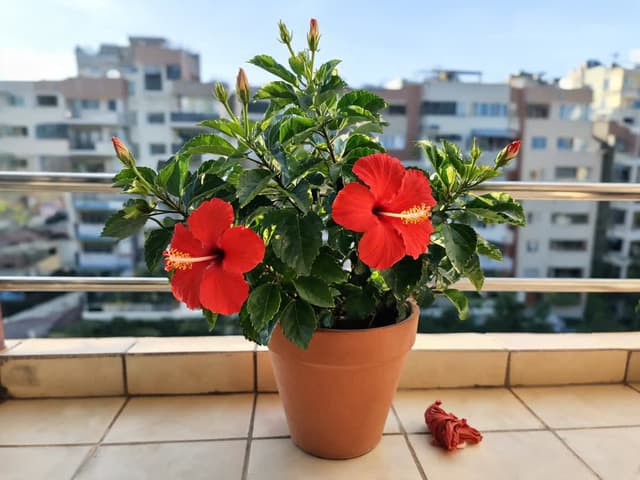
How to Care for Hibiscus: Sun, Watering, Fertilizer, and Pruning for Flowers
How to care for hibiscus: 6 hours of direct sun, evenly moist soil without waterlogging, half-strength fertilizer in spring and summer, and pruning in early spring. Find out why the flower lasts one day and why buds drop before opening.
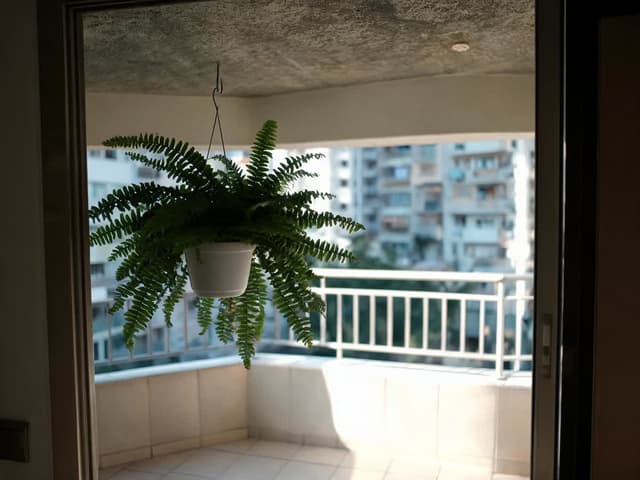
Do Ferns Like Sun or Shade? It Depends on the Type
Ferns prefer bright shade: plenty of light, but no direct sun on their fronds. Tuberous sword fern is the exception that handles sun. Here is the ideal light for each type, where to place pots, and how fronds show too much or too little light.
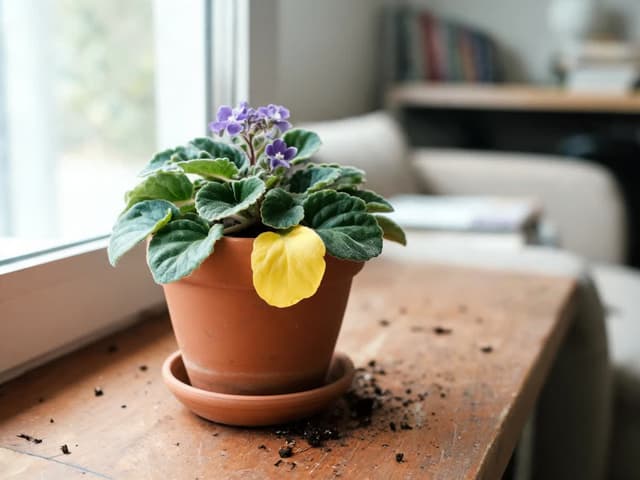
African Violet Yellow Leaves: Causes and What to Do
Yellow leaves on an African violet usually stem from overwatering, and the first place to check is the center of the plant. Losing one lower leaf at a time is normal. Identify whether age, watering, cold water, sunlight, cold drafts, or fertilizer is the culprit based on the yellowing pattern, and see what to do today.