Christmas Cactus Care: How to Get Your Plant to Bloom Every Year
If your Christmas cactus isn't blooming, it's not a lack of love—it's a lack of a trigger. Discover the two specific triggers that force buds, when to use them, and how to fix limp leaves.
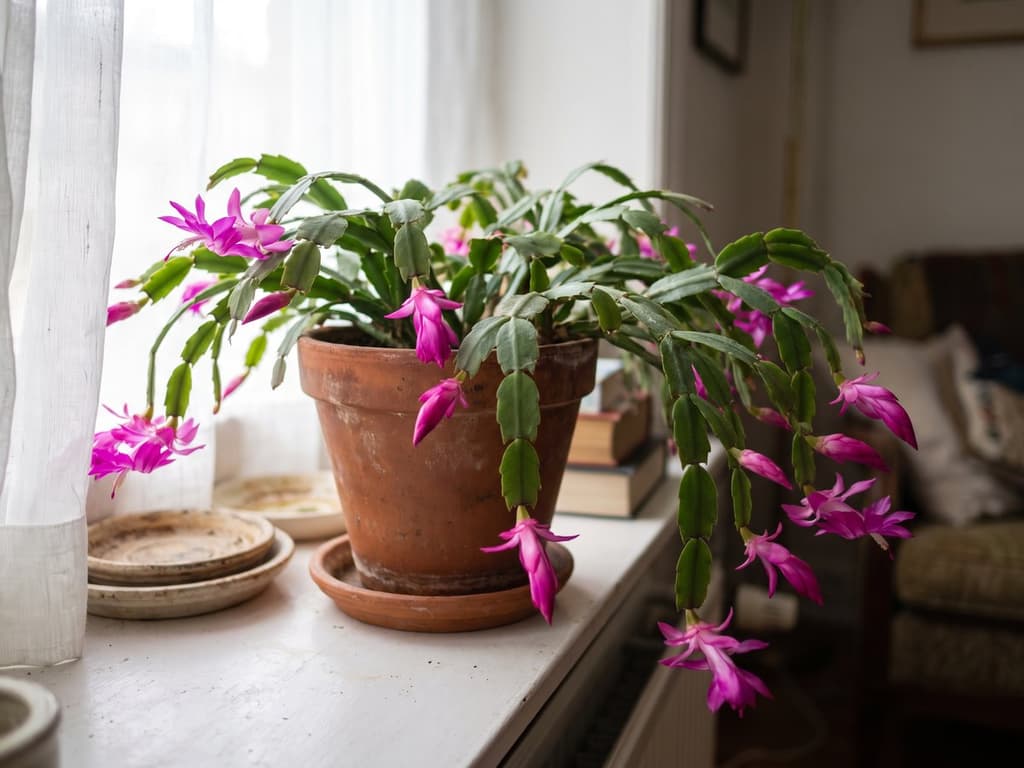
The Christmas cactus (Schlumbergera truncata) thrives on bright indirect light, fast-draining soil, and a watering schedule that shifts three times a year. But it will only bloom when it receives a specific environmental cue: chilly nights between 50°F and 55°F (10°C to 13°C), or long nights with 13 hours of uninterrupted darkness. Just one of these triggers is enough—and this is where most people get it wrong. They try to force both at the same time, move the pot around daily, and end up causing all the buds to drop off.
If your plant is healthy but never produces flowers, fertilizer is rarely the issue. It's all about the calendar.
Quick summary:
The two blooming triggers work independently: nighttime temperatures of 50–55°F (10–13°C) will trigger bud formation all on its own, without any need for darkness. The 13-hour dark period is only necessary if your nighttime temperatures stay between 55°F and 70°F (13°C to 21°C).
In the US, this trigger happens naturally in September and October—which is why it blooms right around the winter holidays. In the southern hemisphere, it happens in March and April, earning it the name "May flower."
It takes 6 to 8 weeks from the initial trigger to the first open flower. Once you see buds starting to form, stop moving the plant: even just rotating the pot can cause the buds to drop.
This plant is an epiphyte—in its native Brazilian rainforest, it grows on tree branches, not in dry desert sand. Planting it in pure, unamended cactus soil is one of the most common mistakes you can make.
It is non-toxic to dogs, cats, and horses (ASPCA).
What kind of plant is this (and why its wild home matters)
The Christmas cactus is a spineless cactus native to the coastal rainforests of Brazil. The species Schlumbergera truncata grows naturally in a tiny, high-altitude region of the Organ and Mar mountains near Rio de Janeiro, living directly on trees and rocks rather than in the ground (BioDiversity4All).
This isn't just fun trivia—it explains almost every care rule. A cactus that lives anchored to a tree branch under a shady forest canopy, with its roots exposed to the air and frequent rain, needs the exact opposite of a desert cactus. It wants filtered light, high humidity, plenty of airflow around the roots, and regular watering—without ever sitting in soggy soil.
Keep this image in mind. Every time this guide tells you "don't" do something, this rainforest habitat is the reason why.
Quick Facts | Source | |
|---|---|---|
Scientific name | Schlumbergera truncata (S. bridgesii is an older synonym) | RHS |
Family | Cactaceae | RHS |
Origin | Coastal mountains of Brazil, 2,300–3,300 ft — epiphyte | BioDiversity4All |
Light | Bright indirect light, away from harsh midday sun | RHS |
Temperature | Never below 50°F (10°C); 64°F to 68°F (18°C to 20°C) during active growth | RHS |
Humidity | High—it is native to humid subtropical forests | RHS |
Mature size | Up to 18 inches tall and wide | RHS |
Bloom time in the US | Late fall to winter (November to January) | BioDiversity4All |
Pet toxicity | Non-toxic to dogs, cats, and horses | ASPCA |
Thanksgiving, Christmas, or Easter cactus?
Three very similar holiday cacti are often sold under the wrong names, even at major garden centers. Because they bloom at different times of the year, identifying your exact species is the first step to knowing when to expect flowers.
You can't tell them apart by the flowers alone; you have to look at the segments—the flat, leaf-like parts of the stem. Take a close look at the edges.
What the edges look like | Species | Typical US bloom time |
|---|---|---|
Pointed, claw-like teeth pointing forward | Thanksgiving cactus (Schlumbergera truncata) | Late fall — November to December |
Scalloped, rounded waves with no sharp points | Christmas cactus (Schlumbergera × buckleyi) | Early winter — December to January |
Flat, smooth edges with tiny bristles at the tip | Easter cactus (Rhipsalidopsis gaertneri) | Spring — March to May |
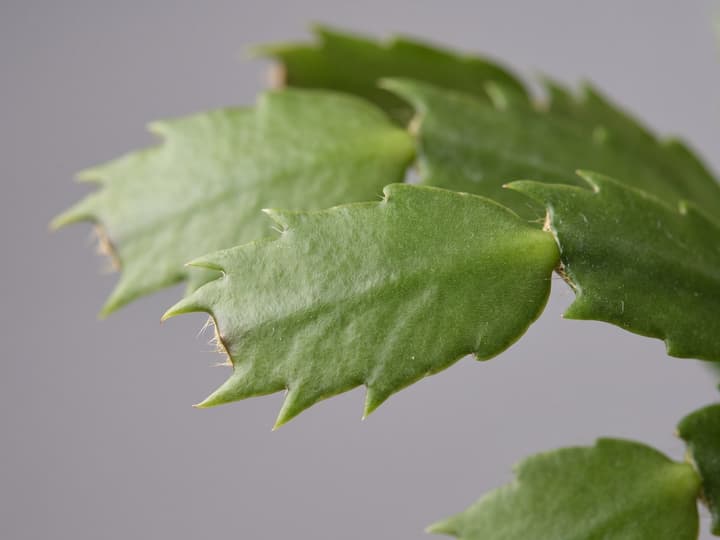
The vast majority of plants sold in stores as "Christmas cacti" are actually S. truncata (Thanksgiving cacti). If your plant has pointed teeth and blooms around late November, this entire guide is for you.
Light: Forest canopy shade, not desert sun
Your plant wants bright, indirect light all day long. In a typical home, three locations work best:
An east-facing window, within 3 feet—this is the ideal spot. It gets gentle morning sun and bright shade for the rest of the day.
Any window that gets intense midday or afternoon sun—usually south- or west-facing—as long as the plant is set back 6 to 10 feet or protected by a sheer curtain.
A covered porch or patio, tucked under an awning or shaded by larger outdoor plants.
Be careful with the opposite extreme: north-facing windows receive very little direct light throughout the year. While a holiday cactus can survive there, it rarely gets enough energy to develop flower buds.
If you look around online, you might find conflicting advice: the NYBG recommends very bright light with at least two hours of winter sun, while the RHS says to keep them out of strong sunlight altogether. Both are actually right for their respective climates: two hours of January sun in New York provides only a fraction of the intensity of two hours of midday sun in the South. The rule of thumb is simple: the weaker the seasonal sun, the closer to the window it goes; the stronger the sun, the further back it should sit. In the heat of summer, keep it shaded.
What doesn't work: direct midday sun. It will turn the edges of the segments red or purple—which is essentially a plant sunburn—and stunt its growth. On the other hand, deep shade will result in thin, leggy segments and zero blooms, since flowers only grow from the very tips of the segments.
A quick cleaning goes a long way: wipe down the segments with a damp cloth once a month. Built-up dust blocks light, making it harder for the plant to photosynthesize (RHS).
Watering: Three seasons, not a single fixed schedule
This is where most plant parents go wrong. Asking "how often should I water a Christmas cactus" will get you answers ranging from every 3 days to every 6 weeks—and all of them are correct depending on the time of year. Watering frequency is about the season, not just the plant.
Always use the same test: stick your finger about an inch into the soil. Your watering routine should change based on the plant's cycle:
Time of Year (US) | Watering Rule | What it looks like in practice |
|---|---|---|
Active Growth — March to August | Water when the top inch of soil feels dry, soaking thoroughly until water drains out the bottom | Roughly every 7 to 10 days |
Bud Induction — September to October | Reduce watering: let the top inch dry out, then wait an extra 2–3 days. Never let the soil dry out completely | Roughly every 12 to 18 days |
Blooming — November to January | Return to normal watering as soon as you see the first flower buds appear | Roughly every 7 to 10 days |
Let's clear up two common myths found online:
The advice to "stop watering in the fall" is misleading and dangerous. You only reduce watering until the buds actually form. Some guides recommend watering only once every 4 to 6 weeks during the cooler months—but doing this while buds are developing will cause them to shrivel and drop. The RHS is clear: let the top layer of soil dry out, but never let the root ball dry out completely.
Never let the pot sit in standing water. If there is water left in the saucer after watering, empty it within 15 minutes (NYBG). Epiphyte roots will rot quickly in waterlogged soil.
Soil and Pots: Remember, it's an epiphyte
Your potting mix needs to be highly aerated—standard potting soil on its own holds far too much moisture. On the flip side, pure desert cactus mix drains too quickly and lacks the organic material this forest native needs. The perfect balance is right in the middle:
3 parts standard potting soil to 1 part perlite or coarse builder's sand—the classic NYBG recipe. To mimic tree bark even closely, replace half of the perlite with orchid bark chips. Your goal is a mix that drains in seconds but still holds a touch of moisture the next day.
When it comes to pots: holiday cacti prefer to be slightly root-bound. A pot that is too large holds excess moisture around a relatively small root system, which is a recipe for root rot. Repot your plant every two years in late winter or early spring (February/March), moving up only one pot size and always ensuring there are drainage holes at the bottom.
Fertilizer: Feed lightly, and only in season
Use a balanced liquid houseplant fertilizer diluted to half strength, every 1 to 2 months during the active growing season—which runs from March to August in the US (UF/IFAS Extension).
Stop fertilizing about a month before you want to trigger blooming. Applying a high-nitrogen fertilizer at the wrong time will force the plant to produce new green segments instead of flower buds, leaving you with a lush but flowerless plant.
Be wary of generic advice suggesting you only fertilize "once a year in the spring"—that is far less than what university horticultural extensions recommend for healthy blooms.
Why your plant isn't blooming: The two triggers
This is the section that answers the question that likely brought you here.
A holiday cactus decides to bloom based on seasonal changes. It reads these environmental cues in two ways, and just one is enough:
Cool temperatures. If nighttime temperatures consistently drop between 50°F and 55°F (10°C to 13°C), the plant will form buds regardless of how much light it gets—no dark closets, no cardboard boxes, and no artificial night required.
Long nights. If your nighttime temperatures stay between 55°F and 70°F (13°C to 21°C), the plant absolutely requires 13 hours of continuous, total darkness every night for 6 to 8 weeks. If temperatures are warmer than 70°F, you will need to extend this dark period for 6 to 9 consecutive weeks (NYBG Plant Information Service).
"Total darkness" means exactly that: even a living room lamp counts as daylight. Turning on a light for just thirty minutes in the middle of the night resets the plant's internal clock. This is why it is critical to keep the plant away from artificial light at night during the entire bud-setting period (UF/IFAS Extension).
When to start, depending on your location
Most care guides assume you want flowers in December. While this makes perfect sense in the northern hemisphere, the timing depends entirely on your local climate.
The math is simple: count backward 6 to 8 weeks from when you want the plant to bloom.
Region | When to start the trigger | When flowers appear | Do you need artificial darkness? |
|---|---|---|---|
US (Northern states) | Late September to October | November to December | Usually not—natural fall nights are long and homes are cooler |
US (Southern states / Florida) | October | December | Yes, if indoor temperatures stay above 70°F at night |
Southern Hemisphere | Late March to April | May to June | Depends on local home heating and temperatures |
In northern regions of the US, these two triggers happen naturally: after the autumn equinox, nights naturally exceed 12 hours, and indoor temperatures drop before the heating is switched on. This is why a holiday cactus left forgotten on a cool porch blooms beautifully, while a babied plant in a warm living room with the TV and lights on late does not.
The step-by-step blooming protocol
Pick the date you want your plant to bloom. Count back 7 weeks (the middle of the 6-to-8-week window).
During these 7 weeks, keep the plant in complete darkness from 6:00 PM to 7:00 AM—use an unused room, a closet, or place a dark breathable bag over the pot. Move it back into bright indirect light during the day.
Reduce watering according to the bud induction guidelines in the watering table.
Do not fertilize during this period.
The moment you see the very first bud, stop the protocol: return the plant to its permanent spot, resume regular watering, and do not move the pot again.
Step 5 is where most people lose their flowers. Schlumbergera buds are highly sensitive to environmental changes—moving the pot to another room, rotating it, or placing it near a drafty window can cause them to drop. The plant aligns its buds toward the light source and will shed them if that direction suddenly changes.
Troubleshooting: What your plant is trying to tell you
Limp, shriveled segments are the most common issue, but they are often misdiagnosed because four entirely different problems can cause the same soft leaves—and two of them require opposite solutions. Always check the soil before taking action.
Symptom | Soil condition | Other confirming signs | Root cause | What to do |
|---|---|---|---|---|
Limp, shriveled segments | Dry as dust | Light pot; soil pulling away from the edges | Underwatering | Water thoroughly until it drains; repeat in 2 days |
Soft, limp segments without shriveling | Soggy / Wet | Dark or mushy stem base; plant feels loose in the pot | Root rot | Remove from pot, trim away mushy black roots, repot in fresh dry mix, and hold off on water for a week |
Reddish or purplish tint on segment edges | Any | Only affects the side facing the window | Too much direct sun | Move further from the window or add a sheer curtain |
Sudden wilting overnight | Any | Exposed to temperatures below 50°F (10°C) or near an A/C vent | Temperature shock | Move to a warmer spot; trim away any black or dead tissue |
Buds falling off before they open | Any | Happened shortly after moving or rotating the pot | Environmental change | Return the plant to its original spot and leave it alone |
Entire segments falling off at the joints | Soggy / Wet | Occurs right after the blooming period ends | Root damage or post-bloom exhaustion | Adjust your watering; wait to fertilize until active growth resumes |
White, cottony spots in the joints | Any | Sticky residue; spots can be wiped away with a Q-tip | Mealybugs | Dip a Q-tip in 70% rubbing alcohol and dab individual pests weekly |
No growth or blooms, but the plant looks healthy | Any | Has been in the same pot for several years | Root-bound or lack of nutrients | Repot in late winter and resume seasonal fertilizing |
If your plant looks healthy but refuses to bloom and none of the above applies, revisit the two triggers section: it is almost always a temperature or lighting issue.
Aphids can also target tender new growth and developing flower buds. If you spot tiny green or black pests clustered at the tips, treat them as you would any houseplant—learn how to get rid of aphids on plants.
Pruning and Propagation: One simple step does both
A holiday cactus doesn't require pruning for its health; over time, it will naturally grow into a large, beautiful trailing basket. However, pruning is highly beneficial for one key reason: flowers only develop on the tips of the segments, so the more branches your plant has, the more flowers it can produce.
Pruning to boost blooms is incredibly easy: in spring, right after the flowers fade, pinch off 1 or 2 segments from the ends of the longest, leggiest stems. Every pinch encourages the plant to branch out, creating two new tips where there was only one. If your plant is older and overcrowded, you can also remove a few entire stems from the base, always separating them at the joint—never cut through a segment, which leaves an unsightly, open wound (RHS).
The best part? The segments you remove can easily be propagated into brand-new plants. Spring, right after the blooming cycle ends, is the perfect time to do this.
Twist off a section of stem containing 2 or 3 segments—always bend at a joint rather than cutting through a segment.
Let the cuttings dry in a shaded spot for 1 to 2 days until the broken end calluses over. Skipping this step is the main reason cuttings rot in the soil.
Insert the callused end about half an inch deep into the same fast-draining potting mix you use for adult plants—just deep enough to keep it upright. You can plant 4 to 6 cuttings together along the edge of a 4-inch pot.
Keep the pot in bright indirect light at a temperature between 65°F and 75°F (18°C to 24°C). Water sparingly—just enough to keep the soil lightly moist, about every 5 to 7 days—and mist the cuttings daily.
Roots will develop in 3 to 12 weeks (RHS). Give a gentle tug on the cutting; if you feel resistance, it has successfully rooted.
Frequently Asked Questions
Are coffee grounds good for Christmas cacti?
There is no scientific evidence that coffee grounds help, and they actually pose a real risk. Wet coffee grounds spread over the soil surface can compact and trap moisture right at the base of the plant—the last thing a drainage-loving epiphyte wants. If you want to use coffee, compost it first with other organic matter rather than applying it directly to the pot.
How long do Christmas cacti live?
Decades. They are among the longest-lived houseplants you can own, and it is very common for specimens to be passed down through generations. The RHS notes that these plants are "extremely long-lived," and the older and more branched they get over the years, the more spectacular their seasonal blooms become.
Is a Christmas cactus toxic to cats and dogs?
No. The ASPCA lists Schlumbergera as non-toxic to dogs, cats, and horses. It is safely categorized as a pet-friendly plant. The only real concern is mechanical: if a curious cat chews on the fibrous segments, it might experience mild stomach upset, just as it would from eating any non-toxic plant material.
Why do the buds fall off before opening?
Bud drop is almost always caused by a sudden change in the plant's environment after the buds have set. The most common culprits are moving or rotating the pot, hot or cold drafts from vents, letting the root ball dry out completely, or overwatering. Once buds appear, leave the plant in place.
How long does the blooming period last?
A healthy bloom cycle typically lasts four to six weeks from the first flower to the last, provided the plant is kept in a stable spot and watered consistently. While individual flowers only last a few days, the buds open in successive waves. Pinching off spent flowers as they fade helps the plant channel its energy into the remaining buds.
Can I leave my Christmas cactus in the sun?
Gentle morning sun is perfectly fine for up to two hours. However, harsh midday and afternoon sun will scorch the plant, turning the segments red or purple and stunting its growth. When in doubt, bright indirect shade is always the safest bet.
In Summary
If your plant is green and healthy but refuses to bloom, don't change your fertilizer—change your calendar.
The next step takes less than ten seconds: go take a close look at the edges of your plant's segments. Pointed, claw-like teeth mean you have a Thanksgiving cactus, and your bud-setting window begins in late September. Rounded, scalloped edges mean you have a true Christmas cactus, which follows its own winter schedule.
If you aren't sure which species you have, or want to verify whether that fuzzy spot on your plant is actually a mealybug, the Bloom app can identify your plant and diagnose symptoms from a single photo. Available now for iPhone and iPad.
Related articles
How to Care for Syngonium: Light, Watering, Cuttings, and Pests
How to care for syngonium indoors: bright indirect light, watering when the soil surface dries, 64 to 81°F (18 to 27°C), and 40 to 60% humidity. Also cover water cuttings, thrips, yellow leaves, and pet toxicity.
Rosemary Leaves Turning Yellow: Causes and Solutions
Rosemary with yellow leaves usually has overly wet roots. Check where the yellowing appears to see if it stems from wet roots, low light, spider mites, powdery mildew, or normal leaf shed, and learn how to save the plant.
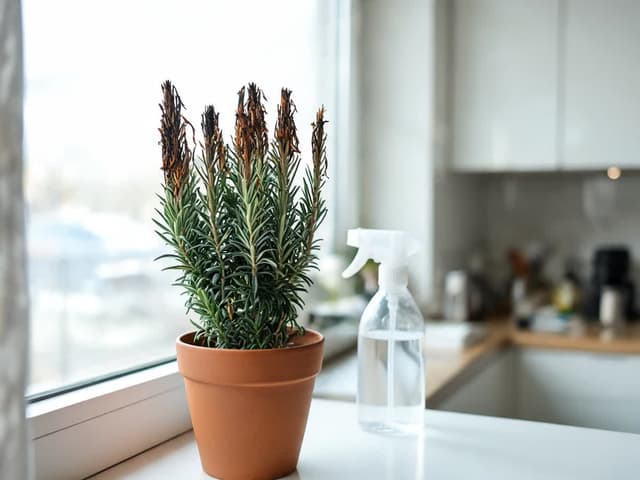
Is Your Rosemary Dying? How to Save Soap-Burned Rosemary
Rosemary with soap-burned leaves can usually be saved: the damage stays on the affected needles. Rinse the leaves, wait a week, scrape the stems, and prune only what is brown inside.