Flowering Basil: Should You Leave or Cut the Flowers?
Flowering basil still produces leaves and remains edible. Cut the flower spike above a pair of leaves if you want leaves; leave it if you want seeds or bees. Learn where to cut and why it flowered early.
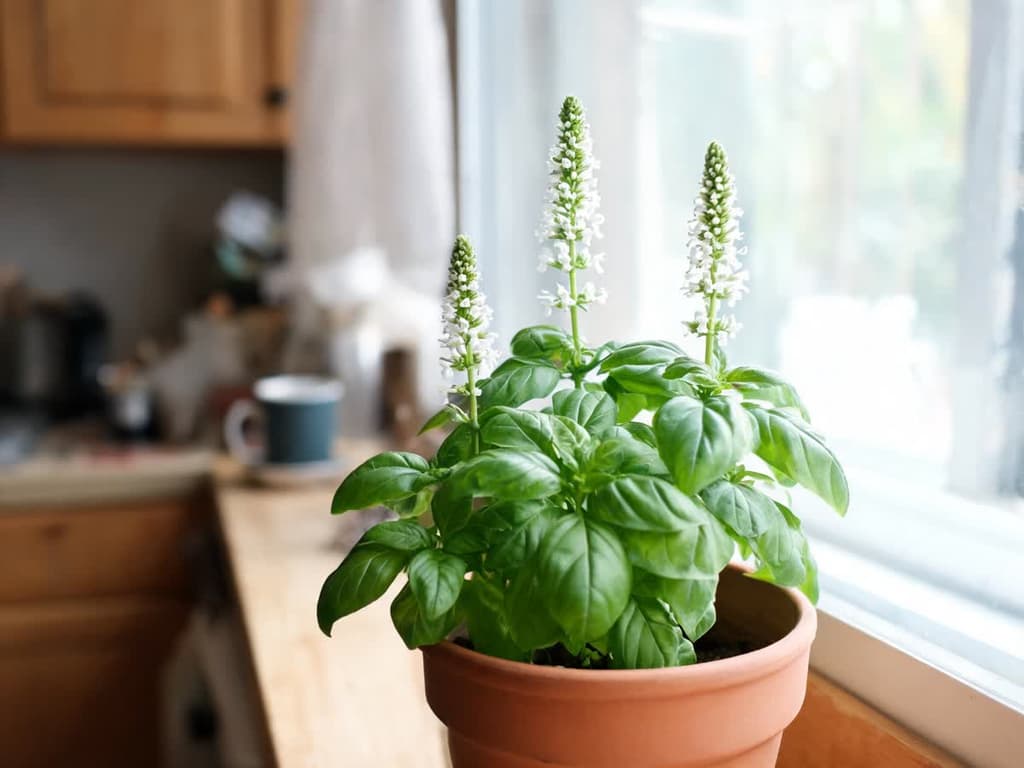
If your basil is flowering and you want to keep harvesting leaves, cut the flower spike (the stem with flowers at the top of the branch) right above a pair of leaves. If you want seeds or want to feed bees, leave the flowers. The leaves and flowers remain edible: flowering changes the leaf's flavor, but it does not make the leaf dangerous. Do not throw the plant away.
The flower spike is the stem that emerges from the tip of the branch, with small white or purple flowers stacked one above the other along the stem. According to the Royal Horticultural Society (RHS), removing the spike as soon as it appears delays flowering and keeps leaf quality for longer. The University of Florida's UF/IFAS explains why: letting basil flower and set seed shortens the harvest season.
Quick summary:
Want leaves: cut the branch with the flower spike right above a pair of leaves as soon as the bud appears.
Want seeds: let the flowers dry on the plant until they turn brown.
Want bees: let one plant flower and cut the flower spikes on the others.
Leaves from a flowering plant: safe to eat, though the flavor changes.
Basil flowers: edible and milder in flavor than the leaves, according to the RHS.
Flowering basil: should I cut or leave the flowers?
Cut the basil flower if you want leaves for cooking. Leave the flower if you want seeds or bees. Basil (Ocimum basilicum) is treated as an annual plant: it grows, flowers, sets seed, and ends its season. Utah State University Extension states that after flowering and setting seed, the plant stops producing leaves.
What you want | What to do | What happens next |
|---|---|---|
Leaves for cooking | Cut the branch with the flower spike above a pair of leaves | The plant shoots out new side growth and the harvest lasts longer (RHS, UF/IFAS) |
Seeds for planting | Let the flower dry on the plant | The harvest season ends sooner (UF/IFAS) |
Food for bees | Let one plant flower and cut the flower spikes on the others | The flower has plenty of nectar and attracts bees (RHS) |
Plant already fully flowering and woody | Cut the branches above a pair of green leaves, leaving 2 to 4 leaves, and take a cutting from a non-flowering branch | The cutting grows into a new plant that starts producing leaves again |
The basil profile shows the species' light, soil, and disease requirements so you can care for the plant after cutting.
How to cut the flower spike without losing the plant
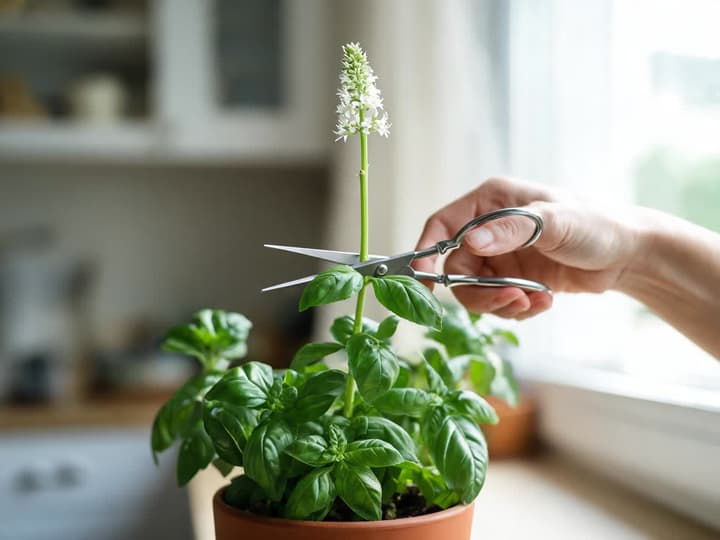
Cut the tip of the branch, along with the spike, right above a pair of leaves, not just the flower bud. Do it like this:
Find the spike: the tip of the branch thins out, and tiers of small green or purple buds appear.
Move down the branch to the first pair of large, healthy leaves below the spike.
Cut the stem with clean scissors right above that pair of leaves.
Leave 2 to 4 leaves on the branch, as Utah State advises.
Repeat on all branches with buds as soon as the buds appear.
New shoots emerge from the junction between the leaf and the stem, just below the cut. NC State Extension recommends pinching (plucking with your fingertips) the tips of long branches and flower buds, so the plant produces more branches and becomes bushy.
Utah State disagrees on one point: pinching off only the flower does not trigger new leaf growth and actually causes flowers to appear in the leaf axils, where the leaf meets the stem. The RHS and UF/IFAS instruct removing the flower. Both approaches align by cutting above a pair of leaves: this removes the flower and also the branch tip, which Utah State calls harvesting. This guide follows this cut, rather than pinching only the bud, because it satisfies both sources.
Can you eat basil leaves when the plant is flowering?
You can eat the leaves from a flowering basil plant, and the flower itself as well. The RHS states that basil flowers are edible and milder in flavor than the leaves. UF/IFAS also lists the flower as a culinary ingredient.
Flowering changes the leaf's flavor. The RHS notes that flowering affects the flavor of the leaves, and Utah State mentions an off-flavor. Neither measures how much the flavor changes nor states that the leaf turns bitter.
A study published in 2012 in the scientific journal Chemija measured basil essential oil across three stages: leaves only, flower buds, and open flowers. The amount of oil increased as the plant developed. The composition changed. Linalool, with a floral scent, peaked at the bud stage. Methyl chavicol, with an anise scent, decreased through to open flowering. This study shows that the composition of basil oil changes with flowering, which may explain the change in scent and flavor. It did not measure whether the leaf turns bitter.
Use leaves from a flowering plant raw, at the end of cooking. The RHS warns that basil loses flavor when cooked for too long. For that reason, place fresh leaves over warm dishes right when serving.
Why basil flowered so early
Basil flowers early in four situations: an overcrowded pot, dry soil, intense heat combined with lack of water, or fertilizer rich in potassium. Sources cite these causes:
Overcrowded pot. The RHS says supermarket pots hold many thin, crowded seedlings that tend to flower early or get fungal issues. According to the RHS, early flowering ends the harvest.
Dry soil. The RHS notes that basil can flower earlier with little water.
Intense heat combined with lack of water. Utah State points to summer heat and water stress as causes of flowering and seeding.
Fertilizer rich in potassium. The RHS advises avoiding tomato fertilizer, rich in potassium (one of the three main fertilizer nutrients), because it promotes flowering.
Day length is not on that list. A study presented in 2018 at the American Society for Horticultural Science (ASHS) conference tested days with 11 to 16 hours of light. Changing the day length did not alter when buds and flowers appeared on 'Genovese' basil, a common basil variety.
To delay the next bloom:
Remove the root ball from the supermarket pot, divide the seedlings into smaller clusters, and pot each cluster separately. The RHS notes that seedlings survive if divided and repotted quickly.
Water when the surface soil feels dry to the touch, before the pot dries out completely.
Use a balanced liquid fertilizer, with nitrogen, phosphorus, and potassium in similar proportions, at the rate and frequency listed on the label.
Harvest the tip of each branch, right above a pair of leaves, before buds appear.
Woody basil full of flowers: can it be saved?
A woody basil plant (with a hard, brown, wood-like stem at the base) covered in flowers still yields leaves, but it will not return to being the young plant it once was. The plant directs its energy toward flowers and seeds, not leaves. Do both of the following on the same day:
Cut back all flower spikes and tips, always above a pair of green leaves. Leave 2 to 4 leaves on each branch, as Utah State advises.
Take a cutting: cut a green, non-flowering stem right below a leaf, strip the lower leaves and the tip, and place the stem in a glass of water (the RHS method). It roots within a few weeks and can then go into a pot with soil.
If no branches are free of flowers, plant fresh seeds. The RHS notes that seeds germinate well at around 68 °F (20 °C).
How to harvest basil seeds
To harvest basil seeds, let the spike dry on the plant. UF/IFAS outlines the steps:
Leave the flowers on the plant until they wither.
Wait until the seeds turn brown and nearly dry inside the seed capsules (the casings holding the seeds).
Cut the spike and release the seeds from the capsules with your hands, over paper.
Store the seeds in a tightly sealed container in a cool spot. They remain viable for several years.
Seeds may produce a plant that differs from the parent plant. UF/IFAS recommends roughly 150 feet (45 meters) of distance between different basil varieties flowering at the same time. Without that distance, bees cross-pollinate the varieties, which can result in hybrid offspring.
Leaving basil to flower for bees
Let at least one basil plant flower if you have several. The RHS recommends this because basil flowers carry abundant nectar, feeding bees and other pollinators. On your other plants, keep cutting the spikes to harvest leaves.
Frequently asked questions
Is that pizza-scented herb with white flowers basil or oregano?
Check the leaves: basil leaves are much larger than oregano leaves. Both herbs flower at the tips of their branches, so the flowers will not help tell them apart. If you are unsure, Bloom (available for iOS) identifies the plant from a photo and tells you which herb it is.
Does basil die after flowering?
Basil is treated as an annual: after flowering and setting seed, it stops producing leaves, according to Utah State. UF/IFAS notes that letting seed develop shortens the season. Cutting the flower spike right at the start delays the end of the harvest.
Are basil flowers toxic to dogs or cats?
The ASPCA, an American animal welfare organization, lists basil as non-toxic to dogs and cats. If your pet ate the plant and feels sick, see a veterinarian.
When does basil start flowering?
Basil usually begins flowering in the warmest months, during mid to late summer, according to the RHS. Overcrowded pots, dry soil, and extreme heat paired with underwatering accelerate blooming.
Related articles
How to Care for Hibiscus: Sun, Watering, Fertilizer, and Pruning for Flowers
How to care for hibiscus: 6 hours of direct sun, evenly moist soil without waterlogging, half-strength fertilizer in spring and summer, and pruning in early spring. Find out why the flower lasts one day and why buds drop before opening.

Do Ferns Like Sun or Shade? It Depends on the Type
Ferns prefer bright shade: plenty of light, but no direct sun on their fronds. Tuberous sword fern is the exception that handles sun. Here is the ideal light for each type, where to place pots, and how fronds show too much or too little light.

African Violet Yellow Leaves: Causes and What to Do
Yellow leaves on an African violet usually stem from overwatering, and the first place to check is the center of the plant. Losing one lower leaf at a time is normal. Identify whether age, watering, cold water, sunlight, cold drafts, or fertilizer is the culprit based on the yellowing pattern, and see what to do today.