How to Prune Basil: Where to Cut So It Grows Back
To prune basil, cut the stem right above a pair of leaves: two new branches grow from there. Learn when to do the first prune, how much to take at a time, how to remove flowers, and what to do with woody stems.
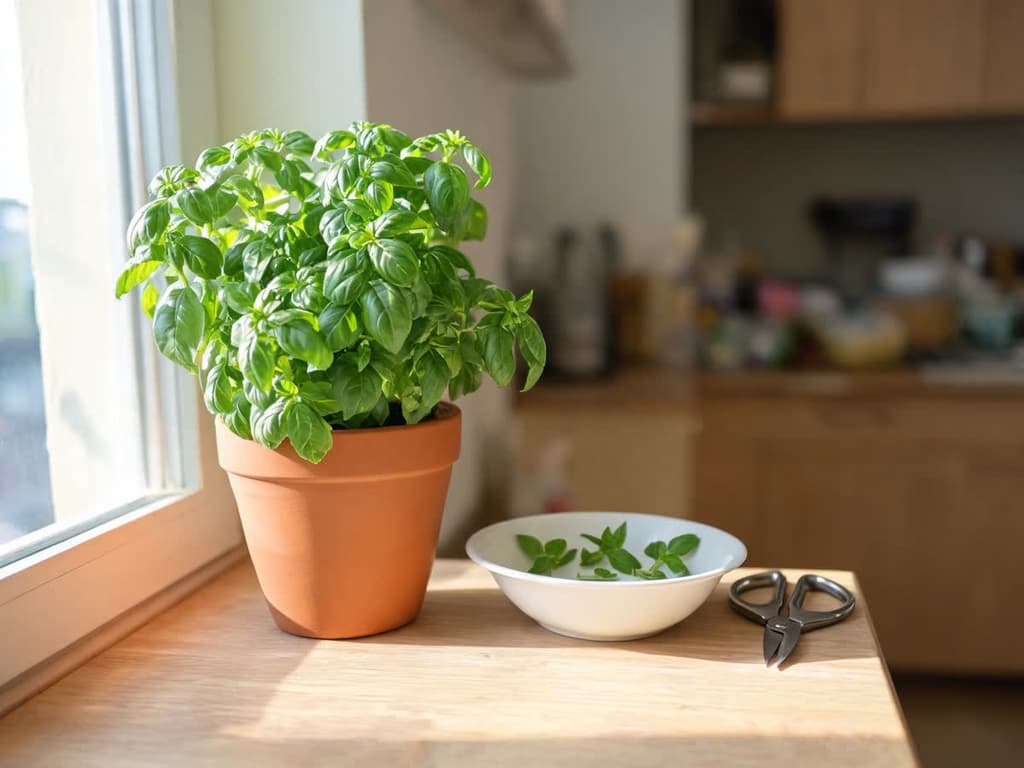
To prune basil, cut the stem right above a pair of leaves using clean shears. The two tiny shoots at the base of those leaves will turn into two new branches, making the plant bushier. After the first pruning, remove at most one-third of the plant at a time and always leave leaves below the cut. Use this exact same cut when harvesting basil day to day.
That point on the stem where the pair of leaves emerges is called a node. The University of Kentucky instructs to cut the stem right above a pair of leaves. According to the university, harvesting the tips makes the plant bushier. University of Illinois Extension notes that new growth appears at the cut site in about a week.
Quick summary:
Where to cut: right above a pair of leaves, never in the middle of the stem between two pairs.
First prune: when the plant has 6 to 8 leaves, according to Utah State University.
How much to take: after the first prune, at most one-third of the plant at a time, and wait a few weeks before another large harvest.
Flowers: cut the flowering branch above a pair of leaves, not just the flower bud.
Woody stem (hard and brown, like a twig): prune the branches that still have green leaves.
Where to cut basil: right above the leaf pair
Cut the stem right above the node, which is the point where a pair of leaves emerges. At the junction between each leaf and the stem sits a small bud, sometimes visible as two tiny leaves. When you remove the tip above it, both buds in that pair grow and turn into two branches.
Follow these steps:
Pick a branch that has at least 3 pairs of leaves.
Move down from the tip to the second or third leaf pair, counting downward from the top.
Look for the two tiny shoots at the base of that pair, one on each side of the stem.
Cut the stem with clean shears right above that pair, without leaving a long stub.
Check that at least 2 leaves remain on the branch. The Utah State University Extension calls for 2 to 4.
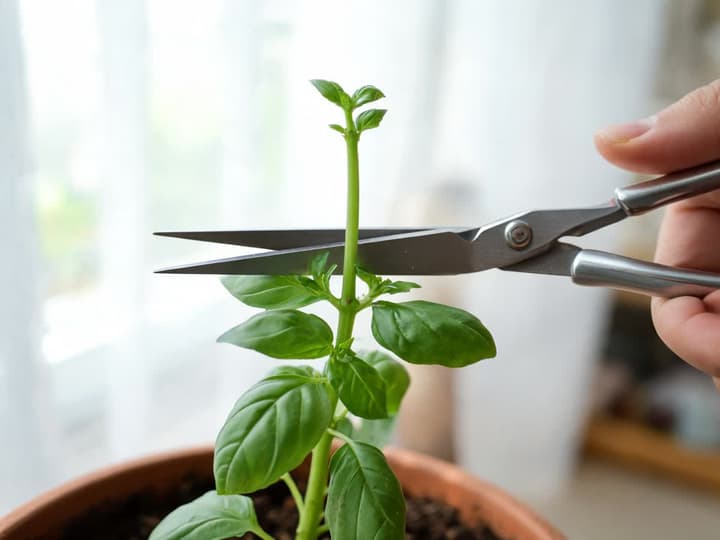
The stem stub left above the node will not sprout because there are no buds there. That is why you make the cut close to the leaf pair.
Cut on a rain-free day when the leaves are dry. The Clemson Home & Garden Information Center, from Clemson University, explains that gray mold (a fungus that leaves a gray coating on plant tissues) enters through cuts made in wet weather. After 48 hours, the cut has already healed and the fungus can no longer enter.
When to prune basil for the first time
Do the first pruning when the plant has 6 to 8 leaves, according to Utah State. On this first cut, trim the main stem above the second pair of leaves, counting from the bottom. This leaves 2 to 4 leaves, and the cut may remove more than one-third of the seedling. This exception applies only to the first pruning, as Utah State is the only source that gives a specific number for it. The plant will then grow two branches instead of one.
After the first pruning, harvest tips frequently. The West Virginia University Extension advises harvesting tips about once a week. According to the same extension, this frequent harvesting causes the plant to branch out (produce more branches) and prevents flowering.
How much to take at a time
Once the plant has branched out, take at most one-third at a time. The University of Kentucky allows harvesting up to one-third of the plant during a large harvest, such as for a batch of pesto. Afterwards, the university recommends waiting a few weeks for regrowth before the next large harvest.
Sources provide different numbers. Illinois Extension advises leaving at least half the plant. Utah State advises leaving 2 to 4 leaves on the cut branch. West Virginia trims only the top 5 to 8 cm (2 to 3 inches) and leaves about 4 leaves. This guide follows the Kentucky limit, since one-third also respects the half requested by Illinois.
An Embrapa trial in Brazlândia (Federal District) shows the risk of drastic cutting (Research Bulletin 352, 2019). Plants cut 15 cm from the ground regrew unevenly, with sprawling branches touching the soil. Those cut at 40 cm, about half their height, regrew upright and produced 21.35% more essential oil (the oil that gives the aroma) than those cut at 15 cm.
Iowa State accepts a heavy pruning on potted indoor basil, leaving 10 to 15 cm (4 to 6 inches) of stem. The Embrapa trial used plants 50 to 97 cm tall in the field. For large plants, this guide follows the measured results from Embrapa.
What you want | How much to cut | When to repeat |
|---|---|---|
Leaves for a recipe | The tips of a few branches, 5 to 8 cm (2 to 3 inches), above a pair of leaves | About once a week (West Virginia) |
Large harvest, for pesto | Up to one-third of the plant, always above a pair of leaves | After a few weeks of regrowth (Kentucky) |
Bushier plant (shaping prune: removing a small amount so the plant branches out) | Just the tip of each long branch, above a pair of leaves | When a new branch has 6 to 8 leaves |
Harvesting and shaping cuts use the exact same technique. The difference lies in the goal: during a shaping prune, you remove very little, just enough to encourage the plant to branch out. The only exception is the seedling's first pruning, where Utah State instructs leaving only 2 to 4 leaves.
Common basil (Ocimum basilicum) grows quickly and is treated as an annual (it lives for one season and dies). The species care sheet details its light needs and common diseases:
Does picking single leaves kill basil?
Picking an individual leaf will not kill basil. Illinois Extension states that individual leaves can also be harvested. What picking a single leaf will not do is cause the plant to branch: cutting the tip above a pair of leaves is what triggers branching.
The problem arises when you strip the lower leaves one by one and leave the top growing. The lower stem ends up bare, the plant grows tall and leggy, and each new leaf emerges farther from the soil. If you only need two or three leaves, pinch off the tip of a branch instead of pulling off bottom leaves.
How to cut basil flowers
Cut the flowering branch right above a pair of leaves, not just the flower bud. Utah State explains that pinching only the flower does not stimulate new leaves. Doing that also encourages flowers in the leaf axils (the point where the leaf meets the stem). The Royal Horticultural Society (RHS), in the United Kingdom, advises removing flower stalks as soon as they appear, because flowering affects the flavor of the leaves.
The flower spike, called an inflorescence, emerges from the branch tip, displaying layers of green or purple buds along the stalk. Illinois Extension notes that if basil blooms and goes to seed, the plant turns woody, stops producing, and the leaves turn bitter. If you want seeds or flowers for bees, allow one plant to bloom and cut the spikes from the others.
Woody basil or bare stems: where to cut
Prune woody basil on branches that still have green leaves, cutting right above a pair of leaves. Leave the hard, brown section of the stem alone. None of the consulted sources measured whether a bare, woody stem can sprout again.
A woody stem is a stem that has hardened and turned brown with bark, like a tree branch. On common basil, this happens after the plant flowers and sets seed, according to Illinois Extension. Follow these steps:
Look for green branches emerging from the woody section.
On each green branch, trim the tip right above a pair of leaves.
Remove the flower spikes from all branches, if present.
Use only non-flowering tips to root cuttings in water.
A bare stem is different: it is a stem that lost all its foliage, usually after the leaves were plucked off. If tiny leaves or buds remain at any node, cut the stem right above that node and wait. If the stem has no leaves or buds at all, none of the consulted sources provide data on regrowth. The safest option is to take cuttings from other leafy branches and start a new plant.
If your basil is blooming and has wilted leaves at the same time, do not prune the entire plant at once. Wilting and blooming are two separate issues, and our page on wilted basil leaves breaks down the causes. Fix your watering routine first, and then cut off the flower spikes and tips, staying within the one-third limit.
Cut branches turn into new plants in water
The cut tip of a non-flowering branch roots easily in a glass of water. West Virginia Extension recommends using the top 10 cm (4 inches) of the stem. On the tip you removed, the RHS advises cutting right below a leaf node and stripping the bottom leaves. Keep the cutting in water until roots form, then transplant it into a pot with potting mix.
Always use a non-flowering branch for propagation. The rooted cutting will replace the parent plant when the older plant turns woody.
Supermarket basil: separate seedlings before pruning
Potted grocery store basil contains dozens of crowded, spindly seedlings in a single root ball. The RHS explains that these tightly packed seedlings easily contract fungal diseases and bolt early. According to the RHS, they can survive if you divide the root ball and repot each section into its own pot right after purchase.
Do the first pruning after dividing them, once each seedling is well established in its new pot. The pruning rule remains the same: cut above a pair of leaves once the seedling has 6 to 8 leaves.
Pruning basil at the end of the season
At the end of the season, pruning shifts into the final harvest. Common basil is an annual and suffers from cold weather before any frost arrives: Illinois Extension notes leaf discoloration at 10 °C (50 °F). UF/IFAS only reports leaves turning black below 4 °C (40 °F); this guide follows the 10 °C threshold, which is safer for the plant. Before the first night with a low of 10 °C, harvest the entire plant or bring the pot indoors, as detailed in our guide to winter basil care.
Iowa State University recommends discarding annual herbs after several harvests and starting fresh plants. Therefore, giving basil a severe prune to keep it alive for another year is unsupported by our sources. Root cuttings in water and start fresh with those instead.
How to confirm your herb is actually basil
Inheriting a garden bed can make it hard to tell whether your plant is common basil, bush basil, or another look-alike herb. This guide applies specifically to common basil; other species may respond differently to pruning and cold. Bloom (available for iOS) identifies your plant from a single photo of its leaves and stems.
Frequently asked questions
How many times does basil grow back after pruning?
Basil grows back after every cut made above a pair of leaves, provided the plant has not flowered. None of the consulted sources state an exact limit for how many times this repeats. Illinois Extension reports that new growth emerges at the cut site in about a week. After several harvests, Iowa State recommends starting over with new plants.
Why is my basil only growing straight up?
Basil grows straight up when no one prunes the tip of the main stem. The University of Kentucky explains that harvesting tips makes the plant fuller. Pinch the tip above a pair of leaves when the plant has 6 to 8 leaves, and repeat on every new branch that develops.
Can I plant grocery store basil in a garden bed?
The RHS recommends keeping store-bought basil in a container indoors. This protects the rest of your garden, as commercially purchased plants can carry pests and diseases into garden beds. To grow basil in a bed, plant your own seedlings grown from seeds or cuttings rooted in water from pruned stems.
How should I store harvested basil?
Place the harvested stems in a glass of water away from direct sun, just like cut flowers in a vase. Utah State explains that frozen basil turns mushy upon thawing and loses its flavor. For longer storage, freeze whole leaves in ice cube trays covered with water, or make pesto and freeze it.
Conclusion
To prune basil, always cut right above a pair of leaves, start when the plant has 6 to 8 leaves, and remove no more than one-third of the foliage at a time. Cut off flowering stems rather than just the buds, and use non-flowering tips to root new cuttings in water. Today, if your plant has never been pruned and has 6 to 8 leaves, cut the main stem above the second pair of leaves from the bottom. If it already has multiple branches, trim the tip of one branch right above a pair of leaves.
Related articles

How to Care for Hibiscus: Sun, Watering, Fertilizer, and Pruning for Flowers
How to care for hibiscus: 6 hours of direct sun, evenly moist soil without waterlogging, half-strength fertilizer in spring and summer, and pruning in early spring. Find out why the flower lasts one day and why buds drop before opening.

Do Ferns Like Sun or Shade? It Depends on the Type
Ferns prefer bright shade: plenty of light, but no direct sun on their fronds. Tuberous sword fern is the exception that handles sun. Here is the ideal light for each type, where to place pots, and how fronds show too much or too little light.

African Violet Yellow Leaves: Causes and What to Do
Yellow leaves on an African violet usually stem from overwatering, and the first place to check is the center of the plant. Losing one lower leaf at a time is normal. Identify whether age, watering, cold water, sunlight, cold drafts, or fertilizer is the culprit based on the yellowing pattern, and see what to do today.