Cactus Soil Mix: The Best Potting Soil and How to Make It at Home
The best cactus soil contains more mineral material than organic material and dries out in about 7 days in warm weather. See university recipes, two tests to check if your current mix works, and when to repot.
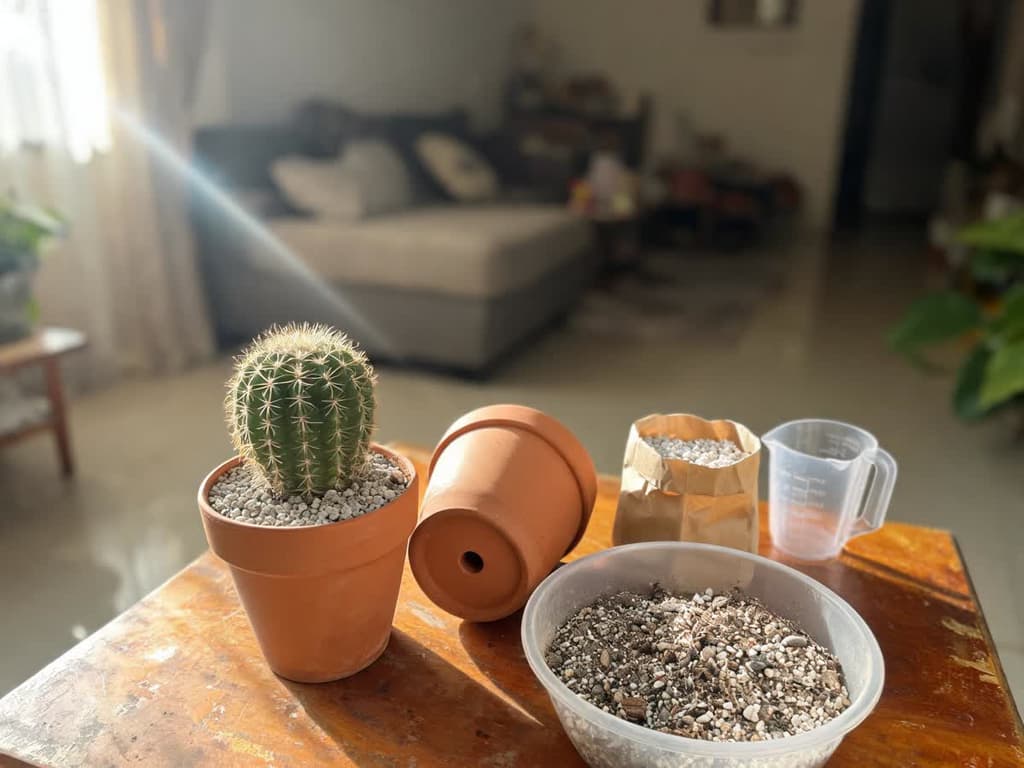
The best soil mix for a cactus (potting soil is the soil in the pot) uses 1 part organic material to 2 parts mineral material. Organic is anything that comes from plants: bagged potting soil, pine bark, or coconut coir. Mineral is rock or sand: perlite, pumice, coarse sand, or fine gravel. That is the recipe from Iowa State University Extension and Outreach (a university public guidance service). The mix goes into a pot with a drainage hole at the bottom.
You do not need to buy anything to see if your current soil works. Water until liquid comes out of the hole and time how long it takes to stop dripping: it should take less than 1 minute. Next, during warm months, the soil should dry out completely in about 7 days. If it fails either of these two tests, the soil holds too much water for a cactus.
Quick summary:
Recipe to follow: 1 part potting soil or coconut coir to 2 parts perlite, pumice, coarse sand, or fine gravel (Iowa State University).
The right soil drains in less than 1 minute (New York Botanical Garden) and dries out in about 7 days in warm weather (Boyce Thompson Arboretum).
Garden soil and pure peat moss do not work: in a container, both stay waterlogged, and dry peat moss begins to repel water.
Commercial cactus and succulent soil divides expert sources. Run the drainage test before using it, and if it fails, mix in more mineral material.
Change the potting soil when the roots appear through the drainage hole (it usually takes 2 to 4 years), in spring, and wait one week before the first watering.
Two tests to see if your cactus soil works
The first test is the drainage test. Water slowly, until water begins coming out of the hole. Stop watering and time how long it takes to stop draining. The New York Botanical Garden states that good cactus soil drains in under one minute after watering.
The second test is the drying test. After that watering, push a wooden skewer to the bottom of the pot every 2 or 3 days. The skewer comes out clean when the soil has dried. The Boyce Thompson Arboretum, in Arizona, says that a cactus pot's soil should dry out completely in about 7 days. That timeframe applies to the warm months; in the winter, the soil dries more slowly and that is normal.
The first test can give a misleading result. Peat moss (the dark fiber of decomposed moss that forms the base of many potting soils) dries out, shrinks, and pulls away from the pot wall. Water runs down this gap and drains through the hole in seconds, without wetting the center of the root ball. The Iowa extension notes that dry peat moss and coconut coir become water repellent and take a long time to rewet. If the water disappeared too quickly, check the center of the root ball with the stick.
Soil that passes both tests allows you to water until it drains without rotting the roots. The interval between waterings changes with the season and the pot. The guide on how often to water a cactus shows how to adjust that interval.
The best soil mix for a cactus
The best cactus soil has more mineral material than organic material. Four institutions publish proportions, and none of them match:
Source | Published recipe | Mineral portion |
|---|---|---|
Iowa State University Extension | 1 part organic + 2 parts mineral | about 67% |
New York Botanical Garden | 3 parts gravel or sand + 1 part potting soil + 1 part coconut coir, peat, or bark | 60% |
University of Arizona Campus Arboretum | about 75% mineral + 25% organic | 75% |
Royal Horticultural Society | 2 parts peat-free potting soil + 1 part grit or washed sand | about 33% |
Follow the Iowa recipe, the first one in the table. It comes from a university extension service and is written for indoor cacti and succulents, which matches an apartment cactus. The Arizona Arboretum writes for outdoor cacti in the Tucson desert. The Royal Horticultural Society writes for UK homes, with less sunlight, and uses less mineral material; they do not explain why.
The organic part, according to Iowa Extension, can be potting soil, pine bark, compost, or coconut coir. The mineral part can be perlite, coarse sand, pumice, or fine gravel. Bloom's general cactus care sheet recommends the same type of mix, with perlite, sand, and gravel:
What each ingredient does in the mix
Organic material holds water and nutrients between waterings. Mineral material opens up air spaces and lets excess water pass through. Cactus soil uses both, with more mineral material than organic material.
The mineral materials you find in garden centers in Brazil:
Perlite: white, extremely lightweight granules of volcanic rock expanded by heat. It creates air space without adding weight to the container.
Pumice: porous volcanic rock, gray or beige, heavier than perlite. The University of Arizona Arboretum says that pumice or volcanic rock work well even on their own as the mineral part.
Fine gravel: small crushed stone. It adds weight and stabilizes tall cacti.
Washed coarse sand: visible grains without fine dust. Fine sand, with a texture like talcum powder, compacts and will not work.
Grain size matters too. The same arboretum uses 4 to 6 mm particles, mixing different sizes. Particles that are too fine block water drainage, and particles that are too coarse hold no water at all.
Sand is where sources diverge. The New York Botanical Garden and the Royal Horticultural Society use sand in their recipes. In contrast, Iowa State Extension says sand provides little aeration inside the pot and serves mostly as weight. The North Carolina State University Extension handbook agrees that sand provides little aeration: it only makes the mix drain quickly near 50% by volume. For cactus, the same handbook limits potting soil and sand combined to 1/3 of the mix and calls for perlite. Follow the extensions: use perlite or pumice for air space and leave coarse sand as part of the mineral material, never as the only one.
The organic materials that work are bagged potting soil, coconut coir, ground pine bark, and carbonized rice hulls. Carbonized rice hulls have already been tested on cacti in Brazil. In an Embrapa trial with coroa-de-frade seedlings (Melocactus zehntneri, a round cactus from the Northeast), the best mix was carbonized rice hulls, vermiculite (a lightweight mineral that holds water), and worm castings, in a 5:3:2 ratio. The seedlings stayed in trays for 90 days. This mix is much more organic than the Iowa recipe: use the trial only as proof that rice hulls work.
Compost and worm castings should only be added in small amounts. North Carolina State Extension warns that many composts carry a pH above 7. The pH scale measures acidity: below 7 is acidic, and above 7 is alkaline. Because of this, it caps compost at 15% to 40% of the mix. Animal manure should be skipped entirely. In cactus propagation mixes, University of Arizona Extension advises against manure because it can introduce soluble salts. The guide on how to propagate cacti follows that same rule.
Garden soil and pure peat moss in a cactus pot
Garden soil does not work for potted cacti, even when it drains well in a garden bed. Iowa State Extension explains that soil and sand packed into a container lack the pore spaces found in a proper container mix. The result is waterlogged soil and weak roots.
Pure peat moss fails in two ways: wet, it stays soggy; dry, it repels water. Dark, fine peat moss, sold in large bags as a garden amendment, retains too much moisture. According to the same extension, it provides almost no air space. When it dries out completely, it takes days to absorb water again, leaving the cactus roots starved of moisture the entire time.
If your cactus came from the supermarket in a dark, fine mix, you do not need to repot it the day you buy it. Run the two tests from the first section: if the soil passes, the cactus can stay where it is until the next scheduled repotting.
Pre-mixed cactus and succulent soil: when to use it
Sources do not agree on pre-mixed cactus soil. Iowa State Extension calls commercial cactus and succulent mix a great option for beginners. The New York Botanical Garden says the opposite: many commercial cactus soils rely too heavily on peat moss, which retains moisture longer than desirable. The Arizona Arboretum agrees with the New York garden and recommends cutting commercial mixes with mineral material.
No one has measured the brands sold in Brazil. A study published in Revista Verde in 2022 describes the composition of cactus and succulent potting mixes from the South and Southeast. The organic base is pine bark, carbonized rice hulls, or charcoal, either pure or with perlite and vermiculite. The proportions vary from brand to brand.
Because of this, decide based on testing rather than the packaging label. Water the pre-mixed soil in a pot with drainage holes and time the drainage speed. Insert a skewer to verify that the center of the root ball absorbed water. If the water stops draining in under 1 minute and the core is moist, use it as is. After that, check drying time: during warm months, the mix should dry in about 7 days. If it takes longer, treat the bagged mix as the organic component in the Iowa recipe: 1 part bagged mix to 2 parts perlite, pumice, or fine gravel.
How to mix cactus soil at home
Gather a mixing tub, gardening gloves, and a cup or container to measure parts by volume. For one or two small pots, mixing takes about 20 minutes.
Moisten the organic base. Dampen your potting soil or coconut coir until moist, but not dripping wet. North Carolina State Extension notes that completely dry peat and bark are extremely difficult to rehydrate later.
Measure 1 part organic material. Use potting soil, coconut coir, shredded pine bark, or carbonized rice hulls.
Measure 2 parts mineral material, using perlite or pumice as the foundation. If your cactus is tall and tips over easily, swap part of the mineral volume for fine gravel, which provides weight. Add coarse sand only in small amounts.
Mix thoroughly with gloved hands until the color looks uniform, with no clumps of dark soil.
Test the mix in a pot with a drainage hole, before planting the cactus. Water it and time the flow: water must stop dripping out in less than 1 minute.
Let the mix dry before potting. Spread it out over newspaper until it feels dry and loose to the touch. The Arizona Arboretum instructs gardeners to pot cacti into completely dry soil.
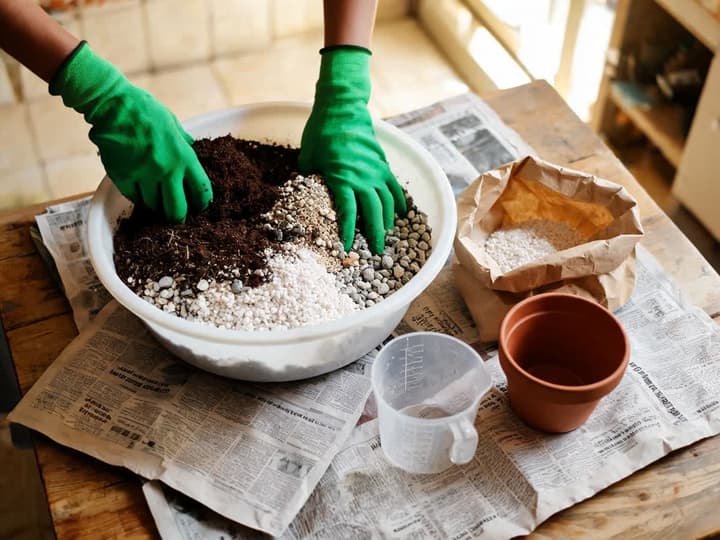
To repot a cactus, the step-by-step guide on how to repot succulents also works for cacti. The difference is how you hold the cactus: wrap its body with a thick strip of folded newspaper, as recommended by Iowa State Extension, to keep from getting pricked.
Pots for cacti: drainage holes, clay versus plastic, and sizing
A drainage hole at the bottom is mandatory. Iowa State Extension says the pot can be glazed ceramic, clay, plastic, or glass, as long as it has a hole. A layer of gravel at the bottom does not replace a drainage hole. A study by Avery Rowe in PLOS ONE, in 2025, measured that this layer generally does not increase the water retained in the pot. It also does not solve the lack of a hole.
Unglazed terracotta pots dry out the soil faster than plastic pots. North Carolina State Extension explains that porous pots lose moisture through their walls, which benefits cacti and succulents. The Arizona Arboretum adds that both materials work well: with plastic, you simply water less frequently.
Pick a container only one size larger than the root ball. The Royal Horticultural Society warns that excess potting mix in an oversized container stays wet and rots the cactus. Iowa State Extension recommends small or shallow pots for cacti. The same extension shows in another publication that, with the same soil mix, tall pots drain better than shallow pots. In practice: with a heavily mineral mix, a shallow pot works; if you use unamended bagged mix straight from the store, choose a taller pot.
Top-dressing gravel over the soil
The Royal Horticultural Society instructs you to finish potting with a layer of grit or fine gravel on top of the soil. Spread a thin layer of grit over the soil, around the body of the cactus.
Embrapa tested a similar surface layer on cacti. In their trial with Melocactus seedlings, the team topped the soil with 0.5 cm of coarse sand. The mulch layer did not alter plant diameter and produced only a small gain in height. No source has measured whether top dressing stops rot. It also cannot fix a soil blend that holds too much moisture.
When to repot and refresh cactus soil
Change the soil when roots appear through the pot's drainage hole. According to the University of Florida Extension, this happens every 2 to 4 years. Iowa State Extension adds another reason: over time, the organic matter decomposes and the soil begins to hold more water. If a pot that used to dry out in 7 days in the heat now takes more than 7 days during warm months, the soil has aged.
The best time is spring, when the cactus resumes active growth. In Brazil, this runs from September to November. Remove the old soil, inspect the roots, and cut away any dark, soft parts with a clean blade. If the base of the cactus is soft, the problem is already rot, and fresh soil alone will not fix it:
After repotting, wait one week before watering for the first time. The Arizona Arboretum calls for at least 7 days without water after planting into dry soil, giving disturbed roots time to heal. A cactus with a soft base and a firm top can still yield cuttings, using the method in the guide on how to propagate cacti.
Forest cacti require a different mix
The recipes in this guide apply to desert cacti. Christmas cacti (Schlumbergera) and orchid cacti (Epiphyllum) grow on trees in humid forests and need a mix that retains more moisture. The Bloom care guide for the Christmas cactus recommends cactus soil blended with perlite and pine bark, with a pH between 5.5 and 6.5:
If you are unsure whether your cactus is a desert or forest species, a photo makes it clear. Bloom (available for iOS) identifies your plant by photo and provides species-specific care guides, including soil requirements.
Frequently asked questions
Can I plant a cactus in regular soil?
Not in garden soil or straight potting soil. Iowa State Extension warns that standard potting soil retains too much moisture and risks rotting cactus roots. Regular potting soil works well as the organic portion of a blend: 1 part potting soil to 2 parts perlite, pumice, coarse sand, or fine gravel.
What can I use instead of cactus potting soil?
Build a mix using materials from your local garden center. For the organic component, use coconut coir, shredded pine bark, or carbonized rice hulls. For the mineral component, use perlite, pumice, fine gravel, or washed coarse sand. Mix 1 part organic to 2 parts mineral, following the Iowa State University Extension recipe.
Can I use succulent soil for a cactus?
Yes. Iowa State Extension gives the exact same recipe for cacti and other succulents: 1 part organic material to 2 parts mineral material. The guide to succulent care relies on that same mix. Any bag labeled "for cacti and succulents" must pass both tests: draining in under 1 minute and drying out in about 7 days during warm weather.
Does fertilized soil or manure work for cacti?
Do not use it as the main base. University of Arizona Extension advises against animal manure in cactus propagation mixes because it can introduce salts. North Carolina State Extension caps compost at 15% to 40% of the container mix. The New York Botanical Garden points out that cacti in standard potting soil already receive higher nutrient levels and require less supplemental fertilizer.
What to do today
Water your cactus until moisture flows from the drainage hole, and time how long it takes to stop dripping. Push a skewer to the bottom of the pot to check if the center of the root ball absorbed water. If it takes under 1 minute and the core is moist: the soil is working well, and your next repotting can wait until spring. If it takes longer: gather perlite or pumice and prepare a mix of 1 part organic material to 2 parts mineral material.
Sources
Iowa State University Extension and Outreach, Growing Succulents Indoors.
Iowa State University Extension and Outreach, Potting Media Components and Handling, March 2025.
NC State Extension, Extension Gardener Handbook, chapter 18, Plants Grown in Containers.
New York Botanical Garden, Mertz Library, Cacti Indoors.
Royal Horticultural Society, Cacti and succulents (houseplants) growing guide.
University of Arizona Campus Arboretum, General Cactus Care.
Kelly, J. How to Propagate Agaves and Cacti from Cuttings and Seed, AZ1483, University of Arizona Cooperative Extension, January 2009.
UF/IFAS Gardening Solutions, Cactus, University of Florida.
Boyce Thompson Arboretum, Succulent Care Tips.
Rowe, A. Effect of drainage layers on water retention of potting media in containers. PLOS ONE 20(2): e0318716, February 2025.
Correia, D. et al. Effect of substrates on the acclimatization of Turk's cap cactus (Melocactus). Embrapa Tropical Agroindustry, expanded abstract of the VII ENSub, 2010.
Gomes, I. B. et al. Use of Brazil nut residues for growing globular cacti in the Amazon region. Revista Verde 17(3): 221–226, 2022.
Related articles
How to Care for Hibiscus: Sun, Watering, Fertilizer, and Pruning for Flowers
How to care for hibiscus: 6 hours of direct sun, evenly moist soil without waterlogging, half-strength fertilizer in spring and summer, and pruning in early spring. Find out why the flower lasts one day and why buds drop before opening.

Do Ferns Like Sun or Shade? It Depends on the Type
Ferns prefer bright shade: plenty of light, but no direct sun on their fronds. Tuberous sword fern is the exception that handles sun. Here is the ideal light for each type, where to place pots, and how fronds show too much or too little light.

African Violet Yellow Leaves: Causes and What to Do
Yellow leaves on an African violet usually stem from overwatering, and the first place to check is the center of the plant. Losing one lower leaf at a time is normal. Identify whether age, watering, cold water, sunlight, cold drafts, or fertilizer is the culprit based on the yellowing pattern, and see what to do today.