How to Care for Bougainvillea: Sun, Watering, Pruning, and Cold
How to care for bougainvillea: 6 hours of direct sun, water when topsoil dries, moderate balanced fertilizer, prune after blooming, protect roots when repotting, and guard against frost.
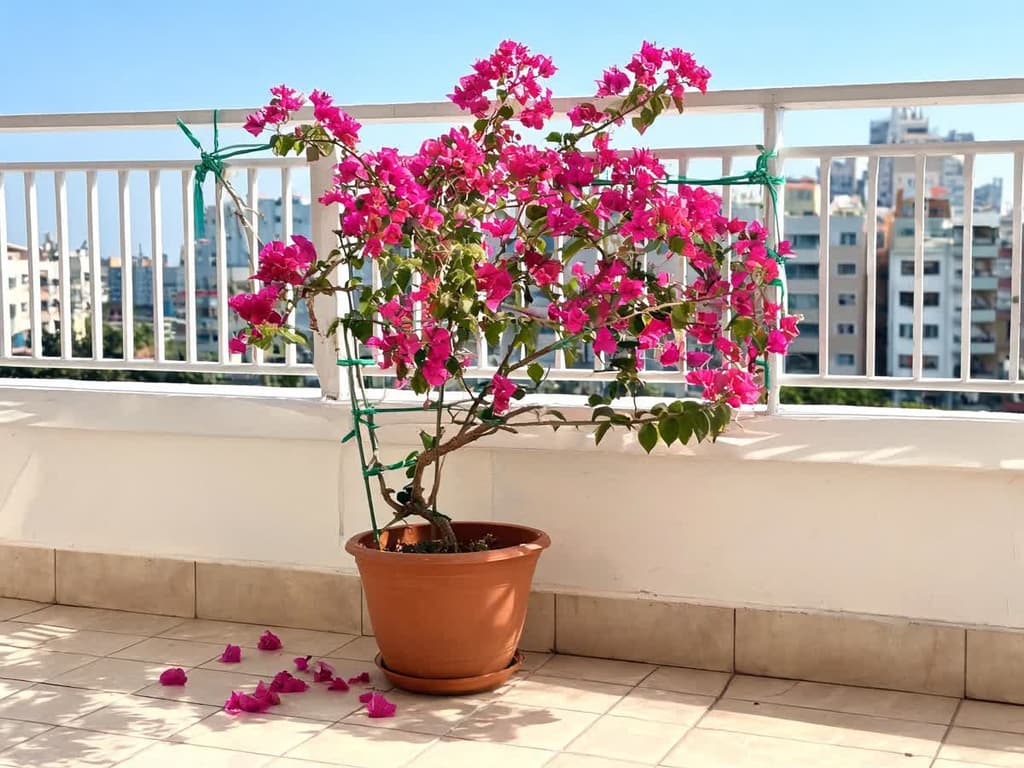
To care for bougainvillea, provide at least 6 hours of direct sun per day and water deeply only when the topsoil dries out. Fertilize moderately, prune right after flowering finishes, and protect the plant from frost. Below 50°F (10°C), it tends to drop its leaves. The numbers in this guide come from university extension services and the Royal Horticultural Society (RHS) in the UK.
Bougainvillea is the same plant that many people call bougainville, primavera, or três-marias. Two species widely used in gardens, glabra and spectabilis, are native to Brazil. This is documented by Flora e Funga do Brasil, from the Rio de Janeiro Botanical Garden. In most of the country, bougainvillea stays on the wall, fence, or balcony pot year-round.
How to care for bougainvillea: quick care summary
Care | What to do |
|---|---|
Light | Direct sunlight for 6 hours or more per day |
Watering | Water thoroughly when the topsoil dries; do not let the pot dry out completely |
Soil | Well-draining, slightly acidic (pH 5.5 to 6.0), without excessive peat moss |
Fertilizer | Balanced (NPK 1:1:1 or 2:1:2) at a moderate dose |
Pruning | Right after blooming ends; cut back by about one third |
Cold | Drops leaves below 50°F (10°C); frost can kill top growth |
Pot | Only slightly larger than the root ball; repot without disturbing the root system |
Thorns | Thick gloves and long sleeves when pruning and tying |
Pets | Not listed by the ASPCA; the documented physical risk comes from thorns |
Bougainvillea names: different terms for the same plant
Buganvília, bougainville, primavera, and três-marias are common names for plants in the genus Bougainvillea (the group of related species). Flora e Funga do Brasil records "três-marias," "primavera," and "buganvilia" for Bougainvillea glabra in the Southeast, and "juvú" in Santa Catarina. For Bougainvillea spectabilis, it also records "tapirica" and "roseira-do-mato."
The scientific name honors the French navigator Louis Antoine de Bougainville. According to the University of Hawaii (CTAHR), he was the first European to record the plant, in Brazil, in 1768. The spelling "bougainville" that many people use comes from his last name.
Both species are native to several Brazilian states. Flora e Funga do Brasil lists glabra in 9 states, from Rio Grande do Sul to Bahia. Spectabilis appears in 12, including Ceará, Alagoas, and Sergipe. They occur in the Atlantic Forest, the Cerrado, the Caatinga, and the Pampa.
The color is not the flower: bracts and the white tube
The colorful part of the bougainvillea is not the flower. They are bracts, meaning modified leaves that surround the flowers. The true flower is the small white tube in the center, according to the NC State Extension of North Carolina State University.
Each cluster has 3 small flowers, according to the RHS and NC State. UF/IFAS (the University of Florida Extension service) counts 3 bracts per cluster, and NC State counts 3 to 6. The bracts do the work of petals: they attract the insects that pollinate the flowers.
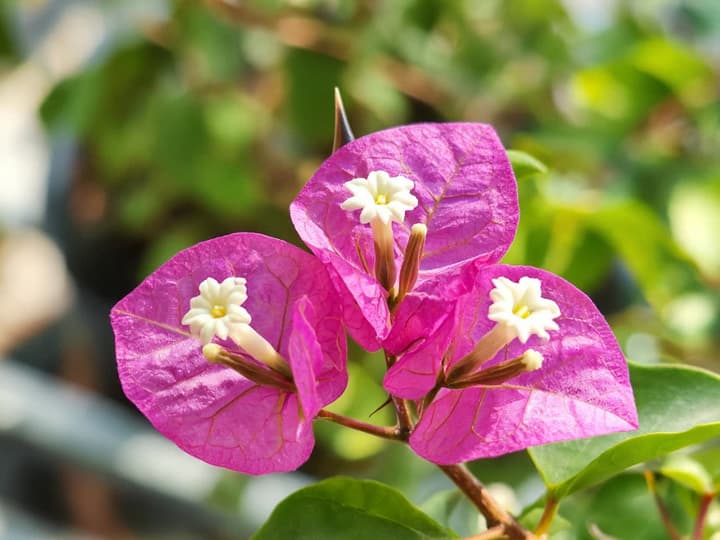
The bract lasts much longer than the flower. According to CTAHR, it can hold its color for several months after the flower fades, gradually fading until it resembles paper. That is why bougainvillea appears to bloom for so long. The bract slowly fades to a papery texture, just like the "flowers" shed on the ground.
Glabra, spectabilis, or hybrid: which bougainvillea you have
Potted and wall-grown bougainvillea is almost always Bougainvillea glabra, Bougainvillea spectabilis, or a hybrid. According to CTAHR, the most common hybrid is Bougainvillea × buttiana, a cross between glabra and Bougainvillea peruviana. The species dictates mature size, flowering habits, and cold tolerance.
Sign | B. glabra | B. spectabilis |
|---|---|---|
Leaves and stems | Smooth, hairless (CTAHR) | Hairy (CTAHR) |
Flower tube | 5-angled (pentagonal shape), short bracts (NC State) | Rounded, longer bracts (NC State) |
Thorns | Small, curved at the tip (CTAHR) | Large, can be curved (CTAHR) |
Bloom time | Multiple times per year (CTAHR) | After a dry spell or a cold period (CTAHR) |
Cold | Tolerates slightly more cold (CTAHR) | Prefers warmer nights (CTAHR) |
Mature size | 10 to 20 ft (3 to 6 m) tall (NC State) | 15 to 40 ft (4.6 to 12 m) tall (NC State) |
For containers, the RHS recommends glabra and the hybrid B. × buttiana, as both bloom at a young age. Spectabilis grows larger and requires room on a wall or pergola. Both species have their own profile: lesser bougainvillea (B. glabra) and great bougainvillea (B. spectabilis).
The easiest sign to check at home is fuzz: run your hand over the leaf and stem. Glabra is smooth and spectabilis is hairy, according to CTAHR. Other differences are subtle, and hybrids blend traits from both species. To identify which bougainvillea you have, Bloom (available for iOS) identifies plants from a photo. The free tier includes 2 identifications per month.
How much sun bougainvillea needs
Bougainvillea needs direct sun to bloom. The RHS calls for at least 6 hours of sun per day. Texas A&M AgriLife Extension gives a minimum of 5 to 6 hours of direct sun. According to UF/IFAS, the more sun, the more flowers, and without direct sun it does not bloom.
In shade, the plant drops its bracts and flowers less, according to CTAHR. NC State accepts partial shade only for glabra, and even then notes that full sun promotes blooming. This guide follows the majority of sources: full sun.
Indoors, a lack of light causes bougainvillea to drop its leaves (CTAHR). In Brazil, the window that gets the most hours of sun faces north. If the plant must stay indoors, keep the pot by this window, with direct sun hitting the leaves.
How to water bougainvillea
Water bougainvillea when the soil surface dries: feel the soil with your finger to check. Add water until it drains out of the pot's drainage hole and empty any standing water from the saucer. CTAHR recommends watering thoroughly and less frequently rather than light daily waterings, and never letting the soil dry out entirely.
NC State, UF/IFAS, and CTAHR recommend watering deeply and allowing the soil to dry out between waterings. The RHS advises keeping the soil consistently moist during active growth, but writes for greenhouse bougainvillea in the UK. This guide follows the first three sources, which write for warm climates more similar to Brazil.
Excess water rots roots and drops leaves, according to UF/IFAS. UF/IFAS also recommends skipping watering on cold nights. For this reason, there is no fixed schedule of days between waterings.
Soil and pot selection for bougainvillea
Bougainvillea thrives in well-drained, slightly acidic soil with a pH of 5.5 to 6.0, according to CTAHR and UF/IFAS. Soil pH measures acidity: below 7 is acidic, while above 7 is alkaline. At a pH above 6.0, the plant faces a higher risk of iron and other micronutrient deficiencies (CTAHR). Iron deficiency shows up as yellowing new growth.
Bougainvillea roots are extremely fine, according to UF/IFAS. For this reason, UF/IFAS advises avoiding mixes with high peat moss content (dark material that holds a lot of water), which encourage rot. CTAHR accepts equal parts peat moss and perlite, but also advises avoiding too much peat moss. This guide follows UF/IFAS. If the potting soil stays wet for too long, mix in perlite (light, white grains that loosen the soil). Always use a pot with a drainage hole at the bottom.
Pot size divides opinions. An answer from the University of Washington horticultural library notes that bougainvillea likes being slightly root-bound in its container. No other source confirms this effect. When in doubt, pick a pot only slightly larger than the root ball and let the topsoil dry out between waterings.
How to repot bougainvillea without damaging the root system
Repot bougainvillea without disturbing the root ball. The root system does not hold the soil in a firm ball and suffers when disturbed, according to the University of Washington library, citing the Sunset Western Garden Book. New roots break easily, according to CTAHR.
The University of California Master Gardeners call it essential to keep the roots intact when planting or repotting. If disturbed too much, they may not recover. To plant in the ground, they suggest cutting the bottom off the plastic pot and placing the plant in the hole with the pot.
Sources agree on one rule: keep the root system undisturbed. The following steps put this into practice:
Repot when roots show through the drainage hole (no source specifies a schedule in years).
Water the plant the day before so the root ball slides out in one piece.
If the pot is plastic, cut the sides open instead of yanking the plant by its stem.
Place the intact root ball into the new container and fill in only along the sides with soil.
The best time is early spring (the season), before the plant resumes growth, according to the University of Washington. In Brazil, this falls between September and October.
How to fertilize bougainvillea
Feed bougainvillea with a balanced fertilizer, such as an NPK ratio of 1:1:1 or 2:1:2, as CTAHR recommends. NPK stands for the three primary nutrients on the label: nitrogen, phosphorus, and potassium. In containers, CTAHR suggests a controlled-release fertilizer (pellets that discharge nutrients gradually), such as 10-10-10, every 3 months. The alternative is a water-soluble fertilizer applied weekly or every 2 weeks at half strength.
Sources disagree on nitrogen (the N in NPK). UF/IFAS, CTAHR, and Texas A&M state that too much nitrogen produces leaves instead of flowers, but they do not cite measurements. A 1962 University of Florida experiment with B. glabra measured the opposite. With no nitrogen, a medium rate, and a high rate, the plants produced an average of 29.1, 35.2, and 61.6 bracts.
The 1962 experiment evaluated short days (9 hours of light) against long days (18 hours), and only short-day plants bloomed. In some treatments, additional nitrogen prompted more new shoots, and glabra flowers on new growth. This guide takes the safest approach: balanced fertilizer applied at CTAHR's frequency and rates. That means controlled-release every 3 months, or water-soluble fertilizer at half strength. Sunlight, new growth, and day length also dictate blooming, and no source establishes which factor carries the most weight.
Coffee grounds are not mentioned by any consulted extension source as a fertilizer for bougainvillea. Lacking tested dosages, stick to balanced fertilizer. At planting, UF/IFAS advises a phosphorus-rich fertilizer, and bone meal is an organic source of phosphorus.
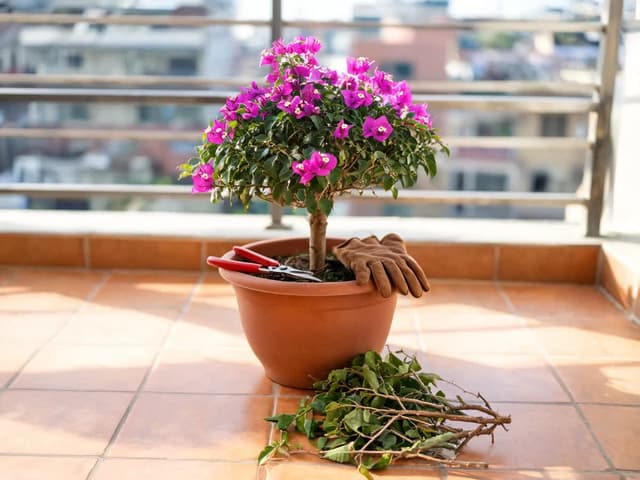
How to prune bougainvillea
Prune bougainvillea right after flowering ends, because blooms form on fresh growth. NC State, UF/IFAS, the RHS, and CTAHR agree that flowers emerge on new shoots. Pruning after a bloom cycle spurs this growth, producing the next burst of color.
To cut the plant back, CTAHR advises removing about one-third of the growth and cutting away thin, weak branches. Trim each lateral branch back until 2 or 3 buds (points where new shoots emerge) remain near the main branch. CTAHR cautions that pruning too often cuts down flowering. For potted plants, the same CTAHR notes that frequent pruning rejuvenates shoots. This guide follows that warning: one main pruning each year, right after flowering.
UF/IFAS warns that pruning in late summer or early fall reduces blooms the following season. In Brazil, this corresponds to February, March, and April, when the branches that will flower during short days are forming. Avoid hard pruning during these months.
Why bougainvillea does not bloom
According to CTAHR, bougainvillea stops flowering due to shade, excess water, frequent pruning, and excess nitrogen. Nitrogen is a disputed point: the only experiment found measured the opposite. According to UF/IFAS Nassau, with too much shade or too much water, the plant tends not to bloom.
Bougainvillea glabra forms buds with 12 hours of light per day or less, at 21 to 24 °C (70 to 75 °F). The data comes from a 1935 study, cited in a 1962 paper from the University of Florida. In Brazil, nights become longer than days from March to September. A bougainvillea that does not bloom in the Brazilian summer may just be waiting for short days.
To induce flowering, growers allow the plant to dry out until the leaves wilt and droop, according to UF/IFAS and CTAHR. Both sources warn that drying it out too much drops the leaves and puts the plant into dormancy. If you try it, water as soon as the leaves soften.
Supporting bougainvillea on walls, fences, or in pots: thorns and ties
Bougainvillea scrambles and anchors itself using curved thorns, according to NC State; spectabilis also relies on twining stems. Trained along a wall, fence, or pergola, the plant requires physical ties.
Tie branches loosely with soft ties and direct the shoots along the structure as they grow. Mississippi State University advises inspecting ties regularly to keep them from constricting stems. Checking ties while watering is an easy habit. In a container, support the plant using a sturdy trellis or balcony railing.
Thorns measure 1 to 2 inches (2.5 to 5 cm) long, according to Nassau County UF/IFAS Extension. UF/IFAS recommends wearing heavy gloves and long sleeves when pruning. CTAHR suggests planting bougainvillea at least 4 ft (1.2 m) away from walkways where thorns might scratch passersby.
Cold and frost: protecting your bougainvillea
Bougainvillea tolerates cold for short periods, but suffers from frost. According to the RHS, it tolerates brief drops to 41°F (5°C), but below 50°F (10°C) it tends to shed its leaves and go dormant. UF/IFAS states that the plant is frost-sensitive and top growth can die back in winter.
Where winter nights (from June to August in Brazil) stay above 50°F (10°C), bougainvillea lives outdoors without special care. Below that, it tends to drop its leaves. In the South and in the mountains, where frost occurs, protect the plant, as UF/IFAS recommends. Move the pot close to a sheltered wall or cover the plant with a thick cloth on frosty nights. Remove the cloth in the morning.
Dropping leaves in cold weather does not indicate a dead plant. According to the RHS, a bougainvillea that loses foliage below 50°F (10°C) is resting and will leaf out again once warm weather returns. Wait for new growth before cutting away stems that look dry.
Bougainvillea losing leaves or turning yellow
Bougainvillea sheds foliage due to overwatering, underwatering, inadequate light, or cold, according to UF/IFAS. Check the soil with a finger first: soggy soil days after watering signals too much moisture, while dry soil throughout signals underwatering. Next, check sunlight hours and nighttime temperatures.
UF/IFAS notes that leaf drop following a bloom flush is normal and commonly precedes a new growth flush. Yellowing new foliage often indicates magnesium or iron deficiency, which a micronutrient-supplemented fertilizer can help fix. The guide on bougainvillea dropping leaves covers each cause in detail.
Bougainvillea pests
Bougainvillea attracts mealybugs, aphids, whiteflies, and spider mites, according to the RHS. The University of California Master Gardeners add caterpillars and slugs to that list and recommend handpicking pests. Sticky leaves with tiny white specks usually point to mealybugs (insects coated in a white, cottony layer) or whiteflies.
Another common nuisance is the bougainvillea looper caterpillar, which feeds on tender young foliage and rolls leaves into tubes for shelter, according to UF/IFAS. Control involves handpicking caterpillars or applying Bacillus thuringiensis (Bt), a biological insecticide, according to product label directions.
The Master Gardeners suggest neem oil (a plant-based horticultural oil) as an option. None of the consulted sources evaluates neem oil or insecticidal soap around cats. If you have cats indoors or outdoors, begin with manual removal and keep them away from treated foliage.
Is bougainvillea toxic to dogs and cats?
The ASPCA Animal Poison Control Center does not maintain an entry for bougainvillea. It designates the plant neither as toxic nor as non-toxic. The primary risk documented by university extension services stems from physical injury by sharp thorns during pruning or passing nearby. Without a formal classification, the safest course is keeping dogs and cats away from the plant and pruned cuttings. The list of toxic plants for pets outlines plants with known safety ratings.
Frequently asked questions about bougainvillea
How long do bougainvillea flowers last?
The bougainvillea's color display lasts several months because its color comes from bracts. According to CTAHR, bracts keep their color long after the central white flower withers. Bougainvillea glabra flowers several times a year. Bougainvillea spectabilis blooms following a dry spell or a chill.
Can you grow bougainvillea indoors?
Yes, but only in a window with direct sun for at least 6 hours per day. In Brazil, that is a north-facing window. In low light, bougainvillea drops its leaves and bracts, according to CTAHR. Across most of Brazil, it grows best on a balcony or in the yard.
Can you use coffee grounds as bougainvillea fertilizer?
No consulted extension source recommends coffee grounds for bougainvillea or provides application rates. The recommended option is a balanced fertilizer with an NPK ratio of 1:1:1 or 2:1:2, applied in moderate amounts, according to CTAHR.
What temperatures can bougainvillea tolerate?
Bougainvillea handles brief dips down to 41°F (5°C), according to the RHS. Below 50°F (10°C), it typically sheds foliage and enters dormancy. Freezing temperatures can kill top growth, according to UF/IFAS. In southern Brazil and higher elevations, protect the plant on nights with frost.
How do you propagate bougainvillea?
Propagate with a semi-ripe cutting (a piece of stem), neither green nor woody, according to the RHS. Take the cutting in summer, from December to February in Brazil. The cutting takes 4 to 12 weeks to root, depending on the variety and the use of rooting hormone, according to CTAHR.
Bougainvillea care summary
Bougainvillea requires 6 hours of direct sun, watering when topsoil dries out, and moderate applications of balanced fertilizer. Prune right after flowering and repot without disturbing the root ball. Protect it from frost: below 50°F (10°C) it merely drops leaves. Color comes from paper-like bracts appearing on new stems.
Related articles
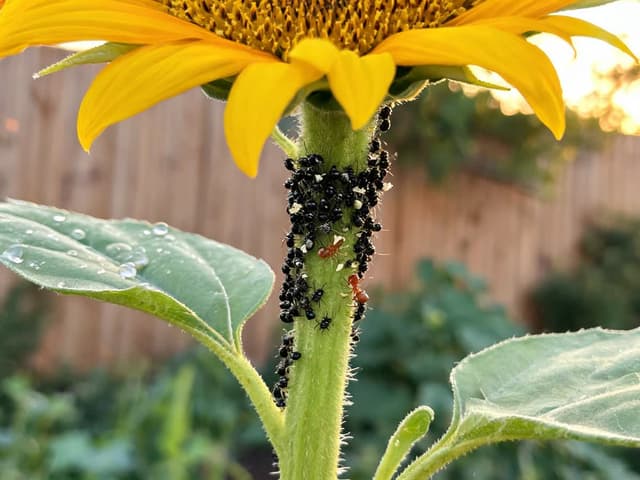
Bugs on Sunflowers: What They Are and What to Do
The bordered patch caterpillar is the main pest among the bugs on sunflowers in Brazil. Learn how to recognize this caterpillar, aphids, leaf beetles, stink bugs, and birds by the damage, when to treat, and when to let the plant finish its cycle.
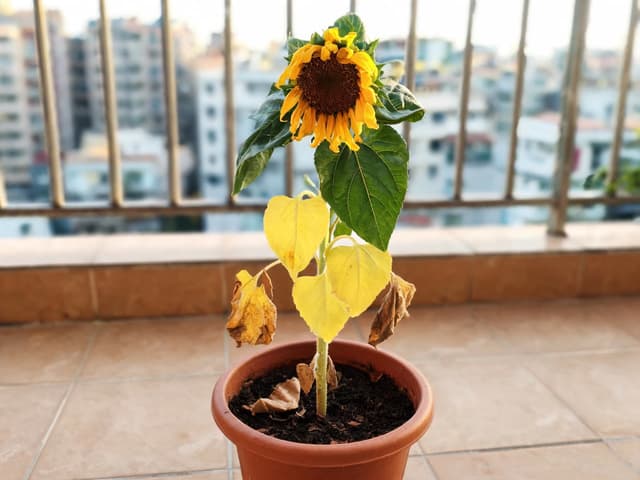
Yellow Leaves on Sunflowers: Causes and What to Do
Yellow leaves on sunflowers: use the plant's stage and where the yellow sits to tell end of life cycle, watering, low fertilizer, fungus or mites apart, plus the test that confirms each cause.
How to Prune Bougainvillea: When, How Much, and Where to Cut
How to prune bougainvillea: cut after flowering, right above a node, and save hard pruning for when the plant starts growing again. See how much to remove, the three types of pruning, and how to train potted bougainvillea.