How to make a poinsettia rebloom in Brazil
What makes the bracts turn red is long nights: 13 to 14 hours of total, uninterrupted darkness for 8 to 10 weeks. English-language guides tell you to start October 1, a Northern Hemisphere date. In Brazil, the window opens in late March.
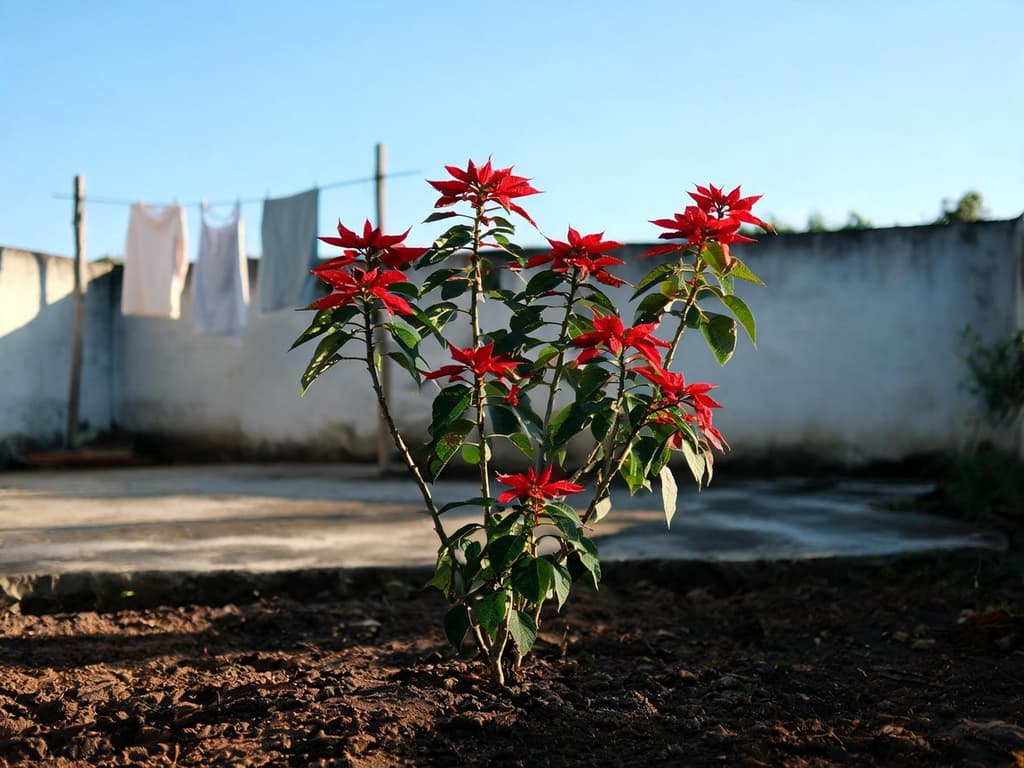
To make a poinsettia rebloom, give it 13 to 14 hours of total darkness per night. Without any light interruption, for 8 to 10 straight weeks. During the day, bright light.
Sun, fertilizer, and pot size do not trigger the color. The length of the night does. The red part only forms after the plant counts enough long nights, several in a row.
English-language guides tell you to start on October 1, and that date is for the Northern Hemisphere. In most of Brazil, the window of long nights opens at the end of March and closes in September, peaking in June. One of the common names for the plant in Brazil is flor-de-são-joão, after the June festival. The potted plant you bought red in December never turned red in December again because, at home, it follows the nights of the Southern Hemisphere.
Quick summary:
The trigger is the length of the night. Flowering starts when day length drops below 12 to 12.5 hours. That equals nights longer than 11.5 to 12 hours. Below that threshold, nothing happens, no matter how much sun and fertilizer the plant gets.
12 hours of darkness is the minimum, not the target. At the start of flowering, a 12-hour night gives roughly half the speed of a 13- or 14-hour night. After flowering has started, color also turns out weaker (Alden and Faust, HortScience, 2021).
In Brazil, natural night length never reaches 14 hours. It maxes out at 13 hours and 19 minutes in São Paulo and 12 hours and 3 minutes in Manaus at the peak of winter. The 14 hours mentioned in American guides only exist here inside a box.
What makes the bract turn red
The red parts of a poinsettia (Euphorbia pulcherrima) are not petals: they are bracts, modified leaves surrounding the true flowers, the tiny yellow beads in the center. They color up because the plant accumulates anthocyanin, the red pigment, and reduces chlorophyll production, the green pigment. It is leaf tissue with different chemistry inside.
The colored bract is a new leaf. It forms after the plant decides to flower.
The review by Lozoya-Gloria, Cuéllar-González, and Ochoa-Alejo, published in 2023 in Frontiers in Plant Science, describes the sequence under short days. First, the final stem segments stop growing. Next, the development of the cyathium begins, the structure that bears the tiny flowers. Finally, the top three leaves become bracts.
The English guide from Ideal Home cites two experts. It writes that the purpose of darkness is "essentially to reverse the process of photosynthesis." It also writes that "reducing exposure to sunlight stops the plant producing chlorophyll, turning the bracts red."
That is not what happens. An old green leaf locked in the dark does not turn red; it turns yellow and drops. Darkness does not bleach anything out: it signals to the plant that the season has arrived. Color appears on the leaves that emerge afterward.
How many hours of darkness does a poinsettia need?
The threshold where the plant begins responding is a 12 to 12.5-hour day, combined with cool nights. That corresponds to a night of approximately 11.5 to 12 hours. That is the starting point, not the target. The target sits between 13 and 14 hours of darkness, which is where flowering happens quickly and the color develops fully.
Michael Alden and James Faust measured this in a paper published in HortScience in September 2021. The study appeared in volume 56, issue 9, pages 1097 to 1103. It is detailed in Alden's master's thesis at Clemson University, from the same year. They tested nights of 11, 12, 13, and 14 hours on two cultivars, and found four things:
with an 11-hour night, far fewer plants actually reached full bloom, showing fewer bracts and a lower color rating;
with a 12-hour night at the start of flowering, progress was about half as fast as with a 13- or 14-hour night;
after flowering began, nights between 12 and 14 hours changed the total time very little. But a 12-hour night harms color development, compared to 13 or 14 hours;
14 hours provides a rapid start, optimal development, and optimal color. It is the number everyone repeats.
Among the seven English-language guides I read from start to finish, all give a specific number of hours. None of the seven cites a source for the number they chose. The figures range from 13 to 16 hours.
Two of them contradict themselves on their own pages. The Pesche's garden center blog instructs 13 hours starting September 21. Two paragraphs below, that same blog instructs 15 hours starting October 1. Ideal Home says "at least 14 hours" in the body and "at least 13 hours" in its own FAQ.
The Michigan State University extension is the only one that acknowledges variation between varieties. It explains why: "some varieties may only need 10 hours of darkness, but 14 hours will ensure rapid initiation across all varieties." In other words, 14 hours is the safe number for anyone who does not know which variety they have at home.
In home practice, aim for 14 hours if you plan to use a box or a closet. If the plant is out in the garden, rely on whatever natural night your city provides, which shifts from northern to southern Brazil.
Why the calendar in English-language guides does not work in Brazil
The dates in this article have been converted for the Southern Hemisphere. Six of the seven guides I read instruct starting between mid-September and October 1. The seventh instructs starting when night temperatures hit 10 °C (50 °F), which is autumn up north. None of the seven mentions the word hemisphere.
What matters to the plant anywhere in the world is night length. I calculated day length for ten Brazilian cities using the NOAA Solar Calculator algorithm. It is the same algorithm weather services use to publish sunrise and sunset times. Then, I subtracted the result from 24 hours to find night length.
Before applying it to Brazil, I tested the method in the Northern Hemisphere. I used Lansing, Ames, and Fort Collins, cities home to the three university extension services cited in this article. There, day length falls from 12 hours 24 minutes on September 18 to 11 hours 58 minutes on September 27. That is exactly the window where flowering begins on its own, according to production literature.
City | Night on June 21 | Night over 12 h | Night over 13 h |
|---|---|---|---|
Manaus | 12:03 | 5/4 to 8/11 | never |
Recife | 12:21 | 4/6 to 9/8 | never |
Salvador | 12:38 | 3/31 to 9/14 | never |
Brasília | 12:49 | 3/29 to 9/16 | never |
Belo Horizonte | 13:05 | 3/27 to 9/18 | 6/2 to 7/12 |
Rio de Janeiro | 13:17 | 3/27 to 9/18 | 5/17 to 7/28 |
São Paulo | 13:19 | 3/27 to 9/18 | 5/15 to 7/30 |
Curitiba | 13:27 | 3/26 to 9/19 | 5/9 to 8/5 |
Porto Alegre | 13:48 | 3/25 to 9/20 | 4/30 to 8/15 |
Chuí (RS) | 14:05 | 3/25 to 9/20 | 4/24 to 8/21 |
Three takeaways from this table:
1. From Belo Horizonte southward, natural nights are already enough. Night length exceeds 13 hours between May and July, which falls right in the full-color range from the Clemson study. An outdoor plant in the backyard, kept away from artificial light, colors up on its own without needing a box.
2. From the Central-West northward, the night crosses the threshold and stops shortly after. Brasília tops out at 12:49, Recife at 12:21, and Manaus at 12:03, for only three months. In this zone, the response is slow and the color comes out light; a cardboard box makes the difference between pale pink and deep red.
3. Nowhere in Brazil does natural night length reach 14 hours. The sole exception is the extreme south of Rio Grande do Sul at the peak of winter. When an American guide says 14 hours, it describes a Michigan autumn; here, that only exists inside a closet.
That leaves the takeaway for houseplants kept indoors. For an indoor plant, the night begins when the last light in the house turns off, not when the sun sets. A plant that spends the night in an illuminated room never finishes the count. That does not change with your city or the season, and it has nothing to do with a lack of sun.
The Brazilian calendar, month by month
This is the cycle mirrored for our location, adapted from the US university extension calendars. It applies to both potted and garden plants.
August and September: pruning and repotting. Do this after the color fades and the old leaves drop. Cut each stem back to leave 10 to 15 cm (4 to 6 inches), with two or three leaves. This is the time to replace the potting mix and move up a pot size if roots have taken over the container.
October to February: growing. Long days, warmth, and rain: this is the active growing season. Water when the top 2 cm (about an inch) of soil dries out, and fertilize every two to four weeks.
Pinch the tips of the new shoots once or twice during this window. This produces a bushier plant instead of one that grows tall with few branches. It is the exact step American guides tell you to perform from April through August.
Until early March: final pruning. After this date, do not cut back any more stems. The Pesche's guide, written for the United States, tells growers not to prune after September 1.
In the northern hemisphere, September 1 is three weeks before the long-night window. In Brazil, the equivalent is March 1. Stems cut after early March do not have enough time to form the tip that will bear the bract.
Late March to May: the window opens. This is when nights exceed 12 hours across most of the country. If you plan to use a box, start now.
If the plant lives out in the garden, this is when you check the ambient lighting around it. Look for streetlights, utility area lights, or neighbor floodlights shining on it after dark.
May to July: color arrives. First the tips turn cream, then pinkish, then red. June marks the peak across most of Brazil, which explains the local name flor-de-são-joão.
The species profile from the Plant Systematics Laboratory at USP Ribeirão Preto records the flowering period in Brazil as autumn. It also lists flor-de-natal, flor-de-páscoa, and flor-de-são-joão among its common names. Christmas is the grower's calendar. São João is the plant's calendar.
July and August: flowering ends. The bracts fade and the plant sheds foliage, which is entirely normal and not a sign of disease. If it drops leaves outside this period, something else is wrong. The guide on poinsettias losing leaves breaks down six distinct causes by symptom.
How to make a poinsettia bloom: the darkness treatment
This is worthwhile for anyone living from the Central-West northwards. It is also worthwhile for anyone keeping the plant indoors, or looking to force color outside the natural season. You will need an opaque cardboard box large enough to cover the entire plant without touching the foliage. A dark closet or a room with zero light leaks also works.
Pick a schedule and stick to it. Covering at 6:00 PM and uncovering at 8:00 AM gives you an exact 14 hours. Consistency matters more than the specific hours you choose.
Cover every single day without skipping. This requires 8 to 10 consecutive weeks. A single interrupted night does not just set you back one day: it can reset the count for that entire cycle.
Give it bright light for the rest of the day. The Michigan State University extension calls for 10 hours of bright light outside the box. Within those 10 hours, the Mississippi State University extension calls for 6 to 8 hours of strong sun. A plant kept in the dark all day does not bloom: it grows weak and leggy until it dies.
Keep nighttime temperatures between 15 °C and 21 °C (59 °F to 70 °F). The Mississippi State University extension recommends the cooler end of that range. The Berger technical guide permits up to the upper threshold at the onset of flowering.
Keep watering and fertilizing as usual throughout the treatment. Water when the top 2 cm of soil dries out, exactly as described in our poinsettia watering guide.
Stop once the color appears. As soon as the bracts have fully colored up, the treatment is finished. Move the plant to the brightest spot in the house and keep it there.
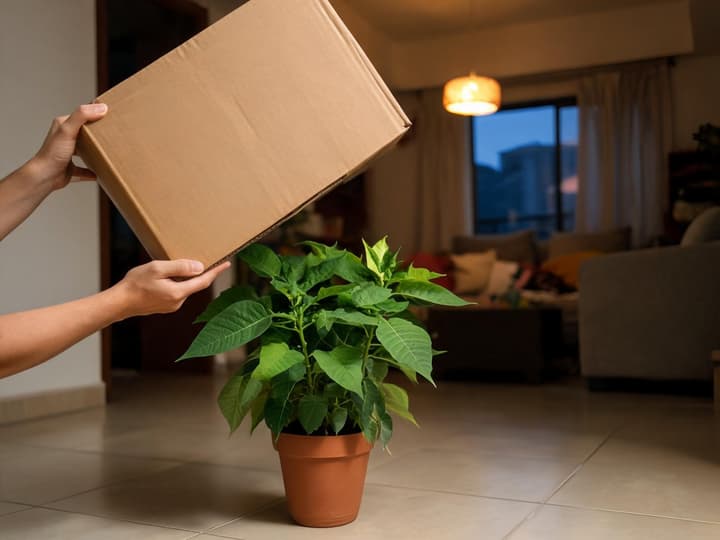
Less light disrupts the dark period than you might think. The Michigan State University extension points to streetlights, car headlights, and television glow. Any of those can disrupt bud formation. A gap beneath a closet door counts, and opening that closet in the middle of the night to grab a towel does too.
If you must travel for a weekend, leave the plant uncovered in normal daylight. Resume the treatment once you return, rather than trapping it in continuous darkness for 48 hours.
How long until color appears
With long nights and temperatures in the proper range, commercial growers work off this timeline, as published by Berger, a floriculture growing media supplier. Flowering begins 14 to 18 days after short days start. First color appears in 30 to 32 days, and flower buds become visible in 35 to 39 days. Full flowering occurs in 54 to 59 days.
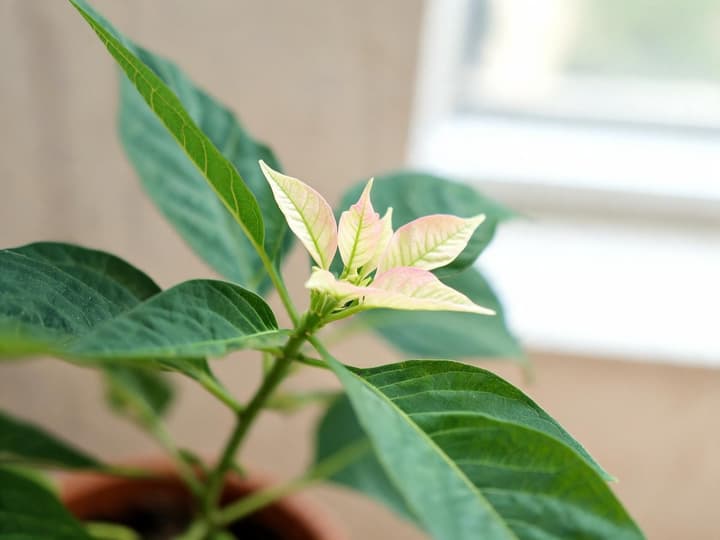
In commercial greenhouses, cultivars finish their cycle in 7 to 10 weeks, depending on response group. Response group is how the industry classifies cultivars by developmental speed. That 7-to-10-week range is identical across both sources: Berger and the Mississippi extension.
At home, working with natural nights instead of controlled greenhouse conditions, expect the longer side: 8 to 10 weeks. The difference lies between the 14-hour night of a greenhouse and the 12 hours 27 minutes of late April in Brasília. That reflects the dynamic measured by the Clemson study: shorter nights lead to slower progress. In practice, treatment started in late March produces initial color in May and a fully flushed plant by June.
How to get red bracts at Christmas in Brazil
This is the one scenario where the Brazilian climate works directly against you. On December 25, the night in São Paulo lasts just 10 hours 25 minutes. That falls more than an hour and a half short of the bare minimum 12-hour threshold, and nearly four hours shy of 14 hours. Without a box, it will not color up in December.
If you really want to try, use the exact same protocol, running it from October through December. Cover the plant for 14 hours every night starting in early October. Provide strong light during the day until the color shows up, which happens in late November if nights stay cool.
This matches what American guides instruct, on those exact dates. The critical difference: up north that happens during autumn, whereas here it takes place during a warm spring.
The heat is the real issue. Alden and Faust tested night temperatures of 16 °C, 20 °C, 24 °C, and 28 °C. They showed that warm night temperatures delay flowering in sensitive cultivars, right in the 12 to 14-hour darkness range. Providing 14 hours of darkness shortens that delay, but does not eliminate it.
Flowering slows above roughly 23 °C (73 °F), according to Berger's technical guide. In October and November, inside an enclosed cardboard box, overnight temperatures easily exceed that mark. That holds true whether in an apartment in São Paulo or Recife.
Two strategies help. First, select the coolest room in the house for the covered period: a utility bathroom, laundry area, or back bedroom. Second, uncover the plant early, at 7:00 AM instead of 8:00 AM, so it does not spend the first hour of the day trapped in stagnant heat.
Even so, Christmas color in Brazil takes work and can fail due to heat. The mid-year natural window, from the Southeast southward, requires no box at all.
No color appeared: what went wrong
What you noticed | Most likely cause | What to do |
|---|---|---|
Stayed completely green, nothing changed | Light interruptions at night (room lamps, streetlights, closet door gap) | Restart the cycle with absolute darkness. Spend a few minutes in the dark room looking for any glow |
The center colored up, but the rest stayed green | Only the uppermost leaves become bracts, which is normal for this species | This is normal. Pinch branch tips during the growing season to produce more stems |
Color came out pale pink or cream | Nights were too short (12 hours or less) or nights were too warm | Extend darkness to 14 hours using a box and relocate the plant to a cooler spot at night |
Flowering was delayed and missed the target date | Warm nights early in the cycle, or a long-response cultivar | Start 2 weeks earlier next year and keep night temperatures between 15 °C and 21 °C |
Tall plant without any growing tips to color up | Pruned after early March, or insufficient daytime light | Finish the final prune earlier and provide the brightest location available during treatment |
Leaves turned yellow and dropped during treatment | Watering issues, not darkness issues | Check the soil moisture before changing anything else. Follow our steps in yellow leaves on plants |
If you inspect your plant and still cannot decide between two rows on this table, Bloom can help. It matches a photo of your symptom against the species-specific problem database to clarify what is happening. For broader care issues, our symptom diagnosis guide runs through troubleshooting questions in the right sequence for any plant.
Frequently asked questions
How many times a year do poinsettias bloom?
Once a year. It has a single flowering cycle triggered by a continuous run of long nights. The color persists anywhere from several weeks to a few months once developed. No care technique can force the same plant to color up twice in a single year.
Why isn't my poinsettia turning red?
Almost always because its nights are interrupted by artificial light. A lamp turned on for just a few minutes is enough to reset that night's count. The second most common cause is trying outside the window: in Brazil, the time is from late March to September, not December.
How long does it take for a poinsettia to turn red?
About 30 to 32 days of long nights before the first color appears, and 54 to 59 days until full bloom under greenhouse conditions. At home, where natural nights are shorter than commercial conditions, expect 8 to 10 weeks from the start of treatment until a fully colored plant.
Does a poinsettia need sun or shade to bloom?
Both, at opposite times of day. It needs 6 to 8 hours of intense daytime light, followed by 13 to 14 hours of pitch black at night. Keeping it in shade all day will not make it color up: it will only stretch out weak and drop leaves.
If I prune my poinsettia, will it bloom again?
Yes, and pruning actually encourages it, provided you do it at the right time. Cut stems back to 10 to 15 cm after flowering finishes, between August and September. Do not prune after early March: overly fresh stems cannot mature the tips needed to carry bracts.
Conclusion
Poinsettias color up by counting dark nights. Provide 13 to 14 hours of uninterrupted darkness for 8 to 10 weeks. Combine that with bright daytime light and nights between 15 °C and 21 °C, and the color returns. Find every other aspect of routine maintenance in our complete poinsettia care guide.
The rule specific to the Southern Hemisphere: mark late March on your calendar, not October. Before doing that, run the simplest test possible. Switch off every light in your home at night and see whether you can still make out the outline of the plant. If you can, too much light reaches it after dark.
If you need help diagnosing what is wrong with your plant rather than timing its blooms, Bloom can help. It identifies the species and compares symptom photos against its issue catalog (available for iOS).
Related articles
How to Care for a Maidenhair Fern: Light, Water, and Revival Tips
Learn how to care for a maidenhair fern indoors: bright indirect light, consistently moist soil, high humidity, and how to revive it if it dries out completely.
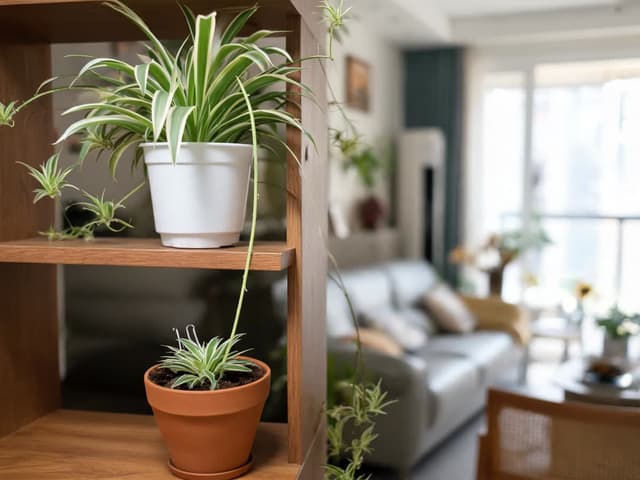
How to Propagate Spider Plants: Root the Pup Before Cutting
The safest spider plant cutting comes from a pup still attached to the mother plant: rest the plantlet on soil in a small pot, wait for roots to establish, and only then cut the stolon. Learn when the pup is ready, whether rooting in water is worth it, how to divide the clump, and why plants fail to produce babies.
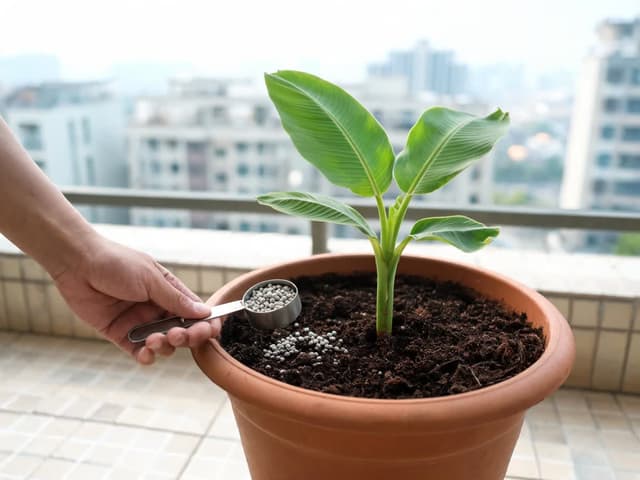
Banana plant fertilizer: fertilizing potted and backyard plants
Banana plant fertilizer needs more potassium than nitrogen, in a 3-1-6 ratio. For a potted plant on a balcony, use the label dose in spring and summer. In the backyard, fertilize every 2 months, adjusting the amount by mat age. Learn the formula, timing in Brazil, and signs of deficiency or excess.