How to Propagate Jasmine: Cuttings, Layering, and the Best Timing
How to propagate jasmine from cuttings or layering: which branch to cut, whether you need rooting hormone, water vs. soil, and ideal timing in Brazil.
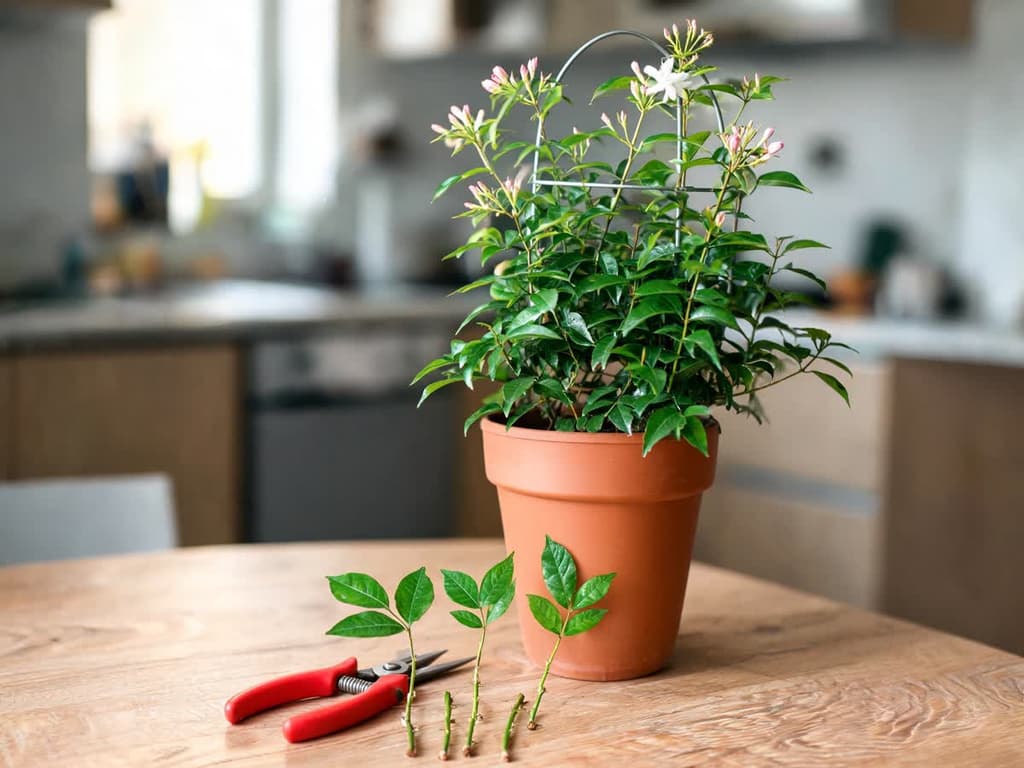
To propagate jasmine, cut the tip of a semi-ripe branch (firm at the base, green and pliable at the top) measuring 8 to 15 cm. Bury the base in moist vermiculite, perlite, or standard potting soil. Cover it with a plastic bag and place it in bright light, away from direct sunlight. In two studies conducted by the Universidade Federal do Paraná, 80% to 95.7% of the cuttings had already rooted without rooting hormone when evaluated at 48 and 54 days.
The best time in Brazil is spring and summer, from September to March. If you do not want to cut the plant, you can use layering: bury a branch while it is still attached to the parent plant until it grows roots. This guide applies to true jasmine, of the genus Jasminum. Several plants called jasmine belong to other genera and propagate differently.
Quick summary:
Use a semi-ripe branch: firm at the base, yet green and flexible at the tip.
For pink jasmine and primrose jasmine, rooting hormone did not increase the percentage of cuttings that rooted. For Arabian jasmine, it helped: 88% of cuttings treated with hormone were alive at 60 days, compared to 67% without it.
Soil is the route evaluated in scientific studies. Water works for pink jasmine, according to the University of Vermont.
Layering takes longer: 90 to 120 days until roots form, according to the Indian government production guide.
Before cutting: check if yours is a true jasmine
True jasmine has opposite leaves: they grow in pairs, facing each other at the same point on the stem. This is the defining feature of the genus Jasminum according to NC State Extension, part of North Carolina State University. Foliage varies by species. Pink jasmine (Jasminum polyanthum) features leaves divided into 5 to 7 leaflets (the small leaf segments that make up a compound leaf).
Common jasmine (Jasminum officinale) has 5 to 9 leaflets, and primrose jasmine (Jasminum mesnyi) has 3, according to the Florida Department of Agriculture and Consumer Services (FDACS). Arabian jasmine (Jasminum sambac) has simple, undivided leaves, according to the RHS. All are featured together on the jasmine profile, which covers the entire genus.
Many fragrant plants go by the name jasmine without belonging to the genus Jasminum. Frangipani is a Plumeria, a thick-branched tree. Star jasmine is a Trachelospermum, and Madagascar jasmine is a Stephanotis. Gardenia, also called Cape jasmine, and night-blooming jasmine belong to other genera. The success rates and timelines in this guide do not apply to them.
Before taking cuttings from a yellow-flowering vine, confirm its species. Clemson Extension warns not to confuse jasmine with Gelsemium sempervirens, which also has yellow flowers and opposite leaves. All parts of Gelsemium are highly toxic if ingested, according to the FDACS. If you do not know which plant you have, Bloom (available for iOS) identifies the species from a photo before you make your first cut.
Green shoot or woody branch: which one to cut
Cut a semi-ripe branch, which falls between soft green growth and mature wood. Its base is already firm and beginning to turn brownish, while the tip remains green and bends without snapping. According to Purdue Extension, at Purdue University, soft green shoots root faster than hardwood, but they wilt much more easily.
The Royal Horticultural Society (RHS), in the UK, recommends semi-ripe wood for pink jasmine and Arabian jasmine. For common jasmine, it also accepts hardwood cuttings. Studies that evaluated jasmine cuttings yielded the following results:
Jasmine | Cutting tested | Rooting hormone | Result | Source |
|---|---|---|---|---|
Pink jasmine (J. polyanthum) | 8 cm, with 4 leaflets at the top | Made no difference | 80% rooted without hormone and 85% with hormone, in 54 days | Silva et al., UFPR, 2012 |
Primrose jasmine (J. mesnyi) | 5 cm, with 2 leaves at the top | Only lengthened roots | 90% to 95.7% rooted in 48 days, in summer | Cruz-Silva et al., UFPR, 2013 |
Arabian jasmine (J. sambac) | 10 to 15 cm, semi-ripe, 4 to 5 nodes (the points where leaves emerge) | Increased surviving cuttings | 67% alive without hormone and 88% with hormone, at 60 days | Netam et al., India, 2018 |
Common jasmine (J. officinale) | Semi-ripe or hardwood | No study | No published measurements | RHS |
All three studies used an intermittent mist bench. Both Paraná studies maintained 24 °C and 90% relative humidity. Their cuttings were shorter (5 and 8 cm); the 10 to 15 cm recommendation comes from Purdue and the Indian study. At home, no one has measured the exact rooting rate. To be safe, prepare 4 to 6 cuttings to ensure you get 1 or 2 rooted plants.
How to propagate jasmine from cuttings, step by step
You will need clean pruning shears, plastic cups with drainage holes at the bottom, vermiculite, perlite, or potting soil, and clear plastic bags. In a greenhouse setting, cuttings had already formed roots at 48 and 54 days. At home, the process may take longer.
Cut in the morning. Take stems in the early morning hours, as done in the primrose jasmine study. Place cut stems in a bucket of water until you prep the cuttings so they do not dry out.
Prepare the cutting. Make a diagonal cut at the base, right below a node (the point where leaves emerge), as advised by Purdue. If the cutting is not the stem tip, make a straight cut at the top, 1 cm above another node. Keep it 8 to 15 cm long.
Remove the lower leaves. Keep only the top pair of leaves. No leaf should end up buried in the soil.
Fill the cup. Use vermiculite, perlite, or standard potting soil, as accepted by Purdue. Both Paraná studies used vermiculite, an expanded mineral sold in garden centers.
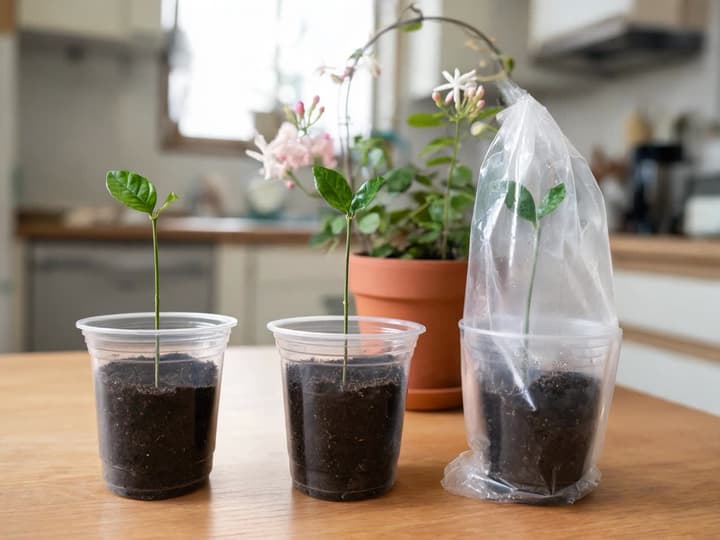
Insert the base. Make a hole with a pencil and bury the base of the cutting with at least 1 node under the soil. Firm the soil around it.
Water and cover. Moisten until water drains through the holes at the bottom of the cup. Cover the cup with a clear plastic bag to trap moisture around the foliage.
Pick the spot. Keep the cutting in bright, indirect light, out of direct sun, as advised by Purdue. Both Paraná studies kept cuttings at 24 °C. Choose a spot in your home that stays as close to that temperature as possible.
Keep the soil moist. Water whenever the surface starts to dry out. The soil must stay moist, never soggy.
Do you need rooting hormone for jasmine?
For pink jasmine and primrose jasmine, no. Rooting hormone is a powder or liquid containing auxin (a root-stimulating substance), applied to the base of the cutting. In the pink jasmine study, 80% of cuttings without hormone rooted successfully. The difference compared to treated cuttings was too small to rule out chance. For primrose jasmine, all groups exceeded 90%, and the hormone merely produced longer roots.
Arabian jasmine responded differently. In the Indian study, 88% of cuttings treated with 1,500 ppm of IBA (indole-3-butyric acid, a type of auxin) were alive at 60 days. Without hormone, only 67% survived. If your jasmine is Arabian jasmine, the rooting hormone is worth the investment.
How long jasmine cuttings take to root
In a greenhouse, cuttings evaluated at 48 days (primrose jasmine) and 54 days (pink jasmine) had already grown roots, which means 7 to 8 weeks. At home, without mist systems, no study has measured the exact timeline. Do not discard a cutting before 2 months as long as it stays green.
New growth on the cutting indicates roots have likely developed, according to the University of Vermont (UVM) Extension. To check, gently tug the cutting: if you feel resistance, roots are holding it in place. If so, remove the plastic bag.
The cutting moves to its permanent pot once roots reach roughly 2.5 cm, notes Purdue. After potting up, with established roots, the new plant can move to a bright, sunny spot, as Purdue recommends. Until then, keep it out of direct sunlight. Moving into a pot and planting in the ground are separate steps. In Indian commercial jasmine production, cuttings stay 4 to 5 months in the nursery bed before transplanting into the field, according to the National Horticulture Board (NHB) of the Indian government.
How to propagate jasmine in water or in soil
Soil is the most reliable method, and it was the only medium measured in the jasmine studies. Purdue advises against rooting cuttings in water: oxygen is lacking, resulting in weak roots that adapt poorly to soil later on. Roots that form in soil grow right where they will live.
Water rooting also works for pink jasmine. UVM specifically lists Jasminum polyanthum among vines that root easily in water. If you want to try it, remove leaves from the bottom 1 or 2 nodes and do not leave any leaves submerged. Change the water whenever it turns cloudy and move the cutting to soil once roots exceed 5 to 8 cm. The two extensions disagree, and no one has scientifically measured water rooting in jasmine. Therefore, soil, as the only tested medium, remains the safest choice.
Layering: propagating jasmine without severing the stem
Layering forces roots to grow on a branch that remains attached to the parent plant. The parent plant sustains the stem while roots develop, eliminating the need for plastic bags or greenhouse covers. The RHS recommends layering for pink jasmine, Arabian jasmine, primrose jasmine, and common jasmine.
Select a long, pliable stem that reaches the ground or a container placed next to it.
Make a shallow, angled nick in the bark along the section to be buried.
Bury this section 10–15 cm deep, ensuring at least 1 node rests under the soil.
Secure the stem with a wire pin and leave the leafy tip exposed above ground.
Keep the soil moist and wait for roots to develop.
In the NHB production guide, growers use a 1-year-old shoot, which roots within 90 to 120 days. Iowa State University teaches the same method for plants with long, flexible stems, citing a window of 6 to 12 weeks. The NHB guide is the only commercial production source specific to jasmine, so its 90 to 120-day timeframe serves as the main benchmark. Iowa State's guidance applies to long-stemmed plants in general. Once the branch resists a gentle tug, cut its connection to the parent plant and pot up your new start.
Some jasmines layer themselves naturally. Arizona State University notes that Arabian jasmine can root wherever a stem stays in contact with damp ground for an extended period. NC State observes the same behavior in winter jasmine (Jasminum nudiflorum). If your jasmine already has a branch rooted in the dirt, sever that rooted section and pot it up.
Air layering forces roots on an elevated stem wrapped in moist moss. None of the sources cited in this guide evaluated air layering on true jasmine. On long, flexible vining stems, simple layering is done on the ground, removing the need to work high up on a stem and wrap it in moss.
Best time to propagate jasmine in Brazil
Take jasmine cuttings in spring and summer, from September to March. The RHS recommends semi-ripe cuttings in summer, and in Brazil summer runs from December to March. For primrose jasmine, the rate above 90% was measured in summer. For jasmines that cannot tolerate frost, the RHS recommends taking cuttings in spring or summer. In Brazil, spring begins in September.
Layering allows for more months because the branch stays attached to the parent plant. The RHS recommends it in the fall, which in Brazil runs from March to June. In winter, from June to September, the RHS only recommends hardwood cuttings, and only for common jasmine.
The study on pink jasmine planted the cuttings at the end of August, in Curitiba, but in a greenhouse at 24 °C. It does not prove that the cutting roots in winter outside a greenhouse.
Can you save a dying jasmine by taking cuttings?
Yes, provided there is still a firm, green branch free of dark spots. Cuttings are your best option here, since layering relies on the parent plant, and an ailing mother plant cannot sustain the layered branch. First, scrape the stem's bark with your fingernail. Green tissue underneath indicates live growth, while dry brown tissue signals dead wood, according to Ask Extension.
Cut above any soft or discolored sections into healthy green growth, then follow the cutting steps. If the base of the mother plant is soft, the page on rot in jasmine explains how to treat it. The article on jasmine with yellow leaves helps distinguish overwatering from other issues.
Frequently asked questions
Can you propagate jasmine from seeds?
Yes, if the plant sets fruit. The RHS notes that jasmine rarely produces fruit in the UK, but seeds can be sown whenever they appear. Cuttings and layering offer an advantage: the new plant grows identical to the parent. For this reason, propagation from stem cuttings is used to preserve the plant's exact traits, according to the UFPR study.
Can I take cuttings from a stem with flowers or buds?
Yes, but choose a stem without buds if possible. In the UFPR studies, cuttings bore only 2 leaves or 4 leaflets at the top, and neither study evaluated flowering stems. If your only viable stem has flowers, remove all blooms and buds. Leave just the top pair of leaves, matching the tested cuttings.
How do you propagate frangipani (plumeria)?
Frangipani is a Plumeria, a thick-stemmed tree rather than a Jasminum. Its cuttings differ from those described in this guide, so the success rates and cutting sizes here do not apply. Care instructions for frangipani appear on its dedicated plant profile.
How many jasmine cuttings should I take?
Prepare 4 to 6 cuttings to ensure you get 1 or 2 rooted plants. In the Paraná greenhouse studies, 80% to 95.7% rooted, but no one has tested success rates at home without a greenhouse mist system. By taking extra cuttings, you will still harvest viable starts even with lower rooting percentages.
Sources
Silva, S. S. et al. Rooting of cuttings of Jasminum polyanthum treated with indolebutyric acid. Scientia Agraria, v. 13, n. 1, p. 17-20, 2012. Universidade Federal do Paraná.
Cruz-Silva, C. T. A.; Fanti, F. P.; Zuffellato-Ribas, K. C. Vegetative propagation of primrose jasmine (Jasminum mesnyi Hance) via stem cuttings. Scientia Agraria, v. 14, n. 2, p. 77-82, 2013.
Netam, N. et al. Effect of different IBA concentration on survivability and rooting of Jasmine (Jasminum sambac) stem cuttings. Journal of Pharmacognosy and Phytochemistry, v. 7, n. 1S, p. 614-617, 2018.
National Horticulture Board, Government of India. Jasmine propagation.
RHS. How to grow jasmine; plant profiles for Jasminum polyanthum, Jasminum officinale, Jasminum sambac, and Jasminum mesnyi.
University of Vermont Extension. More, please! Propagating houseplants.
Purdue University. Propagate trees and shrubs from cuttings.
Iowa State University Extension. How to propagate houseplants: air layering and simple layering.
NC State Extension. Jasminum and Jasminum nudiflorum.
Arizona State University. Jasminum sambac.
FDACS, Division of Plant Industry. Botany Circular 38: jasmines, 2012.
Clemson Cooperative Extension. Jasmine, HGIC 1106.
Ask Extension. Scratch test for stems.
Related articles

How to Care for Hibiscus: Sun, Watering, Fertilizer, and Pruning for Flowers
How to care for hibiscus: 6 hours of direct sun, evenly moist soil without waterlogging, half-strength fertilizer in spring and summer, and pruning in early spring. Find out why the flower lasts one day and why buds drop before opening.

Do Ferns Like Sun or Shade? It Depends on the Type
Ferns prefer bright shade: plenty of light, but no direct sun on their fronds. Tuberous sword fern is the exception that handles sun. Here is the ideal light for each type, where to place pots, and how fronds show too much or too little light.

African Violet Yellow Leaves: Causes and What to Do
Yellow leaves on an African violet usually stem from overwatering, and the first place to check is the center of the plant. Losing one lower leaf at a time is normal. Identify whether age, watering, cold water, sunlight, cold drafts, or fertilizer is the culprit based on the yellowing pattern, and see what to do today.