Jasmine Leaves Turning Yellow: Causes and How to Fix It
Jasmine leaves turning yellow: identify your jasmine species, pinpoint where the yellow starts, and check whether the soil is wet or dry with a simple test for each cause.
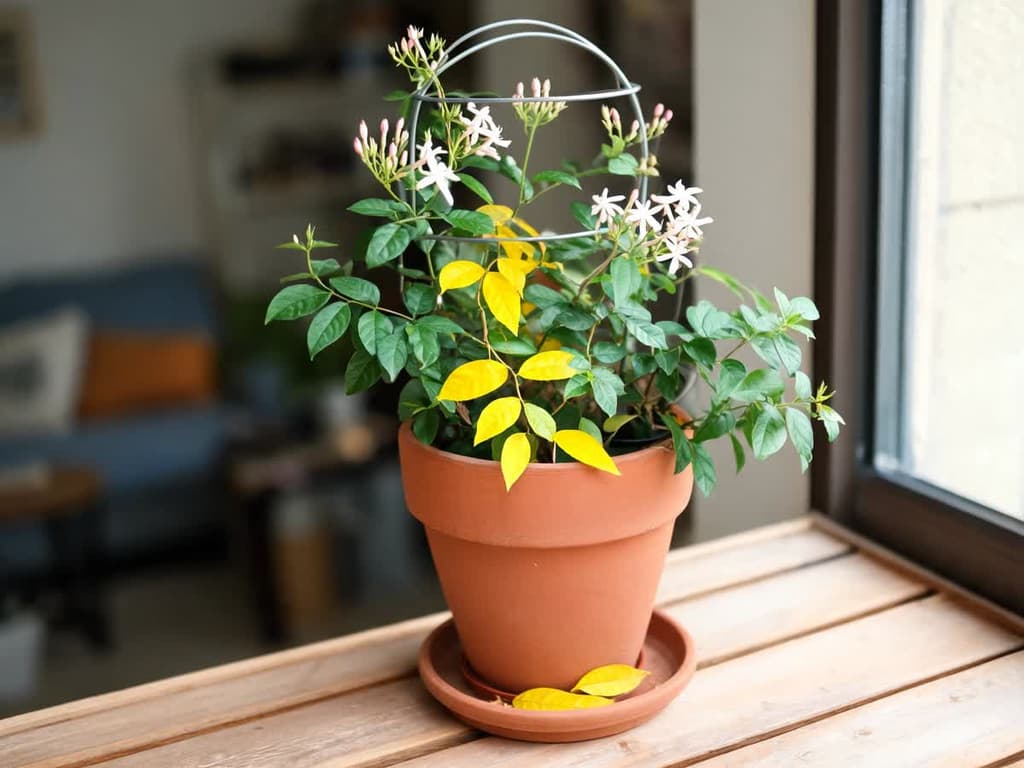
A jasmine with yellow leaves almost always recovers. The cause comes down to three questions: which jasmine you have, where the yellowing started, and whether the potting soil is wet or dry. Old leaves near the base gradually turning yellow is normal leaf shed. Widespread yellowing paired with waterlogged soil points to overwatering.
Yellowing limited to new leaves while the veins stay green points to iron deficiency. Tiny yellow speckles with fine webbing on the underside of the leaf indicate spider mites (tiny, eight-legged pests). Each cause has its own test: a finger in the soil, a sheet of white paper, or a fingernail scratch on the stem. Start with the test that matches what you see.
Quick summary:
Common jasmine (Jasminum officinale) usually drops its leaves in the cold. Yellow leaves falling during this season are part of its normal cycle (RHS and NC State Extension).
Pink jasmine (Jasminum polyanthum) and Arabian jasmine (Jasminum sambac) cannot tolerate frost. Cold temperatures and freezing drafts turn their leaves yellow.
Indoors, Clemson Extension recommends at least 4 hours of direct sun each day. The ideal night temperature is between 50 and 55 °F (10 and 13 °C).
In Arabian jasmine plantations in India, TNAU records three causes for yellow leaves: iron deficiency, nematodes (microscopic root worms), and root rot. Tests for iron deficiency and root rot appear in the sections below.
Yellow leaves generally do not turn green again. The plant recovers through its new growth.
Which jasmine do you have?
The name jasmine applies to several different plants, and the cause of yellowing varies by species. The three most common Jasminum species grown in pots or along walls can be distinguished by their foliage: Arabian jasmine has simple leaves, while the other two have compound leaves.
Jasmine | Foliage | Typical location | What changes about the yellowing |
|---|---|---|---|
Pink jasmine (J. polyanthum) | compound, with up to 7 leaflets (the individual "leaflets" of each leaf) | potted, sold in bloom during cold weather | does not tolerate frost |
Common jasmine (J. officinale) | compound, with 5 to 9 leaflets (7 to 9 according to the RHS, 5 to 9 according to Clemson) | walls, pergolas, fences | usually drops its leaves in the cold |
Arabian jasmine (J. sambac) | simple, entire, and glossy | potted, near the house | does not tolerate frost; scorches in harsh afternoon sun |
Leaf types and cold tolerance ratings for each species come from RHS plant profiles. Complete care profiles are available for pink jasmine, the potted jasmine sold in bloom during cold months, and jasmine, which covers the entire genus.
Three plants called jasmine belong to entirely different genera, and their care requirements can differ from true Jasminum care:
star jasmine (Trachelospermum jasminoides), which Clemson Extension distinguishes from true jasmines;
"Brazilian jasmine," which is mandevilla (Mandevilla sanderi); for this plant, see mandevilla with yellow leaves;
gardenia, sometimes called Cape jasmine, a shrub with fragrant white flowers and glossy, simple leaves.
There is also common jasmine with naturally golden foliage. NC State Extension lists the cultivars 'Frojas', with golden foliage, and 'Aureovariegatum', with leaves splashed in golden yellow. 'Frojas' is sold as 'Fiona Sunrise', and the RHS describes its leaflets as "heavily suffused with golden yellow" (RHS). If the plant was already uniformly yellow, firm, and without leaf drop, the color comes from the variety, not a symptom.
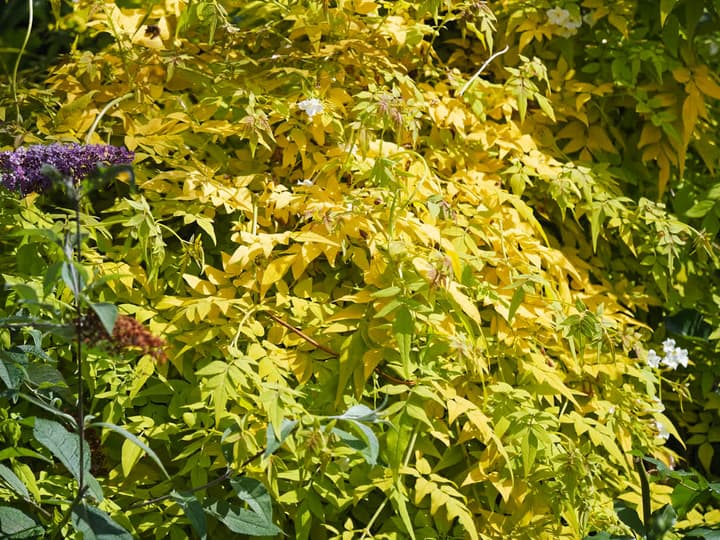
Yellow leaves that are not a problem
If a few old leaves near the base turn yellow gradually while the vine tips remain green and growing, that is normal leaf renewal. Every evergreen plant replaces older foliage with new growth throughout the year.
The RHS describes J. officinale as "usually deciduous." NC State Extension classifies it as deciduous or semi-evergreen, though the body text of the same profile calls it evergreen. Deciduous means the plant drops its leaves in cold weather and puts out fresh growth once temperatures rise. During a chilly winter, outdoor common jasmine on a wall will yellow and lose its foliage without being diseased.
The test is the tip of the stem. If shoot tips are green and firm, the plant is alive and merely shedding older foliage. If the tips also turn yellow, wilt, or dry out, a different problem is at work; see the sections below.
Diagnostic table: yellowing patterns, causes, and tests
What you see | Likely cause | Test | What to do |
|---|---|---|---|
Soft leaves, widespread yellowing across multiple areas, wet soil | overwatering or root rot | slide the plant out of the pot and inspect the roots | empty the saucer, trim rotted roots, repot in fresh soil |
Thin leaves, dry edges, lightweight pot | underwatering | lift the pot: a light pot in your hands indicates bone-dry soil | water slowly until moisture drains through the drainage hole |
Leaves dropping shortly after purchase or after moving the pot | abrupt shift in light, cold exposure during transport, or drafts | recall any changes made over the past 2 weeks | keep in a stable, bright, draft-free spot; adjust only one factor at a time |
Yellowing after a cold night or near a drafty door, window, or AC unit | cold injury or drafts | check nighttime temperatures | move away from drafts; do not prune immediately |
New leaves turn yellow while the veins stay green | iron deficiency (alkaline soil with high pH locking up iron, or weak roots) | check if yellowing is limited strictly to shoot tips | inspect roots and watering routine; then apply an iron fertilizer |
Yellow speckling, fine webbing, dusty appearance under leaves | spider mites | tap the leaf over a sheet of white paper | rinse leaf undersides with a stream of water and apply insecticidal soap |
Sticky leaves, white cottony masses, or brown scale covers along stems | scale, aphids, or whiteflies | run a finger across the lower leaves | dab with a cotton swab dipped in rubbing alcohol, isolate the plant |
Scorched yellow patches strictly on the side facing an afternoon window | harsh afternoon sun | check whether foliage facing inward toward the room remains green | move to morning sun |
Wet soil and soft leaves: overwatering
Yellow, limp leaves paired with wet potting mix are the classic symptoms of overwatering. Waterlogged roots suffocate from lack of oxygen, rot, and can no longer transport moisture up to the foliage. Because of this, the plant wilts even while sitting in saturated soil, and adding more water accelerates the decline.
Stick your finger about 1 inch (3 cm) into the soil. If it comes out damp several days after you last watered, remove the root ball from the pot and inspect the root system. Healthy roots are pale and firm; rotted roots are brown, mushy, and smell sour.
If you find root rot, follow these steps in order:
Gently shake off the old soil and trim away all brown, mushy roots with clean shears.
Repot in fresh potting mix, using a pot with drainage holes that is only slightly larger than the remaining root mass.
Empty the saucer every time water collects in it.
Prune back the top growth in direct proportion to the volume of root mass lost.
University of Minnesota Extension explains the reason for pruning in a case of root rot in star jasmine, a plant from another genus cited here only for the pruning advice. The remaining root system cannot support all the branches, and the plant needs to direct energy into growing new roots. If no firm, light-colored roots remain, the plant will not recover (Ask Extension).
In Arabian jasmine, root rot is among the three causes of yellow leaves recorded in Indian fields by Tamil Nadu Agricultural University (TNAU). The RHS recommends very light watering for potted jasmine in winter, when the plant grows slowly. It does not provide a specific volume: water only when the top 3 cm of soil dries out (RHS).
Dry soil and scorched edges: underwatering
A thirsty jasmine develops yellow interior leaves and crisp, brown margins. The container feels noticeably light when lifted, and the dry root ball pulls away from the inner sides of the pot.
When dry soil pulls away from the pot walls, pour-over water runs straight down the perimeter gap and exits the drainage holes. The interior of the root ball stays dry. Water slowly, wait 5 minutes, and water again until moisture drains through the base and the container feels heavy in your hands.
After that, water when the top 3 cm of soil dries out, not on a fixed schedule. Iowa State Extension lists overwatering and underwatering among the causes of yellow leaves on potted plants. Both mistakes also cause leaf drop (Iowa State).
Recently purchased jasmine or relocated pots
A jasmine that turns yellow and sheds foliage during its first few weeks in your home is usually acclimating to its new environment. Iowa State Extension highlights three common triggers for potted houseplants:
chilling injury during transit when the plant was not adequately protected en route;
hot or cold drafts from nearby doors, open windows, or HVAC vents;
abrupt changes in lighting, such as transitioning from a sunlit greenhouse directly to a dim room.
Pink jasmine is typically sold in full bloom during cooler months after being forced in greenhouse conditions. Inside your home, it experiences different light, different room temperatures, and different watering patterns all at once.
Pick a bright, draft-free location and keep the pot there. Water only when the top inch (3 cm) of potting mix feels dry. Altering both your watering routine and the pot's location in the same week changes two variables at once, making it impossible to tell what worked. Adjust one variable at a time, and wait for new growth to emerge before evaluating results.
Cold temperatures, drafts, and air conditioning
The RHS provides a cold hardiness rating from H1 (greenhouse only) to H7 (below −20 °C). Pink jasmine and Arabian jasmine are H2: the minimum temperature they tolerate is between 1 and 5 °C, and frost kills them (RHS, J. polyanthum; RHS, J. sambac). Common jasmine is much hardier, H5: it tolerates −15 to −10 °C once established (RHS, J. officinale).
Sources disagree on the ideal night temperature for potted jasmine. The RHS recommends keeping J. polyanthum above 13 °C. Clemson Extension indicates nights of 10 to 13 °C and days of 20 to 22 °C for indoor jasmine (Clemson). This guide follows Clemson, which is a university extension service and writes for indoor growing: do not let night temperatures drop below 10 °C.
Foliage that turns yellow after a cold night or near an air-conditioning vent indicates cold or draft damage. Move the pot away from doors, open windows, and air vents. Do not prune immediately after the cold snap. UF/IFAS recommends waiting for new growth to see what actually died, because damaged leaves still protect the rest of the plant (UF/IFAS).
Insufficient light or harsh afternoon sun
A jasmine tucked into a dark corner turns yellow from light starvation: foliage grows pale, stems stretch toward windows, and flower bud formation stops. Clemson Extension recommends at least 4 hours of direct sunlight daily for indoor jasmines, or 14 to 16 hours under strong artificial light. The RHS recommends bright, filtered light for pink jasmine and protection from scorching sun for Arabian jasmine. This guide follows Clemson, utilizing the morning sun exposure suggested by ASU.
Too much sun also causes yellowing. Arizona State University warns that Arabian jasmine facing west, exposed to harsh afternoon sun, develops "yellowish and sunburned looking" foliage. The university recommends an east-facing exposure (ASU). In this case, the side facing the window turns yellow while the side facing the room stays green.
Move your plant to an east-facing spot that receives gentle morning sun. Make the transition gradually over several days, as sudden shifts in light exposure trigger leaf drop (Iowa State).
Interveinal chlorosis: iron, magnesium, and soil pH
A yellow leaf with green veins is a sign of chlorosis, the yellowing of the leaf due to a lack of chlorophyll (the green pigment). WSU Extension separates the causes by position: nitrogen deficiency yellows old leaves evenly, and iron deficiency causes yellowing between the veins of new leaves. Magnesium deficiency also causes yellowing between the veins, and WSU recommends a soil test before fertilizing (WSU).
A lack of iron in the soil is not always the culprit. WSU explains that alkaline soil with a high pH binds iron chemically, and damaged roots cannot take up available nutrients. For this reason, check root health and watering practices first, as described above. Decayed roots generate identical interveinal yellowing and will not improve with fertilizer applications.
If the roots are healthy but new leaves still display interveinal yellowing, apply a fertilizer containing chelated iron according to the product label. On commercial Arabian jasmine farms in India, TNAU recommends spraying ferrous sulfate at 5 g per liter once a month until the yellowing clears. That concentration is calibrated for agricultural field use; for potted plants, follow the package instructions.
Epsom salt (magnesium sulfate) only helps when there is an actual magnesium deficiency. WSU researcher Linda Chalker-Scott advises home gardeners against using the salt without confirming a magnesium deficiency first (UW Miller Library).
Stippling, webbing, or sticky residue: insect pests
Yellow stippling on the foliage, which later coalesces until the entire leaf turns yellow or bronze, signals twospotted spider mites. Each tiny dot is a feeding wound: the mite sucks out the sap and surrounding tissue dies. Extensive feeding causes the plant to drop its leaves (NC State Extension).
Spider mites congregate on the undersides of leaves and are almost invisible to the naked eye. To check for them, tap a leaf sharply over a piece of white paper and watch for moving specks (Iowa State). Fine silk webbing between stems indicates an established population (Iowa State). Mite populations expand rapidly in hot, dry air, completing a full generation in 5 to 20 days (NC State).
To treat, thoroughly spray the undersides of foliage with water in the sink or shower, then treat with insecticidal soap or horticultural oil according to label directions. Iowa State recommends repeating applications weekly for 4 to 6 weeks, because newly laid eggs continue to hatch.
Sticky, shiny leaves point to scale, aphids, or whiteflies. These insects suck sap and excrete a sugary liquid, honeydew, which sticks to the lower leaves and later turns dark with black fungus (Iowa State). Mealybugs look like cotton where the leaf meets the stem; armored scale looks like a small shell attached to the stem. Remove small numbers with a cotton swab dipped in rubbing alcohol and isolate the plant from others.
The RHS and NC State Extension list spider mites, scale insects, and aphids on jasmine, most common when the plant lives indoors. In Indian field crops, two-spotted spider mites appear on jasmine during hot, dry weather (TNAU). Spider mites, scale insects, and aphids are the recorded pests on jasmine, and the jasmine pests page gathers them all.
Can it be saved? The stem scratch test
Gently scratch the bark of a stem with your fingernail. Beneath it lies the cambium, the living layer of the stem. Bright green means that section is alive; beige or brown means that section has died. The test comes from the University of Nebraska Extension, cited by Ask Extension.
Start near the tip of the vine and work your way down until you uncover green tissue. Once new growth appears, prune dead stems back to just above the highest point where green cambium was visible. As long as the base of the stem remains green near the soil line and the root system contains firm, light-colored roots, the jasmine can resprout even after complete leaf loss.
If the plant with yellow leaves is not a jasmine, the blog's yellow leaves guide covers the causes for other houseplants. The yellow leaves on jasmine page lists the jasmine diseases and pests that cause this symptom.
Frequently asked questions
Do yellow jasmine leaves turn green again?
Generally, no. Foliage that turned yellow due to insufficient light or root damage will not regain its green color. For iron chlorosis, TNAU recommends spraying until yellowing resolves, without stating whether existing leaves turn green again. Once you correct the underlying issue, jasmine shows recovery through healthy green new growth and the cessation of leaf drop. Wait for new growth to emerge before judging your treatment.
Should I remove yellow leaves from my jasmine?
Remove only completely yellow or crisp, dried leaves using clean shears or a gentle tug. Leaves that retain green patches still produce energy through photosynthesis. Following cold exposure, leave damaged foliage in place until new shoots emerge, as it helps insulate and shield the inner stems (UF/IFAS). On common jasmine, winter foliage that turns yellow drops naturally, so it requires no corrective pruning.
Do coffee grounds or Epsom salt help a yellow jasmine?
Neither remedy fixes incorrect watering, poor lighting, or chilling injury, which Iowa State identifies as the primary triggers for yellowing and leaf loss in potted houseplants. Epsom salt only corrects confirmed magnesium deficiencies, and WSU recommends avoiding it unless soil testing confirms a deficiency. For coffee grounds, there are no published trials on jasmine; the safest course is to avoid using them as a treatment for yellow leaves.
Is jasmine toxic to dogs and cats?
Jasmine in the genus Jasminum is listed as non-toxic to dogs and cats by the ASPCA. Carolina jessamine (Gelsemium sempervirens) has a similar name, belongs to a different family, and contains neurotoxins that can kill dogs and cats (Pet Poison Helpline).
What to do when jasmine leaves turn yellow
Before treating a jasmine with yellow leaves, check the species, where the yellowing appears, and the soil moisture. Then test for the suspected cause and change one variable at a time. Old leaves dropping slowly and a common jasmine without leaves in the cold require no treatment.
If you are unsure which jasmine variety you own, Bloom (available for iOS) identifies species from a photo. With Premium, it also matches leaf symptoms against common pest and disease damage.
Sources
RHS. How to grow jasmine; plant profiles for Jasminum polyanthum, Jasminum officinale, and Jasminum sambac.
NC State Extension. Jasminum officinale, Jasminum, and Twospotted spider mites on landscape plants.
Clemson Cooperative Extension. Jasmine, HGIC 1106.
Iowa State University Extension. What causes leaves on a houseplant to turn yellow or brown and drop and Diagnosing houseplant problems caused by insect pests.
WSU Extension, HortSense. Common cultural: nutrient deficiency.
Tamil Nadu Agricultural University, TNAU Agritech. Malligai (Jasminum sambac).
Arizona State University. Jasminum sambac.
UF/IFAS Extension. Don't react too quickly to cold-injured plants, 2022.
Ask Extension. Root rot in star jasmine and scratch test on stems.
University of Washington, Elisabeth C. Miller Library. On the use of Epsom salts in the garden.
Pet Poison Helpline. Jessamine.
ASPCA. Jasmine.
Related articles

How to Care for Hibiscus: Sun, Watering, Fertilizer, and Pruning for Flowers
How to care for hibiscus: 6 hours of direct sun, evenly moist soil without waterlogging, half-strength fertilizer in spring and summer, and pruning in early spring. Find out why the flower lasts one day and why buds drop before opening.

Do Ferns Like Sun or Shade? It Depends on the Type
Ferns prefer bright shade: plenty of light, but no direct sun on their fronds. Tuberous sword fern is the exception that handles sun. Here is the ideal light for each type, where to place pots, and how fronds show too much or too little light.

African Violet Yellow Leaves: Causes and What to Do
Yellow leaves on an African violet usually stem from overwatering, and the first place to check is the center of the plant. Losing one lower leaf at a time is normal. Identify whether age, watering, cold water, sunlight, cold drafts, or fertilizer is the culprit based on the yellowing pattern, and see what to do today.