How to Propagate Kalanchoe from Stem and Leaf Cuttings
Propagate kalanchoe with a 2 to 3-inch non-flowering stem cutting. Let the cut callous before planting, and roots will establish in 2 to 3 weeks. Here is how leaf cuttings work and why your new plant needs long nights to bloom.
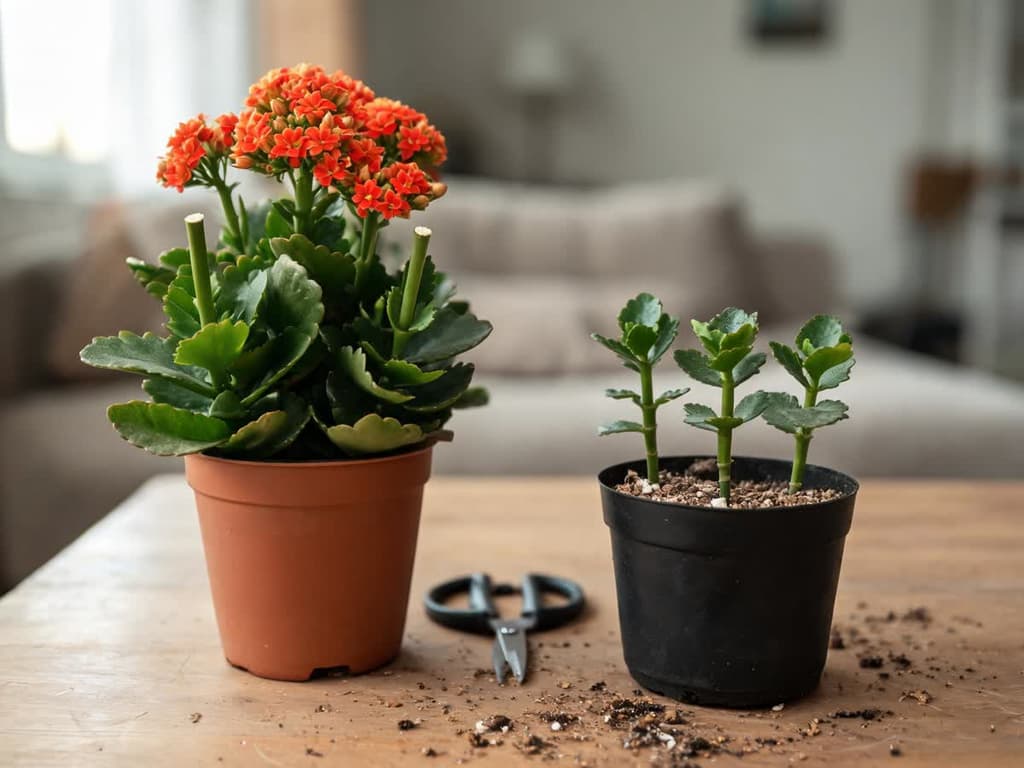
To propagate kalanchoe, take a 2 to 3-inch non-flowering stem cutting that has two pairs of leaves. Let the cut end callous over for a few days, then pot it in light, moist soil. Kept warm under bright light, it will grow roots within 2 to 3 weeks.
A single leaf can also grow roots, though university extension offices do not publish exact timelines for them. Keep in mind that a young plant will not bloom on its own over the summer: it only sets buds once the nights grow long.
This guide covers the familiar blooming potted florist kalanchoe, Kalanchoe blossfeldiana, often called flaming Katy. Calandiva is simply a double-flowering variety of the same plant, and you propagate it the exact same way.
Quick summary:
Use a 2 to 3-inch tip cutting with two pairs of leaves and no flowers.
Let the cut callous over in open air for several days before potting.
Rooting hormone is unnecessary, according to research from Clemson and Auburn.
The best time is from March to July.
A cutting taken in spring will bloom the following winter, or even sooner if you give it 14 hours of continuous darkness each night for 6 weeks.
The kalanchoe that grows babies on its leaves is a different species
A plant that sprouts dozens of tiny plantlets along its leaf margins is mother of thousands (Kalanchoe daigremontiana or Kalanchoe delagoensis). It belongs to the same genus as florist kalanchoe, but it multiplies on its own. As the NC State Extension profile on the Kalanchoe genus explains, some species produce plantlets right along their leaf edges. These tiny offsets drop off and take root wherever they hit the soil.
Florist kalanchoe does not do this. Its foliage is thick, smooth, and scalloped around the edges, topped by clusters of small flowers held high above the leaves. The propagating timelines and cutting sizes meant for mother of thousands will not work here.
If you are not sure which species sits on your windowsill, Bloom can identify it from a quick photo of the leaf. Each species requires its own propagating method, and checking first saves you from trimming the wrong plant.
How to propagate kalanchoe from stem cuttings
Commercial growers multiply florist kalanchoe by taking stem tip cuttings. The Clemson Cooperative Extension and commercial production guides from Auburn University recommend the exact same benchmarks.
Choose a stem without flowers. Clemson suggests taking shoots with only foliage, as flowering stems take longer and struggle to root well.
Cut a 2 to 3-inch tip with two pairs of leaves. Using clean shears, make your cut just below a leaf node.
Strip the leaves from the bottom one or two nodes. A node is the point along the stem where leaves attach. These bare lower nodes sit beneath the soil line, and that is where new roots emerge.
Let the cut air-dry. Clemson mentions several days, and the New York Botanical Garden (NYBG) suggests about a week. The cutting is ready when the tip forms a dry, matte film that feels dry to the touch.
Mix up a light rooting mix. Clemson relies on equal parts peat moss and perlite. A Brazilian research trial found great results using 3 parts vermiculite to 1 part peat (Gonçalves and Minami, 1994).
Bury the bare nodes. Push only the stripped portion of the stem into the mix. Do not let any attached leaves touch the damp soil surface.
Set it in bright, indirect light. Clemson suggests slipping the pot into a large, sealed clear plastic bag to keep humidity high around the cutting.
Keep the mix moist, never soggy. Water lightly only when the soil surface starts feeling dry to the touch.
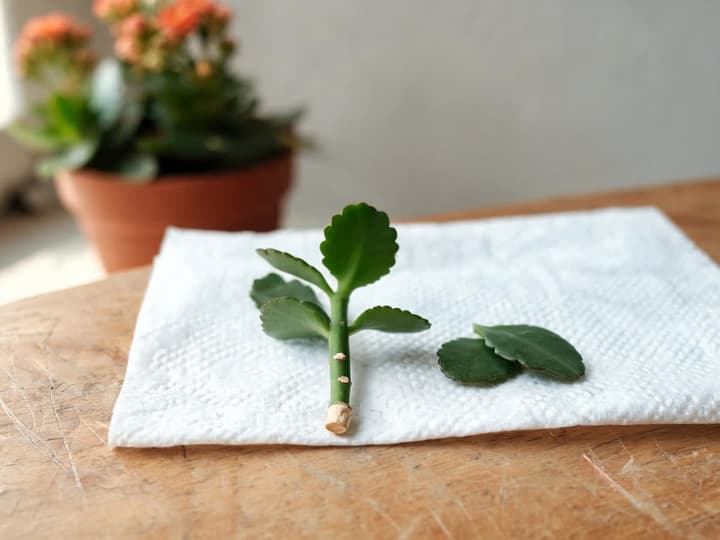
Sources differ when it comes to rooting hormone. The NYBG recommends dipping the cut end into rooting powder. Clemson and Auburn state it simply is not needed. This guide sticks with the university extensions: florist kalanchoe roots reliably without any chemical help.
Soil temperature also makes a clear difference. Auburn recommends keeping the rooting medium at 70 °F (21 °C), noting that bottom heat speeds up root formation. At home, that means keeping your propagation tray off cold windowsills and chilly floors.
How long kalanchoe cuttings take to root
In commercial greenhouses, cuttings are ready to pot up into their permanent containers within 14 to 21 days after sticking. That is the standard timeline reported by both Clemson and Auburn. Auburn pairs automated misting with bottom heat to hit those speeds.
On a home windowsill, the timeline stretches out. The NYBG advises leaving the cutting undisturbed for 1 to 2 months. In the Brazilian study using the 'Singapur' cultivar, roots were formally evaluated 30 days after planting.
Two telltale signs show your cutting has taken:
Gentle resistance when tugged. Hold the stem near its base and give a very soft upward pull. If you feel resistance, new roots are anchoring it down.
Fresh growth at the top. New foliage only starts pushing once functional roots can supply the stem.
If the leaves stay plump and firm but you see no top growth during the first few weeks, resist the urge to dig it up. The cutting lives off moisture stored inside its thick leaves while building its root system underground.
Can you propagate kalanchoe from a single leaf?
You can, but it is far less documented. NC State Extension notes that Kalanchoe blossfeldiana can be multiplied by stem or leaf cuttings. A fact sheet from the University of Florida (UF/IFAS) also lists leaf cuttings among viable propagation methods.
Neither source lays out specific steps or a reliable schedule for leaves. NC State itself tags stem cuttings as the preferred route. Clemson, Auburn, and the NYBG teach only the stem tip method.
Trying a leaf cutting makes sense in two scenarios: a healthy leaf snapped off by accident, or your plant has no non-blooming stems left to trim. Lacking published steps, your safest bet follows stem cutting basics:
Gently twist the entire leaf free, keeping the intact base where it met the stem.
Let the base callus over in open air for the same amount of time as a stem cutting.
Rest the calloused base on top of a light soil mix, without burying the whole leaf blade.
Water only when the surface dries out completely. A leaf sitting on constantly damp soil will rot before it ever roots.
Because no extension publishes a timeline for leaves, stick to stem cuttings if your goal is blooms by next winter. Peperomia is the exact opposite case, where leaf propagation is the primary method, as outlined in our guide on how to propagate peperomia from leaves.
The best time of year to take kalanchoe cuttings
The best time is from spring to early summer, from March to July. Clemson recommends spring and early summer. The NYBG suggests cuttings taken after flowering, in spring or summer.
Both sources are from the United States, and the months in this guide follow the Northern Hemisphere calendar.
Your plant's bloom cycle matters just as much as the calendar month. Kalanchoes typically flower in winter. Wait until the blossoms fade, trim away the spent flower stalks, and gather your cuttings from fresh vegetative shoots.
Fixing a leggy kalanchoe with dropping leaves
You can easily turn the stretched top of an overgrown kalanchoe into a new plant. Snip a 2 to 3-inch piece with two leaf pairs, following the standard stem cutting specs.
The original plant will recover as long as healthy leaves remain on the lower stems. Auburn's grower manual recommends cutting so that 2 to 3 leaf pairs stay on the parent branch. That base then branches out from side buds. The manual notes one new harvestable cutting per month, though that pace reflects commercial stock plants grown under night-interruption lighting.
Long, thin, floppy stems point straight to low light. Clemson describes kalanchoes growing weak and spindly whenever light levels drop. If you put the trimmed parent and its new cuttings right back into that dark corner, both will stretch out again.
Shift the container to the brightest spot in the house, where it catches direct morning sun. Our walkthrough on saving stretched succulents uses this exact same top-cut technique on other fleshy plants.
Can you propagate from a blackened stem?
A top cutting will root if the tissue inside is firm and green. Black, squishy stems at the soil line almost always indicate rot. NC State Extension links root and stem rots to overwatering. Clemson identifies two related culprits: heavy soil that drains poorly and watering too often.
To salvage the healthy top:
Gently pinch the stem from the bottom up with your fingernail until you find the firm part.
Make your cut entirely inside that healthy green section using clean shears.
Inspect the cut cross-section. It should look crisp, clean, and green with no brown flecks. If you spot dark discoloration, cut slightly higher.
Let the cut air dry and plant it like a stem cutting, in fresh soil and a clean pot.
Toss the rotted mush left behind, along with its old soil, straight into the trash. Unsure if your problem is actually rot? Our guide on diagnosing sick houseplants helps you pinpoint the issue before making any cuts.
When will your new kalanchoe cutting bloom?
A new cutting will only form flower buds after several weeks of long nights. Kalanchoe is an obligate short-day plant, meaning it initiates blossoms strictly when night lengths exceed a critical threshold. Auburn classifies it as qualitative: without short days, it grows foliage indefinitely and never blooms.
A cutting started in spring will stay purely green all through summer, which is entirely normal. Summer nights are simply too brief to trigger budding.
Buds form when nights lengthen. In the Northern Hemisphere, short days run from October to February, and a plant exposed to these nights begins blooming around January. Clemson counts about 12 weeks from the start of long nights to bloom. A study from the Federal University of Santa Maria, in the Southern Hemisphere, tracked cuttings taken at the end of summer. They initiated flower buds on their own the following fall (Peiter and colleagues, 2006).
You can trigger blooming early with controlled blackouts. The standard schedule calls for 14 hours of uninterrupted darkness every night for at least 6 weeks, paired with bright light during the day. Auburn recommends 42 consecutive short days to ensure dependable bud sets across all cultivars, noting visible buds show up right around the end of this stretch.
Let the cutting grow into a sturdy young plant before starting this routine. In commercial setups, rooted cuttings get 0 to 4 weeks of long days inside their final pots depending on container size and season (Auburn). That same guide notes that plant size at the moment short days begin directly dictates how large the flowering plant will be.
A stray light turned on in the middle of the night breaks the cycle entirely. Auburn uses this exact response on purpose: nighttime lighting keeps stock plants in vegetative growth while they take root. If your cutting sits in a living room lit up every evening, it may sit through winter without producing a single flower.
Troubleshooting cuttings that rot or fail to take
When a cutting fails, the stem usually tells you why.
Black, mushy base. The cutting rotted. It was likely stuck while the cut was still wet, the soil stayed saturated, or buried leaves broke down underground. Cut above the rot, let the new end dry out completely, and try again in an airier potting mix.
Wilted cutting with a clean base. It lost moisture faster than it could take it in. The surrounding air was too dry, or it sat in direct scorching sun.
Firm stem with zero roots after 2 months. It may have come from a flowering shoot, which takes far longer to root. Start fresh using a leafy, non-flowering branch.
Toxicity risks for dogs and cats
Kalanchoe is toxic to dogs and cats. The ASPCA lists vomiting, diarrhea, and, in rare instances, abnormal heart rhythms. The toxic compounds are bufadienolides, cardiac glycosides that interfere directly with heart function.
Taking cuttings leaves loose leaves and trimmed stems scattered across counters and floors. Sweep up all cuttings immediately and place propagation trays well out of reach of curious pets.
Kalanchoe propagation quick reference
Factor | Recommendation |
|---|---|
Cutting type | Non-flowering stem tip with two leaf pairs |
Cutting size | 2 to 3 inches (5 to 8 cm) |
Prep before planting | Air-dry until calloused (several days up to a week) |
Rooting mix | Equal parts peat and perlite, or 3 parts vermiculite to 1 part peat |
Rooting hormone | Unnecessary |
Light | Bright, indirect light with no direct sun on the cutting |
Soil temperature | Around 70 °F (21 °C) |
Rooting speed | 14 to 21 days commercially; up to 2 months at home |
Best time of year | From March to July |
First bloom | The following winter. Under 14 hours of nightly darkness, buds form after 6 weeks, blooming about 12 weeks from start |
Pet toxicity | Toxic to cats and dogs |
Frequently asked questions
Can you root kalanchoe cuttings in water?
None of our extension sources recommend rooting kalanchoes in water. Clemson, Auburn, and the NYBG consistently specify light, porous potting soil blended with peat, perlite, or coarse sand. Kalanchoe cuttings hold water inside their fleshy leaves and stems; the primary danger is rot, not drying out. Always stick with soil and let the cut end callous first.
Do kalanchoe cuttings need rooting hormone?
No. Both the Clemson Cooperative Extension and Auburn University's production guide state that rooting hormone is unnecessary for tip cuttings. While the NYBG mentions using hormone powder, commercial growers root cuttings cleanly within 2 to 3 weeks without it. Warm soil temperatures around 70 °F (21 °C) do far more to accelerate rooting.
Do you propagate Calandiva the same way?
Yes. Calandiva is simply a cultivar group of Kalanchoe blossfeldiana bred for double petals. Tip cuttings, cutting lengths, callousing periods, and ideal seasons are completely identical. The cutting will grow into an exact duplicate of the parent plant, keeping the same double blooms.
How many kalanchoe cuttings should you plant per pot?
Use one cutting for pots up to 4 inches (11 cm) across, and 1 to 3 cuttings for a 6-inch (15 cm) container, following Auburn's commercial guidelines. In a 6-inch pot, placing 3 cuttings yields a full, ready plant about 2 weeks earlier than planting just one.
Bottom line
Start your kalanchoe cutting using a 2 to 3-inch non-flowering stem tip with two pairs of leaves. Let the raw cut callous over before planting it in a light potting mix, and expect roots in 2 to 3 weeks. Leaf cuttings will also take root, though on an unpredictable schedule.
Flowers arrive with the long nights of winter. To speed things up, give your established cutting 14 hours of pitch darkness every night for 6 straight weeks.
Bloom identifies your houseplant from a single photo and pulls up care requirements tailored to the species. Available exclusively for iPhone.
Sources
Clemson Cooperative Extension, Home & Garden Information Center, factsheet Kalanchoe, HGIC 1554, by Millie Davenport: hgic.clemson.edu. Accessed on September 18, 2026.
Auburn University, Kalanchoe: Commercial Greenhouse Production: plantgrower.org. Accessed September 18, 2026.
New York Botanical Garden, LuEsther T. Mertz Library, guide Kalanchoe (Kalanchoe blossfeldiana) cultivars: Houseplant Care: libguides.nybg.org. Accessed September 18, 2026.
North Carolina State Extension Gardener Plant Toolbox, plant profile for the genus Kalanchoe: plants.ces.ncsu.edu. Accessed on September 18, 2026.
North Carolina State Extension Gardener Plant Toolbox, profile on Kalanchoe blossfeldiana: plants.ces.ncsu.edu. Accessed on September 18, 2026.
University of Florida, IFAS Extension, publication FP309, Kalanchoe blossfeldiana: edis.ifas.ufl.edu. Accessed September 18, 2026.
Gonçalves, A. L. and Minami, K. Effect of artificial substrate on the rooting of kalanchoe cuttings (Kalanchoe x blossfeldiana cv. Singapur). Scientia Agricola, v. 51, 1994: scielo.br. Accessed on September 18, 2026.
Peiter, M. X., Robaina, A. D., Parizi, A. R. C. et al. Model for leaf area determination of Kalanchoe blossfeldiana. Ciência Rural, vol. 36, 2006: scielo.br. Accessed on September 18, 2026.
ASPCA Animal Poison Control, Kalanchoe profile: aspca.org. Accessed on September 18, 2026.
Related articles
How to Care for a Maidenhair Fern: Light, Water, and Revival Tips
Learn how to care for a maidenhair fern indoors: bright indirect light, consistently moist soil, high humidity, and how to revive it if it dries out completely.
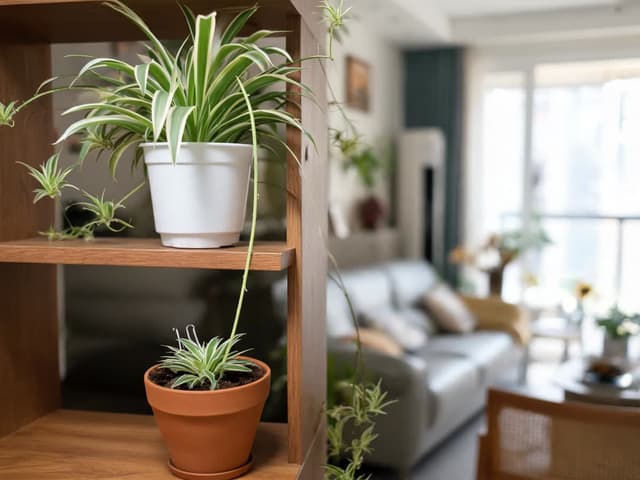
How to Propagate Spider Plants: Root the Pup Before Cutting
The safest spider plant cutting comes from a pup still attached to the mother plant: rest the plantlet on soil in a small pot, wait for roots to establish, and only then cut the stolon. Learn when the pup is ready, whether rooting in water is worth it, how to divide the clump, and why plants fail to produce babies.
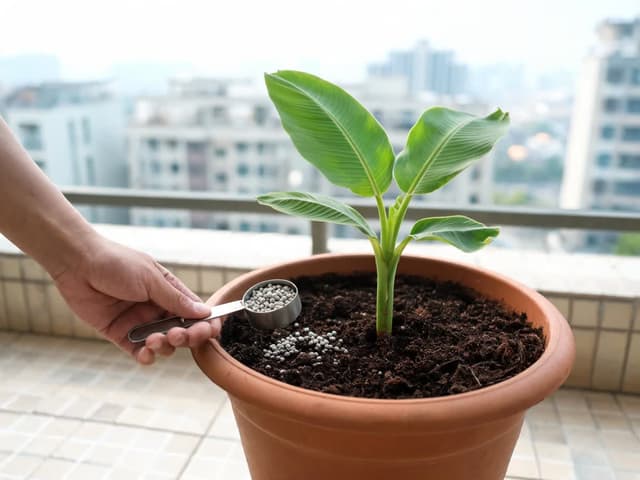
Banana plant fertilizer: fertilizing potted and backyard plants
Banana plant fertilizer needs more potassium than nitrogen, in a 3-1-6 ratio. For a potted plant on a balcony, use the label dose in spring and summer. In the backyard, fertilize every 2 months, adjusting the amount by mat age. Learn the formula, timing in Brazil, and signs of deficiency or excess.