Kalanchoe Soil: The Right Mix and When to Change It
The best kalanchoe soil is a fast-draining mix of peat moss or coco coir with plenty of perlite, in a pot with a drainage hole. See the ratios universities publish, what to do with the soil it came in, and when to repot.
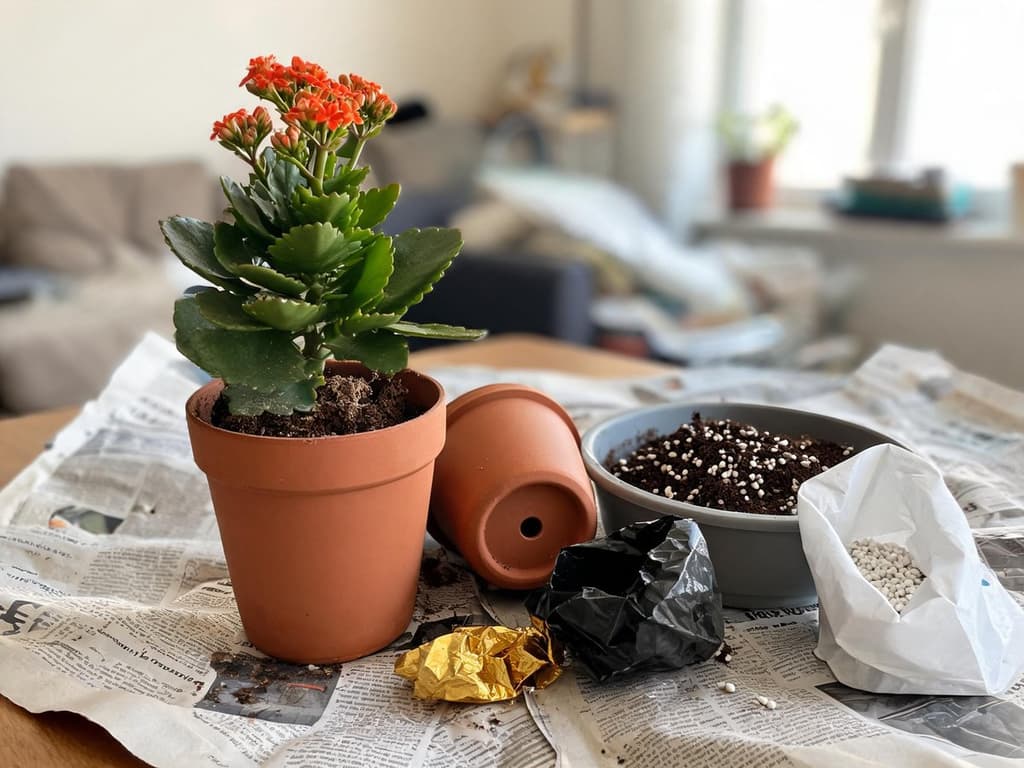
The best kalanchoe soil is a potting mix that dries out quickly. It uses peat moss or coco coir with 40% to 50% perlite, which are light, white granules of volcanic rock expanded by heat. Clemson University uses 60% peat moss (decomposed bog moss remains that hold water) and 40% perlite. A commercial cactus and succulent mix also works, as long as the pot has a drainage hole at the bottom.
Kalanchoe rots when its roots sit for days in waterlogged soil. If your plant's soil is already wet and its leaves are soft, squeeze the base of the stem before doing anything else: a firm base means you should wait, while a mushy base means you need to cut off the top to take a cutting.
Quick summary:
DIY mix: 3 parts bagged potting mix to 2 parts perlite, close to Clemson University's 60% peat moss and 40% perlite ratio.
For commercial growers selling kalanchoe, Auburn University recommends half peat moss and half perlite. The pH (the measure of acidity) stays between 6.0 and 6.5. You do not need to replace the soil the plant came in right away.
Use a pot with a drainage hole that is only slightly larger than the root ball, the block of soil and roots. For pots up to 8 inches (20 cm), leave 1 to 2 inches (2.5 to 5 cm) of space. When watering, take the pot out of the cachepot, the decorative outer pot without drainage.
When to repot: after the last flower fades. For a kalanchoe that blooms naturally during the winter in Brazil, this falls in September and October.
Should I repot my kalanchoe now or wait?
It depends on the base of the stem. Squeeze the stem with two fingers just above the soil line. A firm base means the roots are still supporting the plant. If the potting mix is wet, the first step is to let the pot dry out. A dark, soft base means rot has spread up the stem, and fresh potting mix cannot save the rotting tissue.
What you see | What is likely happening | What to do today |
|---|---|---|
Soil wet for days, stem base firm, leaves firm | Water trapped at the bottom of the pot or cachepot | Remove from the cachepot, let it drain, and do not water until the soil dries out |
Soil wet, lower leaves soft and translucent, base firm | Overwatering starting at the roots | Take the plant out of the pot and inspect the roots (steps below) |
Base of the stem dark and soft | Stem and root rot | Cut off the firm top and propagate it |
Stem flopping over with a firm base and dry soil | Plant stretching toward light | Move to a brighter spot; the potting mix is not the cause |
Soil dry and hard, water running down the sides without soaking in | Dried-out peat moss that has become water-repellent | Rewet the potting mix without repotting |
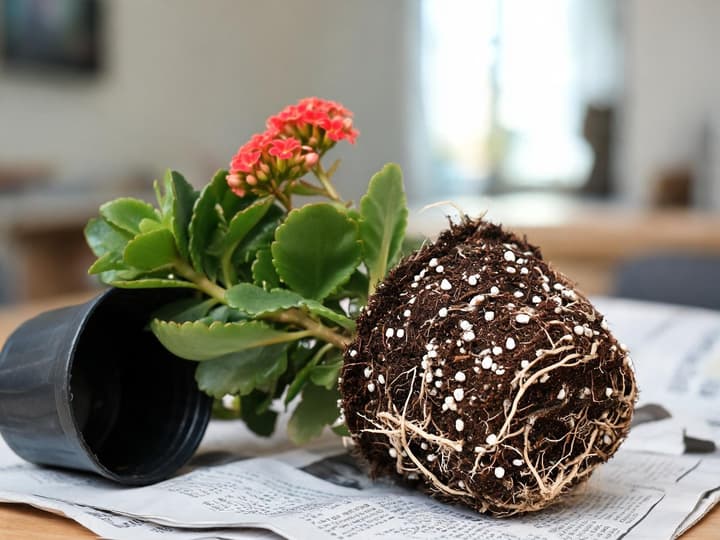
Checking the roots will not kill your kalanchoe. Tip the pot on its side, gently squeeze the plastic sides, and slide the plant out by its base. Pale, firm roots: return the plant to the same pot and let it dry out. Brown, mushy roots that fall apart when pulled: trim that part away and repot in fresh mix, following the steps in the last section.
Clemson University identifies two causes for root rot in this plant: poorly draining mix and watering too frequently. Auburn University adds that extended periods in waterlogged soil lead to stem and root rot. A soft, translucent lower leaf paired with wet soil is a sign of root rot from overwatering. The breakdown below covers other signs of root rot in kalanchoes along with treatment:
If the base of the stem is rotten, your best option is to cut off the top while it is still green and firm, and root it. The cutting roots in half peat moss and half perlite, according to Clemson; cutting and drying steps are detailed in how to save the top and propagate kalanchoe.
A flopping stem with a firm base has a different cause. Clemson notes that kalanchoe becomes leggy under low light. In that case, repotting will not straighten the plant.
Dry potting mix that repels water is common in peat-based blends. NC State Extension explains that severely dried-out peat moss is difficult to rewet. Water slowly with warm water until it drains out the bottom; the same source notes that warm water wets the mix faster than cold water.
What is the best kalanchoe soil?
The best potting mix for kalanchoe consists of two parts: an organic base that holds a little moisture, such as peat moss or coco coir, and perlite, which creates air pockets. Roots need air between waterings. Soil that stays soggy for days rots the roots.
Four institutions have published recommendations for what to use with this plant. Clemson and Auburn use peat moss as a base. NYBG blends organic matter with potting soil, sand, and gravel, while NC State recommends a commercial mix:
Source | Recipe | Use case |
|---|---|---|
60% peat moss and 40% perlite | mature indoor houseplant | |
50% peat moss and 50% perlite, with limestone adjusted to pH 6.0 to 6.5 | commercial greenhouse production | |
commercial cactus or succulent mix | indoor houseplant | |
1 part potting soil, 1 part coarse sand, 1 part organic matter, and a handful of crushed stone | replanting after flowering |
Three of these sources are university extensions, the outreach services through which US universities share plant guidance with the public. Auburn describes the right mix as one that drains quickly while retaining adequate organic matter. Kalanchoe recipes contain more organic matter than general succulent mixes: for succulents overall, Iowa State University recommends 1 part organic matter to 2 parts mineral components, such as perlite or coarse sand.
This guide covers the flaming katy (Kalanchoe blossfeldiana), the flowering plant commonly sold in bloom at florists and grocery stores, featuring clusters of small single or double flowers. The recipes above were published specifically for this species. The genus includes other cultivated potted plants, for which the sources cited here do not provide dedicated recipes.
If your plant was a gift without a label, verify the species before mixing your potting soil. Bloom (available for iOS) identifies plants from a photo, and the free plan includes 2 identifications per month.
Commercial cactus mix or potting soil with perlite?
Both work well. NC State Extension recommends commercial cactus and succulent mix for indoor kalanchoe. Clemson and Auburn use a peat-based potting soil with added perlite. No source has directly compared the two, and this guide recommends the peat and perlite blend, which has two sources supporting it; none of the four sources advises removing peat moss.
With a commercial mix, check the ingredient list on the bag. If perlite, sand, or pumice appear near the top of the label, the mix already drains better than standard potting soil. If bagged potting soil is what you have on hand, make the Clemson recipe:
Pick any measuring scoop, such as a plastic container or mug. Use the same scoop throughout.
Add 3 scoops of bagged potting mix to a bucket or tub. Peat moss or coco coir blends both work.
Add 2 scoops of perlite. Dampen the perlite first or wear a mask: NC State cautions against inhaling perlite dust.
Mix thoroughly by hand until the perlite is evenly distributed.
Mist with water and mix again until the substrate feels damp to the touch, without dripping when squeezed.
If your plant's soil usually stays wet for many days, switch to a 50/50 ratio, matching Auburn's recipe. No source has directly compared these two mixes in home conditions. The 50% perlite mix dries faster, and drying quickly is safer for this plant, which rots in soggy potting soil.
Perlite or coarse sand for kalanchoe?
Choose perlite. The New York Botanical Garden uses coarse builder's sand in its recipe. Iowa State University explains that sand provides little aeration in containers and remains in use mainly to add weight for top-heavy plants. NC State Extension caps bagged potting soil and sand combined at 1/3 of a succulent mix, requiring perlite as well.
This guide follows university extension services, which specialize in container media and have more supporting data than a botanical garden recipe. A flaming katy grows 6 to 18 inches (15 to 45 cm) tall, according to NC State. It does not require sand for weight. Use sand only if the pot tips over under the plant's weight. Also avoid vermiculite, the shiny flakes found in some bagged mixes: Iowa State describes it as a water-retentive material.
Can I use garden soil?
No. Iowa State explains that soil taken from the ground loses its pore space and compacts when placed in a container. It can also introduce weed seeds. For kalanchoe, use a bagged potting mix amended with perlite.
The soil kalanchoe comes in from the store
Auburn University's production guide recommends 50% peat moss and 50% perlite to growers. The pH is adjusted with limestone to sit between 6.0 and 6.5. In a greenhouse, the plant receives steady liquid fertilizer and controlled watering. None of the sources describes the soil blend used by Brazilian growers, and your plant's substrate may differ.
At home, packaging is often the main issue. Kalanchoe arrives in a thin plastic pot with drainage holes, tucked into a cachepot or wrapped in decorative foil. Water flows through the soil and pools at the bottom of the outer container. Iowa State University advises never letting a potted plant sit in a foil wrapper full of water.
The second issue is dried-out peat moss. Iowa State explains that once peat moss and coco coir dry out completely, they become hydrophobic, repelling water. Water runs down the gap between the soil and the pot wall and exits through the drainage hole, leaving the center of the root ball bone dry.
A newly purchased plant does not need repotting right away. Take the pot out of its cachepot to water, let it drain completely, and put it back. Save repotting for after the last flower fades.
What is the ideal soil pH for kalanchoe?
Soil pH measures acidity, and Auburn University recommends a pH between 6.0 and 6.5, which is slightly acidic. Commercial growers achieve this by blending dolomitic limestone, a powdered rock that reduces acidity, into naturally acidic peat moss. In that range, according to the same source, zinc remains readily available, and kalanchoe is sensitive to zinc deficiency.
At home, there is no need to test pH. Iowa State notes that commercial bagged potting mixes generally come pre-amended with limestone. Exercise caution with compost, the organic matter made from decomposed plant debris. NC State Extension warns that many composts have a pH above 7.0 and advises limiting compost to 15% to 40% of the potting mix.
Pots for kalanchoe: drainage holes, material, and height
The pot must have a drainage hole at the bottom. Penn State Extension explains that a cachepot, a decorative container without drainage, is not meant for direct planting. The plant belongs in a pot with drainage holes, with the cachepot serving only as an outer cover. If a decorative container lacks drainage, the extension advises drilling a hole in the bottom. Iowa State adds that adding a layer of pebbles to the bottom is no substitute for a drainage hole.
Pot material changes drying speed. Penn State explains that unglazed clay pulls water and salts from the potting mix, requiring more frequent watering than plastic. NC State Extension notes that this moisture loss is advantageous for cacti and succulents. Iowa State considers terracotta ideal for them. Both clay and plastic work for kalanchoe. In plastic, the soil takes longer to dry: check it with your finger and water only once the soil is dry.
The right pot size is only slightly larger than the root ball. NC State Extension provides guidelines for pots up to 8 inches (20 cm). In this range, the new pot should be 1 to 2 inches (2.5 to 5 cm) wider than the root ball. Iowa State adds that an oversized container typically takes longer to dry out.
Container height also alters drainage. After watering, the bottom of any container stays saturated up to a specific height, and that perched water table depends on the soil mix, not the pot itself. In the same potting mix, a taller container leaves more unsaturated soil above the saturated zone at the bottom, explains Iowa State University. As a result, a small pot with standard height drains better than a wide, shallow dish.
Iowa State's succulent guide suggests small or shallow pots because a small volume of soil dries quickly. Yet the university's container media guide illustrates that, at identical soil volumes, a shallow pot has a larger proportion of waterlogged soil. This guide recommends a small pot with standard height, satisfying both requirements.
Once planted, your kalanchoe needs the succulent soak-and-dry cycle: water until water drains from the hole, and only water again once the mix is dry.
When to repot kalanchoe
Repot after the last flower dries up. The New York Botanical Garden recommends repotting in spring, after flowering, into a pot one size larger. Clemson also advises moving the plant to a slightly larger pot after blooming. In Brazil, kalanchoes that bloom naturally flower in winter, around July, and repotting falls in September and October. Growers can force blooms at any time of year, according to Auburn, so a plant bought in flower may finish blooming in any month.
Outside that post-bloom window, repot if you notice any of these signs:
roots emerging from the bottom drainage holes, a sign that the pot is too small according to Penn State Extension;
potting mix that has settled and compacted in the pot, remaining soggy and slow to dry. According to NC State Extension, organic matter decomposes over time, causing the mix to lose pore space;
a white mineral crust on the surface of the soil, which NC State links to fertilizer salt buildup. First flush the soil slowly with water for several minutes, as the extension recommends; replace the mix entirely if the crust returns;
rotten roots discovered upon checking the root ball: in this case, repot immediately, regardless of the month.
NC State recommends repotting container plants annually with fresh mix. The kalanchoe profile at NC State classifies the plant as slow-growing, though no source has measured an exact repotting interval for it. If none of the warning signs above are present, follow the general rule: repot once a year, right after flowering finishes.
How to repot kalanchoe without damaging it
Set out your prepared soil mix, a clean pot with a drainage hole, clean pruning shears, and newspaper to protect your workspace.
Pre-moisten the potting mix so it is damp but not dripping, assuming the plant's roots are healthy. NC State Extension advises dampening the mix before planting, as bone-dry peat moss absorbs water poorly. If you need to trim away rotten roots, use dry mix instead.
Unpot the plant by tipping the plastic pot on its side and squeezing the outer walls. Hold the plant by the base of its main stem, never by the leaves.
Gently loosen only the loose soil that falls away easily and snip off any brown, mushy roots using clean shears. Leave healthy, pale roots intact.
Add mix to the bottom of the new pot to establish the correct depth: the top of the root ball should sit level with the new soil surface. Auburn University recommends this depth to prevent stem rot. NC State adds that burying a plant deeper than it was previously growing can kill the base of the stem.
Fill in around the root ball without packing the soil down tightly. NC State cautions that pressing down compacts the mix and deprives roots of oxygen. Leave about 1 inch (2.5 cm) of space below the pot rim for watering.
Water based on root condition. If roots were intact: give a light watering the same day. If roots were trimmed: keep the mix dry for 7 days before watering for the first time.
Trimmed roots are open wounds, and moisture encourages fungal rot. Sources differ on when to apply the first watering, and waiting 7 days is the safest choice; the reasoning and care during the first few days after repotting are detailed in como replantar suculenta.
Frequently asked questions
Do kalanchoes do well in pots?
Yes. Auburn University describes kalanchoe as a durable, low-maintenance potted flowering plant for indoor growing. Its container requirements are simple: a drainage hole at the bottom, fast-draining potting soil, and no standing water left in the decorative cachepot. Without drainage, the roots remain wet and rot.
Is kalanchoe a succulent or a cactus?
Kalanchoe is a succulent, not a cactus. NC State Extension classifies it in the family Crassulaceae, distinct from cacti. It stores moisture inside its thick, fleshy leaves and handles drought well. Because of this, commercial cactus and succulent mixes are suitable for it.
Does gravel at the bottom of the pot help kalanchoe?
It does not replace a drainage hole: Iowa State notes that plants stay overly wet even with a gravel layer. NC State advises against adding a drainage layer entirely, noting that water perches in the soil immediately above the gravel; a 2025 study measured the opposite effect, as discussed in our guia de substrato da iuca. For kalanchoe, dedicate that bottom container space entirely to potting mix.
Can you use succulent soil for kalanchoe?
Yes. NC State Extension recommends commercial cactus or succulent soil for indoor kalanchoe. Iowa State's general succulent recipe, which calls for 2 parts mineral components, contains less organic matter than recipes developed specifically for kalanchoe. No source has directly compared the two on this plant. The full succulent recipe is available in cuidados com suculentas.
Next steps
Take your kalanchoe out of its cachepot today and gently squeeze the base of the stem. If the base feels firm: allow excess water to drain out, wait for the soil to dry completely, and once the final blooms fade, repot into a blend of 3 parts bagged potting mix and 2 parts perlite. If you find mushy roots when inspecting the root ball: repot immediately. If the stem base is mushy: take a cutting from the firm upper stem. If your plant lacked an identification tag, Bloom can confirm whether it is a kalanchoe from a photo.
Sources
Clemson University, Home & Garden Information Center, Kalanchoe (Millie Davenport): hgic.clemson.edu. Accessed October 12, 2026.
J. Raymond Kessler Jr., Auburn University, Kalanchoe: Commercial Greenhouse Production: plantgrower.org. Accessed on October 12, 2026.
NC State Extension, Kalanchoe blossfeldiana, Extension Gardener Plant Toolbox: plants.ces.ncsu.edu. Accessed on October 12, 2026.
NC State Extension, Extension Gardener Handbook, chapter 18, Plants Grown in Containers: content.ces.ncsu.edu. Accessed on October 12, 2026.
Iowa State University Extension and Outreach, Potting Media Components and Handling (2025): yardandgarden.extension.iastate.edu. Accessed on October 12, 2026.
Iowa State University Extension and Outreach, How do I care for Kalanchoe? (Aaron Steil, 2024): yardandgarden.extension.iastate.edu. Accessed on October 12, 2026.
Iowa State University Extension and Outreach, Growing Succulents Indoors: yardandgarden.extension.iastate.edu. Accessed October 12, 2026.
Penn State Extension, Repotting Houseplants: extension.psu.edu. Accessed on October 12, 2026.
New York Botanical Garden, Kalanchoe (Kalanchoe blossfeldiana) cultivars: Houseplant Care: libguides.nybg.org. Accessed on October 12, 2026.
Related articles

How to Care for Hibiscus: Sun, Watering, Fertilizer, and Pruning for Flowers
How to care for hibiscus: 6 hours of direct sun, evenly moist soil without waterlogging, half-strength fertilizer in spring and summer, and pruning in early spring. Find out why the flower lasts one day and why buds drop before opening.

Do Ferns Like Sun or Shade? It Depends on the Type
Ferns prefer bright shade: plenty of light, but no direct sun on their fronds. Tuberous sword fern is the exception that handles sun. Here is the ideal light for each type, where to place pots, and how fronds show too much or too little light.

African Violet Yellow Leaves: Causes and What to Do
Yellow leaves on an African violet usually stem from overwatering, and the first place to check is the center of the plant. Losing one lower leaf at a time is normal. Identify whether age, watering, cold water, sunlight, cold drafts, or fertilizer is the culprit based on the yellowing pattern, and see what to do today.