Succulent Care: The 3 Mistakes That Kill Your Plants
Succulents don't die from neglect—they die from over-care. Learn how to water by inspection, mix the perfect soil, and use our quick chart to save a drowning plant.
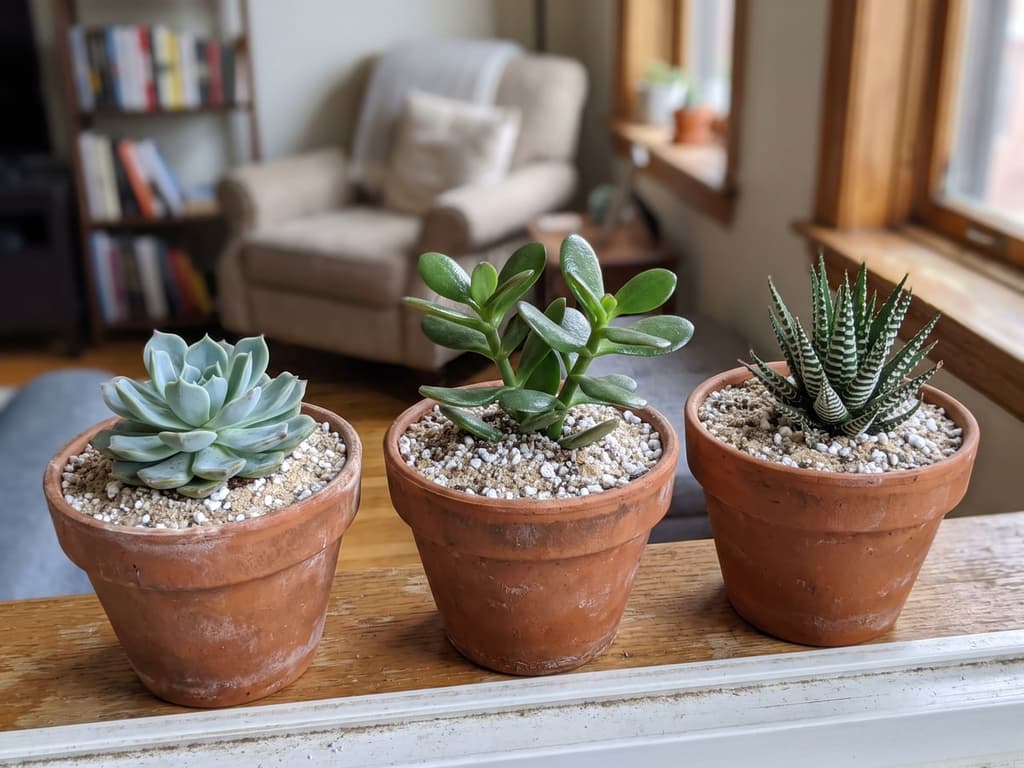
For proper succulent care: use fast-draining soil (1 part potting soil to 2 parts mineral material), a pot with a drainage hole, at least 6 hours of bright light daily, and water only when the soil is completely dry all the way to the middle of the pot—which usually takes anywhere from 5 to 30 days, never a fixed calendar schedule.
This guide is for anyone who has bought a succulent, watched it wither, and couldn't tell if they were watering too much or too little. It is the very question that kills most of them, and the answer isn't simply "water less": it is learning to read the plant before you water.
Quick Summary:
Succulents store water in their leaves. They can survive weeks without watering, but they won't survive a single week with waterlogged roots.
Underwatering and overwatering both cause wrinkled leaves—yet they are opposites. What tells them apart is texture: wrinkled and firm leaves mean thirst; mushy and translucent leaves mean drowning.
Iowa State University Extension notes this exact mistake: root rot symptoms "are often mistaken for a lack of water, and more water is added, compounding the problem" (Iowa State University Extension, revised 2026).
Adding a layer of gravel or pebbles to the bottom of a pot does not improve drainage: water does not move easily from fine-textured soil into coarser material until the fine soil is saturated, meaning gravel actually creates a perched water table right at the roots.
The 3 Mistakes That Kill a Succulent
Almost every succulent that dies indoors does so because of one of these three mistakes, in order of frequency:
Too much water on a fixed schedule. Watering "every week" ignores the fact that soil dries at different rates depending on light, pot size, material, and season. The roots suffocate, rot, and the plant starts showing signs of thirst—which tricks you into watering even more.
Pots without drainage holes. Without an exit, water pools at the bottom, out of sight. Here, the mistake isn't how much you water: it's that the water has nowhere to go.
Too little light. Succulents don't die quickly from low light—instead, they deform first, stretching toward the window and losing their compact shape forever. A plant that has spent months stretching in the dark will rot from a watering it used to tolerate.
These three combine: low light makes the soil take longer to dry, and slow-drying soil turns a normal watering into overwatering. Solving one without the others won't save your plant.
Watering: By Inspection, Not by Calendar
The rule that actually works is the soak-and-dry method: water thoroughly until it runs out of the drainage hole, then let the soil dry out completely before watering again. Iowa State Extension recommends starting with a 2-to-3-week interval and adjusting based on observation, because watering frequency "depends on the soil type, light level, temperature, humidity, and pot type" (Iowa State University Extension, revised 2026).
How to check before every watering—it takes 5 seconds:
Insert a wooden skewer halfway down into the pot and pull it out. If it comes out with soil clinging to it or darkened by moisture, it's not time yet.
Or lift the pot. A waterlogged pot and a dry pot have very different weights. After two or three waterings, you will be able to tell just by lifting it.
Don't trust your finger on the surface. The top 2 cm can dry out in a single day, while the bottom, where the roots live, might stay wet for two weeks.
When you do water, do it thoroughly: pour water until it runs out of the drainage hole, and empty the saucer afterward. Shallow watering only wets the surface, leaving the bottom roots to alternate between bone-dry and unstimulated. Leaving a saucer full of standing water is what causes the issues shown below:
This 5-to-30-day range is wide for a reason. What pushes your plant toward one end or the other:
Pot material. Terracotta is porous and breathes through its walls; plastic and glazed ceramic trap moisture for much longer.
Size. A pot that is too large for the plant holds a volume of soil that the roots can't drink up—meaning it takes forever to dry.
Light. A plant in a bright window respires more and empties its pot much faster than the same plant in a hallway.
Season. In winter, succulents slow down and drink very little. This is when most people kill their plants by keeping up their summer watering routine.
Air humidity. This is an adjustment that standard guides often overlook—they describe winter homes with 30% to 40% humidity. In highly humid regions, the air can exceed 80%, and the same soil takes twice as long to dry. Here, the manual's interval almost always needs to be extended, not shortened.
Is Your Succulent Thirsty or Drowning?
Both issues start with wrinkled leaves, which is why so many people water a plant that is already rotting. Compare the symptoms before you act:
Symptom | Underwatering | Overwatering | Sunburn | Lack of Light |
|---|---|---|---|---|
Leaf Texture | Wrinkled, shriveled, but still firm to the touch | Mushy and translucent, squishy under your finger | Firm, with dry, paper-like patches | Firm and normal |
Color | Yellowish, then turning brown and dry | Yellow or pale, watery appearance | Defined brown or beige spot on one side | Pale green on new growth |
How Leaves Fall | Dry and shriveled before dropping | Drop off easily while still mushy and wet | Do not fall: they keep the scar | Do not fall: they grow spaced out |
Stem | Firm | Mushy and darkened at the base | Firm | Stretched, with widely spaced leaves |
Soil | Dry, sometimes pulling away from the pot walls | Wet on the surface; sometimes with mold or fungus gnats | Irrelevant | Takes a very long time to dry |
What to Do | Water thoroughly until it drains | Stop watering and check the roots | Move to softer light and acclimate slowly | Behead the healthy top and propagate |
The ultimate decider is the base of the stem. Wrinkled leaves with a firm stem almost always mean thirst. Wrinkled leaves with a mushy, dark stem at the base mean rot, and watering in this state will only accelerate its death.
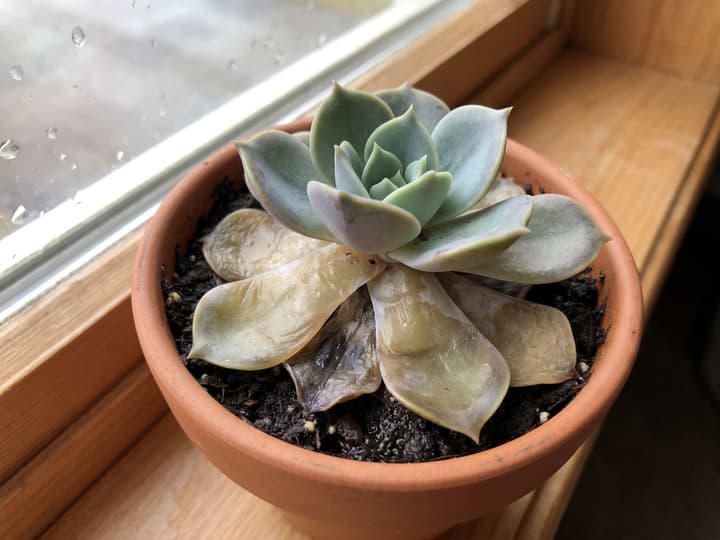
If the stem is already mushy, take the plant out of its pot and check the roots. Healthy roots are light-colored and firm; rotted roots are dark brown, mushy, and fall apart between your fingers. Cut away anything that is rotted, let the plant air-dry for 2 to 3 days, and replant it in fresh, dry soil. This doesn't always work—if the rot has already traveled up the stem, your best bet is to cut a healthy section from the top and propagate it.
How Much Light Succulents Need
Succulents are plants of open, sunny spaces: indoors, they need bright light, all day long. Iowa State Extension recommends 10 or more hours of bright indirect light daily, with most species requiring at least 6 to 8 hours (Iowa State University Extension). In practical terms: the right spot is right on the windowsill, not on a bookshelf across the room. The Echeveria, the most common rosette succulent kept indoors, serves as a benchmark for the rest:
The confusion between "sun" and "shade" exists because both answers can be correct in different contexts:
Direct morning sun (until about 10 AM) is great for almost all of them.
Direct afternoon sun in peak summer can burn most leaf-succulent species—especially those bought from greenhouses that have never experienced full sun.
Bright partial shade (bright light filtered by a sheer curtain or an overhang) is what most indoor succulents prefer year-round.
The rule to avoid damage is not about the time of day: it's about the transition. Sunburn happens when a plant is moved from a dark spot directly into full sun, and the damage is irreversible—the burned area dies and turns into a permanent scar. Iowa State Extension advises making any changes in light conditions gradually (Iowa State University Extension).
A practical timeline: stretch the transition over two weeks, starting with 1 to 2 hours of direct sun per day and slowly increasing the exposure.
The opposite issue also leaves a mark, and it is a much more common problem indoors than sunburn.
Etiolation: When They Stretch and Can't Go Back
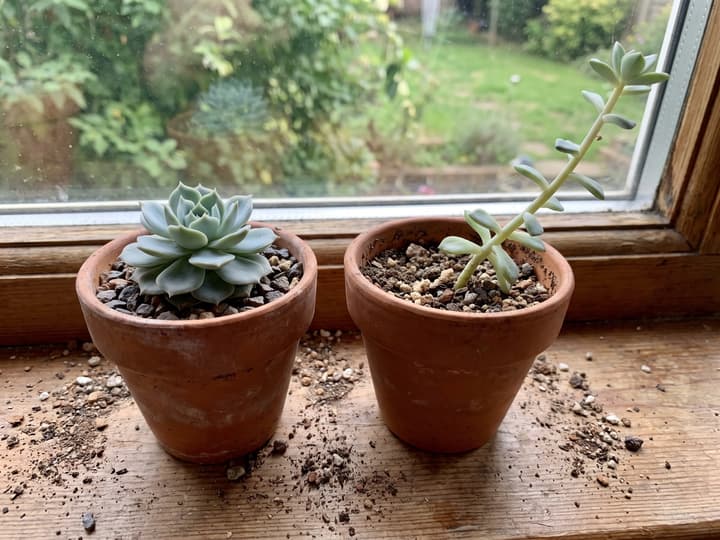
Too little light produces an unmistakable sign: the stem stretches out, the leaves grow far apart, the color pales, and the rosette opens up as if reaching out. This is etiolation.
The one thing most guides don't tell you: the stretched section will never shrink back. More light will make the new growth compact again, but the elongated stem remains elongated—which is why Iowa State Extension treats this as a pruning issue rather than a recovery: some species recover on their own with more light, while others "require pruning or shearing to remove the leggy growth," and in barrel-type cacti, the distortion remains with the plant forever (Iowa State University Extension).
The practical solution is to behead the healthy top (leaving about 5 cm of stem), let the cut callouse over in the air for 3 to 5 days, and replant it in dry soil—the cutting will root and grow compactly with enough light. The leftover stump in the pot will usually sprout new offsets from the sides.
If your window isn't bright enough, artificial light can help: a full-spectrum grow light placed about 30 cm above the plant, kept on for 12 to 16 hours a day, is recommended by the same university extension.
The Soil: Why Standard Soil Kills and What to Use Instead
Standard potting soil ("potting mix," "houseplant soil") is formulated to retain moisture. This is the exact opposite of what a succulent needs. Changing the soil is the single modification that solves most chronic issues.
The ratio recommended by Iowa State Extension is 1 part organic matter to 2 parts mineral material (Iowa State University Extension). Using ingredients easily found at any garden center:
1 part organic: standard potting soil, fine pine bark, or coco coir.
2 parts mineral: perlite, coarse builder's sand (coarse, washed sand—fine beach or masonry sand will compact and make drainage worse), pumice, or fine gravel.
Mix it thoroughly until it looks visibly gritty. Test it: wet the mix in a pot with a drainage hole—the water should run straight through and out the bottom in a few seconds, rather than pooling on the surface.
Why a Layer of Gravel at the Bottom Doesn't Work
This is the most repeated piece of advice on the internet, and it is scientifically incorrect. Linda Chalker-Scott, an associate professor of horticulture at Washington State University, explains the physics: water does not move easily from a fine-textured layer to a coarse-textured one—"gravitational water will not move from a fine-textured soil into a coarser material until the fine soil is saturated" (Washington State University Extension, 2008).
In other words: by putting gravel at the bottom, you aren't creating drainage—you are creating a barrier. The soil above the gravel must become completely waterlogged before a single drop drains. You have effectively reduced the height of usable soil and guaranteed a saturated zone right where the roots are. This is the exact condition the gravel layer was supposed to prevent.
True drainage comes from a drainage hole and gritty soil. Iowa State is explicit on this point: layers of gravel at the bottom "are not an adequate substitute for a drainage hole."
The Pot
A drainage hole is mandatory, no exceptions. Decorative pots without holes will kill succulents regardless of your watering routine.
Unglazed terracotta is best for those prone to overwatering: it breathes through its walls and shortens the time the soil stays wet. Plastic and glazed ceramic work fine, but require longer intervals between waterings.
A snug fit, not a loose one. Choose a pot that is only slightly larger than the root ball of the plant. A pot that is too large holds excess wet soil that the roots cannot reach.
Want to use a pretty cachepot without a hole? Use the double-pot method: keep the plant in a plastic pot with drainage holes, and place that pot inside the decorative one. When watering, take the plastic pot out, water it in the sink, let it drain completely, and put it back. This is the solution recommended by Iowa State Extension.
Never leave standing water in the saucer. Empty it within 30 minutes of watering.
Fertilizer, Repotting, and Propagation
Fertilizer. Succulents come from nutrient-poor soils and need very little. Use a standard liquid fertilizer or a specific cactus fertilizer during spring and summer, always at half or a quarter of the recommended label strength (Iowa State University Extension), and do not fertilize in fall and winter when the plant is dormant. Too much fertilizer produces weak, leggy growth that is highly vulnerable to pests.
Repotting. Only when the plant is visibly rootbound or the soil has degraded into a compacted powder—which usually takes years, not months. Repot when the soil is dry, do not water on the day of repotting, and wait 3 to 5 days before the first watering: disturbed roots with fresh tears are highly susceptible to rot.
Propagation. This is the easy part. Gently twist off a whole leaf from the base (without tearing it), let it dry on dry soil for a few days, and mist it lightly every 2 or 3 days—in a few weeks, roots and a tiny new plantlet will sprout from the base of the leaf. For stems, follow the same process as with etiolation: cut, let callouse, and plant.
Pests. The most common succulent pest is the mealybug, which looks like tiny white cotton-like fluff in the crevices between leaves and stems. Treat them by dabbing individual insects with a cotton swab dipped in isopropyl alcohol over several sessions—and ensure good air circulation to prevent them. If you see tiny, mobile green bugs clustered on new growth, that is a different issue: see our guide on how to identify and get rid of aphids.
Are Succulents Toxic to Cats and Dogs?
It depends entirely on the species, and the differences are significant. Two of the most common succulents are listed on the ASPCA toxic plants database (accessed August 2026): Aloe vera contains saponins and anthraquinones, which cause vomiting, lethargy, and diarrhea in dogs and cats (ASPCA); Jade (Crassula ovata, listed by the ASPCA under the synonym Crassula argentea) causes vomiting, depression, and incoordination (ASPCA).
On the other hand, Zebra Haworthia (Haworthia fasciata) and the Echeveria species listed in the database—including the common Mexican snowball (Echeveria elegans)—are classified as non-toxic to dogs and cats (ASPCA). These are the safe choices for pet owners who want to enjoy succulents.
A quick reminder: "non-toxic" does not mean edible. Any plant ingested in large quantities can cause mild stomach upset in pets.
Frequently Asked Questions
How often should I water a succulent?
There is no fixed schedule. Check before every watering: insert a wooden skewer halfway into the pot and only water if it comes out clean and dry. In practice, this interval ranges from 5 to 30 days—closer to 5 days for small terracotta pots in bright sun, and over 30 days in winter.
Do succulents prefer sun or shade?
Sun, but with a gradual transition. Most prefer bright light all day with direct sun only in the morning. Hot afternoon summer sun can burn leaves, especially on plants acclimated to greenhouses. True shade is not suitable: in low light, they stretch, lose color, and will not return to their compact shape.
How can I tell if my succulent is thirsty?
Gently squeeze a lower leaf. If it is wrinkled but still firm, and the soil is dry at the bottom of the pot, it is thirsty—go ahead and water. If it is mushy, translucent, or watery, and the soil is damp, it is the opposite: overwatered. Texture is a much better indicator than appearance.
Can succulents live indoors?
Yes, as long as they are placed near your brightest window. Indoors, the limiting factor is never temperature—the range of 13 °C to 24 °C they prefer (Iowa State) is typical of most living rooms—it is light. Placed more than 1 meter away from a window, almost any succulent will stretch out within a few months.
Can you save a rotting succulent?
Sometimes. Remove it from the pot, cut away all mushy, brown roots, and replant it in dry soil, holding off on watering for a week. If the stem is already mushy at the base, your best option is to cut a healthy section from the top, let it callouse for 3 to 5 days, and plant the cutting.
Before Changing Anything, Identify Your Plant
"Succulent" is not a single species: it is a group containing thousands of plants from different botanical families, and their tolerance to direct sun and cold varies widely. A Haworthia will burn in conditions where a Sedum thrives. If you don't know the name of your plant, you can find out by taking a photo of its leaves with Bloom, which identifies the plant and provides a tailored care sheet. The app is available for iPhone. If you want to compare options before choosing, we have a list of succulent care apps.
Conclusion
Succulents don't die from neglect—they die from over-care applied at the wrong pace. If you change only one thing today, switch from calendar watering to inspection watering: use a skewer, and only water if it comes out dry.
After that, in order: make sure your pot has a drainage hole, move your plant to the brightest window in the house, and save the soil upgrade for your next repotting. These three steps solve the vast majority of issues, and none of them require buying anything expensive.
Related articles
How to Care for Syngonium: Light, Watering, Cuttings, and Pests
How to care for syngonium indoors: bright indirect light, watering when the soil surface dries, 64 to 81°F (18 to 27°C), and 40 to 60% humidity. Also cover water cuttings, thrips, yellow leaves, and pet toxicity.
Rosemary Leaves Turning Yellow: Causes and Solutions
Rosemary with yellow leaves usually has overly wet roots. Check where the yellowing appears to see if it stems from wet roots, low light, spider mites, powdery mildew, or normal leaf shed, and learn how to save the plant.
Is Your Rosemary Dying? How to Save Soap-Burned Rosemary
Rosemary with soap-burned leaves can usually be saved: the damage stays on the affected needles. Rinse the leaves, wait a week, scrape the stems, and prune only what is brown inside.