How to Propagate Pothos: Where to Cut and How to Get a Fuller Pot
Cut the stem 3 cm below a node with a leaf and root it in water or soil: roots are ready in 3 to 4 weeks. Learn which node roots fastest and how to pot several cuttings together for a full plant.
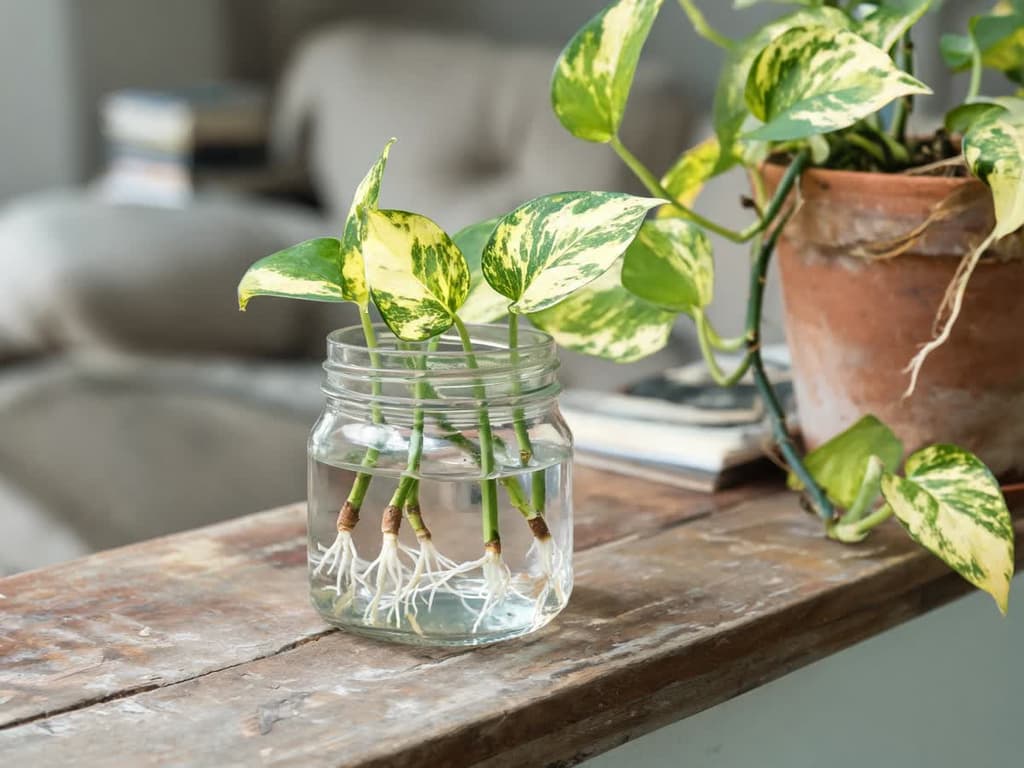
To propagate pothos (Epipremnum aureum), cut a piece of the vine with at least one node and one leaf, leaving 3 cm of stem below the node. The node is the point on the vine where the leaf emerges. Keep the node submerged in water or buried in moist potting soil, with the leaf sticking out. The root is ready for potting in 3 to 4 weeks, according to the University of Wisconsin and the University of Florida (UF/IFAS).
A leaf cut without a node will not turn into a new plant, because the new shoot grows from the axillary bud, a tiny bud located at the node. The mother plant stays alive after the cut, continuing from the nodes that remain on the vine.
Quick summary:
Cut at least 3 cm below a node: this piece of stem stays at the base of the cutting.
The nodes near the tip of the vine yield the fastest cutting, starting from the second node.
Both water and soil work. Roots formed in water tend to struggle more when the cutting moves into a pot.
The roots are ready in 3 to 4 weeks. The first root tip appears earlier, in about 10 days.
To make your pothos look full, plant multiple rooted cuttings in the same pot.
Where to find the pothos node
The pothos node is the point on the vine where the leaf petiole connects. A short, brown aerial root usually emerges from this exact same spot, which pothos uses to climb walls and tree trunks. NC State Extension, the extension service of North Carolina State University, describes pothos climbing by means of these brown aerial roots.
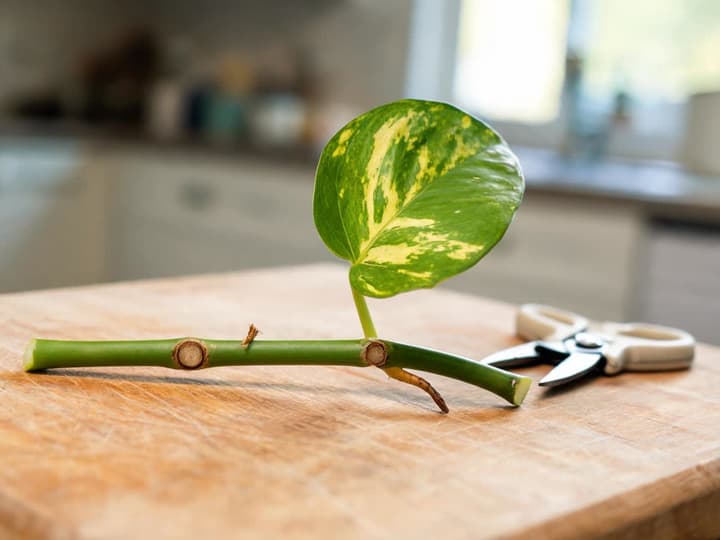
The smooth stretch between two nodes is called the internode. It has no buds to sprout from, which is why every cutting must include at least one node. The node anatomy is identical to that of monstera, another plant in the arum family. The guide on monstera cuttings shows where to find the node's bud in detail.
Which section of the vine makes the best pothos cutting
Nodes near the tip of the vine produce the cutting that unfolds a new leaf earliest. A study published in 1988 in the scientific journal HortScience compared single-node cuttings (stem pieces cut for rooting) taken from 14 positions along the vine. From the second to the 14th node, the further from the tip, the more days the cutting took to open its first leaf.
The first node, the one with the newest unfurled leaf, was the exception: its cutting grew less. Therefore, start counting from the second node. The same study measured two additional cutting details that speed up shooting:
Stem below the node. Cuttings with 3 cm or more of stem below the node sprouted faster.
Aerial root stub. Leaving 6 to 8 mm of the old aerial root on the node helped the shoot grow. Do not pull the aerial root off the cutting.
Keep the leaf on the cutting. In a 1987 study in the same journal, a cutting with a leaf took 10 days longer to open its first new leaf. Even so, it developed a longer, heavier shoot with more leaves than a leafless cutting.
The size of the cutting depends on how many new plants you want. Iowa State University recommends 8 to 15 cm cuttings with at least 2 nodes. Commercial growers use 2.5 to 4 cm cuttings with one node and one leaf, according to UF/IFAS. This guide uses 2-node cuttings because you keep a spare node if one fails. Iowa State writes for home propagators, while UF/IFAS describes commercial production. Single-node cuttings let you take many propagations from one long vine.
Can you propagate pothos from just a leaf?
A pothos leaf without a node will not become a plant. The NC State propagation manual explains that an isolated leaf carries no bud, which is the miniature shoot located at the node. Without a bud, a leaf only sprouts in plants capable of generating a new adventitious bud. The manual lists pothos among plants propagated by a stem section with a node, not by a single leaf.
A leaf in water sometimes puts out a few roots, yet it still fails to produce a plant. Peace lilies also cannot be propagated from a leaf in water. Look at the base of your leaf petiole: without a piece of stem containing a node, it will not sprout.
Step-by-step: how to propagate pothos
Gather gloves, clean pruning shears, and a jar of water or a pot with drainage holes filled with moist potting soil.
Put on gloves. NC State notes that pothos causes contact dermatitis, a skin irritation. The University of Wisconsin warns that the sap can irritate skin.
Clean the scissor blades with rubbing alcohol, as directed by the NC State manual.
Choose a firm vine and count the nodes starting from the tip. The first one belongs to the newest unfurled leaf: skip this node.
Cut the vine at least 3 cm below the node that will sit at the base of the cutting.
Remove the leaf that would sit submerged in water or buried in the soil, which is the one on the lower node. Keep the top leaf. On a 1-node cutting, keep the leaf outside and submerge or bury only the node.
If you want, apply powdered rooting hormone to the cut end. It is a garden store product that stimulates roots, and Iowa State notes it is optional.
In water, keep the lower node covered and make sure no leaves sit in the water, as advised by University of Vermont (UVM) Extension. In soil, poke a hole with a pencil, bury the bottom node, and leave the leaf above the surface.
Place the cutting in a bright spot out of direct sunlight, between 18 and 24 °C. Iowa State recommends 4 to 6 hours of bright indirect light per day.
Rooting pothos in water vs. soil
Pothos cuttings root in water, potting soil, perlite, and vermiculite. Perlite and vermiculite are lightweight materials sold in garden centers that retain moisture and air. Wisconsin reports that pothos roots in water or vermiculite within 3 to 4 weeks.
Rooting medium | Advantage | Caution |
|---|---|---|
Water | You can watch the roots grow | Change the water 1 to 2 times a week, never leaving the roots exposed (Iowa State) |
Moist potting soil | The cutting starts where it will grow and avoids transplant shock | Use a pot with drainage holes; keep soil moist, never waterlogged |
Perlite | Iowa State considers it an excellent rooting medium with a good balance of air and water | Keep it moist in a pot with drainage holes |
Roots formed in water are thicker and not adapted to soil, according to Iowa State. After moving into a pot, the cutting can wilt, drop leaves, or develop dry leaf tips. No study has measured which medium yields a higher success rate for pothos. Soil is the safer option because roots are already adapted and avoid transplant shock. Choose water if you enjoy watching root development.
When moving from water to soil, transplant when the new roots are about 2.5 cm long, as recommended by Iowa State. UVM waits until roots reach 5 to 8 cm. This guide follows Iowa State: the cutting spends less time in water and develops the rest of its root system directly in soil. Pothos can also grow in water indefinitely, but this guide focuses on moving the cutting into soil.
Tip cuttings taken from a pothos climbing a support, such as a pole, produce cuttings with larger leaves. UF/IFAS notes that commercial growers do this whenever they want large-leaf cuttings.
How to make pothos fuller using cuttings
Pothos gets sparse because it sheds its lower leaves over time. NC State explains that older leaves turn yellow and drop, concentrating foliage at the vine tips. NC State recommends pruning the vines to keep the plant bushy.
To make your pot look full, plant cuttings together. Wisconsin states that the best approach is potting several rooted cuttings together in a single pot. In a UF/IFAS trial using small-leaf pothos, researchers planted 10 cuttings per container in 10 cm and 15 cm pots.
To fill out a plant you already have, use its own long vines:
Cut long vines into 1- or 2-node cuttings, each with one leaf.
Root the cuttings in water or moist potting soil, following the step-by-step instructions.
Once roots form, plant the cuttings into the soil of the mother plant's pot near the base of the stems, leaving the leaves above the surface.
UF/IFAS planted 10 rooted cuttings in a 15 cm pot during their trial. That is a commercial density; at home, you can plant fewer.
Layering: rooting a cutting without severing the stem
Layering means rooting a stem while it is still attached to the parent plant by pressing a node against moist soil. University of Nevada, Reno (UNR) Extension outlines this method for climbing plants: roots sprout from the node that rests against the soil. Penn State notes that layering works well on pothos because every node already carries an aerial root.
Select a long vine and pin a node against moist potting soil, either in the same pot or in an adjacent one.
Anchor the stem to the soil using a bobby pin, half of a bent paper clip, or a small stone, as recommended by UNR.
Keep the soil moist until the node takes root. To check, give the pinned stem a very gentle tug: resistance means roots have formed. None of the sources cited in this guide measured a specific timeframe for layering pothos.
Once roots have formed, sever the vine between the mother plant and the newly rooted node.
If rooted in the parent pot, leave the cutting where it is to thicken the base. In an adjacent pot, it is already planted. Another way to root a plant while attached is air layering, which wraps the stem in moss. The step-by-step guide to dracaena air layering explains that technique.
Pothos cuttings not rooting or rotting
A pothos cutting that fails to root is usually sitting in low light or cold conditions. Iowa State explains that low light delays rooting, and the cutting may rot or dry out before roots form. In a 1987 HortScience study, cuttings given more light and rooting media warmed to 28 °C developed more roots and shoots compared to cuttings kept in low light with media between 10 and 16 °C.
A cutting rotting in water typically has leaves submerged or sits in stagnant water. Check these factors:
Submerged leaves. UVM directs growers to keep all foliage above the water line. Remove any submerged leaf.
Cloudy water. UVM advises changing the water whenever it turns murky. Iowa State recommends changing it 1 to 2 times a week.
Soft or blackened node. Trim off the mushy section and re-root the remaining firm stem that retains a node, leaving 3 cm of stem below it.
Weak mother plant. The NC State manual notes that cuttings taken from nutrient-deficient or drought-stressed parent plants root poorly.
A pothos with rotted roots can still yield viable tip cuttings. Wisconsin states that brown or absent roots indicate rot, most often caused by overwatering.
Take cuttings from vine tips that still have firm green stems, always keeping a node. Root them in clean water, changing it 1 to 2 times a week. Irregular green and yellow blotches are normal variegation on golden pothos. Overwatering signs, according to NC State, include rotted roots alongside blackened leaf margins.
How long pothos cuttings take to root
Pothos cuttings develop roots ready for potting in 3 to 4 weeks, according to Wisconsin and UF/IFAS. The very first root tip shows up earlier: UNR reports it emerges in about 10 days in water. A 10-day root tip is still too short for potting up.
Shoots also emerge early. Wisconsin notes that new shoot growth can start within 1 to 2 weeks in warm temperatures. UF/IFAS cites 2 to 3 weeks. Cooler temperatures lengthen these timelines.
To test root development in soil starting in the third week, give the cutting a very gentle tug. UVM explains that if the cutting resists the pull, roots are actively growing.
Best time to propagate pothos in Brazil
The best time to take pothos cuttings in Brazil runs from September to March, during spring and summer. Penn State says pothos cuttings root best during the growing season, from spring to summer. In the Southern Hemisphere, spring begins in September.
Propagation also works throughout the rest of the year. Iowa State says most houseplants root at any time. During the Brazilian winter, from June to August, leave the cutting in the warmest and brightest spot in the house.
Caring for pothos cuttings in the first few weeks
Keep the cutting's soil moist without letting it become waterlogged until roots establish. Iowa State recommends high air humidity: tent a loose plastic bag over the pot, propped up with sticks so it does not touch the leaves.
UNR cautions that cuttings can experience shock when transitioned from water to soil. During their initial weeks in a pot, keep the soil evenly moist and maintain the cutting in the same bright location away from direct sun.
Variegated pothos cuttings require bright light to keep their coloration. NC State notes that low light causes pothos to lose variegation, which is the yellow or white patterning on the foliage.
Pothos, satin pothos, or heartleaf philodendron?
This guide applies to all pothos (Epipremnum aureum). Common cultivars include golden (green and yellow), marble queen (green with white marbling), jade (solid dark green), and neon (bright chartreuse). Three similar plants are frequently confused with it:
Satin pothos (*Scindapsus pictus*). Belongs to a different genus, featuring dark green foliage marked with silver blotches, according to NC State.
Heartleaf philodendron (*Philodendron hederaceum*). NC State points out that pothos leaf petioles have a grooved channel, whereas philodendron petioles are smooth and rounded.
*Epipremnum pinnatum*. NC State notes this is a distinct species, although pothos was formerly classified as one of its botanical varieties.
If you are unsure which plant you have, the Bloom app identifies plants from a single leaf photo.
Stem cuttings preserve the mother plant's exact coloration because they are genetic clones, as University of Illinois Extension explains. A variegated pothos yields a variegated cutting. UF/IFAS notes that pothos does not bloom indoors, meaning there are no seeds: cuttings are the only way to obtain another plant with identical coloration.
Pothos is toxic to dogs and cats, according to the ASPCA, the animal poison control center in the United States. Keep cuttings and the water jar out of reach of pets.
Frequently asked questions
How do you plant pothos from stem cuttings?
To plant pothos from stem cuttings, take a vine section with at least two nodes and one leaf. Strip the leaf from the bottom node and bury that node in a pot with drainage holes filled with moist potting mix, keeping the top leaf above the soil line. Iowa State recommends bright indirect light and high humidity until roots take hold.
How long does pothos take to root in water?
Pothos takes about 10 days to produce its first root tip in water, according to the University of Nevada. The root system is ready for potting in 3 to 4 weeks, according to the University of Wisconsin. Move the cutting to potting soil once the new roots measure approximately 2.5 cm, as recommended by Iowa State.
How do you cut pothos for propagation without killing the plant?
To take pothos cuttings without harming the plant, trim the vine using clean pruning shears at least 3 cm below a node. The mother plant continues growing from its remaining nodes. Penn State prunes the mother plant's vine anywhere immediately above a node. For the cutting itself, this guide preserves 3 cm below the node based on the shoot growth gains demonstrated in the 1988 HortScience study. Wisconsin notes that pothos tolerates heavy pruning down to just 5 cm of vine above the soil.
Do pothos cuttings need rooting hormone?
Pothos cuttings do not require rooting hormone. Iowa State considers hormone treatment optional and warns that overapplication can inhibit rooting. Bright indirect light and air temperatures between 18 and 24 °C support root formation. None of the sources cited in this guide compared pothos propagation with versus without rooting hormone.
Where to start today
Select the longest vine on your pothos and count its nodes starting from the tip. Wearing gloves, cut two-node cuttings beginning at the second node, leaving 3 cm of stem below the lower node of each piece. Root the cuttings together in a jar of water, and once roots reach 2.5 cm, plant them all into the mother plant's pot.
Sources
NC State Extension Gardener Plant Toolbox: Epipremnum aureum and Scindapsus pictus. Accessed September 30, 2026.
NC State Extension, Extension Gardener Handbook: chapter 13, Propagation. Accessed September 30, 2026.
University of Wisconsin–Madison, Wisconsin Horticulture: Pothos, Epipremnum aureum. Accessed September 30, 2026.
Penn State Extension: Pothos as a Houseplant. Accessed September 30, 2026.
Iowa State University Extension and Outreach: How to Propagate Houseplants by Stem Tip Cuttings. Accessed September 30, 2026.
University of Florida IFAS Extension: Cultural Guidelines for Commercial Production of Interiorscape Epipremnum (EP151) and New Florida Foliage Plant Cultivar: Pothos 'Pearls and Jade' (EP441). Accessed on September 30, 2026.
Wang, Y.-T. and Boogher, C. A. Effect of Nodal Position, Cutting Length, and Root Retention on the Propagation of Golden Pothos. HortScience, 23(2), 1988.
Wang, Y.-T. Effect of Warm Medium, Light Intensity, BA, and Parent Leaf on Propagation of Golden Pothos. HortScience, 22(4), 1987.
University of Nevada, Reno Extension: Propagating Houseplants. Accessed on September 30, 2026.
University of Vermont Extension: More, Please: Propagating Houseplants. Accessed on September 30, 2026.
University of Illinois Extension: Winter gardening: propagating houseplants to beat the winter blues. Accessed September 30, 2026.
ASPCA Animal Poison Control: Golden Pothos. Accessed on September 30, 2026.
Related articles
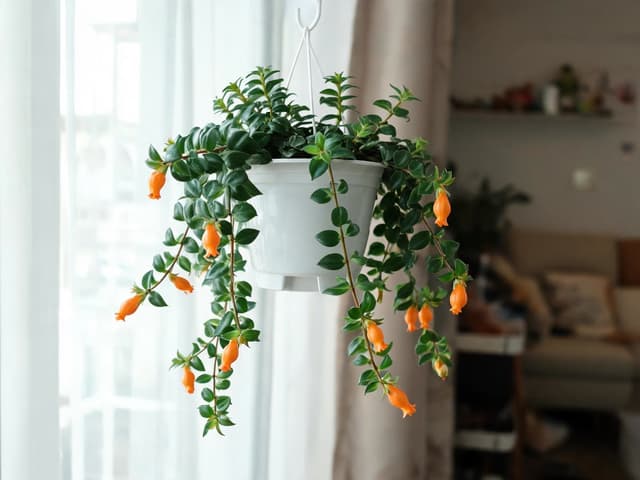
How to Care for a Goldfish Plant: Light, Watering, and Blooms
How to care for a goldfish plant: bright light without strong sun, water when the soil surface dries, and humid air. Learn how to tell a Nematanthus from a Columnea, why it drops leaves, and how to get it to bloom again.
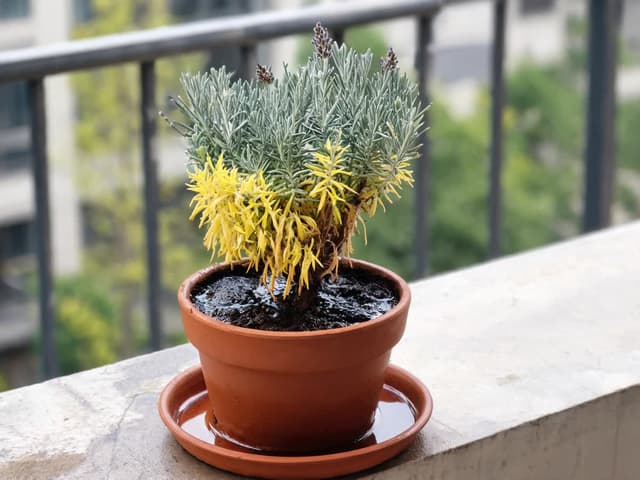
Lavender Leaves Turning Yellow: Where the Yellowing Starts Shows the Cause
Lower leaves turning yellow with moist soil means overwatered roots, the most common cause. Old leaves drying one by one on woody stems is normal. Take the stem and root test, see if your plant can still be saved, and find out what to do today.
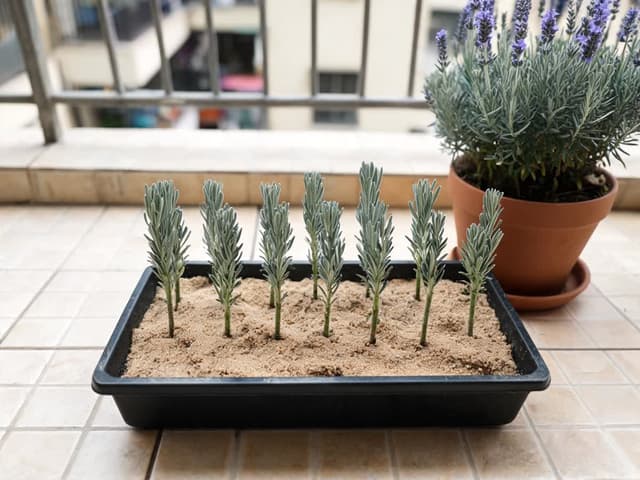
How to Propagate Lavender: Where to Cut and Why Cuttings Rot
A lavender cutting comes from a non-flowering branch tip, about 4 inches long, planted in sandy soil that never stays soggy. Learn where to cut, rooting times, seasonality in Brazil, and what to do if the base turns black.