Large Indoor Plants: 8 Species and the Distance from the Window Each One Tolerates
Large plants are not dark corner plants. This list is organized by how much darkness each species tolerates without shrinking, with potted height, growth rate, and full pot weight.
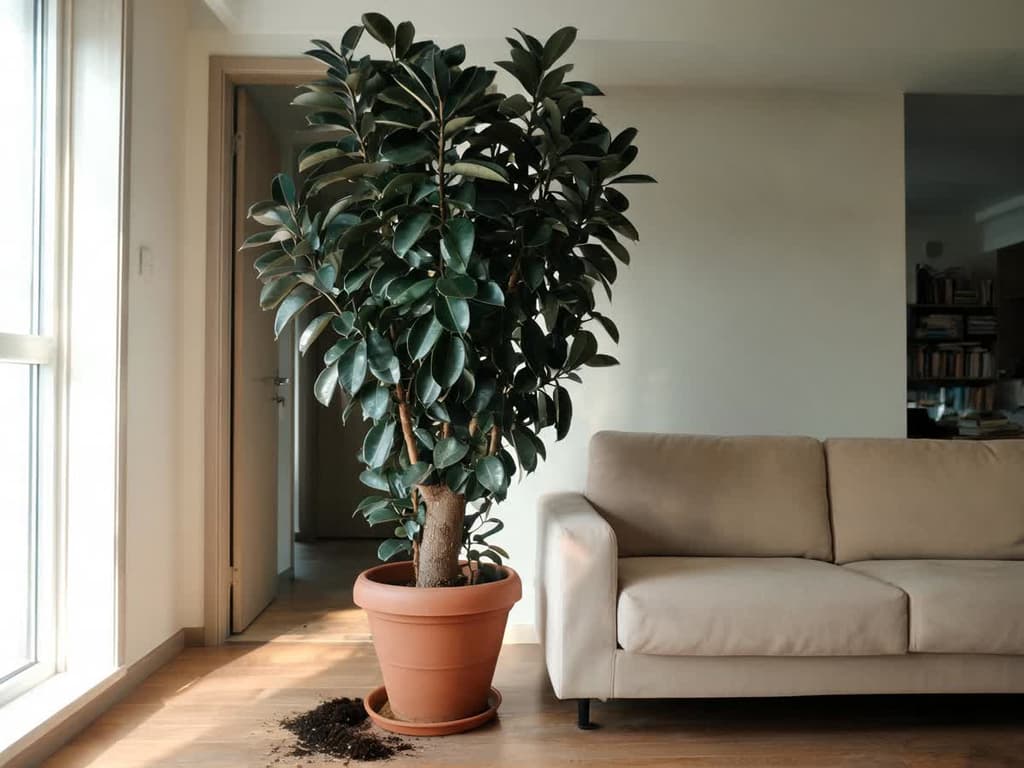
Anyone looking for large indoor plants almost always has a spot in mind, and that spot is a corner. The corner is the problem. A 6-foot plant has far more foliage to support than a tabletop plant. And foliage is precisely what low light takes away first.
That is why this list is not ordered by beauty or trends. It is ordered by how much darkness each species can tolerate without shrinking. All eight are plants bought already large, and all eight work well in apartments. The first can sit farthest from the window, and the last needs to be right against the glass.
A large indoor plant is one bought at 4 feet or taller that sits on the floor, not on a table. The difference compared to a small plant lies in the amount of foliage that needs light to stay alive. That is why the choice begins with the distance between the pot and the window.
List summary:
# | Plant | Where it can sit | Potted height | Rate |
|---|---|---|---|---|
1 | Lady palm | the farthest from the window of all | 6 to 8 ft | slow |
2 | Dracaena | 3 to 10 ft from a bright window | 4 to 6 ft | slow |
3 | Areca palm | bright indirect light, close to the window | 6 to 7 ft | medium |
4 | Monstera | close to the window, or leaves grow without holes | 6 to 8 ft | fast |
5 | Rubber plant | about 3 ft from an east or west window | 2 to 10 ft | fast |
6 | Fiddle-leaf fig | the same light, without moving spots | 2 to 10 ft | medium |
7 | Giant bird of paradise | at the window | no known maximum height | medium |
8 | Ponytail palm | only at the window, needs the most light on the list | 6 to 8 ft | slow |
Why a large plant declines in the exact corner where you want to put it
Low light does not make a large plant stop growing. It makes the plant shed leaves until it fits the light it receives. Indoor plant research from the University of Florida describes the process like this. When a plant moves to a location with less light, it tends to drop foliage to conserve energy. And the amount of foliage lost depends on how much the light dropped.
The plant's math is simple. Every existing leaf costs energy to stay alive, even when producing nothing. If the spot's light does not cover that cost, the plant dismantles part of itself to balance the budget. That is how a plant bought at 6 feet with a full canopy turns into a 4-foot plant with bare lower stems.
Surviving and staying large are also not the same thing. Clemson University Extension gives the figure in a light unit called foot-candles. One foot-candle equals the light of a candle 1 foot away. About 100 foot-candles for 12 hours a day maintains plant quality for a year. For fertilizer to make any difference, at least 200 foot-candles for 12 hours are necessary. Below that, fertilizing does nothing because what is missing is light, not food.
The contrast with low-light plants appears in the same University of Florida table. It lists the minimum indoor light species by species. Peace lily, golden pothos, and snake plant appear at 75 foot-candles. Dracaena, fiddle-leaf fig, and kentia palm appear at 150, and the ponytail palm at 225 or higher. The plants that tolerate a dark apartment corner are small and medium ones, and they are different species.
How much light does the spot have where you want to put the plant
You do not need a measuring device to use the foot-candle figures on this page. The table below translates each range into distance from the window, based on guidelines from University of Illinois Extension.
Indoor horticulture sources almost all come from the Northern Hemisphere, and the numbers in this table came from there. The brightest window in the house faces south, and the weakest faces north. East and west windows fall between the two.
Light range | South window (the bright one) | East or west window | North window (the weak one) |
|---|---|---|---|
Low (75 foot-candles) | 15 to 20 ft away | 3 to 10 ft away | about 3 ft away |
Medium (150 foot-candles) | 3 to 10 ft away | about 3 ft away | directly in front |
High (300 foot-candles) | up to 5 ft away | directly in front | does not reach |
Direct sun (1,500 foot-candles) | directly in front | does not reach | does not reach |
To receive merely the low light range, the plant already needs to sit 15 to 20 feet from the bright window. A room corner with no line of sight to any window falls below that. And below that, there is no large plant on this list.
There is a test without equipment for the exact spot where you want to place the pot. At noon, with indoor lights turned off, place your hand 1 foot from the floor at that point. A shadow with a sharp outline means high light. A diffuse shadow means medium light. A very faint shadow, almost without an outline, is low light, and only the lady palm on this list sustains itself there. If there is no shadow at all, the spot will not work for any of the eight.
8 large indoor plants and the distance from the window each one tolerates
1. Lady palm (Rhapis excelsa), the one that goes farthest from the window
Clemson University Extension describes the lady palm as adaptable to most indoor environments. It is the only species on the list with that description. No source publishes a minimum light figure in numbers for it, and that absence deserves to be stated. Treat the low range in the table as its minimum, not as the ideal spot.
It grows in clumps, with multiple slender stems emerging from the base, wrapped in dark fiber. This alters space planning, because the lady palm gains width alongside height. Clemson describes indoor specimens as wide as they are tall. In containers, Missouri Botanical Garden gives 6 feet as a typical height, and Clemson mentions more than 8 feet. The pace is slow, also classified as slow by North Carolina State University Extension.
ASPCA does not list the lady palm among toxic plants for dogs and cats. The entry is published under the older name Rhapis flabelliformus.
The full profile is in the lady palm guide. Watering differences between it, the areca palm, and parlor palm are covered in how to care for indoor palms.
2. Dracaena (Dracaena fragrans), and the leaf that narrows when light is lacking
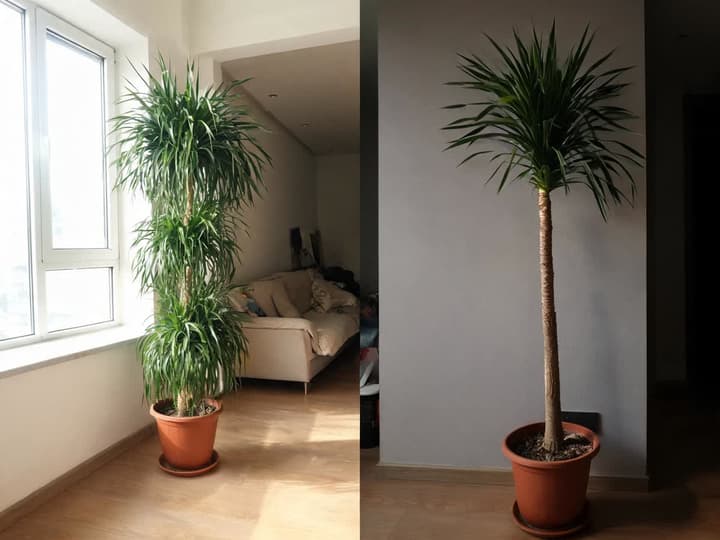
Dracaena requires a minimum of 150 foot-candles of indoor light, according to the University of Florida table. In practice, that puts it 3 to 10 feet from a south-facing window. Or about 3 feet from an east- or west-facing window.
It has the easiest warning sign to read on the list. North Carolina Extension notes that, under insufficient light, new leaves grow narrower. You do not need to wait for the plant to lose height. Compare this year's leaf with last year's, and the answer is right there.
In a pot it reaches between 4 and 6 feet, compared to 20 feet or more in its native habitat, according to Missouri Botanical Garden. Growth is slow. Over the years, it sheds lower leaves and develops a bare stem resembling a trunk. That is normal habit for the species, not disease.
ASPCA lists dracaena as toxic to dogs, cats, and horses due to saponins, compounds that irritate the digestive tract. Reported signs include vomiting (occasionally with blood), depression, loss of appetite, hypersalivation, and dilated pupils in cats. The Dracaena genus profile compiles the species sold under this name.
3. Areca palm (Dypsis lutescens), 6 to 10 inches per year
The areca palm is one of the best-selling large palms for indoors. It is also the only species on this list with a published growth rate. Clemson University Extension gives 6 to 10 inches per year indoors, and 6 to 7 feet in indoor height. North Carolina Extension classifies the pace as medium, although the University of Florida describes the areca palm as fast-growing. In its native habitat in Madagascar, it exceeds 30 feet.
It needs bright indirect light, which in the table above means close to the window, not in the middle of the room. Direct sun on the foliage scorches the tips. Like the lady palm, the areca palm grows in clumps, so the pot requires width. The lowest fronds extend into walkways.
ASPCA does not list the areca palm among toxic plants for dogs and cats. Take care with the name when buying. "Areca" is also the common name of another palm, Areca catechu, which is not this plant. Check the botanical name on the label or in the areca palm profile.
4. Monstera (Monstera deliciosa), and the hole that fails to form
Monstera is the most widely purchased large plant, and the one that provides the clearest visual warning of low light. According to Clemson University Extension, under light levels that are too low, the leaves do not develop perforations. If yours has been producing solid, unslit foliage, it is neither diseased nor lacking fertilizer. It lacks light.
In a container it stands between 6 and 8 feet. In nature it climbs up to 70 feet supported by large trees, according to Missouri Botanical Garden. That difference explains the second practical point: monstera cannot support itself. North Carolina Extension warns that a sturdy support is necessary to keep stems from breaking. Without a stake, it grows sideways and collapses under its own weight.
The growth rate is fast, making it the best choice on the list for anyone who prefers to buy a medium size and watch it grow. ASPCA lists monstera as toxic to dogs and cats due to insoluble calcium oxalates, crystals that penetrate and irritate oral tissues. Signs include oral irritation, burning of the tongue and lips, excessive drooling, vomiting, and difficulty swallowing. The monstera profile covers the rest of its care.
5. Rubber plant (Ficus elastica), fast and easy to contain
The indoor rubber plant appears as a medium-light plant on the University of Illinois Extension list, along with the fiddle-leaf fig. According to the table, this means about 3 feet from an east or west window. Or 3 to 10 feet from a south window.
It is one of two fast-growing species on the list, according to North Carolina Extension's classification. In pots it stays between 2 and 10 feet, compared to 50 to 100 feet in its native environment. Because it grows fast and stays slender, it responds well to pruning for fullness. It is the species where buying medium and letting it grow makes the most sense.
Two practical warnings. Cuts release a sticky white latex that stains floors and irritates skin, according to North Carolina Extension. Pruning requires gloves and newspaper on the floor. And ASPCA lacks an entry for this species: the pages for "fig" and "weeping fig" apply to the weeping fig, which is another plant. Pet owners will not find the answer about the rubber plant on ASPCA.
Its full guide is in how to care for the rubber plant.
6. Fiddle-leaf fig (Ficus lyrata), the one that dislikes being moved
The fiddle-leaf fig requires the same 150 foot-candles as dracaena, according to the University of Florida table. It also appears as a medium-light plant on the Illinois list. Its sensitive point is different: changing locations.
It is the species that objects most to being moved, and the following section explains the mechanism. Choose its spot before buying, and do not change it later. In a pot it reaches between 2 and 10 feet, compared to 60 to 100 feet in its native African habitat. The rate is medium according to North Carolina Extension, and Texas A&M University describes it as very slow: expect years, not months.
The University of Florida recommends cutting roots that circle the pot before repotting. Circling roots leave the plant unstable as it gains height, and on a 6-foot plant instability means falling over.
ASPCA also lacks an entry for the fiddle-leaf fig. The page titled "fiddle-leaf" on ASPCA belongs to a philodendron, another species. The fiddle-leaf fig profile contains soil and watering care.
7. Giant bird of paradise (Strelitzia nicolai), the one that needs the window
The giant bird of paradise sits closest to the window and has the most variable data. The University of Florida and the Royal Horticultural Society cite full sun to light shade. North Carolina Extension calls for bright indirect light. All three point to the same indoor location, which is right at the window. None publishes a maximum potted height. The Royal Horticultural Society simply warns that it outgrows most homes over the long term.
What is documented is its native size: 20 to 30 feet, according to North Carolina Extension. Indoors, the limiting factor is leaf width. They are large like banana leaves and tear when brushing against walls or catching drafts from open doors. Older foliage drops and leaves lower stems bare, which is normal for the species.
Regarding pets, the answer requires attention to common names. ASPCA has no entry for Strelitzia nicolai. The "bird of paradise" page belongs to a plant in another family, and "bird of paradise flower" refers to Strelitzia reginae, a different species. North Carolina Extension, however, classifies Strelitzia nicolai as toxic with low severity. If an animal ingests any part of the plant, the listing expects nausea, vomiting, and drowsiness. Contact with the plant can also irritate skin.
8. Ponytail palm (Beaucarnea recurvata), the highest light requirement on the list
The ponytail palm closes the list because it has the highest minimum light requirement on the University of Florida's chart: 225 foot-candles or more. Translated through the distance chart, it only works directly in front of a window, and a south-facing one is best. It is a plant from Mexico's semiarid region, not forest shade.
Its swollen base stores water, which reverses instincts for anyone who has ever killed a plant with overwatering. The ponytail palm forgives neglect: watering is spaced out, with potting mix drying out completely between waterings. What it does not forgive is shade.
In a pot it reaches between 6 and 8 feet, compared to 30 feet in habitat, and growth is slow. The plant you buy is essentially the plant you will have years from now. Its guide is in how to care for the ponytail palm.
The ASPCA does not list the ponytail palm among toxic plants for dogs and cats.
The prettiest plant in the store is the one that drops the most leaves at home
The first month at home runs counter to shopping instincts. In the nursery you pick the fullest specimen, with a dense crown and thick trunk. Density is the precise indicator that the plant was raised under intense light and has not yet acclimated to an indoor space.
University of Florida research on figs records the same pattern. A dense canopy indicates a tree that has not yet adjusted to indoors, meaning it is not acclimated. It can drop most leaves from the center of the canopy upon entering a home. The leaf that falls is the sun leaf from the plant's interior, smaller and lighter in color. It was produced while the plant was still in an open-air nursery.
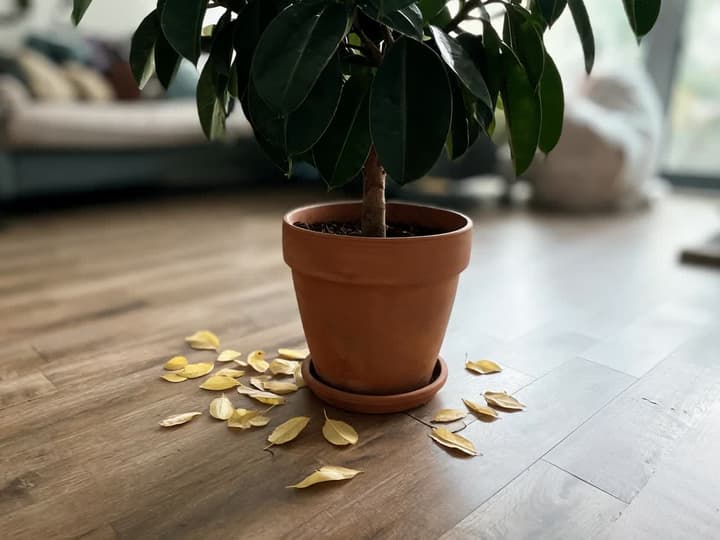
Numbers from the same study provide scale. They come from weeping figs (Ficus benjamina), the test species. In roughly 2-gallon pots, shade-grown plants dropped 144 leaves, while those coming straight from full sun dropped 286. In roughly 4-gallon pots, the count was 329 versus 564 leaves. The tally covers three weeks of transit and one month indoors. Smaller plants carried around 800 leaves each, compared to roughly 2,000 on the larger ones.
A large plant does not lose a higher fraction than a small one. Research shows the percentage was similar across both sizes, and the larger plant loses that identical percentage from a much larger canopy. That is why it covers the floor in leaves and alarms owners more. This drop is not disease, and more water or fertilizer will not resolve it.
What to do during the first six weeks is almost nothing. Choose the permanent spot before the plant enters the house, and do not move it afterward. Do not repot, because a new container and new mix add a second stress on top of the first. Water when the top inch of potting soil is dry, and no more than that. The same study estimates four months to a year before shedding stops, depending on plant size.
You might not know whether a falling leaf indicates light adjustment or something else. The Bloom app identifies the species from a photo and matches symptoms against the most probable causes.
How much a large plant's watered pot weighs
Before choosing a spot, do a calculation that no store tag provides. Peat-based potting mix retains between 50% and 65% of its own volume in water right after watering. Standard mixes reach 68% to 70%, according to substrate materials from University of Arkansas Extension. And water weighs 8.34 pounds per gallon (1 kilogram per liter).
In a 10-gallon pot of peat-based potting soil, that accounts for 42 to 55 pounds of water alone. In a mix retaining 70%, it reaches 58 pounds. Dry potting mix weighs 2 to 3.3 pounds per 2.5 gallons. Adding both parts together, a 10-gallon pot reaches roughly 50 to 70 pounds of wet soil. The pot, plant, and saucer add weight on top of that. This is the figure that decides whether the container can sit on a balcony and whether you can move it on your own later.
Container height also matters. Using the same soil, a tall pot drains better than a short, wide one. The greater the pot height, the less space remains saturated with water and the more space remains filled with air, according to the same source. For a large indoor plant, a tall pot is the safer choice.
The danger of a large pot in a dark spot is clear: abundant wet soil, a plant consuming little water due to inadequate light, and roots rotting weeks before any sign shows on the foliage.
Buy large or let it grow
The answer depends on the species, and the only published indoor growth figure is for the areca palm. It ranges from 6 to 10 inches per year, according to Clemson University Extension. For the other seven, no annual growth figures exist in inches per year from university or botanical garden sources. Only the rate category is recorded: fast for monstera and rubber plant, medium for fiddle-leaf fig, areca palm, and giant bird of paradise, slow for lady palm, dracaena, and ponytail palm.
With a slow rate, buying large is the only realistic option. The ponytail palm, dracaena, and lady palm you bring home are practically the plants you will have. With a fast rate, the logic changes. Monstera and rubber plant are the two worth buying in medium sizes because they gain height every growing season.
There is another reason to buy medium. A plant grown under your home's light is already acclimated to it and has no sun leaves to shed. It will never go through that first month of leaf loss described above, because it was never an open-air nursery plant.
Frequently asked questions
My large plant has yellow leaves after purchasing. What should I do?
Look at where the yellow leaves are. Yellow foliage in the center and base, with the plant still dense on top, indicates adjustment to new light. This acclimation stops on its own within a few months. If the yellow leaves are outer ones and the potting mix has stayed wet for days, space out waterings until the top inch dries out. Also confirm the drainage hole is clear and the saucer does not hold standing water.
Do grow lights fix insufficient light for large plants?
They help, because duration compensates for intensity. University of Florida research shows that indoor plants grow best under 12 to 18 hours of light per day. Continuous 24-hour light harms some species. A grow light running 12 hours a day expands what the spot provides, but it will not turn a windowless corner into a window.
Which large plant can handle a windowless hallway or bathroom?
None of the eight. A spot with no natural light falls below the lowest range in the table. There, choosing the right species is not the issue: you must add artificial lighting or abandon putting a large pot in that location.
Which of these large plants are toxic to cats and dogs?
ASPCA lists monstera (calcium oxalates causing oral burning and irritation) and dracaena (saponins causing vomiting and drooling) as toxic. It does not list lady palm, areca palm, or ponytail palm as toxic. ASPCA lacks entries for rubber plant, fiddle-leaf fig, and giant bird of paradise. North Carolina Extension, however, considers giant bird of paradise toxic.
Why did fungus gnats appear in the soil of my large pot?
A large pot holds far more moist potting mix than a small container, and moist surface soil is where fungus gnats lay eggs. The fix is allowing the top inch of soil to dry between waterings, which happens to be the proper watering approach for the plant. Bottom watering through the saucer removes surface moisture without leaving root systems dry.
How this list was put together
There is only one criterion: how much darkness the species tolerates without losing foliage and height. The order comes from minimum indoor light published by the University of Florida Extension, where the species is in the table. Where it is not, the order comes from the shade-tolerance descriptions from Clemson and North Carolina extensions. Potted height and native height come from the Missouri Botanical Garden and North Carolina Extension. Toxicity comes from ASPCA species profiles, and species without profiles are marked as such.
Low-light staples found on every indoor list were intentionally left off: peace lily, pothos, ZZ plant, and snake plant. You cannot buy them at 5 feet tall. And all four sit in the 75-foot-candle tier of the University of Florida table, on the opposite end of the question this article addresses.
Related articles
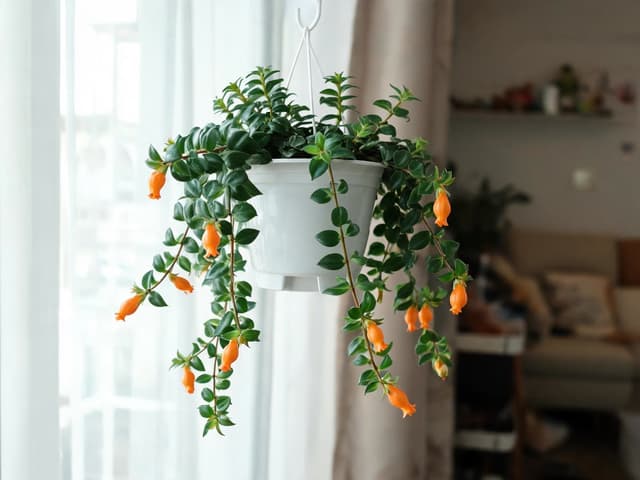
How to Care for a Goldfish Plant: Light, Watering, and Blooms
How to care for a goldfish plant: bright light without strong sun, water when the soil surface dries, and humid air. Learn how to tell a Nematanthus from a Columnea, why it drops leaves, and how to get it to bloom again.
Lavender Leaves Turning Yellow: Where the Yellowing Starts Shows the Cause
Lower leaves turning yellow with moist soil means overwatered roots, the most common cause. Old leaves drying one by one on woody stems is normal. Take the stem and root test, see if your plant can still be saved, and find out what to do today.
How to Propagate Lavender: Where to Cut and Why Cuttings Rot
A lavender cutting comes from a non-flowering branch tip, about 4 inches long, planted in sandy soil that never stays soggy. Learn where to cut, rooting times, seasonality in Brazil, and what to do if the base turns black.